Cost Plus Pricing: What you see is not what you get

Why can businesses not sell normal goods at cost price and prosper? They can and should be. In fact businesses can sell normal goods at cost price and make as much as a 100% profit. They can even mark up products in a Split Velocity model and not worry about inflation because the model works constantly to counter it. They can do so in an economy that has little to no inflation or deflation and have the opportunity to grow with much greater certainty.

Once they can do so inflation caused by the pressure to increase prices tails off and moves into a “price plane”. A price plane is the tendency of the general price level to remain the same or constant for long durations of time bringing problems such as creeping inflation to an end. Ceteris paribus, a loaf of bread or mealie meal in 2025 will have the same price in 2505.

So why do they mark up?

There are two reasons why businesses mark up goods and services they sell. The first reason is obviously they are profit seeking. However, we have shown that in a Split Velocity model businesses can sell their products at cost price (hence with no profit) and still make a 100% gain as well as operate in an economy free of inflation. This is how a normal economy should function. If this is true then why do businesses mark up their products? The systemic reason why businesses mark-up goods and services is because of the defective CFI. As explained, the defective CFI is losing or wasting 100% of GDP per annum. This is an insane amount of useful finance. This hidden loss is part of the Western Knowledge Paradigm (WKP) which has mistakes nearly every country in the world applies and downloads into how its economy operates and is managed. The WKP is treated by African and other nations as the stuff of legendary genius studded with accolades and prizes to boot. However, it is riddled with flaws, misconceptions, bad decisions and outright mistakes, like the hidden annual losses caused by the CFI. These flaws, mistakes and misconceptions are also found in the WKP’s sciences. Nations need to be wary of the WKP and its flaws.
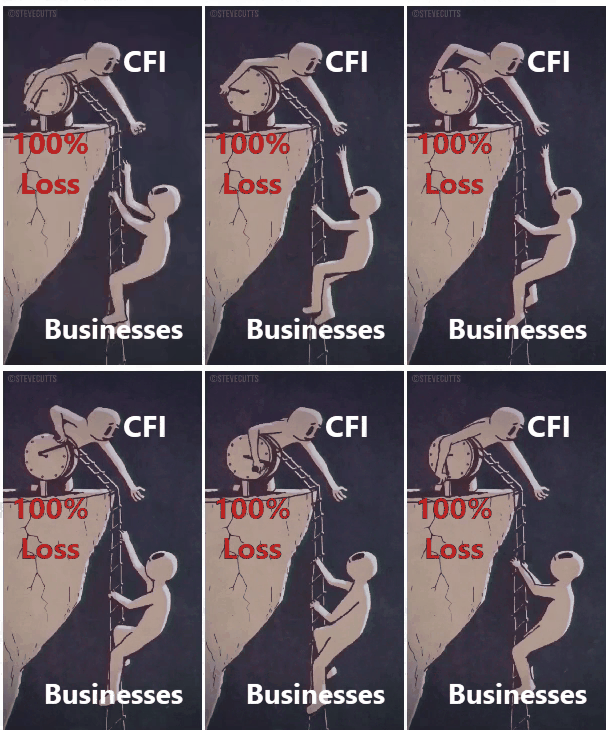
Its a 100% inefficient economy: The evil and diabolical system called the defective CFI is what keeps humanity
bound to poverty and scarcity, if you don’t know, can’t recognize what it is doing or understand your enemy, you cannot defeat it.

Central banks trained by the WKP are unaware of inefficiencies in the CFI, referred to as implosion or subtraction in the book Greater Poverty and Wealth of Nations (2010), they do not act to counter it. For example, in Zambia there is ZMK700 billion in liquidity missing from the economy (US$28bn), .i.e. equivalent to GDP in 2024 that represents useful financial resources that could have been introduced by the central bank at constant price if a Split Velocity model were introduced (this is enough finance to pay off all of Zambia’s debt in one go, without batting an eyelid). These useful resources are arbitrarily lost to the CFI every year. Central banks are generally not aware that this liquidity needs to be restored by minting or creating new money and channeling it through a Split Velocity model as an economic stimulus at constant price. Therefore, they do nothing to correct money supply. Like everyone else the WKP makes them assume the CFI over time is perfect, when in fact at any point in time it is losing the equivalent of GDP to nothing more than the inefficient design of the CFI. This is an insane, dumbfounding amount of money and resources especially when many countries face great want, poverty and underdevelopment. [Accounting & Audit firms where are you? Its time you woke up. Your clients need you.]

Businesses find they have to step in and start “printing” or creating their own money

As a consequence of this finance (equivalent to annual GDP) missing from the economy (due to the CFI being faulty) businesses are forced to step in and play the role of clueless central banks, which is to create money in the economy. How are business “printing” or creating money out of thin air? This is how: If a good costs $100 and a business sells it for $120, internally or from the micro-view it appears to simply be marking up its goods and services, the truth is that from the systemic or macro-view it is attempting to do the work of a central bank. Central banks led by the WKP are dumbfounded and have no idea that this is their role. The consequence of this is that businesses must take matters into their own hands and begin to “print”, create or mint their own new money. Hence, the mark up is introduced. In an economy worth only $100, and therefore with only $100 in circulation, the business in our example prices its product with a $20 mark up. There is only $100 in circulation. The business is charging $120 for its product. The mark-up of $20 is the business creating new money that does not exist in the economy. Why?, because the central bank under a WKP has no idea this is its job to do.

We call this attempt to create or “print” money cost-plus-pricing, marking up or the more popular term is “profit”. However, creating money is a role that is meant to be exclusively under the jurisdiction of a central bank. The Fisher Equation MV=PY cannot play this role, its not designed to do this as it creates a financial system that cannot contain inflation, which is why the new Punabantu Equation of Exchange KV(MS/E)=PYR is introduced to create a more robust system that can handle the increase in money supply at constant price, referred to as a Split Velocity model. Businesses, unbeknownst to themselves, are trying to recover money the economy is losing to the CFI equivalent to GDP per annum using mark ups, a role that belongs to central banks.

If businesses tried to sell a product at $100, the defective CFI would claim this value using subtraction in the CFI, and instead of seeing this loss is being caused by a 100% drop in efficiency caused by the faulty CFI businesses, instead of rejecting this loss, out of error, embrace it and refer to this loss to the business as the “cost of production” or “the cost of doing business”. This is a huge mistake on the part of enterprise and where the term “sleight of the hand” applies as we saw earlier with the shuffling of cups and palming of the ball. The palming of the ball is used to illustrate a 100% loss of revenue by businesses to the CFI for absolutely no reason other than that it is of defective design. Businesses at present are completely unaware of this huge loss from their balance sheet equivalent to 100% of revenue occurring at any point in time. They are clueless and continue operating with the ignorance of this loss or deduction of finance from their operations, of which the only indication is usually how difficult it is to finance operations that keep their going concern afloat and how difficult it is to move their businesses toward growth. Under the strain of losses equivalent to annual total revenue, running a businesses becomes like trying to run and move through molasses, many businesses wind up, shut down and the founders or team of entrepreneurs give up, without ever knowing what they were really up against. Similarly, in the same way that businesses struggle, as a result of the WKP central banks are unaware that they have a primary role of resolving inefficiencies in the CFI to recover and restore this finance to the operations of businesses. The lack of efficiency in the CFI pushes back the production possibility frontier significantly in real time. It is a genuine loss in finance that triggers a loss in productivity that severely retards economic growth. This vacuum of income that should be in the hands of productivity is why countries experience remarkably slow single digit rates of economic growth each year. This process triggers world-wide scarcity, poverty and stifles genuine prosperity.

Therefore, businesses and entrepreneurs are being fooled by the economy or CFI in two critical ways. First is the belief that they need to add a markup to realise a gain when they trade. This gain, when aggregated is miniscule and becomes the mediocre 1%-7% gain in GDP we observe in many economies. The example we used is the 20% mark-up of $20*. This mark up, in real terms, is an attempt to create money due to central banks misled by the present day WKP failing to play their role because they are led to believe the economy is functioning normally over time .e.g. a period of 1 year.

The second manner in which businesses and entrepreneurs are being fooled by the CFI is that when they allocate income earned to factors of production, which we represented with $100**, they are unaware that this is in fact an allocation to subtraction or implosion in the CFI, which the central bank not businesses is supposed mitigate using a Split Velocity model. This overlap makes it nearly impossible to see the loss taking place in front of their eyes, in broad daylight – hence it is referred to as the “sleight of hand trick” played by the CFI and the shuffling of cups where the ball is palmed is used as a method for illustrating how businesses and entrepreneurs lose total revenue (TR) annually to the CFI right before their eyes and are clueless about this real loss because their own “eye to hand” co-ordination and observation tells them they are paying for the cost of production (they see the ball go under a specific cup), when in fact, in real terms, they are allocating this finance to the faulty CFI where it is simply wasted (the ball is palmed). When entrepreneurs try to operate their business with this finance (the cup is lifted and there is nothing but air underneath it) they accept the loss because they think the payment went to the cost of production, unable to determine they have been “scammed” by the CFI they operate their going concerns wondering why running a business is so hard.

The faulty CFI and its hidden loss equivalent to 100% of GDP per annum would imply that the present civilization that applies it has to be the “dumbest civilization in the universe”, or if it is seen as a deliberate tool for economic oppression then it can be described as “the smartest, most diabolical method for human economic subjugation ever conceived” so evil and pervasive that it can function right before human eyes and intellect, in broad daylight and yet defy detection.

A result of the WKP is that every business and institution in the world, in operation today, loses the equivalent of its total revenue (TR) annually to the CFI, for no reason whatsoever, other than its 100% inefficient and ineffective design.

African nations and leaders must familiarize themselves with the WKP’s substandard economic and financial system proliferated by the CFI, because it is they and their people who, facing the worst circumstances, bare the brunt of its negative outcomes and vulnerabilities.

* It is easily shown that in a Split Velocity model a business can sell a product at cost price and still make a 100% gain that is equivalent to profit [even though technically it is not referred to as profit]

** Businesses and entrepreneurs remain completely clueless about this loss because the CFI masterfully, in the most sinister and evil way acts to hide this loss by using costs of production to shadow subtraction (palms the ball) which robs businesses annually of the equivalent of their total revenue every year.

When a business spends $100 to produce a product, then technically there is only $100 in the economy to buy it. When this business marks up its product to $20, it is trying to create new money by asking for money that does not exist in the economy to buy its wares. The next time you see products lined up on shelves, remember that what you are seeing from the macro-view is businesses trying to create or print money that does not exist in the economy because of a weak WKP. If a central bank does not act, the absence of the $20 will cause deflation (which can be just as disruptive as inflation). The other option is for the central bank to increase money supply over time by $20 to solve this problem. However, in doing so it facilitates the continuity of trade but then inadvertently supports a process that has come to be identified as creeping inflation. This is due to the fact that in a normal economy run on the Fisher Equation (MV=PY) any increase in money supply without a corresponding increase in goods will cause inflation.

Creeping inflation then becomes ongoing as it is grafted into the very manner in which a WKP economy operates since the business is selling a product for $20 more than the system has been designed to accommodate, with no increase in production. Hence, generally over time goods and services become more and more expensive and the domestic currency loses value in a manner that is fundamentally outside the control of a central bank. A loaf of bread or bag of mealie meal in 1975 will not cost the same in 2025. People find they have to work harder to afford the same basket of goods. They have to take on more jobs to maintain the same life-style and they eventually begin to suffocate under living conditions where affordability persistently escapes their attempts to hold onto it.

However, if businesses do not mark up products they cannot survive due to the fact the hemorrhage of resources being wasted pointlessly by the CFI is pushing them down toward or keeping them below break even until they are forced to eventually shut down. Businesses are therefore today, unbeknownst to themselves, literally in a life and death struggle against the economy they operate in. They are groomed to believe the economy they operate in is helping them, when in fact it is trying to kill or shut them down – every hour, every single day. This is due to the inordinate yet unaccounted for losses taking place in the defective CFI of which even businesses themselves are completely unaware. These losses apply to businesses of any size, be they the corner grocery store, ntemba or multi-billion dollar conglomerate. They remain dumb about it due to the “sleight of the hand trick” played by the CFI which forces all business to lose 100% of their total revenue (TR) per annum as a hidden loss to their operations, when you add up this loss to all businesses or productivity in an economy it becomes equivalent to GDP. There cannot be a more sinister or more evil system than this as it robs humanity of sorely needed income and resources like a pierced jugular bleeding profusely that is draining the life out of humanity, hindering productivity, destroying businesses and entrepreneurs.

This is a sophisticated loss that requires exceptionally astute minds to identify. However, as mentioned earlier due to the limitations of the widely accepted and applied WKP central banks are presently unaware of losses taking place at any point in time in the CFI that are equivalent to GDP and assume the economy is perfect (study the Empirical Test for Split Velocity to understand this). Hence they assume the life and death struggle of business is “normal”, and like a public hanging of businesses by the faulty CFI, sometimes the public comes to watch the spectacle in the town square or on social media as a form of entertainment or news. Central banks are not to blame for this problem, the blame falls squarely on the WKP being applied today.

In this sense the central bank is like the life guard, who is supposed to be supplying the economy with money (in a Split Velocity model) at constant price equivalent to the deficit caused by the CFI so businesses can operate normally. However, because of a substandard WKP it is unaware that the CFI is defective and that losses equivalent to GDP are taking place and nothing is done to intervene. Therefore, the WKP, as it stands at the shore views and describes the desperate businesses with hands waving for help and in need of rescue as excitement, attention seeking and revelry; businesses are making hand gestures in rough waters for fun and attention, and when businesses drown its assumed they have just gone down into the water scuba diving. This ongoing ignorance brought about by the WKP, that has been ongoing for 250 years since Adam Smith, is the brutal tragedy and reality of economics, accounting and finance that is the origin of strife in the 21st Century. Over the last 250 years it estimated that $3,120 trillion in global GDP has been lost to the defective CFI. Global GDP flounders at around $110 trillion today with a global per capita income of $13,900, when in reality it should be at around $3,230 trillion with a per capita income of $398,765 per person. The progress humanity has lost over the past 250 years is truly mind boggling.

Every economy in the world has the latent internal resources with which to finance the doubling of GDP in one year at constant price. In order to exploit this we must move ahead of the current WKP, realize that it is fallible and avoid its pitfalls. What difference would being able to recover 100% of GDP from the faulty CFI make to your country applied over the next 50 years? How much more could you do and achieve if being able to recover 100% of total revenue every year from the faulty CFI were restored to your business or institution?

This is what we designed Split Velocity to achieve.
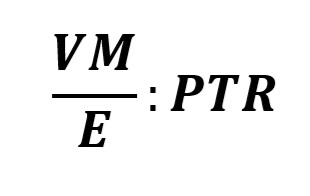
The new Punabantu Equation of Exchange*

This is a basic introduction to the new Punabantu Equation of Exchange which supersedes the Irving Fisher Equation of Exchange. The new Punabantu Equation of Exchange demonstrates how Split Velocity is able to increase GDP at constant price by introducing additional “virtual” (split) velocities that allow money to act as a stimulus without inflation due to variances in velocity. This process facilitates the doubling of GDP in one year at constant price by recovering losses being induced in the economy by the defective CFI.

[*Note that these passages are extracted from the book the Greater Poverty and Wealth of Nations (2010) © All Rights reserved, as prescribed by this copyrighted proprietary work and intellectual property.]

Let us use Irving Fisher’s Equation of Exchange as one method to explain how Operating Level Economics (OLE ) accelerated growth works.

The Fisher Equation is as follows:

MV=PT

This is an identity, Where basically:

M- money supply

V-velocity of money

T-total number of transactions made over a period of time

P- value of money

T in the Fisher Equation is not ordinarily linked to output due to the linear economy’s disposition toward zero growth; therefore an increase in transactions ( as it is with an increase in money supply) in a linear economy will be limited by implosion [subtraction in the CFI] and not necessarily lead to an increase in output. However, in a dynamic economy T, which functions on a different growth principle based on split velocity is equated directly to output and is therefore converted to Y or an index value of the physical volume of output in the economy. Therefore, PY in the equation corresponds with GDP.

The Fisher equation is correct as an identity, however, this identity is incomplete as it leaves out one of the most important factors that determine the productive capacity or performance of money in an economy which in turn directly influences the efficiency of production and the general level of output. This factor is the economic operating system in which money (M), Transactions (T) or Output (Y), Velocity (V) and Price (P) function. The operating system is denoted by the letter (R).

The operating system (R) is the number of transactions or allocations of money per cycle. By not including R in the Fisher Equation monetary and fiscal policy as a means of facilitating economic growth and expansion are severely limited.

The world’s economies today function on one transaction (Y) per cycle, that is, R=1. In other words an economy where Y=24 bn has approximately 24 bn transactions per annum occurring at a pace of 1 transaction per cycle, in this case, the cycle is measured over one year. If the economic system where to change to 2 transactions per cycle, that is, R=2, at constant price then output would be YR or 24×2= 48 bn. In other words over the same period of time, that is, 1 year ceteris paribus, the economy could gain the resources to double in size. Instead of one transaction taking place when expenditure takes place the system can make that routine expenditure automatically perform two or more transactions even though the one active expense and choice was made. For example, when a business pays for capital rather than just one transaction taking place the same value is also automatically paid to labour thus performing two transactions in simultaneously. The system (R) determines the rate or pace of productivity though it is not part of the Fisher Equation.

The fact that R=1 makes the ‘operating system’ an invisible property that is not found in the Fisher Equation. It has not been taken into account when using it to formulate policy on money supply in the same way that an equation where the multiplicative factor is constantly 1 will inevitably ignore the factor’s presence. This ‘invisible force’ and the inability to see or account for it is one of reasons why monetary policy has become increasingly unsuccessful in attempts to catalyse growth in modern economies. R can be made visible on the right hand side of the Fisher Equation showing that the system (R) or number of transactions per cycle, determines how many transactions (Y) will take place over a period of time e.g. 1 year:

The system (R) is a module of efficiency. An increase in T is a consequence of a rise in the efficiency of output as a result of a rise in productive efficiency. In the same way that a car travelling at twice the velocity will cover twice the distance over the same period of time the efficiency of R=2 raises the pace of productivity producing twice the volume of output over the same period of time, that is, 1 year.

Money is like a fuel. The more of it the economy burns to do the same work the less efficiently it is functioning, hence inflation is a result. Similarly, an increase in R which is an increase in efficiency has the inverse effect on money supply. It causes output to increase but money supply to shrink (deflation). The less money needed to create output the more efficient the economy. R affects money supply inversely by increasing the efficiency of money which contracts money supply while it raises  the volume of output (Y) inversely. The influence of the factor R appears on the left side as:

Where R=E

.i.e. VM/E:PTR

The operating system R also affects the velocity of money. When the velocity of money changes it has an interesting effect in that it functions as though there are two economies operating in one space. This occurs as a result of a combined velocity which keeps the velocity of money constant, but working with twice the efficiency. It is based on the system’s dual structure the process which is to be discussed later in this paper.  The factor by which R affects the velocity of money will be denoted as K,  (where K=R).

.i.e. KV(M/E):PTR

However, when the system changes from R=1 to R=2 a money supply deficit is created. There is not enough money in circulation to satisfy the growth in transactions and circulation of goods and services throughout the economy, hence, there arises an inequality seen in the equation above caused by (M/E). When money moves in more than one direction, from one transaction simultaneously performing more than one task, the balance between money supply and productivity must be restored, hence, this adjustment remains within present day monetary policy rules or regulations. The balance is restored by adjusting by S. S is the principle on which split velocity at constant price becomes possible. To do this the fall in money supply (as a result of a change in the system (R) must be increased by R to remain balanced with output. This adjustment at constant price is denoted by S, (where S=R). This last step is significant in that it shows that by changing the system money supply can be turned into a catalyst for growth and development (The stock of money and its behaviour 1-9 provide a more graphic explanation). The final ratio is thus:

The new identity and complete Equation of Exchange, which includes the system in which money functions is as follows:

Where

R – operating system

S – emoney multiplier

E – emoney constrictor

K – virtual velocity

S,E and K are working parts of the operating system dependent on R

In a balanced operating system R=E=K=S

If R=1 in the above equation this reduces it to the original Fisher Equation MV=PT silencing R,E, K and S. This makes the system seem invisible or inconsequential and illusive while it is in fact a useful and yet a missing economic tool. The fact that economies today are linear and function on R=1 entails that MV=PT in a constant operating system. When the system is changed and made to perform dynamically where R>1 or R=2 this creates a sudden money supply deficit or a sudden deflation of 1/R allowing new resources to be created by S (where S=R) simultaneously allocated to capital and households [Split Velocity]. This restores the balance between money supply and output and as a result takes place at constant price in the new system (R=2 or R>1). Inflation does not take place due to the fact that the velocity of money is split allowing it to move in two directions simultaneously. As R is increased on the basis of split velocity as a technological advancement in the use of emoney output or GDP grows by the same rate within the capacity of the technology paradigm. Ceteris paribus by adjusting an economy by R=2 its GDP will double over the same period namely one year supported by the technology paradigm.

R is by no means simply a multiplicative factor, it is part of an operating system. In other words not only does it affect volume it can be manipulated to do so intelligently by changing the process by which allocation takes place thus creating an inverse relationship between money supply and output that can be exploited to catalyse growth and development equally. The equation is systemic meaning it is like a weaving process, the strands or components of the equation may remain the same or be altered, but what is most significant is that the ‘operating system’ or method of weaving changes. The weaving process in this case is the simultaneous allocation of income or finance to households and capital that keeps the dynamic [money moving in more than one direction simultaneously] economy in balance. If the method of allocation raises the number of transactions per cycle this change creates new levels of efficiency, which in turn lead to higher GDP growth rates over the same period of time.

This means that an economy has at its disposal the CFI or “operating system” – (R) as a formidable tool with which to catalyse productivity other than through the four basic factors: money, price, output and velocity alone. R is the system in which these factors operate. A change in R can create a condition in which the four factors can be controlled to obtain desired economic results without negatively affecting an economy.

Making the invisible aspects of the operating system – R hidden in the Equation of Exchange visible is of immense importance to growth and development and opens up new avenues for eliminating poverty, recession and underdevelopment. Here is a more detailed and step by step introduction to the new catalyst and its equation.

The Stock of Money and Its Behaviour

  1. The real stock of money (M) or hard cash (notes and coins) in an economy is fixed. It cannot rise or fall unless more or less hard cash is introduced. Money supply on the other hand is relative it can rise and fall despite the amount of notes and coins being constant.
  • The way the stock of money behaves however will determine how much money there ‘appears’ to be in an economy. For example, if the velocity of money is two. Though the real stock of money is only 300 bn it will have the impact on the economy of 600 bn (MV). Let us call this the Virtual Stock of Money (Vm).
  • The third factor that influences the stock of money  M and the virtual stock of money Vm is the system in which it operates. The system is determined by the number of transactions per cycle. A cycle is the duration during which a single unit of money performs a single task. If the total stock of available financial resources or a unit of money can only be allocated to one task at a time e.g. producing or consuming, as is the case with the world’s economies today, then it is linear. If money per unit of currency were allowed to move from being linear (one transaction at a time) , that is, either producing or consuming to doing both at the same time then the number of transactions it is capable of performing per cycle would increase by 2 (split velocity) and the system would no longer be linear but dynamic. When (R=2) the Virtual stock of money falls by half or by the value of R.
  • What happens in 3 as a result of a change in the economic system is very important due to the fact that it means an  inverse effect on money supply and GDP takes place. Altering the economic operating system* entails changing it  from 1 transaction per cycle to two transactions per cycle. This increase in efficiency causes the supply of goods and services to rise while money supply falls. This inverse relationship is important. By introducing it between VM and PT it becomes possible to manipulate the economy using the economic operating system to restore the balance. The restoration facilitates a system that enables growth in output. It is something that it is practically impossible to do in a linear economy.

* Note that the operating system or economic operating system (eos) refers to the circular flow of income (CFI) and can be used interchangeably.

  • What happens in 4 is an important development as it means that by altering the CFI or economic operating system (R) governments can shrink the virtual size of money supply and allow it to be optimised , that is, on the dynamic principle [dynamic is two allocations of finance per transaction e.g. to households and capital, rather than just one], which uses this to create new resources for capital (industry) and households. The impact of this discovery is as important to growth and development as the impact of credit creation on investment and opens the door to a whole new net-cash catalyst industry that complements credit creation managed by the banking industry. The catalyst at R=2 is capable of generating new financial resources for eliminating poverty, it is capable of doubling output, doubling productivity, it increases financing available for public works and increases the impact of AID provided by domestic and international agencies. It is capable of putting nations back on track to recovery, economic growth, economic development and a higher general standard of living without some of the harmful consequences of interest rate cuts or utilisation of government reserves to finance public expenditure. It also significantly increases the resources available to banks for credit creation and to domestic and international AID/development agencies for programmes and projects. Furthermore, it significantly increases the dexterity with which central and federal banks can regulate an economy in order to protect it from recession and shocks.
  • When an economic system advances e.g. from being linear [where finance moves in one direction per transaction .i.e. Split Velocity] to being dynamic [finance moves in more than one direction per transaction], the efficiency of money (Em) rises (due to the Virtual stock of money falling thus enabling dynamic allocation). At a constant velocity of money  the work done by a unit of money increases and when this happens the Virtual stock of money appears to shrink. For example, the real stock of money may be 300 bn. This money works at a velocity of 2. The economy behaves as though there is 600 bn circulating through it due to the fact that this money circulates through the economy twice per annum. It therefore sustains a GDP of 600 bn where the general price level is 25 and output is 24 bn.
  • If the economic [operating] system (CFI) changes from being linear to being dynamic , that is, from one transaction per cycle (R=1) to two transactions per cycle (R=2) the virtual stock of money will appear to shrink by half. This is due to money being made more efficient by performing two tasks simultaneously rather than one. This is as a result of a change in the economic system. (To illustrate this, it is like a mule (money) pulling a single cart (number of transactions) over a distance in a pace of time (velocity) required by the market. There is only one mule transporting goods and services (facilitating productivity). The mule is pulling its maximum load. No more transactions can be added to this system otherwise it slows the mule down (deflation) making it too slow to deliver its goods required by the market on time. Neither can another mule (additional money) be added to the same load to speed things up as the cart would arrive at the market before all its goods were ready for sale (inflation). By increasing the work done by money (R=2 transactions per cycle) another cart of equal size and load is harnessed to the mule. The load of productivity becomes too heavy for one mule to pull. This slows it down (making the stock of money shrink (virtual deflation). This alteration makes it possible to introduce another mule (new financial resources created by the operating system) to help tow the two carts at constant price. Now there are two mules pulling two equal loads (split velocity) facilitating twice the level of output (GDP) at the pace required by the market to get the goods there on time). The additional mule harnessed to a dynamic operating system (CFI) creates new resources 300 bn to 600 bn. When this happens the Virtual velocity of money (K) pushes this value up to 1.2 trillion at constant price. This is necessary since the velocity of money flowing in either direction (toward capital and toward households) remains constant at 2. The split in allocation (split velocity) creates two economies functioning simultaneously, namely the capital economy working at a velocity of 2 and the consumer economy working at a velocity of 2. This creates a combined virtual velocity of 4 per annum, however, money is moving only at a velocity of 2 per annum in its respective capital and consumer economies which though fully integrated are separately fueled (by money).  In consideration of the older Fisher Equation even if ‘transactions’ remains constant since money appears to be operating in two economies. This split velocity is extremely important as it keeps the general price level at 25 while output increases from 24 bn to 48 bn. It keeps the velocity of money at 2 (in each economy) allowing the stock of money to grow from 300 bn to 600 bn. This will be reflected by the value K in the equation. A change in the economic [operating] system (CFI) from R=1 (linear) to R=2 (dynamic) will cause the efficiency of output to double from 600 bn GDP per annum to 1.2 trillion GDP over the same period of time at constant price generally allowing a doubling of output in an economy per year.
  • The addition of 300 bn to the real stock of money restores the deficit created by advancing the financial system from R=1 to R=2 (M/E) and this restoration (S) at a constant velocity of money of 2 doubles the output from 24 bn to 48 bn raising GDP from 600 bn to 1.2 trillion over the same period of time. This situation keeps the economy in balance with 1.2 trillion VM servicing 1.2 trillion GDP. The dynamic economy or dynamic operating system is in this case twice as efficient, twice as productive, twice as able to provide and twice as stable as the linear economy. When the system remains linear, that is, R=1, as the world’s economies are today, then GDP growth rates will be encouraged to balance at zero. In other words linear economies are designed to remain stagnant [this stagnance or lack of growth is why a linear economy is referred to as a “zero growth economy”] To grow they must rely on cost plus pricing, more on which is discussed later. This is why they annually produce such poor levels of output that economies and economists have become accustomed to. To overcome stagnation industry and households have to ‘overwork’ themselves or use surplus efficiency to survive. The result is a salvaged annual GDP that often resides between a paltry 0-10% per annum. When GDP accelerates to levels as high as 65% as observed in some oil producing countries as a result of oil, the economy is not inherently designed to distribute wealth equally between capital households thus leading to growth without development, that is, growth while poverty levels remain high. This causes adverse or artificial scarcity from which present day poverty and its plethora of socio-economic problems arise. The switch from a linear to a dynamic operating system at (R=2) doubles the level of financing in an economy, ceteris paribus, allowing a doubling of GDP over the same period of time. It means that the US economy has the potential to grow from US$12.5 trillion in GDP (IMF 2005) to US$25 trillion in one year ceteris paribus; the US government may not need all these resources and may not need the economy to grow this quickly and could instead capture the percentage of these resources it felt was required for its population and needs. It means that the South African government has the potential to make the South African economy grow from US$240bn (IMF 2005) to US$480 bn a year. It means that the EU could make its economy grow from US$13.5 trillion (IMF 2005) to US$27  trillion in a year.  It means that the Zambian government cold make the Zambian economy grow from US$7.3 bn to (IMF 2005) to US$14.6 bn in a year. Since this Operating Level Economics (OLE) .i.e. circular flow of Income economic method acts as a catalyst this growth is natural allowing the economy to expand the same way it would if left to itself except in a much shorter duration of time. There is no hocus-pocus involved. Nations are in this case no longer limited by the linear operating system’s implosionary limitations [limitations caused by subtraction] and losses that lead to very low annual growth rates. They can grow much faster and at a rate that they deem fitting. Any well managed linear economy can increase GDP in this way without breaking a sweat due to the fact that it is already operating at level required to do so only implosion [subtraction in the CFI] dissipates the potential output it should naturally have access to. Dynamic allocation naturalises or balances productivity and output that implosion [subtraction in the CFI] in a linear economy has kept persistently unequal. When economies become dynamic [more than one allocation of finance per transaction] they acquire a rate of growth that they should have been exposed to all along. Artificial scarcity and the problems it creates are no longer a limit to what governments can achieve for betterment of their people. If the US government felt that it needed to grow by only 36% more in a year to create enough productivity within the US economy to wipe out industrial stagnance, squalor in inner cities, poverty, unemployment and create a general standard of living in line with government policy then the US Federal Reserve Bank would regulate the economy to R=1.36 rather than the full R=2.  In other words it would capture only 36% of its total potential to grow in that year as allowing growth by the remaining 64% may be considered too excessive or extravagant for the existing population. A balance is thus found that avoids the problems caused by adverse scarcity and adverse surpluses. For African nations trying to find sustainable resources for projects like NEPAD transforming from a linear to dynamic operating system provides an alternative route to sustainable development and development financing. In this case governments are in a better position due to the fact that they control the availability of resources rather than being controlled for the worse by artificial scarcity, which is averse to socio-economic development.
  • Finally, the new equation for money moves on from the monetarist Fisher Equation:

MV=PT

To the new Punabantu Equation of Exchange:

Where R=E=K=S R is the economic [operating] system in which Money (M), Velocity of money (V), Price (P) and Output (Y) function. The values R=E=K=S in the equation [above] remain equal. Money Supply M has to be multiplied by whatever it is made to virtually shrink by 1/E. In this case money supply is made to shrink by the economic system R=2 therefore the real stock of money has to be increased by the proportionate value of R which is represented as S otherwise there will be a deficit in the real stock of money M. However, this increase takes place on an alternate velocity thus causing no change in the general price level, but rather the alternate side effect, that is, an increase in growth. To prove this S can be cancelled out by R in the equation (also using a concept of mechanical efficiency) due to the fact that though money supply is doubled (from 300 bn to 600 bn) to facilitate productivity in the restructured economic [operating] system its virtual value remains 300 bn due to the fact that it does not change along the same velocity. This is an important benefit of dynamic allocation. M is a real quantity while R, its common denominator, is a virtual one determined by the mechanical level of efficiency present in the economy (R=2). Modern economies are linear systems (R=1). Any attempts to increase money supply will lead to an increase in the general price level (inflation). The dynamic economy therefore offers new hope to ailing economies as a catalyst with which to boost productivity and consumption equally without using external resources. It is also a new tool by which to increase and accelerate annual GDP growth rates and bring an end to poverty, unemployment, stagnation and economic instability.

The equation satisfies both Monetarist and Keynesian schools of thought in that it creates new resources in S to catalyze productivity and yet the increase has no impact on inflation due to the fact that it is cancelled out by 1/E. K,V,S and E become constants. K is representative of the fact that money flowing to consumers (households) and capital (raw materials, equipment, repayment of loans etc.) does so at the same velocity (V), however, they take place simultaneously creating a Virtual Velocity (Vv) of 4 (Vv=KV=2×2) seen by a dual economy delivering financing output at the same velocity, but at double the volume (two carts: split velocity). The change in R from R=1 to R=2 causes money supply to shrink (M/E) making it necessary to restore its value by S; (MS/E) This works fine since it allows the stock of money to double and yet appear to remain the same (adding another mule). Doubling goes hand in hand with it being allocated equally and simultaneously to capital and households creating the R=2 economy (doubling the load by adding an additional cart) in which growth and development rise equally rather than one above or before the other. The increase in productive efficiency allows the stock of goods to increase by YR rather than just Y over the same period of time (1 year).

In terms of the efficiency of money an economy shrinks by M/E and must be restored to MS by S were as the inverse occurs and output grows by YR where R=S.

The economic system R (the number of transactions per cycle) is  a non-obtrusive catalyst. It acts inversely on money and output by increasing the rate of productivity that lowers money supply allowing it to be expanded while making it possible for producers to expand output. This allows economic expansion (growth + development) to take place rather than one at the expense of the other. This is a significant improvement in economic management.

MONETARY THEORY & ACCELERATED GROWTH IN A NUT SHELL

OLE theory states that, ceteris paribus, every economy at any point in time contains within its economic operating system the latent financial resources with which to double its GDP in one year at constant price. Therefore, economies are capable of geometric gains in growth as opposed to the linear gains in GDP observed today.

The Fisher Equation and Punabantu Equation

The Fisher Equation is as follows:

MV=PT

This is an identity, where basically:
M- money supply

V-velocity of money

T-total number of transactions made over a period of time e.g. 1 year

P- general price level

T in the Fisher Equation is not ordinarily linked to output due to the linear economy’s disposition toward zero growth; therefore, an increase in transactions as it is with an increase in money supply in a linear economy will be limited by implosion [subtraction in the CFI] and not necessarily lead to an increase in output. However, in a dynamic economy T, which functions on a different growth principle based on split velocity  is equated directly to output and is therefore converted to Y or an index value of the physical volume of output in the economy. Therefore, PY in the equation as will be seen to correspond with GDP.

Moving from the Fisher Equation to the Punabantu Equation: The new identity and complete Equation of Exchange, which includes the system in which money functions is as follows:

Where

R – operating system

S – emoney multiplier

E – emoney constrictor

K – virtual velocity

Y – output of goods and services

S,E and K are working parts of the operating system dependent on R where R=E=K=S

If R=1 in the above equation this reduces it to the original Fisher Equation MV=PT silencing R,E, K and S. This makes the operating system seem invisible or inconsequential and illusive while it is in fact a useful and a yet missing economic tool in growth and development. The fact that economies today are linear and function on R=1 entails that MV=PT in a linear operating system and T rather than Y should be used in the equation.

The annual rate at which output grows (GDP) is determined by the operating system and the technology paradigm (organisation of human skills and capital to create a desired level of productivity.)

Where M=300, Velocity=2, P=US$25, Y=24 bn

If the economy is linear as it is with economies today then R=1 therefore growth does not benefit from the operating system’s accelerant . For example: .

PYR=25x24x1= US$600bn, Therefore, GDP is US$600 bn for the year

If the operating system is used to double growth over 1 year, that is, R=2

PYR= 25x24x2 = US$ 1,200 bn over the same period; therefore GDP has the potential to double to US$1,200 over the same period.

This accelerated growth takes place at constant price:

.i.e. P=KV(MS/E)/YR= 1,200/24×2=US$25

Accelerated growth is geometric allowing doubling to take place each consecutive year; significantly shortening the pace at which development occurs.

Hence, using the new Punabantu Equation of Exchange, as demonstrated in the equation above by the doubling of GDP from $600bn to $1,200 bn in one year, where the price level remains constant at $25, it is verified mathematically that an economy can finance the doubling of its GDP in one year at constant price. The new equation of exchange confers sovereign economic status on an economy as it allows a domestic currency to be minted and introduced into circulation where instead of generating inflation it acts as a stimulus for growth and development. It allows governments to grow their economies until productivity is on par with the needs of a given population.

[Note that doubling time (the rate of economic growth each year) does not have to be fully applied. It can be applied by percentage anywhere between 0% – 100%. The pace at which an economy can grow is determined by its technology paradigm.]

Are human beings the world over meant to suffer due to poverty and scarce resources as we see happening in the world today?

Are human beings the world over meant to suffer due to poverty and scarce resources as we see happening in the world today?

Let’s see, in terms of the bible you suffer because,

You lack faith:

26 Look at the birds of the air; they do not sow or reap or store away in barns, and yet your heavenly Father feeds them. Are you not much more valuable than they? 27 Can any one of you by worrying add a single hour to your life?

28 “And why do you worry about clothes? See how the flowers of the field grow. They do not labor or spin. 29 Yet I tell you that not even Solomon in all his splendor was dressed like one of these. 30 If that is how God clothes the grass of the field, which is here today and tomorrow is thrown into the fire, will he not much more clothe you—you of little faith

In terms of economics, countries can finance the doubling of GDP in one year. *

[*This statement agrees with verses in Matthew 6:26-30. In other words there is a scientific basis in economics for what religion is trying to explain to humanity when it says human beings were not put on the earth to suffer, but to experience incredible abundance. If that is the case why do we see so many jobless youth – many who have qualifications, beggars on streets, families struggling to make ends meet and falling apart, drug addiction, homelessness, sprawling shanty towns, lack of access of large populations to electricity, running water, basic plumbing, businesses large and small in a life and death struggle just to break even, a general and pervasive inadequacy of resources in nearly every endeavour humanity tries to undertake? Why is the economy failing to deliver its bounty and prosperity to every man, woman and child on earth? The scientific reason for this is that the tremendous volume of resources (equivalent to annual GDP) meant to provide the abundance that is due to all of humanity is being cancelled 100% by the defective CFI, which is why the unnecessary suffering, inadequacy and unpleasantness prevails. This defective CFI robs humanity of much needed resources and abundance in broad day-light, it is compared to the sleight of the hand trickery in the video below. Professionals in economics, finance, and accounting need to understand this hidden loss being caused by the faulty CFI and begin to act to recover these losses for their clients, businesses, public and private institutions, government and humanity in general to begin to stop the suffering and for humanity to begin to enjoy the prosperity and abundance it deserves. Advisory & Audit services professionals, businesses and institutions should be leading this effort due to the fact that the public relies on them to find faults (.e.g. the defective design of the CFI) and to find and offer the most efficient tools and methods to apply in operations for managing and growing the private and public sector as well as the economy in general.]

The book I authored, The Greater Poverty and Wealth of Nations (2010) goes to significant lengths to explain scientifically how every economy in the world has the innate ability to double its GDP in year.

Can growth this fast really be done?** The answer to this is very simple. As a citizen of a country you are already experiencing doubling time in one year. You see the circular flow of income (CFI) operates at a 100% level of inefficiency. This means that for a modern day economy anywhere in the world to grow by any percentage, even 0.1%, 1%, 2%, 3% or 7% it must first lose 100% of the capacity to grow it gained to the poorly designed CFI. So, you’re already doubling, the defective CFI is just not letting you have this wealth – its resetting to zero, like a car spinning its wheels, burning rubber, the CFI is making sure you, your people and your country are going no-where.

This is why the modern day economy is referred to as a zero growth economy or system. The economy is designed to shut businesses down. They try to survive and fight back by introducing a process called “cost-plus-pricing” or mark-ups, however, they cannot resist the crushing weight of the defective CFI and at some point the majority of business and industries will fold as they struggle to break even. Size is nothing, it can be a large conglomerate or your corner store business they will struggle with profitability and many will inevitable succumb to the defective CFI. Businesses and industry are therefore in a life and death struggle with the economy, yet they believe its helping them and designed to make them progress. Every economy in the world today needlessly loses 100% of GDP to to the poorly designed CFI.

It is what can be described as a “sleight of the hand” 100% loss that occurs in plain sight .e.g. the 3 cups and a ball are used to illustrate this loss, see the video below.

[**Technically doubling in one year is already taking place. It can be described as a standard characteristic of all economies. Therefore, to ask if it is possible is moot or pointless. This means that tremendous prosperity is grafted directly into how economies are supposed to work. The catch is that this growth is being cancelled by the poorly designed CFI. Split Velocity recovers these resources and restores them to businesses and government.]

You can be 100% certain you saw which cup the ball went under. In other words common sense, your degree or PhD, ACCA, CIMA etc. training and many years of experience can reassure you that you are right and there’s nothing wrong with how the current economy works. Like the image above you therefore point where you know you saw the ball go. But a sleight of the hand trick is designed for over-confident people. The fault in the design of CFI is like “Ka red na ka black” trickster. It will take the equivalent of GDP from your economy while you’re looking, in broad daylight and when you walk away with nothing but 1% growth every year you will blame yourself for all the problems and failures you see around you. Don’t blame yourself. Take the time to understand what’s going on. Study the Empirical test for Split Velocity, understand where 100% of your country’s GDP is being lost for no reason other than the defective design of the circular flow of income (CFI). As much as 100% of GDP per annum can be recovered from the defective CFI, bringing an end to poverty and scarcity, allowing humanity to enjoy the abundance and prosperity it deserves.

Any individual or institution, global or local, that tells you it is trying to solve poverty underdevelopment and slow growth (locally or worldwide), but is not addressing the losses in the CFI either does not know what kind of evil it is up against or does not genuinely understand the problem scientifically. An annual loss of resources equal to GDP that withdraws this wealth from economies every year is why these problems are chronic and have no remedy despite years and years of trying to stop them. The loss being equivalent to GDP and annual is simply too huge for any kind of development strategy or policy to address, except by going straight to the CFI to reverse this loss.

Let’s say the ball’s value is equivalent to annual GDP as has been explained. As a crowd you see the defective CFI place the ball under one of the three cups. It then shuffles the cups around, you try like a hawk to keep your eye on the cup you saw receive the ball. After shuffling the cup the CFI asks you to claim your GDP.

Confidently you point at the cup you kept your eye on and know for sure the ball was under. When the CFI lifts the cup there is nothing there but air. You walk away with the 0.1%, 1%, 2%, 3% or 7% in change you had in your pocket thinking you must have picked the wrong cup.

The truth is that there was no ball under any of the cups you picked because the performer (the CFI) palmed the ball just as you saw it enter the cup. There was no GDP (ball) equivalence under any of the cups. That GDP was palmed by the CFI. And just like that Zambia loses US$28 bn annually to the CFI, the United States lost US$29 trillion to the CFI in 2024, Kenya lost US$113bn, Brazil lost US$2.3 trillion etc to the poorly designed CFI.

The world-wide loss to humanity due to the defective CFI was US$110 trillion in 2024 alone. Ask yourself, what difference would this income have made to governments, businesses and economic activity, as well as to the lives of every man, woman and child – if this loss were recovered?***

[***These are actual financial losses to businesses and industries in every sector of commerce as well losses in revenue to other private and public sector institutions, including national governments. These huge losses are presently unaccounted for, they are hidden in plain sight from economics, finance and accounting practice, as it is applied today.]

But because you blamed yourself, and lack faith in the prosperity you deserve, you remain part of the reason why countries are generally impoverished. [See the video below]

Links to resources to help you learn about Split Velocity:

https://www.linkedin.com/posts/siize-punabantu-b8a25792_split-velocity-solutions-explained-rv4-activity-7238480676369399808-ntMB/

Like the cup and ball scam in the video, losses to the CFI take place right before the eyes of the public. The poorly designed CFI creates a loss right before economists, and anyone engaged in finance. To find this hidden loss you must familiarize yourself with the Empirical Test for Split Velocity, where the loss is made visible, and thereby it becomes recoverable.

Episodes 1-5 Explaining Split Velocity in as simple way anyone can understand

https://studio.youtube.com/playlist/PLCPOUU2yVtC-4DwV5VQnRbVNzW0aZLu-z/videos

Split Velocity: Where would we be as we enter 2025?

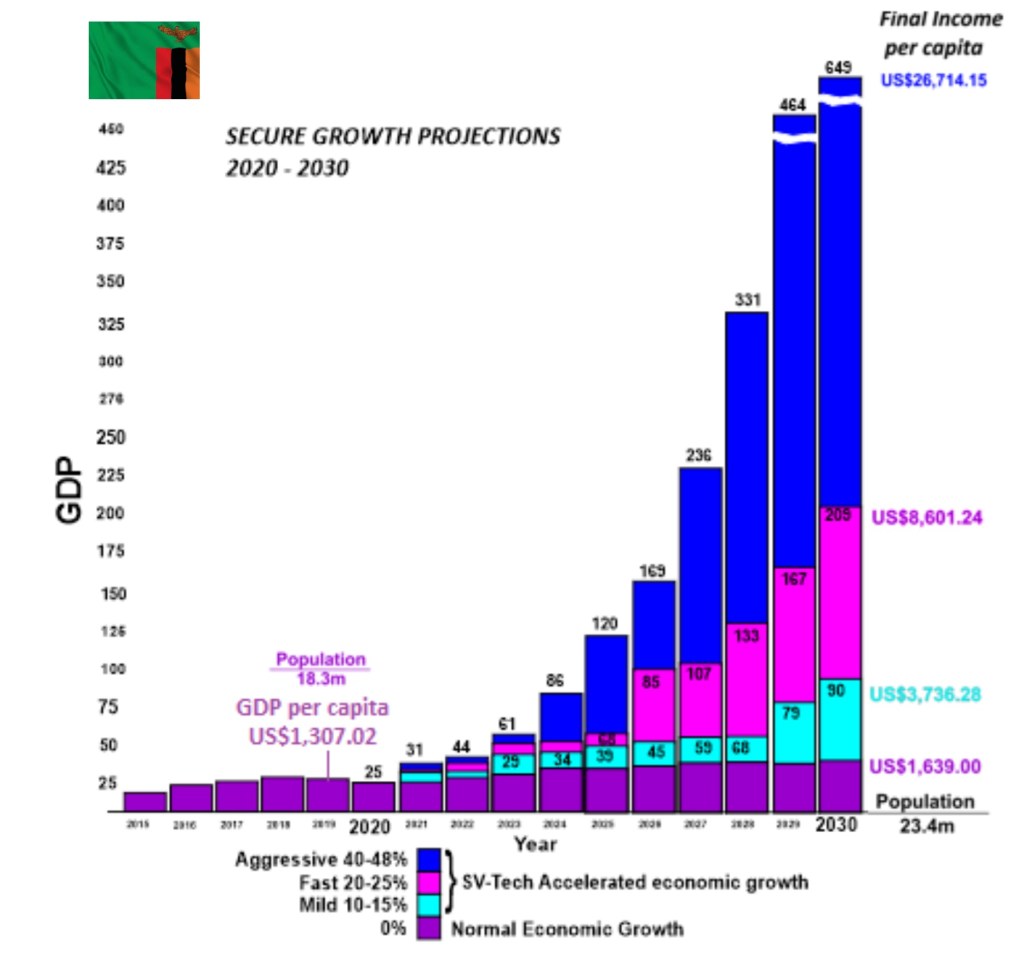
Were Split Velocity implemented between 2020 -2024/5 Zambia would be moving away from a per capita income of U$1,630 to a per capita income of US$3,736 and a GDP of between US$80 billion to US$120 billion (Guaranteed i.e. financed by Split Velocity). A Split Velocity model does not just make predictions, it ensures the resources to finance projections are made available in the economy.

It would have taken the Split Velocity model 4 years to improve per capita income by just US$2,106. This illustrates how difficult it is to grow a national economy. Nevertheless, this would be a 129% improvement in per capita income and therefore per chance a significant 129% improvement in living standards for all Zambians.

At present Zambia’s per capita has lowered from US$1,307.02 to US$1,226.00 as predicted by the chart illustrated below this trend of zero or low growth further aggravated by debt, drought, inflation and other unanticipated economic shocks will continue to 2030 and continue indefinitely beyond that despite valiant and commendable effort to move the economy forward.

The struggle for economic growth is real and it is hoped that the remarkable improvements a Split Velocity model can provide will be introduced to guarantee economic growth in the future.

A Split Velocity model offers the ability to raise per capita income to US$26,814.15 within a short period (10 years). However, it must be implemented to begin to enjoy these levels of growth.

The chart shows that by 2024/5 had we implemented the Spit Velocity model in 2020 today we would be approaching a growth in GDP o between US$86bn – US$120 billion and per capita income of between US$3,736.28 – US$5,653.00. The bottom purple bars show how, as predicted, we are moving in the status quo section when no stimulus is provided by a Split Velocity model. As you can see by 2024/25 the chart predicts Zambia’s GDP will be below US$34 billion, however, GDP at US$28 billion is much lower than this due to various shocks to the economy. The SV model could have mitigated against these shocks. We hope the SV model will be adopted in future as the strategy for Zambia’s economic advancement.

How countries can trade without deficits

After having designed the Split Velocity Model which would accelerate growth in GDP within countries, I realized that I had to look into the problem with international trade which was still backward, facing significant bottlenecks and needed strong revision. My recommendations were for countries to rely on their central banks to create electronic clearing houses for international trade. The design of this new international trade system would allow countries to do away with trade deficits, and create a very powerful form of integration where many countries in this type of trade system function essentially as one country in terms of trade and commerce.

Most economic blocks want to create a single currency. It is an objective born out of economic fantasies about a single currency being able to unify nations. This is of course a concept that comes about as a result of shallow strategies intended for the advancement of economies to which not much thought has been applied. For instance, organizations may be creating regional or continental payment systems, but what is the point of these really if they are not capable of generating the new income and a new revenue source observed in an ECH system?

I would advise old and newly emerging economic blocks and communities that have national currencies to abandon the notion that a single currency will somehow transform them from a backwater enterprise into a super star of commerce. Creating a single currency does no such thing, it is a fashion statement. If currencies are interchangeable and recognized by central banks, this in effect creates a single currency that represents unity in diversity. What does accomplish this is creating a unifying international trade system. When countries can trade, exchange imports and exports without injuring one another with deficits they effectively become one country. This truly accomplishes what the single currency will never achieve.

How can countries do what appears impossible – engage in international trade without deficits?

Economic communities, such as BRICS for instance, need to focus on trade unity as opposed to the objective of a single currency. Trade unity in essence means that nations are devising a system where countries benefit from international trade whether they are a net importer or exporter of goods and services. When this happens the movement of goods and services does not injure the country that opens its borders to imports. When countries can import without deficits and countries can enjoy the gains from exports there are no losers, only winners, and in this condition every country is better off. When one country exports to another and another accepts imports the fact that there are no losers means it is no different from goods and services moving within one country. In this process currencies become equal and products move growing the economy of both the exporter and importer creating net economic gain for both countries.

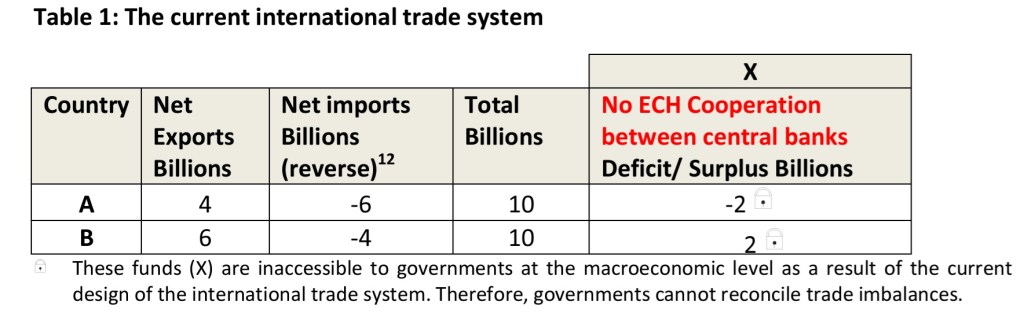
The table below illustrates the current international trade system. Imagine there are just 2 countries in the world, country A and country B. The combined trade of the two countries amounts to $10 billion, however, in this archaic trade system one country enjoys its surplus of $2 billion at the expense of its trade partner suffering from a deficit of -$2 billion. This is not an example of unity, it represents the opposite of fundamental balance, that is, the opposite of “yinyang” or positive life-force, it is not an example of two countries in a trade block that is uplifting for both, it is really an out of balance rivalry that makes no sense in economics if countries are coming together to form an economic community.

  1. The exporters (companies) in both countries earn a direct income of US$4 billion and US$6 billion respectively.
  2. Country A benefits from trade more than Country B since it has a surplus of US$2 billion.
  3. Country B is disadvantaged by having a deficit of US$2 billion.
  4. There are no financial resources at the governmental level generated by the system with which to correct the trade imbalance since currencies bypass central banks during trade.
  5. Neither Country A nor Country B can advance in international trade without one country compromising the other.

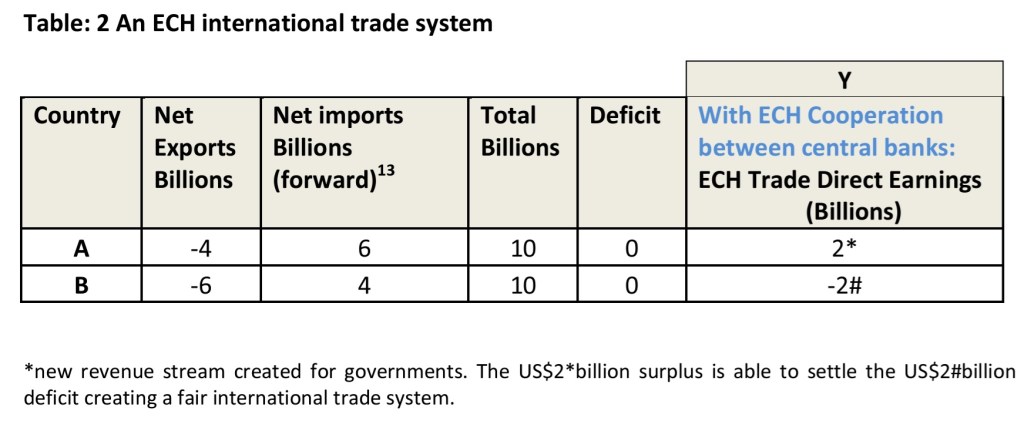
This system is archaic, it can be replaced with a more sensible international trade system that will ensure both importers and exporters benefit from trade. The basic approach is to use an electronic clearing house or ECH International Trade System, which involves central banks in how the movement of goods and services takes place between countries. The table below shows what happens when central banks introduce an ECH, trade deficits that harm countries come to an end. In essence these countries are brought together in manner that is closer than the “single currency” system, economically they become like one nation. Both exporter and importers now benefit international trade.

“…..when an ECH system is introduced currencies no longer bypass central banks when international trade is taking place (see diagram below). The principle used is that goods move freely between countries, however, currencies remain domestic. Currencies do not need to move since central banks can debit and credit one another to facilitate trade (receive payments from importers and make payments to exporters respectively in each country); basically the movement of goods and services between countries (the finances in column X are unlocked as shown in column Y Table 2 by switching the system. The result is the revenues with which to finance and reconcile the net surplus and deficit between trading countries to zero become accessible by governments, thus ensuring there are no deficits, that is, losses to either exporting or importing countries. As explained earlier, to achieve this, the international trade system has to change. In a new ECH international trade system exporters earn income from exports, but countries also earn direct income from imports creating a surplus with which to reconcile the deficits created by international trade. “

The system creates the changes for Country A and B shown in Table 2.

As you can see from Period 1 to Period 2 of the table below an ECH International Trade System agreed between country A and B moves from having detrimental deficits in Period 1 to no deficits in Period 2. Trade is balanced at the ECH level. Countries that open their economies to imports are not injured by a trade deficit, which the Treasury has to constantly mitigate against by having forex/hard currencies for covering imports. There is no longer a need whatsoever for holding foreign currency to cover exports, this process is now redundant. Since individual companies in exporting countries still earn income for their exports the net gain for net exporters is not affected, they still enjoy that “high level exporter” status, and the countries to whom they export can no longer claim imports hurt their economies due to nonsensical foreign exchange barriers to trade. When nations join an ECH International Trade System it in essence naturally means though national currencies are diverse they are now automatically interchangeable and behave like one currency bringing sanity and much needed equality to the international trade system. At present international trade discriminates against sovereign currencies in less developed economies, a practice that is unacceptable in this day and age. To skip the ECH process and go straight to a single currency creates a disingenuous international trade system that does not in reality create equality or resolve the problem of deficits for member states. BRICS and the African Union will find the ECH system more powerful and meaningful than simply copying the single currency process which does not in real terms unify cooperating countries, it is more about controlling their economies in an imperial manner rather than bringing nations together in genuine solidarity.

Before an ECH International Trade System was introduced there was no gain at the governmental or macroeconomic level except through customs duties, taxes on imports and exports. However, have you noted that after the ECH system is introduced Country A and Country B are looking at a $2 billion earning, which did not exist before, that they can now mutually decide how to spend. This $2 billion which is non-existent before the ECH, can essentially show that there are huge amounts of income to be gained as a result of introducing an ECH. Governments must ask themselves what they could achieve with this tremendous source of revenue at the domestic level and in financing their international institutions. For instance, what could the World Bank, United Nations, African Union, European Union and other international institutions accomplish if they were allocated a percentage of this income, which globally amounts to trillions of dollars plucked out of thin air, since they are created simply by upgrading the international trade system to an ECH model. This change to an ECH system creates a shocking amount of value and income with which to invest in positive programs. These trillions of dollars in value, which did not exist before and are created simply by introducing an ECH system, can be used to fund programs, foster greater cooperation, global harmony and peace between countries.

This type of trade union is what economic communities such as BRICS, the African Union and African countries in general should be striving for. In comparison a single currency is really just a fad with very little economic value. A fad in the sense that it invokes imperialistic ambitions that are not necessarily beneficial to participating countries in the long run that find themselves yielding dignity and control of their own economies. In fact it erodes the cultural heritage expressed through a national currency and erodes the socio-economic value inherent in national currencies if it requires domestic currencies to be phased out. Why create a bland single currency when you can instead use an ECH system to bring a basket of diverse national currencies and celebrate the fact that they are interchangeable and hence have become “one currency”. The UN should support a “World Currency Day” where vendors at a trade fair and businesses in every country, on that day, accept payments using any currency, basically encouraging people the world over to scrutinize, collect, learn about, respect and embrace each other’s currencies. This is a celebration that can be held every year by participating countries bringing them together in a way that celebrates every country, being like one country. A single currency created by an economic community can still co-exist and become a currency in this basket. To accept another nation’s currency is to accept its people, respect the work they do, value their effort and labour, and embrace the fact that all humanity is equal, expressing this through currency expresses it through commerce which helps lead to the economic emancipation of humanity, which is long overdue. No nation should take pride in the fact that its currency is superior to another nation or group of nation’s currencies, because a genius knows discrimination is bad for businesses, and a great leader of great intellect understands that a currency that postures itself in this way is blinded by pride and consequently losing not gaining strength and value. The strength, value and power of a national currency cannot be greater than when it is equal to and unconditionally exchangeable with currencies of other nations, the reason being that in this position it becomes capable of the greatest and most efficient trade possible.

Creating a single currency for a group of nations or trading block does make sense, however, this system, which is a top down model, should not necessarily mean that individual countries should completely abandon and obliterate their national currencies. Isn’t it more sensible to create such a strong partnership that if a trader says they are trading in Kwacha, they are in fact saying they are trading in a hard currency like Japanese Yen or Chinese Yuan? The same for Brazilian Real, Naira, Rupees, Rands etc. because these countries have come together to create one currency. This one currency can also mean that each individual currency is equal to that of its partner country as they all back each other up.

When buyers in a country want to import goods and currency is no longer a barrier to making these purchases, this truly grows and enhances international trade. This is a fact, however, it is politely ignored. The reality is that when currencies act as a barrier to trade they not only hinder commerce, but represent a form of discrimination formalized and institutionalized through how currencies are used as mechanisms for exclusion by the international trade system, that though discriminatory and potentially illegal, modern day governments have been groomed to believe are an acceptable corporate practice . For how long do developing countries have to wait for genuine equality? Discriminated against initially on skin colour, then after an epiphany everyone is then considered equal, discriminated against in terms of intellectual ability, then a light bulb turns on and intellectual equality is proposed, and the reality today is that this discrimination exists in economic cooperation by the use of currencies to exclude developing economies. Why is this the case when they need the most help?

How long will it take for this light bulb to turn on, so that developing countries with sovereign currencies can enter the store (international trade) through its front door and pick what they want and need like every other developed country and not have to queue at the store’s little neo-colonial window and explain how it is they can afford what they want to buy before the shop keeper agrees to sell to them. Like Dr Kaunda, developing countries should ask for the purchased bicycle to be given through little window, this is the hypocrisy of the current international trade system governments in developing countries have been groomed from independence to believe is how business should be conducted, when it is in fact a farce.

These excluded countries must first work to sell imports with which to have the hard currency or “slave master’s” currency in their Treasuries up front to cover imports while other countries can simply purchase imports directly, invest these funds in productivity and reconcile the need for cover after the fact, an unfair advantage that should no longer be available to a few countries to the exclusion of other countries. This access should be available to every sovereign nation as a fundamental right, because today as humanity, we are better than this. The result of this kind of unnecessary discrimination is that it weighs down commerce making it inefficient and less agile than it should be consequently making the entire international trade system weak and farcical. Officials claim they want the best in international trade, want countries to grow, want increased participation and financial inclusion which can only come from greater equality yet in the meantime the very foundations of international trade are a nonsensical system built on discrimination against sovereign currencies. Discrimination is bad for business, how currency is used is no exception. It can’t be had both ways, the hypocrisy needs to be thrown out and genuine business come to the fore.

So as you can see, in an ECH International Trade System facilitated by central banks the need to hold the US dollar or any currency for that matter becomes redundant as all currencies are considered equal, the practice of discrimination against currencies that is hurting growth and industrialization especially in developing countries, is cast out. There is no need for the Treasury in Zambia to hold any foreign currency, the Kwacha is enough because in an ECH system the Kwacha, which represents the hard work of the Zambian people, is regarded as equal to currency in any other country. The fear that plagues governments of running out of hard currency is thrown out the window, it is an archaic neo-colonial fear that should no longer be allowed to exist to haunt struggling nations. Net exporters that are already champions of international trade like China continue to enjoy their status and can do so in good conscience due to the fact that their exporters still enjoy gains from exporting, trade deficits can no longer be used as an excuse for countries blocking imports such as that seen recently with electric vehicles.

Competition becomes healthier, nations succeed by competing on innovation and quality of goods and services. Currency discrimination is thrown out, the International Trade System is fair, business thrives and commerce between countries is allowed to blossom. The icing on the cake is the trillions of dollars worth of value unlocked by the ECH system, that did not exist before, that nations now have to play with to foster peace and international cooperation.

Dr Kaunda, “Give me my bicycle through the little window.” {National Museum]
Currency discrimination in the international trade system is an inhumane practice reminiscent of the holocaust, carried over from the colonial period. It turns countries into concentration camps where many trapped by their currency suffer tremendously. This heinous ongoing practice
of mass discrimination has sadly continued to be practiced and institutionalized by Bretton Woods institutions. This is an area where reforms are urgently required as they represent a conflict of interest in terms of the purpose of these institutions and why they were created. It is a neocolonial practice that is illegal and cannot be justified or rationalized in the same way other forms of discrimination observed in slavery, Jim Crow and colonialism carried on, structural racism of this nature cannot be justified or rationalized in any manner whatsoever, it can only be abandoned and replaced. A new, fair and equal currency system is required that respects all governments, all sovereign currencies, regards them as equal, and that respects the multitude of nations, their people and the hard work their currencies represent, before or after the fact. The only currency a nation should be required to have in its Treasury is its own currency, because its own currency is enough, it is equal to all other currencies.

[This method for creating a new inclusive and equal international trade system is sourced from the book The Greater Poverty & Wealth of Nations (2010) written by Siize Punabantu, for more in depth writing about this system and approach you can also read Currency Wars & International Trade: download the paper here]