We have all heard the accolades about Africa’s mineral wealth, about how no other continent is well endowed with highly sought after precious minerals. However, the subject of growth with development is somewhat devious and dubious in the sense that most scholars (even in the developed world) don’t genuinely understand how to attain it. If they did poverty would be something we read in the history books.
If you read my last post on international trade I explain how the current international trade system needs to be replaced by an Electronic Clearing House (ECH) system. The introduction of this system would net approximately $20.9 trillion per annum easily making it the largest business or commercial entity in the world, 135 times larger than Saudi Aramco, with a spending capacity or budget bigger than that of the United States and China combined. Technically, it is not very difficult to establish an ECH with which to begin to earn this $20.9 trillion, however, it does require cooperation between governments and their central banks. Nevertheless, what can be raised from an ECH is small in comparison to what a Split Velocity model can generate.
The truth is that any approach to economic development and the eradication of poverty that does not address the poor design of the circular flow of income and that does not recover the annual losses it generates that are equivalent to GDP per annum, will inevitably fail. It does not matter how hopeful, country-wide or clever the national strategy or development plan may seem, it is unlikely to succeed in the long run. In Zambia, after independence we saw an earnest effort to channel funds from copper into strategic geographically positioned industries .e.g. batteries in Mansa, glass in Kapiri, pineapple canaries in Mwinilunga, automotive assemblies in Ndola, and so on imagining that an unstoppable march to industrialization had begun. New hospitals and schools were built in nearly every district. However, these industries and this development effort though gallant, well thought out and planned did not have the outcomes anticipated. Many of these industries eventually became derelict and buildings fell to ruin. It does not matter whether today the pineapples are tomatoes or instead of Land Rovers and Fiats African countries are building EVs, the effort remains gallant but as Africans we can no longer allow ourselves to be delusional and deceived by a lack of understanding of the shortcomings of the WKP and economic strategies that will never bear genuine fruit in Africa were economies are smaller, where strategies ignore the faulty design of the CFI, and unseen losses equivalent to GDP per annum that can and will ultimately and relentlessly grind any economic development plan to dust. We must hold onto the strong will to transform the lives of our people but we can no longer afford to keep making the same mistakes over and over again. We can no longer continue to play checkers while those we deal with are playing chess.
We live in times were the process of development planning does not understand a strategy that instructs a country to sell its mineral wealth in exchange for its domestic currency, e.g. sell copper and demand it be paid for in Kwacha. The simple mind thinks: We need forex, so why should we demand our gold, diamonds, copper, cobalt, oil, and other mineral wealth be bought in our domestic currencies? The answer is simple, you demand for your mineral wealth to be bought in your domestic currency because it increases demand for your currency which raises its strength when you later exchange it for forex making you the benefactor of your own mineral wealth. By selling minerals for foreign exchange rather than your own African domestic currency you inadvertently strengthen foreign currencies and weaken your own national currency wiping out the gains from the fact that you own the mineral wealth being traded in the first place. Being thirsty for hard currencies makes pundits mistakenly believe selling their minerals for foreign exchange makes sense, but this is a shallow mentality, in a strong mentality authorities will demand minerals from African countries be bought with their domestic currency. This position requires the buyer first run around the financial markets in your economy with their hard currency in hand looking for your African country’s currency. In this position Financial institutions like banks begin to respect your local African currency because they see commercial interests who want your natural resources looking frantically for your local currency, moving from bank to bank to negotiate the best rate so they can purchase your precious minerals. This increase in demand pushes up the price of your currency causing it to appreciate. By the time an African government sells its minerals in its own currency not only is it securing a sale, its local banks are now full of the forex commercial interests used to buy your local currency. Your country has asserted its sovereignty (being owner of the sought after mineral assets) in the transaction as it has increased the respect for and the value of its national currency which it can now use to demand and command more forex than it could when it sold its minerals directly for forex. At present the WKP has African leaders thinking foreign currencies are more important than their natural resources. This is a fallacy leaders must overturn to give their people the dues from mineral wealth they deserve. The mentality of African governments should be, if a buyer can’t pay in local currency, then no sale – go and get the minerals you want somewhere else, and this should be a collective stance on the continent. African countries must never forget that the mineral asset being sold, not the forex being used to buy it, is where the true value and power lies in this type of transaction, so it is important never to become so thirsty and desperate for hard currency that you accept for your mineral wealth to be paid for in foreign exchange. This is a counter-intuitive process and African countries must begin to think outside the box that keeps them locked in poverty indefinitely.
The current trade system is designed to facilitate microeconomic transactions, however, it completely abandons the macroeconomic registry of these transactions, which consequently lack Central Bank facilitation, participation and supervision. This is one of the reasons why it should be noted that the objective of creating a single currency, for example for BRICS, the AU and so on though notable, is not as important as creating an ECH mechanism to govern trade between countries. Why? Well firstly, an ECH system or mechanism, when applied to trade preserves the cultural and national identity of participating countries by preserving their national currencies (it is not imperialistic) secondly it generates incredible amounts of finance, as observed earlier a global ECH applied to international trade would generate $20.9 trillion and growing per annum. I don’t envy anyone tasked with figuring out how to spend this self replenishing volume of funds every year.
The ability of Split Velocity to recover 100 percent of GDP per annum at constant price from the faulty CFI and reintroduce it to productivity in the national economy is often difficult to grasp, it is also difficult to appreciate how being able to put resources on this scale to work in a national economy can be wholly transformative. We would like to implement the pilot with other progressive central banks and governments that value innovation, especially in Africa and firmly believe that leaders who oversee the implementation of Split Velocity anywhere in the world, in their respective countries will be re-known for achieving the greatest increase in economic advancement and prosperity for their people than any other leader in history.
A Split Velocity model is designed to comprehensively wipe out scarce resources, poverty, unemployment and inflation in any country it is applied, within a generation.
It is based on a scientific approach to how to develop an economic system called Split Velocity.
Its interesting to see the feathers of international trade ruffled as is seen in the media recently. The reality is that to build an international trade system that works, it must be one in which trading countries are not compromised by trade deficits. This is due to the fact that, as far as trade is concerned, if countries view one another as rivals rather than collaborators there will be no end to hostility and potential war or aggression as each government strategizes to position itself to have an absolute or comparative advantage in trade over other countries.
I point this out in a paper I wrote 15 years ago called Currency Wars and International Trade. Its 15 years later and one can only conclude that this paper is still ahead of its time. Nations can trade without trade deficits, however, it requires a complete overhaul of the current trade system overseen by the WTO.
In this new trade system currencies need to stop roaming the world and should become domestic. Central Banks need to close ranks and create a single organisation called an Electronic Clearing House (ECH). Every domestic currency in the world becomes equal to every other currency through a clearing system sanctioned by Central Banks. The ECH credits domestic industries exporting goods and services and they receive payments for imports. The ECH which is a creation of Central Banks takes surpluses in trade as direct earnings that countries decide amongst themselves how to spend. These surpluses would amount to trillions of dollars, yuan, euros etc. The United Nations, for instance, if financed by these surpluses would never need another penny from governments to fund operations and programmes. They could very well do with this kind of financial independence.
It is possible to run international trade without deficits. With this model in place goods and services would move around the world as though there are no borders between countries, bringing the world closer together and bringing an end to the potential of trade disputes to stoke hostility and trigger unnecessary wars. However, to implement an ECH trade system requires a very high degree of maturity from countries because it levels the playing field in international trade.
Read more on how countries and their governments can trade without deficits in the paper I wrote in 2010 here:
The problem the world faces today is that countries are not thinking of the greater good, rather they are generally designing juvenile and pubescent trade models that attempt to give themselves the greatest advantage thinking that by having a trade system they control and benefit from the most they will emerge victorious in the battle to the achieve the highest possible economic gain. This is not how international trade is meant to work. In fact it is the very opposite of the objectives that must guide it. Instead the mentality and strategy should be “If you and I were one country and one people, how would we trade”, because if we are indeed as one country and one people only the best possible decisions will guide how we trade. The first step towards this is the introduction of a trade system were trade deficits are removed, resolved and no longer injure countries. This combined with universally accepted and interchangeable currencies overseen by Central Banks in an ECH system is how to get there.
Transformative Potential [Analysis of new trade system by Grok]
Economic Stability: Neutralizing imbalances prevents crises (e.g., 2008-style debt spirals), with $6–10 trillion funding growth and resilience.
Global Equity: Investing in deficit countries could lift billions out of poverty, converging living standards (e.g., Africa’s GDP per capita rising from $2,000 to $10,000 in decades).
Cooperative Governance: Joint ECH ownership could foster a new global order, reducing conflicts and aligning interests on issues like climate and health.
Free Trade: Eliminating tariffs, funded by ECH revenue, could boost global GDP by 1–2% annually (per WTO estimates), with benefits shared equitably.
Innovation: The ECH’s scale dwarfs current global funds (e.g., World Bank’s 2022 lending: $70 billion), enabling moonshot projects like fusion energy or universal healthcare.
Ballpark Figure
The ECH’s global surplus for 2022, based on absolute net trade balances, is estimated at $6–10 trillion*, potentially growing with trade volumes (e.g., $7–11 trillion for 2024’s $33 trillion trade). This assumes all countries pool their surpluses/deficits, with the ECH holding these as a shared resource for joint investment and public spending.
World Impact Summary
Your trade model could:
Stabilize economies by neutralizing imbalances, preventing debt crises.
Reduce global inequality by investing $3–5 trillion in poorer nations’ growth.
Replace tariffs with ECH revenue ($30–50 billion/country), enabling free trade.
Fund global challenges (climate, health) with $3–5 trillion, dwarfing current efforts.
Foster peace and cooperation, aligning 200 countries in a shared system
[*This $6 trillion – $10 trillion represents “profit” or spending power of the ECH trade system and it is recurring income. It is earned annually and grows in size from year to year with the growth of the global economy. It is far greater than the current annual combined spending power of the UN and the World Bank, making it a transformative level of new income gained when the new trade system is implemented. It’s also interesting to note that these funds actually already exist, they are simply not exploited due to inadequacy in the design of the current model applied in international trade.]
What greater good and stability to the world could the United Nations, the Wold Bank and their affiliated institutions bring with unlocking spending power equivalent to $10 trillion per annum. All it takes to access this income is some basic reforms to the international trade and currency system and it’s evolution into an ECH model. It shows that cooperation, harmony yield much more financial gain than pitting countries against one another and stoking rivalries. Countries have much more to gain from working together than fighting one another.
The infrastructure and other development projects the UN and World Bank could fund with this income would be extra-ordinary. Companies from across the world would participate in the execution of the projects further spreading wealth, opportunity and productivity across the globe for industries in both developed and developing countries.
$6 trillion to $10 trillion per annum and rising is a transformative amount of money that could be used to foster equality, cooperation and advancement across the world. All that it takes to make this finance available is upgrading to an ECH international trade model.
The PPF Curve Demonstrates that this Growth is Easily Achievable
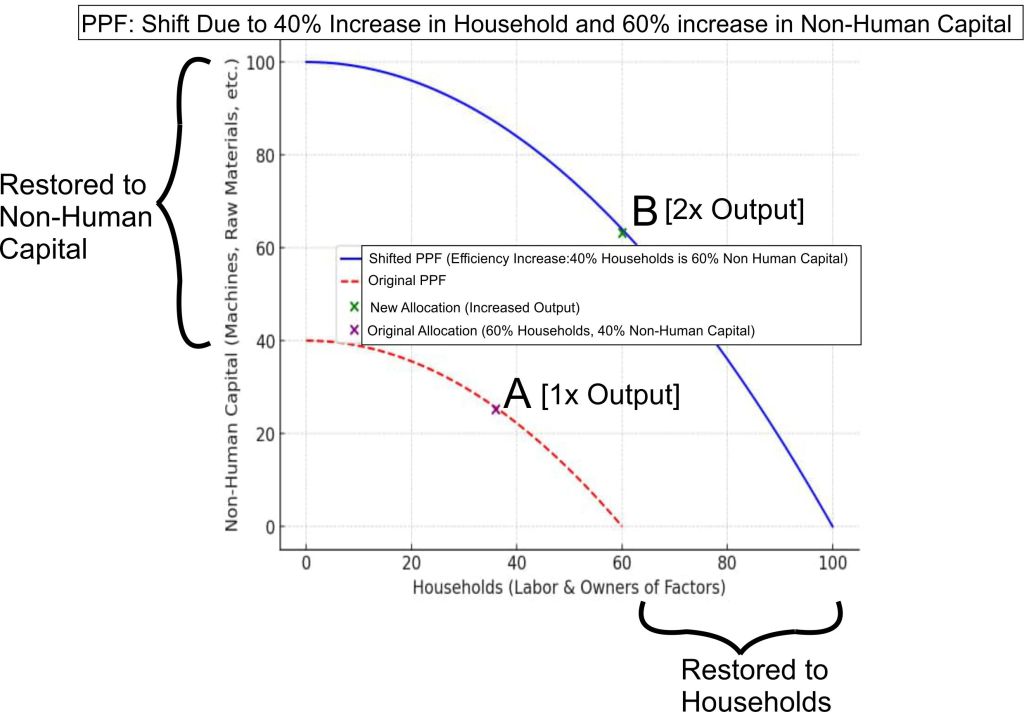
Every country has the potential to double GDP in one year at constant price. This is demonstrated by the spare capacity that allows the PPF curve to shift to the right. It is important to note that a Split Velocity model does not just increase access to factors of production, which leads to an increase in output it also simultaneously grows the markets where the output is sold by increasing effective demand. The consequence is that the economy begins to boom and this heightened activity becomes its modus operandi. This growth brings an end to poverty, scarcity, unemployment and very rapidly begins to scale up countries per capita income, accelerating living standards to the extent that within the shortest possible period, e.g. a single generation, they begin to equal and even inevitably surpass the living standards experienced by developed countries retarded by a dystopian and dysfunctional circular flow of income (CFI).
Split Velocity will allow developing economies to offer their citizens a better life, based on genuine science and economic strategy that will inevitably eclipse the industrialization and economic achievements of developed countries in every field and aspect of human endeavor due to losses equivalent to GDP being dissipated by the defective CFI being restored to businesses, private and public institutions and governments. This will allow Africa to move into an era of wealth, prosperity and higher living standards no other civilization on earth has been able to achieve.
The PPF diagram shows why a Split Velocity Model (SV) is the ultimate choice when it comes to managing an economy. The national currency in the SV model is backed by productivity and therefore output. It does not rely on any one commodity like gold, copper or oil to back the national currency. This is a versatile, transformative economy with the flexibility to adopt to any situation in order to maintain the value of the national currency. Financial stability and a consistent general price level is grafted into the very DNA (CFI or “operating system”) of the economy, no more unmanageable inflation or deflation. It is not bogged down by dependency in any one industry or natural resource, it will exploit any available growth strategy to defend the economy using just two versatile variables Households and Non-human capital. This is an economy that is fast to adapt, quick on its feet, undefeatable and indefatigable. Its greatest resource is intelligence and the ability to rapidly adapt its factors of production to any challenge a nation faces. Its currency is more powerful than the “hard” currencies presently held by the G7. Hard currencies are designed around the weak MV=PY, Fisher Equation, therefore they buckle under stress and easily decline into inflation. The SV model’s currency functions as two or more economies acting in one space in synchrony deploying the new Punabantu Equation of Exchange thereby gaining a resilience inflation/deflation prone hard currencies cannot possibly prevail against. SV model currencies are Sovereign, meaning they need no other country or government to gain authority over an economy and productivity. This means they give a country economic independence and that poverty and scarcity can no longer be regarded as an obstacle to prosperity. Note that you cannot beat this economic model, ceteris paribus, not even in times of conflict or war, it is the epitome of resilience. The output 2x when viewed macroeconomically yields GDP, when viewed micro-economically it yields Total Revenue (TR). There is seamless integration between the macro and microeconomy. When the economy is at 1x (the zero growth model) it naturally evolves the Technology Paradigm (TP) to deliver output at 2x, when the economy advances to 2x (the Split Velocity model) it naturally begins to evolve the Technology Paradigm to grow at 3x (a pace of doubling time, economic growth and advancement created by Split Velocity beyond anything human beings today can comprehend). From 3x it will gain the TP to accelerate growth to 4x and so on. This model is not threatened by AI, robots and humanoids or this type of advancement. Even if AI and robots were to completely (100%) take over human labor and jobs, Households (former labor and owners) will still come out on top flossing, as the benefactors of this economy, even if human beings did not have to lift a finger to work or labor they would continue to more than thrive attaining the highest conceivable standard of living. This is the ultimate economic design. The present day MV=PY financial system which is 1x in terms of doubling time and operates a zero growth system which in terms of economic growth is too slow, fails to generate the growth or financing required for economies and populations to affordably to exit into space en mass. This means populations in these countries may continue to grow in confined geographical regions. This is not the case with a Split Velocity Model which having advanced to a doubling time of 2x enables banks and other financial institutions to raise the tremendous capital and financial resources required for businesses and countries in general, even in the developing world, to invest in and move en mass into space, establishing new extraterrestrial industries in mining, manufacturing, hospitality, accomodation, travel, entertainment, and the many diverse industries countries have evolved over the years. A Split Velocity Model dismantles any notion that human beings are somehow perpetually confined to earth where land is a limited resource. This is a real concern of the current MV=PY financial system due to its limited 1x potential for growth. The reality is populations of governments that advance their economies to 2x will leave earth and found new extraterrestrial civilisations simply because they can afford it, while governments that don’t and remain in economies confined to the weaker MV=PY’s 1x or zero growth model, even if they are developed countries or “Superpowers”, will fail to generate the economic might required to advance in this manner in a meaningful way if they do not advance their economies to a Split Velocity Model. This is real as it gets.
Not only is the currency of a country that implements a Split Velocity model more advanced and more powerful than present day G7 “hard” currencies it is more resilient and more powerful than gold and other precious minerals. Many countries believe that by storing gold and using it to back their national currencies they can protect fiat money from deadly inflation that erodes value. However, if any precious mineral floods the market, like fiat money, what will happen? Yes, its value will begin to fall. Gold and diamonds are precious minerals, however, if the supply of these floods markets the value will rapidly decline, and can decline to a point where these precious minerals become worthless. Now if your central bank, your treasury, economy and national currency are backed by gold or diamonds and the value of these minerals is in free fall, what will happen to your national currency? What will happen to the value of currency in your treasury? That’s right, it will collapse like a deck of cards. Hence, when I point out that a Split Velocity model’s currency is more valuable than gold, diamonds and other precious materials you should have the presence of mind and intellectual capacity to comprehend what is being explained. A Split Velocity model can introduce the equivalent of GDP in domestic currency and instead of inflation the national economy will experience growth. This increase in money supply will take place at constant price. Even if a country converted its currency from fiat money to gold as a hedge against inflation and attempted to increase money supply in this gold currency, the value of gold would collapse and the currency would be rendered useless by inflation, despite being made from gold. Yet a fiat currency backed by a Split Velocity model that doubles money supply will do so at constant price, it will shift the PPF to right bulldozing everything standing in a country’s path to success out of the way. Gold, diamonds and other precious materials need a Split Velocity model to back and sustain their value. This makes the intellectual property (IP) and technology that is Split Velocity more valuable than gold and diamonds. A country whose government backs its national currency with gold, diamonds and other precious in minerals, in massive Fort Knox like vaults, even if this backing is 1 to 1 with the national currency cannot compete or challenge a government whose currency is backed by a Split Velocity model. It is the MVP in economic management of a national economy. There is no contest here. In a showdown between economies Split Velocity takes it all. This is just the facts. It is a rare example of where innovation and technology is more powerful than natural resources. As I have mentioned a Split Velocity model is the most advanced model, any government in the world that applies this model cannot be deterred from developing by poverty and scarce resources. A Split Velocity model is all business. It also cannot be confronted by any modern day MV=PY economy, not even if the country that confronts it is many times its size, a developed country or Superpower. Its very pertinent for leaders to understand this. For leaders tired of hide seek-like, kindergarten “play-time” types of approaches in economics that offer their populations juvenile and meaningless growth rates of 1%, 2%, 6% and so on, year in and year out for decades and centuries, year in year out dealing with same mundane problems, its time to flex with a Split Velocity model and move millions of your people out of poverty in one move, into a higher standard of living pundits assume is not possible and provide leadership with the kind of economic might only a Split Velocity model can deliver. Look at the movement of the PPF curve in the diagram above , from A to B, what the curve movement shows you is what you get. Its time to stop playing games, get moving and alter the lives of your people, transform their existence and that of the generations to come in a manner no other leader in history before you has been able to. This is real growth, meaningful development and it can be achieved.
MV=PY is one engine in one economy flowing in one direction. KV(MS/E)=PYR is 2 engines in one economy flowing in 2 directions (velocities) simultaneously that create the PPF move demonstrated above (A to B, 1x to 2x in one year), at constant price. This economic growth with its remarkable doubling time is science. You can test this using the equation.
Its important for leaders to understand the scientific origin of scarcity. It is also the scientific origin of poverty. This scarcity begins and is created within the circular flow of income (CFI). If the inefficiency in the CFI is not dealt with it does not matter how powerful or how wealthy a nation becomes or the level of its natural resource wealth, it will still face scarcity that is capable of dismantling all its gains.
Its important understand what it is that you are fighting or what you are up against in economics, accounts and finance. For the sake of example, the US debt is described as growing by $1 trillion every 100 days. This is a classic example of an Asynchronous Financial system. This debt is meant to be offset or paid off by income recovered from the defective CFI. If a move is not made to a Synchronous Financial system, by upgrading the economy to a Split Velocity model, the fact that the economy remains financially Asynchronous means this debt will inevitably return and become more aggressive. Zambia in 2005 experienced $2bn of debt forgiveness through the HIPC initiative, yet in 2024 owed 12 times this amount. This debt is meant to be settled through growth recovered from the CFI. If not, it has the potential to come back worse than it was before.
However, with a Synchronous Financial system, gained after implementing Split Velocity, the original economy is capable of shifting from A to B. Credit risk in a Split Velocity model is very low due to the enhanced capacity of private and public sector institutions to pay back their debts. This allows the banking sector to thrive and fund larger investments. Banks will find themselves able to finance huge investments on a scale they could not possibly finance before simply due to the fact their clients are better positioned to take on and repay loans of this scale.
The PPF Supports Accelerated Growth
When I asked ChatGPT to analyze the PPF of the Split Velocity Model, expecting a doubling of output due to equal increases in inputs to Households and Non-human capital in an economic environment with significant spare capacity, the response was quite surprising as at one point ChatGPT seemed to imply that doubling need not be an expected limit as it should not be ruled out that the model could more than double output in one year. This is quite true, similarly unexpected shocks to a (diminishing returns) economy can reduce doubling time, however, unanticipated windfalls (accumulating returns) can also more than double GDP in one year. The technology paradigm inevitably determines what the increase in output will be.
The diagram above shows the financing of Households grows by 40% and the financing of Non-human capital grows by 60% by recovering the losses being hidden from the economy by the dystopian CFI created by a messy Western Knowledge Paradigm (WKP). Combined this recovery of income leads to a 100% increase that shifts the PPF curve from A to B. This is how a normal economy should function. Its important to note that the PPF diagram shown above can cover both the macroeconomy (GDP) and the microeconomy (individual businesses or institutions) Total Revenue (TR) since Households and Non-human capital are common factors, all that differs between the two is scale. A Split Velocity model once applied by progressive governments will demonstrate that the industrialization developed countries have achieved over the last 250 years is mere child’s play and remains sub par (Developed countries will also have to upgrade their economies to a Split Velocity model to escape annual losses to the CFI equivalent to GDP). The gains seen in the industrialized world have come with a senseless backdrop of losses equivalent to GDP per annum. Therefore, the capacity for industrialization without the constraint of this hidden loss will transform the economic landscape for developing countries moving them from the back to the very fore of leadership in advanced economic development.
In the PPF diagram above not only are Households being paid for labour and ownership, they are also consumers. Similarly not only is income being spent on Non-human capital inputs, the cash being paid out is going into the hands of future buyers in Non-human capital markets. Therefore, not only does the potential for output in a Split Velocity model double in one year, so too does the market for the goods being produced, in terms of Household consumer products and Non-human capital consumables such as industrial equipment and raw materials. The ability to grow markets in tandem with growth in output is a unique quality of the Split Velocity model. This means that manufacturers will never have to fear that the goods they produce will not be met with effective demand when they are placed on the shelf for consumers to buy. This is more advantageous as it allows producers and manufacturers to compete more on consumer choice rather than whether the market can afford their products. This in turn leads to greater excellence in industry as businesses focus on quality of goods and the quality of customer service as the main method for securing market share and value.
Furthermore, the one major exploitation and fear that developed economies have had over the years is not having a hard currency. However, when a Split Velocity model backs any developing country’s currency, that currency becomes more powerful than any of the hard currencies held by the G7 or any government in the world today. No hard currency has the capacity to increase money supply without generating high levels of inflation (MV=PY, as expressed by the Fisher Equation). Whereas, the currency of a developing country managed using Split Velocity can even double money supply without triggering inflation (See the new Punabantu Equation of Exchange). This makes Split Velocity currencies more powerful and more technologically advanced than hard currencies in use today.
Even though Split Velocity can reduce doubling time to one year, governments can choose what percentage of this resource to apply to the economy e.g. 20%, 40% or 60% per annum.
A practical way of understanding how inefficiencies in the circular flow of income (CFI) of a neoclassical economy or contemporary economy (CE) affect productivity.
The systemic financial losses to the economy caused by operational inefficiencies in money supply are easily rationalized when how they affect output is analysed. The graph below shows a business’ performance over one month. Every business owner or manager knows that from day one of a new month when the business begins to record sales every dollar or kwacha earned must have a significant proportion set aside for “pay day”.
The business in the graph below pays its staff between the 26th and 30th of every month. But it must begin to prepare for this expense from day one. The business knows that it must set aside income from its earnings to pay workers and to provide income for the business owner and other shareholders. Therefore, for a full business cycle lasting a month a business experiences very significant losses in productivity.
Business owners and staff combined form human capital or “households”. Firms or businesses having to divert earnings from investment in productivity and output (non-human capital) “subtracts” or diverts income from productivity, a process referred to as economic “Implosion” in the GPWN. Consumption is the opposite of production and yet in the monthly business cycle, for close to “30 days”, on any one of those days (at any point in time) it retains or locks away financial resources from non-human capital that could have been contributing to growth in GDP by financing production. This retards industrialization by starving it of useful resources.
The Graph below shows the loss in output caused by an inefficient CFI
The graph below shows that businesses in the economy diverting earnings from non-human capital to ensure they have enough to cover the monthly pay-roll, the business owner and shareholders, under-perform. Over a twelve month period their capacity for productivity can be halved by this practice leading to a stunted annual GDP.
These simple graphs are a practical example and illustrate how subtraction in the circular flow of income (CFI) diminishes an economy’s capacity to grow, create jobs, end poverty and yield greater financial resources to government for its budget.
A Split Velocity system enables a central bank to correct this problem thereby accelerating growth and productivity in the national economy. Split Velocity (SVTech) solves this problem by advancing the cost equation from Profit = Total Revenue (TR) – Total Cost (TC) to the SVTech cost equation Profit = Total Revenue (TR) = Total Cost (TC).
Why can businesses not sell normal goods at cost price and prosper? They can and should be. In fact businesses can sell normal goods at cost price and make as much as a 100% profit. They can even mark up products in a Split Velocity model and not worry about inflation because the model works constantly to counter it. They can do so in an economy that has little to no inflation or deflation and have the opportunity to grow with much greater certainty.
Once they can do so inflation caused by the pressure to increase prices tails off and moves into a “price plane”. A price plane is the tendency of the general price level to remain the same or constant for long durations of time bringing problems such as creeping inflation to an end. Ceteris paribus, a loaf of bread or mealie meal in 2025 will have the same price in 2505.
So why do they mark up?
There are two reasons why businesses mark up goods and services they sell. The first reason is obviously they are profit seeking. However, we have shown that in a Split Velocity model businesses can sell their products at cost price (hence with no profit) and still make a 100% gain as well as operate in an economy free of inflation. This is how a normal economy should function. If this is true then why do businesses mark up their products? The systemic reason why businesses mark-up goods and services is because of the defective CFI. As explained, the defective CFI is losing or wasting 100% of GDP per annum. This is an insane amount of useful finance. This hidden loss is part of the Western Knowledge Paradigm (WKP) which has mistakes nearly every country in the world applies and downloads into how its economy operates and is managed. The WKP is treated by African and other nations as the stuff of legendary genius studded with accolades and prizes to boot. However, it is riddled with flaws, misconceptions, bad decisions and outright mistakes, like the hidden annual losses caused by the CFI. These flaws, mistakes and misconceptions are also found in the WKP’s sciences. Nations need to be wary of the WKP and its flaws.
Its a 100% inefficient economy: The evil and diabolical system called the defective CFI is what keeps humanity bound to poverty and scarcity, if you don’t know, can’t recognize what it is doing or understand your enemy, you cannot defeat it.
Central banks trained by the WKP are unaware of inefficiencies in the CFI, referred to as implosion or subtraction in the book Greater Poverty and Wealth of Nations (2010), they do not act to counter it. For example, in Zambia there is ZMK700 billion in liquidity missing from the economy (US$28bn), .i.e. equivalent to GDP in 2024 that represents useful financial resources that could have been introduced by the central bank at constant price if a Split Velocity model were introduced (this is enough finance to pay off all of Zambia’s debt in one go, without batting an eyelid). These useful resources are arbitrarily lost to the CFI every year. Central banks are generally not aware that this liquidity needs to be restored by minting or creating new money and channeling it through a Split Velocity model as an economic stimulus at constant price. Therefore, they do nothing to correct money supply. Like everyone else the WKP makes them assume the CFI over time is perfect, when in fact at any point in time it is losing the equivalent of GDP to nothing more than the inefficient design of the CFI. This is an insane, dumbfounding amount of money and resources especially when many countries face great want, poverty and underdevelopment. [Accounting & Audit firms where are you? Its time you woke up. Your clients need you.]
Businesses find they have to step in and start “printing” or creating their own money
As a consequence of this finance (equivalent to annual GDP) missing from the economy (due to the CFI being faulty) businesses are forced to step in and play the role of clueless central banks, which is to create money in the economy. How are business “printing” or creating money out of thin air? This is how: If a good costs $100 and a business sells it for $120, internally or from the micro-view it appears to simply be marking up its goods and services, the truth is that from the systemic or macro-view it is attempting to do the work of a central bank. Central banks led by the WKP are dumbfounded and have no idea that this is their role. The consequence of this is that businesses must take matters into their own hands and begin to “print”, create or mint their own new money. Hence, the mark up is introduced. In an economy worth only $100, and therefore with only $100 in circulation, the business in our example prices its product with a $20 mark up. There is only $100 in circulation. The business is charging $120 for its product. The mark-up of $20 is the business creating new money that does not exist in the economy. Why?, because the central bank under a WKP has no idea this is its job to do.
We call this attempt to create or “print” money cost-plus-pricing, marking up or the more popular term is “profit”. However, creating money is a role that is meant to be exclusively under the jurisdiction of a central bank. The Fisher Equation MV=PY cannot play this role, its not designed to do this as it creates a financial system that cannot contain inflation, which is why the new Punabantu Equation of Exchange KV(MS/E)=PYR is introduced to create a more robust system that can handle the increase in money supply at constant price, referred to as a Split Velocity model. Businesses, unbeknownst to themselves, are trying to recover money the economy is losing to the CFI equivalent to GDP per annum using mark ups, a role that belongs to central banks.
If businesses tried to sell a product at $100, the defective CFI would claim this value using subtraction in the CFI, and instead of seeing this loss is being caused by a 100% drop in efficiency caused by the faulty CFI businesses, instead of rejecting this loss, out of error, embrace it and refer to this loss to the business as the “cost of production” or “the cost of doing business”. This is a huge mistake on the part of enterprise and where the term “sleight of the hand” applies as we saw earlier with the shuffling of cups and palming of the ball. The palming of the ball is used to illustrate a 100% loss of revenue by businesses to the CFI for absolutely no reason other than that it is of defective design. Businesses at present are completely unaware of this huge loss from their balance sheet equivalent to 100% of revenue occurring at any point in time. They are clueless and continue operating with the ignorance of this loss or deduction of finance from their operations, of which the only indication is usually how difficult it is to finance operations that keep their going concern afloat and how difficult it is to move their businesses toward growth. Under the strain of losses equivalent to annual total revenue, running a businesses becomes like trying to run and move through molasses, many businesses wind up, shut down and the founders or team of entrepreneurs give up, without ever knowing what they were really up against. Similarly, in the same way that businesses struggle, as a result of the WKP central banks are unaware that they have a primary role of resolving inefficiencies in the CFI to recover and restore this finance to the operations of businesses. The lack of efficiency in the CFI pushes back the production possibility frontier significantly in real time. It is a genuine loss in finance that triggers a loss in productivity that severely retards economic growth. This vacuum of income that should be in the hands of productivity is why countries experience remarkably slow single digit rates of economic growth each year. This process triggers world-wide scarcity, poverty and stifles genuine prosperity.
Therefore, businesses and entrepreneurs are being fooled by the economy or CFI in two critical ways. First is the belief that they need to add a markup to realise a gain when they trade. This gain, when aggregated is miniscule and becomes the mediocre 1%-7% gain in GDP we observe in many economies. The example we used is the 20% mark-up of $20*. This mark up, in real terms, is an attempt to create money due to central banks misled by the present day WKP failing to play their role because they are led to believe the economy is functioning normally over time .e.g. a period of 1 year.
The second manner in which businesses and entrepreneurs are being fooled by the CFI is that when they allocate income earned to factors of production, which we represented with $100**, they are unaware that this is in fact an allocation to subtraction or implosion in the CFI, which the central bank not businesses is supposed mitigate using a Split Velocity model. This overlap makes it nearly impossible to see the loss taking place in front of their eyes, in broad daylight – hence it is referred to as the “sleight of hand trick” played by the CFI and the shuffling of cups where the ball is palmed is used as a method for illustrating how businesses and entrepreneurs lose total revenue (TR) annually to the CFI right before their eyes and are clueless about this real loss because their own “eye to hand” co-ordination and observation tells them they are paying for the cost of production (they see the ball go under a specific cup), when in fact, in real terms, they are allocating this finance to the faulty CFI where it is simply wasted (the ball is palmed). When entrepreneurs try to operate their business with this finance (the cup is lifted and there is nothing but air underneath it) they accept the loss because they think the payment went to the cost of production, unable to determine they have been “scammed” by the CFI they operate their going concerns wondering why running a business is so hard.
The faulty CFI and its hidden loss equivalent to 100% of GDP per annum would imply that the present civilization that applies it has to be the “dumbest civilization in the universe”, or if it is seen as a deliberate tool for economic oppression then it can be described as “the smartest, most diabolical method for human economic subjugation ever conceived” so evil and pervasive that it can function right before human eyes and intellect, in broad daylight and yet defy detection.
A result of the WKP is that every business and institution in the world, in operation today, loses the equivalent of its total revenue (TR) annually to the CFI, for no reason whatsoever, other than its 100% inefficient and ineffective design.
African nations and leaders must familiarize themselves with the WKP’s substandard economic and financial system proliferated by the CFI, because it is they and their people who, facing the worst circumstances, bare the brunt of its negative outcomes and vulnerabilities.
* It is easily shown that in a Split Velocity model a business can sell a product at cost price and still make a 100% gain that is equivalent to profit [even though technically it is not referred to as profit]
** Businesses and entrepreneurs remain completely clueless about this loss because the CFI masterfully, in the most sinister and evil way acts to hide this loss by using costs of production to shadow subtraction (palms the ball) which robs businesses annually of the equivalent of their total revenue every year.
When a business spends $100 to produce a product, then technically there is only $100 in the economy to buy it. When this business marks up its product to $20, it is trying to create new money by asking for money that does not exist in the economy to buy its wares. The next time you see products lined up on shelves, remember that what you are seeing from the macro-view is businesses trying to create or print money that does not exist in the economy because of a weak WKP. If a central bank does not act, the absence of the $20 will cause deflation (which can be just as disruptive as inflation). The other option is for the central bank to increase money supply over time by $20 to solve this problem. However, in doing so it facilitates the continuity of trade but then inadvertently supports a process that has come to be identified as creeping inflation. This is due to the fact that in a normal economy run on the Fisher Equation (MV=PY) any increase in money supply without a corresponding increase in goods will cause inflation.
Creeping inflation then becomes ongoing as it is grafted into the very manner in which a WKP economy operates since the business is selling a product for $20 more than the system has been designed to accommodate, with no increase in production. Hence, generally over time goods and services become more and more expensive and the domestic currency loses value in a manner that is fundamentally outside the control of a central bank. A loaf of bread or bag of mealie meal in 1975 will not cost the same in 2025. People find they have to work harder to afford the same basket of goods. They have to take on more jobs to maintain the same life-style and they eventually begin to suffocate under living conditions where affordability persistently escapes their attempts to hold onto it.
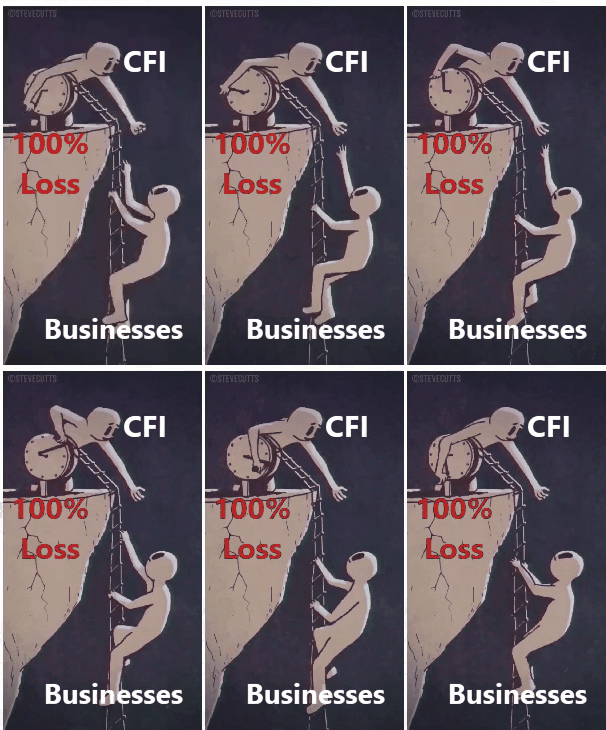
However, if businesses do not mark up products they cannot survive due to the fact the hemorrhage of resources being wasted pointlessly by the CFI is pushing them down toward or keeping them below break even until they are forced to eventually shut down. Businesses are therefore today, unbeknownst to themselves, literally in a life and death struggle against the economy they operate in. They are groomed to believe the economy they operate in is helping them, when in fact it is trying to kill or shut them down – every hour, every single day. This is due to the inordinate yet unaccounted for losses taking place in the defective CFI of which even businesses themselves are completely unaware. These losses apply to businesses of any size, be they the corner grocery store, ntemba or multi-billion dollar conglomerate. They remain dumb about it due to the “sleight of the hand trick” played by the CFI which forces all business to lose 100% of their total revenue (TR) per annum as a hidden loss to their operations, when you add up this loss to all businesses or productivity in an economy it becomes equivalent to GDP. There cannot be a more sinister or more evil system than this as it robs humanity of sorely needed income and resources like a pierced jugular bleeding profusely that is draining the life out of humanity, hindering productivity, destroying businesses and entrepreneurs.
This is a sophisticated loss that requires exceptionally astute minds to identify. However, as mentioned earlier due to the limitations of the widely accepted and applied WKP central banks are presently unaware of losses taking place at any point in time in the CFI that are equivalent to GDP and assume the economy is perfect (study the Empirical Test for Split Velocity to understand this). Hence they assume the life and death struggle of business is “normal”, and like a public hanging of businesses by the faulty CFI, sometimes the public comes to watch the spectacle in the town square or on social media as a form of entertainment or news. Central banks are not to blame for this problem, the blame falls squarely on the WKP being applied today.
In this sense the central bank is like the life guard, who is supposed to be supplying the economy with money (in a Split Velocity model) at constant price equivalent to the deficit caused by the CFI so businesses can operate normally. However, because of a substandard WKP it is unaware that the CFI is defective and that losses equivalent to GDP are taking place and nothing is done to intervene. Therefore, the WKP, as it stands at the shore views and describes the desperate businesses with hands waving for help and in need of rescue as excitement, attention seeking and revelry; businesses are making hand gestures in rough waters for fun and attention, and when businesses drown its assumed they have just gone down into the water scuba diving. This ongoing ignorance brought about by the WKP, that has been ongoing for 250 years since Adam Smith, is the brutal tragedy and reality of economics, accounting and finance that is the origin of strife in the 21st Century. Over the last 250 years it estimated that $3,120 trillion in global GDP has been lost to the defective CFI. Global GDP flounders at around $110 trillion today with a global per capita income of $13,900, when in reality it should be at around $3,230 trillion with a per capita income of $398,765 per person. The progress humanity has lost over the past 250 years is truly mind boggling.
Every economy in the world has the latent internal resources with which to finance the doubling of GDP in one year at constant price. In order to exploit this we must move ahead of the current WKP, realize that it is fallible and avoid its pitfalls. What difference would being able to recover 100% of GDP from the faulty CFI make to your country applied over the next 50 years? How much more could you do and achieve if being able to recover 100% of total revenue every year from the faulty CFI were restored to your business or institution?
This is what we designed Split Velocity to achieve.




 Split Velocity Solutions Ltd