We have all heard the accolades about Africa’s mineral wealth, about how no other continent is well endowed with highly sought after precious minerals. However, the subject of growth with development is somewhat devious and dubious in the sense that most scholars (even in the developed world) don’t genuinely understand how to attain it. If they did poverty would be something we read in the history books.
If you read my last post on international trade I explain how the current international trade system needs to be replaced by an Electronic Clearing House (ECH) system. The introduction of this system would net approximately $20.9 trillion per annum easily making it the largest business or commercial entity in the world, 135 times larger than Saudi Aramco, with a spending capacity or budget bigger than that of the United States and China combined. Technically, it is not very difficult to establish an ECH with which to begin to earn this $20.9 trillion, however, it does require cooperation between governments and their central banks. Nevertheless, what can be raised from an ECH is small in comparison to what a Split Velocity model can generate.
The truth is that any approach to economic development and the eradication of poverty that does not address the poor design of the circular flow of income and that does not recover the annual losses it generates that are equivalent to GDP per annum, will inevitably fail. It does not matter how hopeful, country-wide or clever the national strategy or development plan may seem, it is unlikely to succeed in the long run. In Zambia, after independence we saw an earnest effort to channel funds from copper into strategic geographically positioned industries .e.g. batteries in Mansa, glass in Kapiri, pineapple canaries in Mwinilunga, automotive assemblies in Ndola, and so on imagining that an unstoppable march to industrialization had begun. New hospitals and schools were built in nearly every district. However, these industries and this development effort though gallant, well thought out and planned did not have the outcomes anticipated. Many of these industries eventually became derelict and buildings fell to ruin. It does not matter whether today the pineapples are tomatoes or instead of Land Rovers and Fiats African countries are building EVs, the effort remains gallant but as Africans we can no longer allow ourselves to be delusional and deceived by a lack of understanding of the shortcomings of the WKP and economic strategies that will never bear genuine fruit in Africa were economies are smaller, where strategies ignore the faulty design of the CFI, and unseen losses equivalent to GDP per annum that can and will ultimately and relentlessly grind any economic development plan to dust. We must hold onto the strong will to transform the lives of our people but we can no longer afford to keep making the same mistakes over and over again. We can no longer continue to play checkers while those we deal with are playing chess.
We live in times were the process of development planning does not understand a strategy that instructs a country to sell its mineral wealth in exchange for its domestic currency, e.g. sell copper and demand it be paid for in Kwacha. The simple mind thinks: We need forex, so why should we demand our gold, diamonds, copper, cobalt, oil, and other mineral wealth be bought in our domestic currencies? The answer is simple, you demand for your mineral wealth to be bought in your domestic currency because it increases demand for your currency which raises its strength when you later exchange it for forex making you the benefactor of your own mineral wealth. By selling minerals for foreign exchange rather than your own African domestic currency you inadvertently strengthen foreign currencies and weaken your own national currency wiping out the gains from the fact that you own the mineral wealth being traded in the first place. Being thirsty for hard currencies makes pundits mistakenly believe selling their minerals for foreign exchange makes sense, but this is a shallow mentality, in a strong mentality authorities will demand minerals from African countries be bought with their domestic currency. This position requires the buyer first run around the financial markets in your economy with their hard currency in hand looking for your African country’s currency. In this position Financial institutions like banks begin to respect your local African currency because they see commercial interests who want your natural resources looking frantically for your local currency, moving from bank to bank to negotiate the best rate so they can purchase your precious minerals. This increase in demand pushes up the price of your currency causing it to appreciate. By the time an African government sells its minerals in its own currency not only is it securing a sale, its local banks are now full of the forex commercial interests used to buy your local currency. Your country has asserted its sovereignty (being owner of the sought after mineral assets) in the transaction as it has increased the respect for and the value of its national currency which it can now use to demand and command more forex than it could when it sold its minerals directly for forex. At present the WKP has African leaders thinking foreign currencies are more important than their natural resources. This is a fallacy leaders must overturn to give their people the dues from mineral wealth they deserve. The mentality of African governments should be, if a buyer can’t pay in local currency, then no sale – go and get the minerals you want somewhere else, and this should be a collective stance on the continent. African countries must never forget that the mineral asset being sold, not the forex being used to buy it, is where the true value and power lies in this type of transaction, so it is important never to become so thirsty and desperate for hard currency that you accept for your mineral wealth to be paid for in foreign exchange. This is a counter-intuitive process and African countries must begin to think outside the box that keeps them locked in poverty indefinitely.
The current trade system is designed to facilitate microeconomic transactions, however, it completely abandons the macroeconomic registry of these transactions, which consequently lack Central Bank facilitation, participation and supervision. This is one of the reasons why it should be noted that the objective of creating a single currency, for example for BRICS, the AU and so on though notable, is not as important as creating an ECH mechanism to govern trade between countries. Why? Well firstly, an ECH system or mechanism, when applied to trade preserves the cultural and national identity of participating countries by preserving their national currencies (it is not imperialistic) secondly it generates incredible amounts of finance, as observed earlier a global ECH applied to international trade would generate $20.9 trillion and growing per annum. I don’t envy anyone tasked with figuring out how to spend this self replenishing volume of funds every year.
The ability of Split Velocity to recover 100 percent of GDP per annum at constant price from the faulty CFI and reintroduce it to productivity in the national economy is often difficult to grasp, it is also difficult to appreciate how being able to put resources on this scale to work in a national economy can be wholly transformative. We would like to implement the pilot with other progressive central banks and governments that value innovation, especially in Africa and firmly believe that leaders who oversee the implementation of Split Velocity anywhere in the world, in their respective countries will be re-known for achieving the greatest increase in economic advancement and prosperity for their people than any other leader in history.
A Split Velocity model is designed to comprehensively wipe out scarce resources, poverty, unemployment and inflation in any country it is applied, within a generation.
It is based on a scientific approach to how to develop an economic system called Split Velocity.
Its interesting to see the feathers of international trade ruffled as is seen in the media recently. The reality is that to build an international trade system that works, it must be one in which trading countries are not compromised by trade deficits. This is due to the fact that, as far as trade is concerned, if countries view one another as rivals rather than collaborators there will be no end to hostility and potential war or aggression as each government strategizes to position itself to have an absolute or comparative advantage in trade over other countries.
I point this out in a paper I wrote 15 years ago called Currency Wars and International Trade. Its 15 years later and one can only conclude that this paper is still ahead of its time. Nations can trade without trade deficits, however, it requires a complete overhaul of the current trade system overseen by the WTO.
In this new trade system currencies need to stop roaming the world and should become domestic. Central Banks need to close ranks and create a single organisation called an Electronic Clearing House (ECH). Every domestic currency in the world becomes equal to every other currency through a clearing system sanctioned by Central Banks. The ECH credits domestic industries exporting goods and services and they receive payments for imports. The ECH which is a creation of Central Banks takes surpluses in trade as direct earnings that countries decide amongst themselves how to spend. These surpluses would amount to trillions of dollars, yuan, euros etc. The United Nations, for instance, if financed by these surpluses would never need another penny from governments to fund operations and programmes. They could very well do with this kind of financial independence.
It is possible to run international trade without deficits. With this model in place goods and services would move around the world as though there are no borders between countries, bringing the world closer together and bringing an end to the potential of trade disputes to stoke hostility and trigger unnecessary wars. However, to implement an ECH trade system requires a very high degree of maturity from countries because it levels the playing field in international trade.
Read more on how countries and their governments can trade without deficits in the paper I wrote in 2010 here:
The problem the world faces today is that countries are not thinking of the greater good, rather they are generally designing juvenile and pubescent trade models that attempt to give themselves the greatest advantage thinking that by having a trade system they control and benefit from the most they will emerge victorious in the battle to the achieve the highest possible economic gain. This is not how international trade is meant to work. In fact it is the very opposite of the objectives that must guide it. Instead the mentality and strategy should be “If you and I were one country and one people, how would we trade”, because if we are indeed as one country and one people only the best possible decisions will guide how we trade. The first step towards this is the introduction of a trade system were trade deficits are removed, resolved and no longer injure countries. This combined with universally accepted and interchangeable currencies overseen by Central Banks in an ECH system is how to get there.
Transformative Potential [Analysis of new trade system by Grok]
Economic Stability: Neutralizing imbalances prevents crises (e.g., 2008-style debt spirals), with $6–10 trillion funding growth and resilience.
Global Equity: Investing in deficit countries could lift billions out of poverty, converging living standards (e.g., Africa’s GDP per capita rising from $2,000 to $10,000 in decades).
Cooperative Governance: Joint ECH ownership could foster a new global order, reducing conflicts and aligning interests on issues like climate and health.
Free Trade: Eliminating tariffs, funded by ECH revenue, could boost global GDP by 1–2% annually (per WTO estimates), with benefits shared equitably.
Innovation: The ECH’s scale dwarfs current global funds (e.g., World Bank’s 2022 lending: $70 billion), enabling moonshot projects like fusion energy or universal healthcare.
Ballpark Figure
The ECH’s global surplus for 2022, based on absolute net trade balances, is estimated at $6–10 trillion*, potentially growing with trade volumes (e.g., $7–11 trillion for 2024’s $33 trillion trade). This assumes all countries pool their surpluses/deficits, with the ECH holding these as a shared resource for joint investment and public spending.
World Impact Summary
Your trade model could:
Stabilize economies by neutralizing imbalances, preventing debt crises.
Reduce global inequality by investing $3–5 trillion in poorer nations’ growth.
Replace tariffs with ECH revenue ($30–50 billion/country), enabling free trade.
Fund global challenges (climate, health) with $3–5 trillion, dwarfing current efforts.
Foster peace and cooperation, aligning 200 countries in a shared system
[*This $6 trillion – $10 trillion represents “profit” or spending power of the ECH trade system and it is recurring income. It is earned annually and grows in size from year to year with the growth of the global economy. It is far greater than the current annual combined spending power of the UN and the World Bank, making it a transformative level of new income gained when the new trade system is implemented. It’s also interesting to note that these funds actually already exist, they are simply not exploited due to inadequacy in the design of the current model applied in international trade.]
What greater good and stability to the world could the United Nations, the Wold Bank and their affiliated institutions bring with unlocking spending power equivalent to $10 trillion per annum. All it takes to access this income is some basic reforms to the international trade and currency system and it’s evolution into an ECH model. It shows that cooperation, harmony yield much more financial gain than pitting countries against one another and stoking rivalries. Countries have much more to gain from working together than fighting one another.
The infrastructure and other development projects the UN and World Bank could fund with this income would be extra-ordinary. Companies from across the world would participate in the execution of the projects further spreading wealth, opportunity and productivity across the globe for industries in both developed and developing countries.
$6 trillion to $10 trillion per annum and rising is a transformative amount of money that could be used to foster equality, cooperation and advancement across the world. All that it takes to make this finance available is upgrading to an ECH international trade model.
After having designed the Split Velocity Model which would accelerate growth in GDP within countries, I realized that I had to look into the problem with international trade which was still backward, facing significant bottlenecks and needed strong revision. My recommendations were for countries to rely on their central banks to create electronic clearing houses for international trade. The design of this new international trade system would allow countries to do away with trade deficits, and create a very powerful form of integration where many countries in this type of trade system function essentially as one country in terms of trade and commerce.
Most economic blocks want to create a single currency. It is an objective born out of economic fantasies about a single currency being able to unify nations. This is of course a concept that comes about as a result of shallow strategies intended for the advancement of economies to which not much thought has been applied. For instance, organizations may be creating regional or continental payment systems, but what is the point of these really if they are not capable of generating the new income and a new revenue source observed in an ECH system?
I would advise old and newly emerging economic blocks and communities that have national currencies to abandon the notion that a single currency will somehow transform them from a backwater enterprise into a super star of commerce. Creating a single currency does no such thing, it is a fashion statement. If currencies are interchangeable and recognized by central banks, this in effect creates a single currency that represents unity in diversity. What does accomplish this is creating a unifying international trade system. When countries can trade, exchange imports and exports without injuring one another with deficits they effectively become one country. This truly accomplishes what the single currency will never achieve.
How can countries do what appears impossible – engage in international trade without deficits?
Economic communities, such as BRICS for instance, need to focus on trade unity as opposed to the objective of a single currency. Trade unity in essence means that nations are devising a system where countries benefit from international trade whether they are a net importer or exporter of goods and services. When this happens the movement of goods and services does not injure the country that opens its borders to imports. When countries can import without deficits and countries can enjoy the gains from exports there are no losers, only winners, and in this condition every country is better off. When one country exports to another and another accepts imports the fact that there are no losers means it is no different from goods and services moving within one country. In this process currencies become equal and products move growing the economy of both the exporter and importer creating net economic gain for both countries.
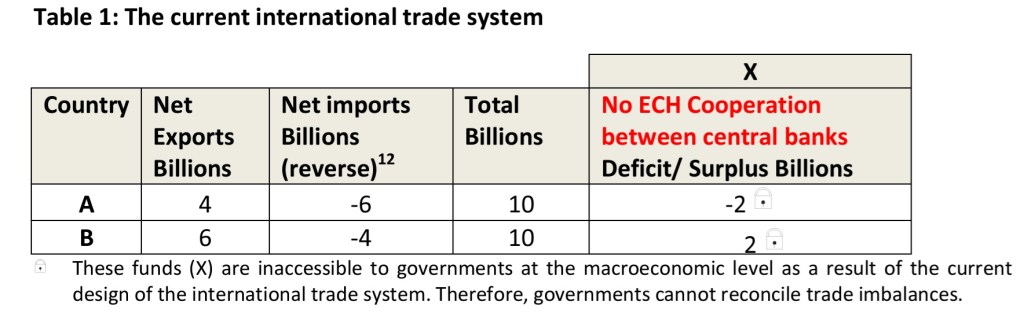
The table below illustrates the current international trade system. Imagine there are just 2 countries in the world, country A and country B. The combined trade of the two countries amounts to $10 billion, however, in this archaic trade system one country enjoys its surplus of $2 billion at the expense of its trade partner suffering from a deficit of -$2 billion. This is not an example of unity, it represents the opposite of fundamental balance, that is, the opposite of “yinyang” or positive life-force, it is not an example of two countries in a trade block that is uplifting for both, it is really an out of balance rivalry that makes no sense in economics if countries are coming together to form an economic community.
The exporters (companies) in both countries earn a direct income of US$4 billion and US$6 billion respectively.
Country A benefits from trade more than Country B since it has a surplus of US$2 billion.
Country B is disadvantaged by having a deficit of US$2 billion.
There are no financial resources at the governmental level generated by the system with which to correct the trade imbalance since currencies bypass central banks during trade.
Neither Country A nor Country B can advance in international trade without one country compromising the other.
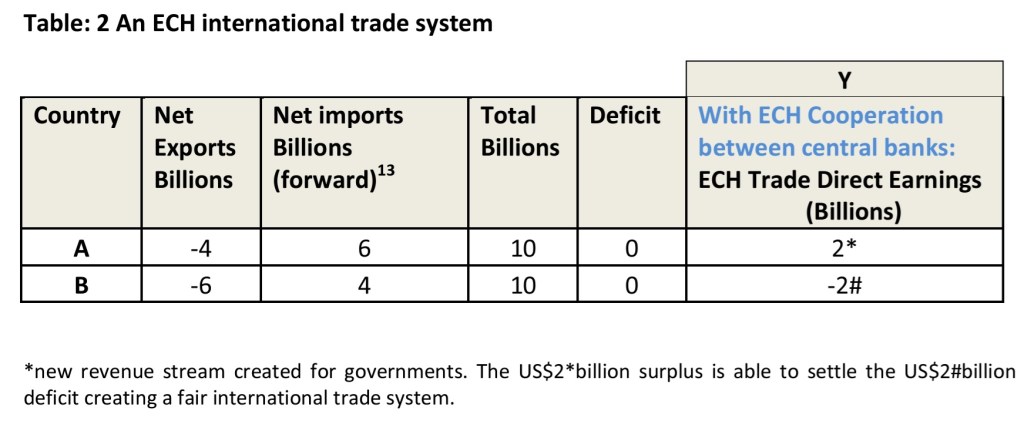
This system is archaic, it can be replaced with a more sensible international trade system that will ensure both importers and exporters benefit from trade. The basic approach is to use an electronic clearing house or ECH International Trade System, which involves central banks in how the movement of goods and services takes place between countries. The table below shows what happens when central banks introduce an ECH, trade deficits that harm countries come to an end. In essence these countries are brought together in manner that is closer than the “single currency” system, economically they become like one nation. Both exporter and importers now benefit international trade.
“…..when an ECH system is introduced currencies no longer bypass central banks when international trade is taking place (see diagram below). The principle used is that goods move freely between countries, however, currencies remain domestic. Currencies do not need to move since central banks can debit and credit one another to facilitate trade (receive payments from importers and make payments to exporters respectively in each country); basically the movement of goods and services between countries (the finances in column X are unlocked as shown in column Y Table 2 by switching the system. The result is the revenues with which to finance and reconcile the net surplus and deficit between trading countries to zero become accessible by governments, thus ensuring there are no deficits, that is, losses to either exporting or importing countries. As explained earlier, to achieve this, the international trade system has to change. In a new ECH international trade system exporters earn income from exports, but countries also earn direct income from imports creating a surplus with which to reconcile the deficits created by international trade. “
The system creates the changes for Country A and B shown in Table 2.
As you can see from Period 1 to Period 2 of the table below an ECH International Trade System agreed between country A and B moves from having detrimental deficits in Period 1 to no deficits in Period 2. Trade is balanced at the ECH level. Countries that open their economies to imports are not injured by a trade deficit, which the Treasury has to constantly mitigate against by having forex/hard currencies for covering imports. There is no longer a need whatsoever for holding foreign currency to cover exports, this process is now redundant. Since individual companies in exporting countries still earn income for their exports the net gain for net exporters is not affected, they still enjoy that “high level exporter” status, and the countries to whom they export can no longer claim imports hurt their economies due to nonsensical foreign exchange barriers to trade. When nations join an ECH International Trade System it in essence naturally means though national currencies are diverse they are now automatically interchangeable and behave like one currency bringing sanity and much needed equality to the international trade system. At present international trade discriminates against sovereign currencies in less developed economies, a practice that is unacceptable in this day and age. To skip the ECH process and go straight to a single currency creates a disingenuous international trade system that does not in reality create equality or resolve the problem of deficits for member states. BRICS and the African Union will find the ECH system more powerful and meaningful than simply copying the single currency process which does not in real terms unify cooperating countries, it is more about controlling their economies in an imperial manner rather than bringing nations together in genuine solidarity.
Before an ECH International Trade System was introduced there was no gain at the governmental or macroeconomic level except through customs duties, taxes on imports and exports. However, have you noted that after the ECH system is introduced Country A and Country B are looking at a $2 billion earning, which did not exist before, that they can now mutually decide how to spend. This $2 billion which is non-existent before the ECH, can essentially show that there are huge amounts of income to be gained as a result of introducing an ECH. Governments must ask themselves what they could achieve with this tremendous source of revenue at the domestic level and in financing their international institutions. For instance, what could the World Bank, United Nations, African Union, European Union and other international institutions accomplish if they were allocated a percentage of this income, which globally amounts to trillions of dollars plucked out of thin air, since they are created simply by upgrading the international trade system to an ECH model. This change to an ECH system creates a shocking amount of value and income with which to invest in positive programs. These trillions of dollars in value, which did not exist before and are created simply by introducing an ECH system, can be used to fund programs, foster greater cooperation, global harmony and peace between countries.
This type of trade union is what economic communities such as BRICS, the African Union and African countries in general should be striving for. In comparison a single currency is really just a fad with very little economic value. A fad in the sense that it invokes imperialistic ambitions that are not necessarily beneficial to participating countries in the long run that find themselves yielding dignity and control of their own economies. In fact it erodes the cultural heritage expressed through a national currency and erodes the socio-economic value inherent in national currencies if it requires domestic currencies to be phased out. Why create a bland single currency when you can instead use an ECH system to bring a basket of diverse national currencies and celebrate the fact that they are interchangeable and hence have become “one currency”. The UN should support a “World Currency Day” where vendors at a trade fair and businesses in every country, on that day, accept payments using any currency, basically encouraging people the world over to scrutinize, collect, learn about, respect and embrace each other’s currencies. This is a celebration that can be held every year by participating countries bringing them together in a way that celebrates every country, being like one country. A single currency created by an economic community can still co-exist and become a currency in this basket. To accept another nation’s currency is to accept its people, respect the work they do, value their effort and labour, and embrace the fact that all humanity is equal, expressing this through currency expresses it through commerce which helps lead to the economic emancipation of humanity, which is long overdue. No nation should take pride in the fact that its currency is superior to another nation or group of nation’s currencies, because a genius knows discrimination is bad for businesses, and a great leader of great intellect understands that a currency that postures itself in this way is blinded by pride and consequently losing not gaining strength and value. The strength, value and power of a national currency cannot be greater than when it is equal to and unconditionally exchangeable with currencies of other nations, the reason being that in this position it becomes capable of the greatest and most efficient trade possible.
Creating a single currency for a group of nations or trading block does make sense, however, this system, which is a top down model, should not necessarily mean that individual countries should completely abandon and obliterate their national currencies. Isn’t it more sensible to create such a strong partnership that if a trader says they are trading in Kwacha, they are in fact saying they are trading in a hard currency like Japanese Yen or Chinese Yuan? The same for Brazilian Real, Naira, Rupees, Rands etc. because these countries have come together to create one currency. This one currency can also mean that each individual currency is equal to that of its partner country as they all back each other up.
When buyers in a country want to import goods and currency is no longer a barrier to making these purchases, this truly grows and enhances international trade. This is a fact, however, it is politely ignored. The reality is that when currencies act as a barrier to trade they not only hinder commerce, but represent a form of discrimination formalized and institutionalized through how currencies are used as mechanisms for exclusion by the international trade system, that though discriminatory and potentially illegal, modern day governments have been groomed to believe are an acceptable corporate practice . For how long do developing countries have to wait for genuine equality? Discriminated against initially on skin colour, then after an epiphany everyone is then considered equal, discriminated against in terms of intellectual ability, then a light bulb turns on and intellectual equality is proposed, and the reality today is that this discrimination exists in economic cooperation by the use of currencies to exclude developing economies. Why is this the case when they need the most help?
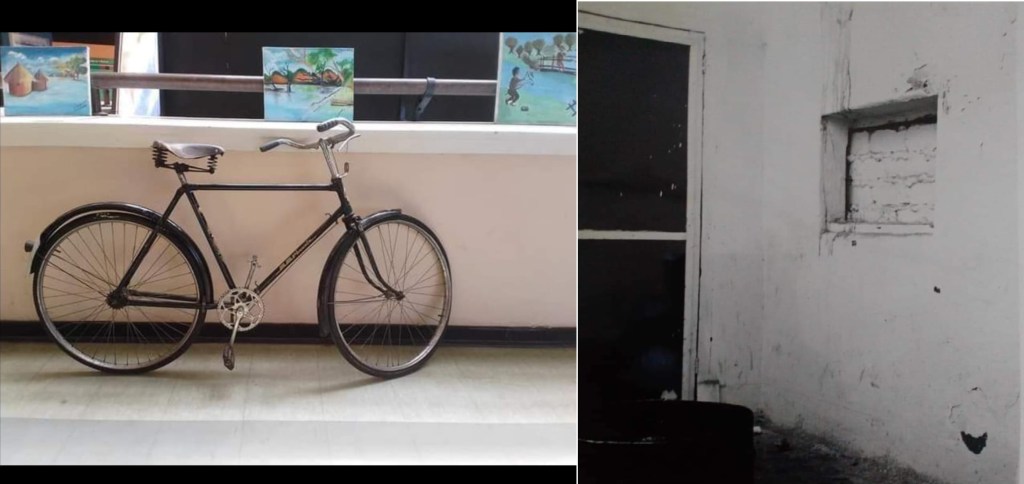
How long will it take for this light bulb to turn on, so that developing countries with sovereign currencies can enter the store (international trade) through its front door and pick what they want and need like every other developed country and not have to queue at the store’s little neo-colonial window and explain how it is they can afford what they want to buy before the shop keeper agrees to sell to them. Like Dr Kaunda, developing countries should ask for the purchased bicycle to be given through little window, this is the hypocrisy of the current international trade system governments in developing countries have been groomed from independence to believe is how business should be conducted, when it is in fact a farce.
These excluded countries must first work to sell imports with which to have the hard currency or “slave master’s” currency in their Treasuries up front to cover imports while other countries can simply purchase imports directly, invest these funds in productivity and reconcile the need for cover after the fact, an unfair advantage that should no longer be available to a few countries to the exclusion of other countries. This access should be available to every sovereign nation as a fundamental right, because today as humanity, we are better than this. The result of this kind of unnecessary discrimination is that it weighs down commerce making it inefficient and less agile than it should be consequently making the entire international trade system weak and farcical. Officials claim they want the best in international trade, want countries to grow, want increased participation and financial inclusion which can only come from greater equality yet in the meantime the very foundations of international trade are a nonsensical system built on discrimination against sovereign currencies. Discrimination is bad for business, how currency is used is no exception. It can’t be had both ways, the hypocrisy needs to be thrown out and genuine business come to the fore.
So as you can see, in an ECH International Trade System facilitated by central banks the need to hold the US dollar or any currency for that matter becomes redundant as all currencies are considered equal, the practice of discrimination against currencies that is hurting growth and industrialization especially in developing countries, is cast out. There is no need for the Treasury in Zambia to hold any foreign currency, the Kwacha is enough because in an ECH system the Kwacha, which represents the hard work of the Zambian people, is regarded as equal to currency in any other country. The fear that plagues governments of running out of hard currency is thrown out the window, it is an archaic neo-colonial fear that should no longer be allowed to exist to haunt struggling nations. Net exporters that are already champions of international trade like China continue to enjoy their status and can do so in good conscience due to the fact that their exporters still enjoy gains from exporting, trade deficits can no longer be used as an excuse for countries blocking imports such as that seen recently with electric vehicles.
Competition becomes healthier, nations succeed by competing on innovation and quality of goods and services. Currency discrimination is thrown out, the International Trade System is fair, business thrives and commerce between countries is allowed to blossom. The icing on the cake is the trillions of dollars worth of value unlocked by the ECH system, that did not exist before, that nations now have to play with to foster peace and international cooperation.
Dr Kaunda, “Give me my bicycle through the little window.” {National Museum] Currency discrimination in the international trade system is an inhumane practice reminiscent of the holocaust, carried over from the colonial period. It turns countries into concentration camps where many trapped by their currency suffer tremendously. This heinous ongoing practice of mass discrimination has sadly continued to be practiced and institutionalized by Bretton Woods institutions. This is an area where reforms are urgently required as they represent a conflict of interest in terms of the purpose of these institutions and why they were created. It is a neocolonial practice that is illegal and cannot be justified or rationalized in the same way other forms of discrimination observed in slavery, Jim Crow and colonialism carried on, structural racism of this nature cannot be justified or rationalized in any manner whatsoever, it can only be abandoned and replaced. A new, fair and equal currency system is required that respects all governments, all sovereign currencies, regards them as equal, and that respects the multitude of nations, their people and the hard work their currencies represent, before or after the fact. The only currency a nation should be required to have in its Treasury is its own currency, because its own currency is enough, it is equal to all other currencies.
[This method for creating a new inclusive and equal international trade system is sourced from the book The Greater Poverty & Wealth of Nations (2010) written by Siize Punabantu, for more in depth writing about this system and approach you can also read Currency Wars & International Trade: download the paper here]



 Split Velocity Solutions Ltd