


Provisions were made for you to prosper…….to give you hope and a future.
14th September 2023
How we Identified a problem that has persisted for 250 years and solved it
Adam Smith, who is considered the father of economics, published the book the Wealth of Nations in 1776, nearly 250 years ago. Since that time our understanding of economics, business, accountancy and finance has grown remarkably. However, despite the greatest minds applied to determine how and why countries can become prosperous why is it that nations continue to struggle with scarcity in some shape or form and wrestle with outright poverty to this day? Why has a lack of wealthy nations generally characterized what is observed in countries? Even countries that are described as “rich” first world nations or developed countries have not escaped the problems created by scarcity, they are simply comparatively better off.
The problem has to do with the design of the circular flow income. Often concepts in economics tend to appear complicated and lofty such that it is difficult to rationalise or sense check various theories. The consequence of this is that critical mistakes can be made and continue to generate chronic problems that carry on in perpetuity. The circular flow of income is one of these problems.
Let’s try to simplify this problem to an extent that any layperson can relate to it. A person who needs to water a garden in a dry climate may take a bucket, fill it with water and walk a short distance to where the garden is and empty the water in the bucket onto crops. The modern day CFI, which is understood over time, namely 1 year to determine GDP, assumes that the bucket is efficient, it is filled with water and this water is used to irrigate crops. However, the gardener cannot explain why out of the vast area cultivated and seeds planted the yield from the garden is rarely ever greater than 4%-5% per year (It should be noted that a growth rate of 15% though regarded as remarkable today, is considered “slow” when compared to the annual growth rates Split Velocity technology demonstrates it can achieve).
Split Velocity examines this process, not just over time (1 year) but also at any point in time. At any point in time the design of CFI is such that it subtracts money or financial resources between factors of production, namely households and capital creating a tremendously inefficient economic model where 100% of growth is lost (all the water in the bucket). To escape this loss businesses use a practice called cost-plus-pricing where they demand more for the products they sell than they are actually worth in terms of what it cost to produce them. Hence, the persistence of scarcity and inflation in the modern day economy. When a bucket (the economy) has a poorly designed CFI and therefore has holes (subtraction) and is losing the sum of its capacity for economic growth this is what causes poverty or scarcity observed in modern economies. The fact that the holes in the bucket have not been identified in economics, business, accountancy and finance, is why poverty and scarcity have not been addressed
The sad images shown below are the consequence of the management of global resources in this age or in this world with a dysfunctional CFI (the water in the bucket being needlessly wasted). This dysfunction causes no one to be spared of suffering in some shape or form be they rich or poor, business owners or employees. The rule of these resources is rendered inadequate because it is crippled by a broken and defective CFI that manufactures inordinate levels of scarcity and poverty. To make things worse inflation is grafted into the very superstructure of how it functions. This defective model is generally known to be intolerable and the suffering it is causing humanity out of ignorance is not acceptable.

Favelas, Brazil are created by the defective CFI.

Alexandria, SA is created by the defective CFI.

Kheliche, SA is created by the defective CFI.

Dharavi, India is created by the defective CFI.

Kibera, Kenya is created by the defective CFI.

Kensington, Philadelphia – USA, these conditions are created by a defective CFI.
Symptoms of scarcity and poverty such as these can be wiped out within a single generation by using Split Velocity to recover losses due to scarcity being generated by the defective CFI and restoring them to the economy. The defective CFI belongs to this current “world” which is made by a “backward civilisation” or “age” that is built on scarcity and the suffering it creates for businesses and humanity. Even though things may look difficult for businesses and life unbearable for many there is great hope. It is inevitable that “this world” is at an end, it will be cast out, meaning it will be relegated to the past by new knowledge and a greater understanding of the the CFI that naturally ushers in a new age, a new civilization that is far greater, that is founded and built on unprecedented prosperity, rather than this world, as it is seen and experienced today, that is founded on unprecedented scarcity. The kind of adverse scarcity and poverty witnessed in the images above will end, in this era. Thinking the bucket is full when it is in fact empty is a grand deception cast over the entire globe of 8 billion people, however, there will come a time when this deception is thrown out and overcome, that humanity may enjoy the provisions it deserves, a greater prosperity it was meant to have.
If greatest thinkers of the developed world such as both Adam Smith and Karl Marx could not solve this problem there is a need to dig deeper. Policy makers need to understand that they cannot fight scarcity and poverty using conventional tools. The haemorrhage of useful resources from every economy in the world today (i.e. shown by the water being lost from the bucket) is equivalent to GDP per day and per annum. This is a colossal loss of “blood” from the economy that FDI, poverty initiatives, restructuring etc cannot mitigate, stop and roll back.
When a tap, a bucket and water are used to rationalise how the modern day CFI functions, its easy to see that the economy is losing tremendous amounts of productivity because the bucket cannot efficiently hold water (it has holes due to subtraction). This explains why economies the world over experience such low growth rates. From the water being lost due to inefficiency, businesses are only able to recover as little as 4%-5% of it, and this becomes the slow growth rates with which people are familiar today and which have continued to remain a problem. Even if you were to make a succinct list of 100 of the greatest economists that have ever lived in human history, none were able to see or identify this problem, it has remained in plain sight, yet unseen even in the highest academic circles, for a quarter of a millennium!

Because modern day economics only sees the function of the CFI over time, it is completely oblivious to the losses taking place at any point in time, which means economics is completely oblivious or unaware of the fact that the economy (the bucket) is constantly losing water (real economic growth). Hence the public and people in general have remained wondering how and why scarcity and poverty plagues countries to this day, and have been perplexed about it for 250 years!
The failure to accurately identify and diagnose the scientific origin of scarcity within the CFI has caused many philosophers to lead the masses on various paths and schools of thought all the way into the 21st Century without genuinely bringing an end to poverty and scarcity. Persistent scarcity created by an inefficient and poorly designed CFI has led to two prominent opposing schools of thought in economics prescribed to managing economies these are namely Capitalism from Adam Smith and Communism from Karl Marx. Though both these schools offer different approaches for managing scarce resources they do not identify the fact that scarcity fundamentally and scientifically emerges from the faulty design of the CFI. Both schools assume that the bucket is full of water at the time it is emptied on crops, which means that the arguments on which they are built are based on a false assumption and therefore cannot provide a workable solution to the problem, if they were able to, poverty and scarcity would no longer exist today. The belief that the bucket is full when emptied, is grand deception that sadly has perpetrated scarcity, poverty and hardship around the world despite innumerable interventions by both local and global development institutions.
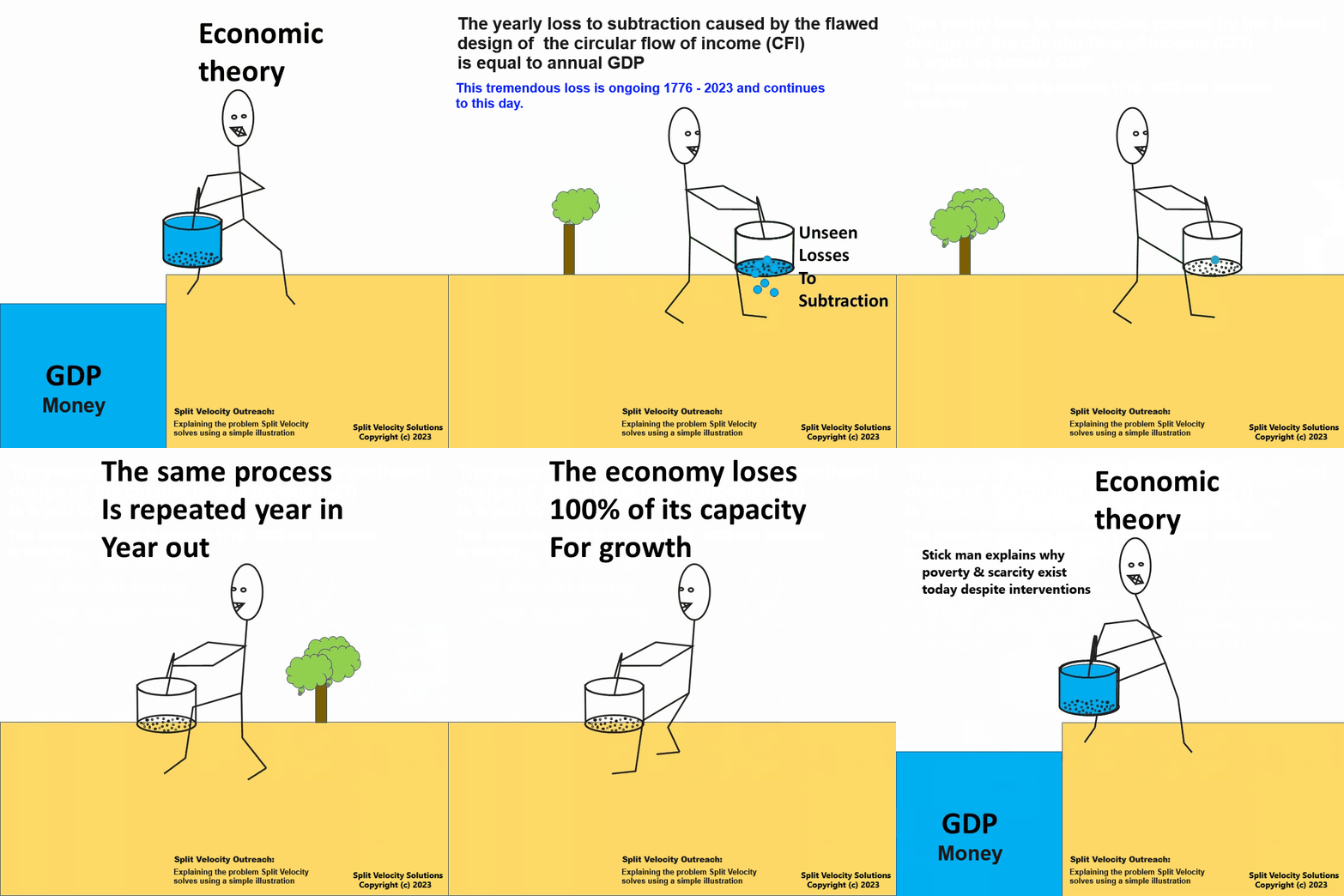
Economic theory tells the public when the bucket is emptied onto crops it is 100% full (CFI over time). However, an audit of the CFI shows that the bucket, when it is emptied, is completely empty (CFI examined at any point in time), the little drop which finances growth is businesses using cost plus pricing or mark-ups to resist being shut down by the zero growth design of the economy.
Would you water your garden using a bucket that is full of holes, where nearly all the water you pour into it leaks out the bottom before you reach your crops? And keep doing this generation after generation repeatedly for 250 years? This form of scarcity, suffering and bondage placed like a blanket over entire civilisations (8 billion people) is rather unusual.
[The bucket and water explanation for losses in the inefficient and ineffective CFI equivalent to GDP per annum offer a simple way to understand how these losses occur. For a more expedient academic explanation follow this link for the empirical evidence based test]
If you understand the explanation offered above, then its easy to see how the CFI can be described as a “machine” or mechanism for the national and global creation, generation and distribution of scarcity or poverty. Slow economic growth and poverty is created and distributed by human beings. This creates a fundamental paradox because the defective CFI creates exactly the opposite economic conditions to the growth and prosperity that governments and humanity in general say they aspire to.
22nd August 2023
The Role of CBDCs in the Growth of an Economy
Any country that applies a Split-Velocity model to its economy will have a local currency that behaves like or gains the characteristics of a reserve currency. Having a reserve currency is therefore no longer as coveted an objective as it has been in the past.
When this is recognised, even those who own and manage the most successful reserve currency in the world, namely the US-dollar will recognise it has to remain in step with innovation. Technically this can be theorised as to why the FedNow system is being introduced in the US. However, most people do not have the financial literacy to understand why the Federal Reserve has to move in this direction. A Split Velocity model is able to recover 100% of the losses taking place in the poorly designed Circular Flow of Income (CFI) of the modern economy per annum, at constant price.
This gives an economy the choice and ability to reduce doubling time to 1 year. Technically this means that a reserve currency is now for the most part redundant as a coveted national asset, and the Federal Reserve, being way ahead of everyone else in terms of economic management, sees this. This doesn’t mean it isn’t useful to have, we see the BRICS nations taking important steps to introduce a new reserve currency. However, the US Federal Reserve is likely to have already come to the realisation that if a Split Velocity model can make any local currency, anywhere in the world, gain the fundamental characteristics of a reserve currency, then this is no longer a coveted advantage to try to cling to and that the BRICS move can no longer be considered a genuine threat to the US, its now a dated financial methodology, that has been superseded by new developments in Fintech.
Secondly, the fact that a Split Velocity model reduces doubling time to 1 year will become the new sought after advantage, much more important than a redundant or now dated reserve currency status. Understanding this the US Fed can be understood to be acting in its own interest and in the interest of the American people by positioning itself to exploit new Fintech, hence the stance it has taken with FedNow. Most people reacting to FedNow may have concerns over control and privacy, however, many of these fears pale in comparison to the national risk of the US Fed not pushing this agenda. The question then of course becomes, what risk?
Its important to understand that an SV Tech model can generate resources from within an economy with which to finance the doubling of GDP in 1 year at constant price. This enables a government to determine the percentage of this that becomes the applied annual rate of growth that makes it the most powerful financial tool, in existence today, that any government in the world can apply to grow its economy. This means that this technology can achieve and eventually exceed any country’s economic Super Power status today, in terms of buying power and economic advantage, which would explain why introducing the systems that facilitate a Split Velocity model take priority over any other subsidiary concerns about a CBDC, even the loss of a reserve currency status that is being over-taken by new developments in economic theory and advances in Fintech. This is necessary for an economy to remain competitive by taking advantage of the latest developments in financial technology.
24th November 2022
Once corrected using Split Velocity technology (SV-Tech) a new, corrected circular flow of income begins to function in an economy
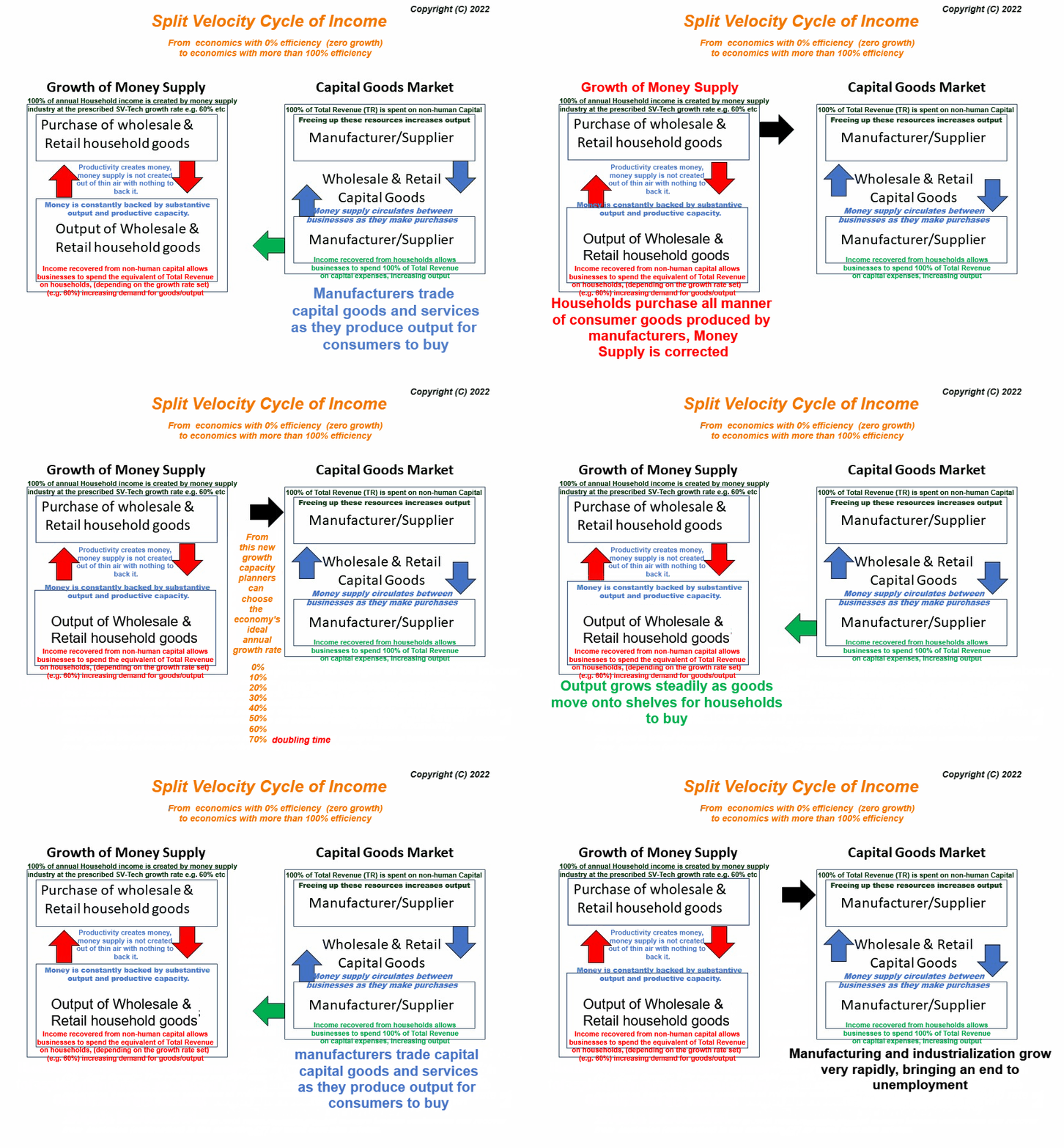
The animation above shows how Split Velocity offers a robust technology for managing an economy towards growth and abundance. In the cycle shown above the annual growth rate though constant is adjustable downward or upward. At present, every economy in the world is a zero growth economy. A zero growth economy is crippled by a low GDP growth rate and is identified by the fact that it cannot survive without cost-plus pricing or mark-ups.
The output of wholesale and retail goods entering the economy is balanced by money supply provided by the money supply industry. See “operationalising the money supply industry” below. Output or goods in circulation being churned out by the capital economy must be constantly balanced by money supply to the household economy to seek and maintain constant price. This money supply deficit, which will annually be equivalent to GDP means the money supply industry is essential and has to supply the e-currency to keep up with this output and growth.
Split Velocity increases output of goods in an economy by shrinking not increasing money supply. Shrinking money supply and making it more efficient and requiring it to do more work increases the output of household wholesale and retail goods. When e-money is created or minted via an operationalised money supply industry it enters the economy backed by productivity that in real terms is backed by this existing output.
Increasing the efficiency of money increases productivity and output. This productivity and output is then monetized by an increase in money supply. When money is created in Split Velocity it is backed by goods and productivity, equivalent to upto 100% of GDP. No other financial system or model in the world today offers this level of financial safety for backing currency, not even a gold standard. Any currency issued using Split Velocity gains this stability.
Money supply in a Split Velocity economy is backed by productivity and output. For a gold standard to keep up with Split Velocity a central bank would have to store gold equivalent to a country’s GDP, which is impractical. The gold standard is not as robust as a Split Velocity model as a means of protecting the value of a currency and the ability to keep it stable.
Consumer expenditure patterns determine how money is distributed to industry.
From day 1 of the calendar year the current economic system is designed to lose 100% of its growth and productive capacity. Businesses resist this attempt to shut them down by using cost-plus-pricing. They are only able to in aggregate recover as little 3% or 5% of the losses to subtraction. The consequence of this is that by the end of the year an economy only grows by 3% or 5%. These mediocre growth rates are the scientific explanation for why governments the world over struggle with various forms of scarcity and poverty due to inadequate economic resources.
From day 1 of the calendar year Split Velocity is designed to be capable of recovering or gaining 100% of GDP. Split Velocity protects the economy by defending businesses instead of trying to shut them down. It is capable of recovering 100% of the resources being needlessly lost to subtraction in the CFI by a weak, substandard and poorly designed financial model driven by a weak economics and restore this lost value to businesses and households.
Split Velocity resolves the widening conflict between labour and machines (non-human capital)
A major concern for the labour movement and governments across the world is the relentless onward march of technology. Robots and AI taking the place of human jobs in both physical and mental areas of the workspace that pose the single greatest dilemma or challenge to the ability of human labour to remain relevant, find relevant work and the capacity of workers to earn an income with which to live a meaningful life.
However, by Split Velocity managing the economy into households and non-human capital, any application of technology, be it AI or robots that takes up jobs previously performed by households does not take financial resources away from households, instead it channels new resources to households. These resources can be used to keep human beings employed, help them find new skills, enjoy a higher standard of living and remain in receipt of income with which to continue to find work, vocations, life-style adjustments, and life fulfilment.
Smarter more efficient machines not only create more wealth for households, they also increase the quality and output of goods. This means that not only are more and more goods finding their way onto shelves for households to consume, these goods are of an ever increasing quality.
Science not Rhetoric: Together we can end global poverty and scarcity
Furthermore, investment in and the advancement of non-human capital (e.g. with access to 100% of total revenue (TR) for repaying loans, tax, covering overheads and capital expenditure (CAPEX) per annum improves its efficiency, which in turn increases its capacity to generate output of household products, not just quantitatively but qualitatively. This essentially will mean the end of human suffering caused by scarcity anywhere in the world, basically the end of global poverty not just as an “ideal” but a fundamental scientifically verified outcome of economics, finance and business management.
This means that robotics, AI and automated industries are no longer on a course that is diametrically opposed or in conflict with labour. In fact the rapid expansion of the capital economy in an SV-Tech model only serves to raise and improve the opportunities and standard of living for labour and households in general. Both humanity and machines/AI in the SV-Tech economy can thrive in harmony as the progress of one enhances the progress of the other.
The non-human capital economy needs households to consume the goods it manufactures in order to earn income with which to keep growing and remain in operation. Therefore, its primary role is to keep putting household goods on shelves that people want to buy. To compete these goods have to become better and more attractive to consumers over time. Improvements and advancements in AI and non-human capital leads to greater output of goods of ever improving quality.
The consumption of goods feeds the non-human capital economy with the financial resources it needs to keep growing continuously from year to year. The rate of growth of populations moves in tandem with the more than robust capacity for productivity of the non-human capital economy to feed and cater for it.
In order to satisfy demand non-human capital will keep building better machines, it will keep taking on bigger investment projects and to do so will continue to borrow from banks. All this activity only serves to provide goods to households.
In fact in this model it is unlikely that population growth rates can ever exceed the ability of the non-human capital economy to produce the output required for all of humanity to enjoy more than a robust standard of living. All
With the Split Velocity model humanity and ever growing populations will never starve, lack shelter or want for anything material that is basic for human life. The economy can provide adequate goods and the reason for this can be verified as being made possible by science that ensures it is a condition that is both pervasive and sustainable.
Operationalizing the Money Supply Industry
15th August 2022
Operationalizing Split Velocity creates the money supply industry. Technically, even though cryptocurrencies (private money supply – sometimes referred to as decentralized finance) and fiat (public money supply – sometimes referred to as centralized finance) exist, there is no industry.
As has been mentioned the money supply industry should ideally compliment the commercial banking industry, but is currently missing from the financial sector. Split Velocity corrects the defective CFI and restores the hidden/unseen losses and restores them to businesses, government, private and public sector institutions.
This effectively brings an end to scarce resources, high levels of credit risk, underdevelopment and poverty whilst at the same time ushers in unprecedented new levels of growth, improvements in the standard of living, advancements in infrastructure development and leap forward in socio-economic development, possibly greater than has ever been possible in human history.
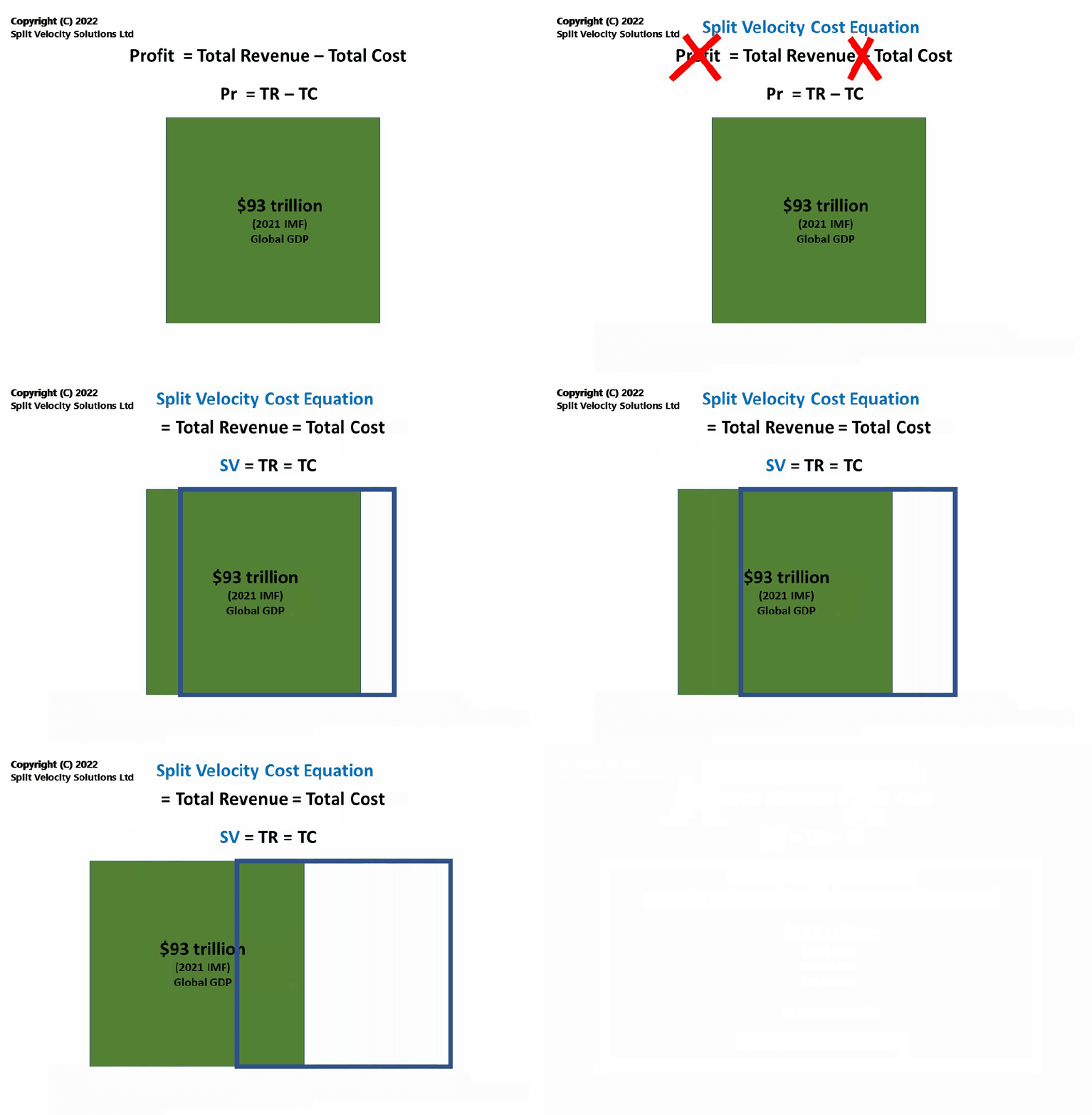
Split Velocity identifies and draws out the hidden financial loss and
and decline in productivity caused by
the defective, poorly designed CFI restoring it to stakeholders
Contrary to conventional belief maintaining constant price
is relatively easy in a Split Velocity model. With the Cost Equation upgraded or corrected
to the Split Velocity Cost Equation shown above, the Fisher Equation is upgraded to the Split Velocity model’s
equation of Exchange, referred to in the GPWN as the Punabantu Equation of Exchange.
The equation shows that a Split Velocity model establishes a “price plane” and will resist
both inflation and deflation when changes in money supply take place. Technically,
because the velocity is “Split” there is no real increase in money supply (i.e. $186 tn/2=$93 tn)
this increases the efficiency of money observed in increases in output (businesses and institutions have
more income to allocate to non-human capital expenses consequently shifting the production possibility frontier to the right and driving output upward maintaining constant price, meanwhile households experience an increase in income with which to consume higher levels of output. A Split Velocity model is a well oiled machine expertly designed to achieve what an economy is expected to achieve and represents best practice. This is ideally how an economy should be managed, how it should operate and correctly function to obtain the best and most efficient and effective results, with no unnecessary losses to the CFI – see how the Punabantu Equation of Exchange supersedes the Fisher Equation in the GPWN 2010).
As demonstrated by the animation above the poorly designed, defective CFI wasted $93 trillion in 2021. The most affected by this loss are households, that is, employers, business owners, owners of factors of production, shareholders and labour, that is, employees engaged with with activity related to production. This is one situation where both shareholders and employees have a common problem. The CFI subtracts tremendous value from the economy worsening returns on dividends, earnings and conditions of service.
Incredibly this $93 trillion loss, that can be recovered, is not addressed as it is not identified at postgraduate and doctoral levels of economics and finance. It is not identified at the highest levels of thought, academic qualifications and professional practice today.
This loss is revealed in an audit of the CFI. The damage this loss has done, the suffering it has caused humanity to endure and continues to impose on development in the presence of inadequate resources needs to be corrected for the function of economies to be normalized and to allow businesses and institutions in both the private and public sector to begin to function optimally.
What this illustrates is that cryptocurrencies and fiat: the money supply industry in general, is in its infancy. There is is tremendous potential waiting in the wings to be deployed. Extensive skill and a shift in the knowledge paradigm is required to unlock this wealth, the need to learn and understand a Split Velocity model cannot be understated, neither should it be taken for granted as something easy to do. There is a need to step out of the comfort zone and embrace the changes and transformation a better understanding can bring. The learning curve is steep, but not insurmountable.
Split Velocity Growth has the advantage of being based on Science not Ideology
When Split Velocity is operationalised in an economy it will achieve its objectives. It is possibly the first and only economic strategy capable of lifting an economy comprehensively out of poverty. The perpetual failure of past policies and strategies is evidence of gaps in the knowledge paradigm for how to mobilize resources and achieve rapid growth that is transformative. These mistakes should not be repreated in perpetuity. Fortunately Split Velocity fills the gaps offering a strategy, methodology and technology that will not dissapoint implementors.
Split Velocity processes and technology is based on science not ideology. In terms of resource mobilisation for development, Ceteris paribus, it is capable of reducing doubling time for GDP to 1 year at constant price. Depending on its needs, from this an economy can choose what proportion of these resources it wants to apply by determining a growth rate . e.g. 40%, 50%, 60%, 70% and so on. This is regardless of the current size of an economy.
Its common knowledge that every aspect of socio-economic existence, including whether an economy is a superpower or fundamentally a weakling is dependent on economic performance. The strategic importance of Split Velocity technology, ceteris paribus, is its ability to double GDP in one year at constant price. To achieve this feat a Split Velocity model does not even need to apply its full resource mobilization capacity since the rule of 72 reduces the duration required for this threshold to be achieved achieved. Rates of acceleration can be lower, yet suitable, for example, optimized between 40% to 70% or less. This leaves spare capacity to address economic shocks, where productivity has to be ramped up to compensate for slow growth witnessed during recessions.
Economies unable to access Split Velocity will risk not having access to these guaranteed accelerated growth rates and associated doubling times, therefore early adoption of the innovation is advantageous.
14th July 2022

4th Mid-Year Coordination Meeting of the African Union, Regional Economic Communities and Regional Mechanisms 14th – 17th July 2022, will be held in Lusaka, Zambia.
Wishing them the best during their deliberations.
6th June 2022
Split Velocity NFTs: The Debut of Ingots

The Founder’s Collection
The very first catalogue of NFTs and its theme can be viewed on the links provided below.
This catalogue of NFTs are a founder’s collection designed and conceptualized by the founder of Split Velocity. It will consist of a limited number of ND Ingot NFTs and will only be available once, offering a once in lifetime opportunity to own a founder’s edition NFT. These can be viewed now but will only go on offer after building awareness, marketing and other modalities are in place. Nevertheless, there is an option to make an offer right now for anyone who is ready to do so. Once these first collections are sold out you may never get the opportunity to acquire one of these NFT assets from this specific collection. ND Ingots have both artistic and will have utility value.
To gain some information on ND *Ingots, the theme chosen and reason for variation and use of simple child centric/child friendly colours, how they work – read the summary of Split Velocity NFT Ingot white paper etc click here
To view the first entries on the Founder’s Collection of NFT *Ingots: Tier 1 Ingots click here, Tier 2 Ingots click here, for Tier 3 Ingots click here, please like, share, help circulate the Ingots and the Founder’s Collection.
…
Monday 14th January 2022 – Wishing you a Happy Valentines Day, Zambia!
Normalising International Trade
Source: GPWN (2010)
How to build a better International Trade System with no trade deficits
Using the International Trade System to create a permanent solution to currency instability would strengthen economies and currencies like the Zambian Kwacha.
A fundamental governing principle of monetary theory is that when goods and services enter or leave a fixed medium of money supply (retention) within an economy they respectively cause an appreciation or depreciation of a currency that can be restored or regulated by increasing or decreasing money supply in proportion to goods and services in circulation. When currencies are confined to their respective borders goods and services can move against this retention. A new and well-organised international trading system based on this principle can begin with Central Banks playing a key supervisory role in the relationship between international trade and currency. In this system when external goods enter an economy they inevitably cause an imbalance between the volume of domestic currency in circulation and aggregate goods and services. In monetary terms, imported goods create a deficit effect on money supply. At the same time there are industries within an economy externalising a nation’s resources by exporting goods and services creating a surplus effect on money supply. The deficit created by goods and services entering an economy can be balanced by Central Banks receiving these payments and reintroducing this liquidity using the surplus effect. This liquidity can be re-injected into the economy by paying it to domestic exporters using local currency leaving no doubts as to the cycle of monetary receipts and allocations in international trade. Hence, exports naturally pay for imports when they create a surplus in liquidity and vice versa. The economy remains balanced. Nothing could be simpler. The global trading system is thus allowed to act like an efficient self regulating organism made up of balanced self-regulated domestic macro-economies. There is less complexity, less clutter, less monetary chaos.
In this example the entry into an economy of imports empowers a Central Bank to increase liquidity, which facilitates payments to exporters in domestic currency. With this relationship there is absolutely no need for an importing country to have to source the national or domestic currency of the economy from which it imports goods and services or some internationally accepted trading currency. Having to do this is an unnecessary barrier to international trade that hurts both the exporting and the importing country. Its partner Central Bank already has the domestic currency to effect payment. In fact, no domestic currency whatsoever would need to leave its borders and no foreign currency has to enter them. For example, in this condition there are absolutely no currency exchange barriers to trade that would injure industries in the US that need export markets; the same applies to consumers and industries in Zambia that need to import and vice versa. Both Zambia and the US would face absolutely no currency reserve problems as there would be no need to hold foreign reserves in the first place. Currencies remain territoriality bound and constant (retention) while goods and services move. In essence each nation’s individual currency would act like a single currency that automatically transmutes itself through Central and/or Federal Bank currency supervision partnerships. This facilitates the tranquil movement of goods and services between economies. Commercial banks already follow this approach. Why should a commercial bank physically move money to another country when its subsidiary there already has the facility and resource to make a payment in local currency? For instance, it receives a payment in dollars in the US then instructs its subsidiary in Zambia to make the same payment in Kwacha, vice versa. If it works for commercial banks it can work for the IMF, WTO and Central Banks. The US Federal Reserve Bank (FRB) and the Bank of Zambia (BoZ), or any central bank for that matter, can have a partnership that facilitates and catalyses trade without currencies as barriers that stunt growth. This is what global partnerships are about.
Trade deficits and surpluses can be handled just as easily using this policy. In the United States in 2002 a trade deficit of US$435.2 billion of imported goods threatened the US economy. With GDP at US$10trillion this caused a deficit that could have been solved at the US Federal Reserve simply by balancing its internal liquidity were the international trade system different. Not a single dollar would have escaped the US economy and the FRB due to its partnerships with other central banks. Financial stability in the US, and other individual economies, would mean stability in the rest of the world. The domestic balance between the stock of money and stock of goods and services would be manageable. The US Federal Reserve’s ability to internally control balance of payments and retain a stable economy would increase dramatically. There is a need to see that a general trend in economies today is toward trade deficits due to the ever-increasing complexities of specialisation, comparative advantage and interdependence in the midst of a stagnant international trade system. The current global trade system and mechanisms are ‘pre-historic’ and show a lack of innovation on the part of policy makers.
In a new supervisory partnership of Central Banks supported by the WB, WTO and IMF, and the proper use of monetary policy, even if a country like Japan experienced a trade surplus it would be able to internally regulate the effects of this condition thus protecting itself, its trading partners and the global economy. At present trade deficits and surpluses uncontrollably spill over borders and translate into fluctuating internal and external exchange rates, which create a sickly and now archaic global trade system that destabilises economies. Currencies and goods run amok, hence, nations anxiously horde each other’s currencies in fear of inadequate trading capacity. Within a few months global speculation or induced devaluation can wipe out the value of foreign reserves in a country despite the torturous effort of governments to build them up. Shortages in domestic currency due to it spilling over into neighbouring countries can lead to CBs having to print new money at high costs; or an economy can be destabilised by its own externalised domestic currency being channelled back into its economy by exports or transfers. FDI is threatened as investors fear inadequate hard currency to meet obligations. An export company cannot export as there is inadequate foreign exchange in circulation to buy raw materials which leads back to the problem of insufficient hard currency. A Zambian producer cannot purchase equipment as the economy has no foreign currency or due to the fact that a very high price has to be paid for it that deters productivity and renders growth incapable of repaying national debt. Meanwhile, across the Atlantic manufacturers in the US may sit idle and lay off workers, though warehouses are full of unsold goods, waiting to be hit by the full effect of a recession as potentially vast external markets either do not have access to the dollar, cannot acquire it, find it too expensive to buy or as it is in the case of Zambia, are standing by for copper export revenues to arrive from the LME on 56 Leadenhall Street. All this friction contributes to a global economy slowing down.
Currencies proliferating all over the globe crossing borders and running amok outside the statutory jurisdiction of central banks (CBs) and an attempt to regulate them has become a poor rather than a prudent application of free markets and monetary policy that has increased the vulnerability, risk and exposure of economies to financial instability. There is an alternative to this chaos and the method for operationalising the process by which this takes place is to create an electronic clearing house facility for international trade.
ECH Trade System
The globalisation of money was introduced in Chapter One. The globalisation of money is as important to international development as free trade. In the present system major trading currencies such as the US dollar or Euro have to be obtained before countries are able to acquire imports. To do this they themselves must find exportable products and earn the foreign exchange with which to pay for imports. The capacity to produce exportable goods and services is thus a fundamental barrier to a country’s capacity to acquire foreign exchange and therefore its capacity to participate in international trade. Foreign exchange, though readily available on international markets can therefore be considered a significant barrier to international trade due to the hurdles countries must overcome to be able to acquire it.
There are two possible ways of overcoming this barrier. The less attractive method is to attempt to create a continental currency or internationally acceptable currency owned and controlled by developed countries that overcomes these barriers. The more attractive method is to introduce an electronic clearing house (ECH) for facilitating international trade. An electronic clearing house for international trade entails that when goods and services are traded between countries, exported and imported goods move whilst domestic currencies stay put. This method is more practical and brings with it many new potential benefits.
Using an ECH process, when a country imports goods and services the payments from domestic exports accrue to the Central Bank or an agency appointed by the CB to manage the ECH process. In other words imports entering a country have a positive effect on the balance of payments and are a direct source of income that accrues to government. These funds are then placed in an ECH Import Account. When a country exports goods and services domestic exporters are paid for their exports from funds in the ECH Import Account. Therefore, if imports exceed exports the remaining balance of trade is a surplus to add to government expenditure. Should exports exceed imports the country is not disadvantaged as its exporters are still earning income and a government is able to move toward a positive trade balance with little effort. Therefore, currencies remain domestic whilst goods and services are allowed to move between countries.
In the conventional trade process the formula for Net Trade is as follows
Net Trade = Exports (Ex) – Imports (Im)*
Trade Surplus = Ex > Im
Trade Deficit = Ex < Im
- Under the current trade system there are no direct earnings from trade gained by governments. Direct earnings are only gained by exporters. An example that may be used here is of the United States. Let us assume that in 2005 the United States, as a result of having an open economy, received US$1,036.25 bn in imports and exported US$207.25 bn. The US’s current balance would be as follows:
Net Trade = US$207.25bn – US$ 1,036.25bn = US$829bn (Trade Deficit)
Under the current trade system the United States is punished for allowing imports by having a trade deficit of US$829bn rather than rewarded for having an open economy. This is a contradiction of free markets and open economies encouraged in the modern economy. Furthermore , there are no direct earnings.
In the trade architecture proposed by OLE the formula for Net trade (ECH Balance) is as follows:
ECH Balance (Direct Earnings) = Import Account – Export Account
ECH Balance = ImA – ExA
ECH deficit : ImAExA
Using an ECH system the US’s current account would be worked out as follows:
ECH Balance = ImA – ExA
Net Trade = US$ 1,036.25bn-US$207.25bn = US$829bn (Trade Surplus)
Direct Earnings = US$829 bn
In this system an economy and its government is rewarded by being more open, in the US’s case with US$829 bn in direct earnings. This is profit from economic trade that accrues to government. The CE trade system offers no direct earning benefits of this kind as they all accrue to importers and exporters.
[At present the concept and use of foreign exchange is not smart because it acts as a barrier to international trade. Forcing countries to earn hard currencies through exports before they are able to demand foreign goods and services is moribund, not just poor policy, but poor or shallow thinking at an international level. Imagine the goods and services around the globe that go unsold as a result of this backward pre-historic currency system. Imagine the goods and services in the United States that go unsold every year simply because governments do not have the US dollar to purchase American made goods and services or because the lack of US dollar reserves drives depreciation of domestic currencies making US exports too expensive because the local currency is too weak to-buy-the-dollar to-buy-US-goods-and-services. International trade at present functions with shackles on its hands and feet. Its the main reason why the US remains uncompetitive and unable to outperform other export countries despite being the most powerful economy in the world. The US has difficulty being a leader in exports simply because its own currency is a barrier to selling its goods and services abroad. An ECH Trade System allows domestic currencies from different central banks and governments to act as a single currency, even though the currencies themselves are different nationalities. Not only are governments no longer crippled by shallow reserves, international trade is unfettered and released to explode in increased sales thereby driving global growth as well as spurring economic growth, especially in countries whose potential is being limited by currency barriers.]
.Managing an ECH Trade System
An ECH international trade system should be easier for governments and the World Trade Organisation (WTO) to manage than a conventional CE trade system.
When imports exceed exports this is the ideal condition in an ECH model as it enables governments to earn income directly from imports and supports free market theory and policy. However, the ultimate objective in the management of international trade is a balance between imports and exports. In a global system where some of the surpluses are shared between governments more can be done to improve international trade.
When exports exceed imports and a country faces a deficit governments have better options for dealing with this problem than they have for a deficit experienced in a conventional economy.
[Central banks in the group can create a common foreign exchange reserve and administer a policy that allows any country with surpluses at any one time to lend to countries with deficits at any one time, fortifying the economies of members. Since the members allow international trade and purchases directly in each others currencies, they only require forex for transactions outside the group, reducing their dependence on it. As the membership of the group grows, the lower the dependency on forex. Member countries do not mind purchases in the currencies of other members as they share a common reserve, and their individual currencies behave as though they are a single currency. Creating a common foreign exchange reserve managed by members is essential to the success of this kind of ECH. There is still likely to be some play in exchange rates leaving room for speculation and currency trading, however, in this new trade and currency architecture CBs are better equipped to accommodate this activity because they can shrug of the negative aspects of currency speculation]
[Once an ECH system is in place, its important for CBs to pool together the management of member’s forex reserves. The reason for this is very simple. Before the ECH each member’s domestic currency is only backed by its national reserves. However, when the ECH is formed and members agree on policy to manage their forex reserves in each others interest (one for all, and all for one), then each member’s domestic currency is now backed by the groups forex reserve. The simple fact that each member has reduced the risk associated with its domestic currency by default multiplies not only the confidence in the domestic currency but also technically strengthens the value of local currency. This creates a matrix where each member states that its local currency is backed by the group reserve which has a multiplier effect in terms of the total value of the reserve. This value is real due to how this system mitigates against risk in each member country, thereby multiplying the strength of the ECH group as a whole, in real terms. For the sake of example, from each member’s domestic currency being backed by a national reserve worth just a few billion dollars, each member’s domestic currency is now backed by hundreds of billions of dollars held by the group to which each member is entitled to state its domestic currency is fortified. This backing is real, because it lowers the risk profile of each member. Technically the size of the reserve will consist of the value of the collective reserve multiplied by the number of members, because this is how it will behave. For instance, if the collective forex reserve is worth $100bn and there are 50 members and each member quotes their domestic currency against the reserve, then the $100bn functions and does the work of $5 trillion. This approach to increasing wealth and value as a well managed financial tool or instrument is no different from fractional reserve banking or insurance as well as the risk management that goes with these financial products. It allows the collective forex reserve to do much more work than forex reserves isolated to each individual member. Even though a member may have $2bn in reserve, its domestic currency is now backed by the $100bn collective reserve in terms of risk, even though the collective reserve is $100bn it multitasks for 50 members, in terms of work done and presence, giving it a regional real value of $5 trillion.]
An ECH Trade System Allows for More Stable Currencies
Since money does not move between economies Central Banks have to agree to honour foreign demand for the products they produce. This agreement might resemble the promise made by the Governor of the CB commonly found on notes which reads I promise to pay the bearer on demand except that now as an agreement between governments it might read I promise to pay the bearer of any currency (party to the ECH process) on demand. It allows domestic currencies to function as though they are a single currency and can remove the need for often damaging appreciation or depreciation resulting from changes in the balance of payments between aggregate exports and imports.
The essential result is that it appears as though there exists a single currency between trading partners. In other words not holding foreign currency can no longer prevent a country from obtaining imports from another country. As long as consumers and producers in a domestic economy hold sufficient local currency to demand foreign commodities and finished goods, which they can pay for via the CB they are able to naturally acquire imports. Foreign exchange (forex) is no longer a barrier to international trade.
[History is is one of the most important subjects in the world, because to lose sight of and fail to learn from the past, is to fail to understand how best to secure the future. Currencies hold cultural value and can often be a source of history, national pride, culture and identity. By each member central bank maintaining its national currency this is preserved, however, through the membership the individual currency is no different from any other currency in the collective basket creating a multi-national and multi-cultural single currency able to preserve the history and national heritage of each central bank.]
1st November 2021
What a Split Velocity Budget for 2022 would entail: Corporate Strategy and understanding the implications of barriers to entry in economic management
In a lesson in how to interpret growth rates the critical role the growth rate plays in the development of an economy was assessed by humanizing two economies, that of a developed country and a developing country. By doing this it became evident that a growth rate of 3.5% prescribed to a developing country is insufficient to realistically transform it from poor to wealthy within a generation or less (10-25 years). When applied to the 8NDP it does not conform with a transformation agenda as explained at an earlier time here, which shows an ongoing inconsistency and misalignment between policy and action. Over a ten year period there is no transformation, per capita incomes remain low and poverty remains to haunt the economy.
A larger budget in an economy that is not growing represents a redistribution or reallocation of income and expenditure, not a creation of new wealth and growth. The re-distribution of income should not be equated to the creation of new wealth, this represents a flawed understanding of how to realistically create growth addressed by what is identified earlier as the Planing Paradoxes here. It basically identifies that the reallocation or redistribution of income does not create economic growth or create new wealth. It merely cuts the same cake in different portions, a problem also earlier identified in prescriptions of Professor Panagariya and Prof Danny Rodick here. It is important to not keep making these same mistakes over and over as this is what perpetuates poverty, despite the high level thought processes that appear to be applied little or nothing is accomplished and this is only realized after a decade when time wasted cannot be recovered and given back to the generation that has lost it.
Realistically there are only two methods for creating rapid economic growth in a country and this is either through a benefactor or a Spit Velocity system. Earlier it was identified that countries that appear to have transformed by a miracle of redistribution on or “special management style” that say “this is how we did it, copy us” will in fact be found to have done so through a benefactor, therefore, it is important not to fall for flawed thinking and policy regardless of how persuasively it is couched to seem authentic. Read about this as “game theory” where poorer countries are “gamed” into remaining perpetually poor here. This is the same problem with applying growth rates suitable for wealthy developed countries to poorer less developed economies, whilst reassuring them they have the right financial planning when in fact they are being misled, see the table here. Its important for people living in developing countries to learn how to escape from these misdirects that keep them poor in perpetuity. All that glitters is not gold.
In the table below a Split Velocity system is applied to the 2022 budget to demonstrate the impact of a system able to correctly set the growth rate in an economy. Instead of 3.5% Split Velocity is shown setting the growth rate for the current Zambian economy and therefore the budget in four distinct settings 10%, 25%, 31% and 42.98% per annum. The growth in resources that finance the budget every year created by the Split Velocity system are derived from increases in the size of the economy over time in accord with the growth rates as has been depicted in the table below.
The national budget was announced by the Minister of Finance, Hon Dr. Musokotwane on Friday 29th October 2022 outlaying a budget of K173 billion that represents 37.1% of GDP.
Below is the projected rate of economic growth and increase in budget size over a 10 year period when Split Velocity is applied to the 2022 budget with the correct growth rate and the intention of maintaining an annual growth rate of 42.98%. The ability to set the national growth rate becomes available when wealth creation is distributed alongside credit creation economy-wide through commercial banks and non-banks. Once control over the growth rate is gained this naturally leads to control over the value of the Kwacha, inflation, debt contraction capacity, forex reserves, import cover and other factors that were previously difficult to control. Once the distribution of wealth creation as a new financial product alongside credit creation takes place wealth creation naturally becomes part of effective monetary policy by providing a new tool. This tool provides the ability to set the growth rate. Once the ability to set the growth rate is achieved this spells the end of inflation and other related types of instability as the growth rate is able to provide direct control over the economy’s access to foreign exchange and is able to determine the size of foreign exchange reserves and how they are applied to import cover. At this stage, despite being from a developing country, the kwacha should be considered as stable and reliable as any hard currency traded on international markets (It should be noted that once a Split Velocity system is implemented, the Zambian Kwacha, as a currency, is backed by a more reliable financial system than that currently used to manage international hard currencies in developed economies – see the comparison here).
[Split Velocity is transparent and open to scrutiny, it is based on a scientific approach and simply applies accounting, finance, business and economics in manner suitable for more resource constrained economies. It offers an approach that professionals in the foremost international development organisations have overlooked, especially for less developed economies. Let the approach speak for itself. You’re encouraged to find the time to browse the website and understand what it is designed to do.]
Here the emphasis of the correct policy advice concerning economic growth rates is made very clear.
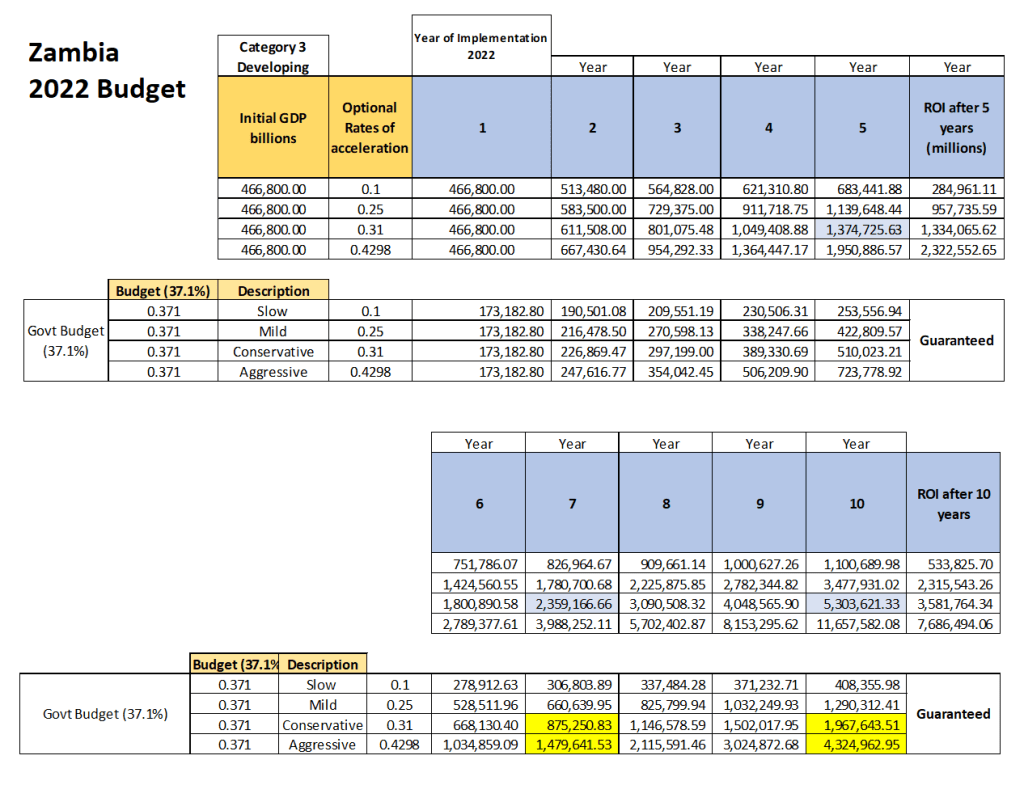
The table above demonstrates how Split Velocity grows the government’s Budget from K173 bn in 2022 to K4.3 tn in 2032 (10 years). As part of the long term gains of a Split Velocity system. This increase by 2032 is guaranteed to be approximately no less than 20x the size of the current national budget (K173 bn).
A budget growing in size in the presence of a stagnant GDP is not healthy for an economy. The resources envelope created by Split Velocity will create ample fiscal space to reduce dependency of the budget from 37.1% of GDP to lower more suitable levels around 25% of GDP or lower. This can be done whilst still maintaining a budget approximately 20x larger after 10 years.
Up-Front Gains of Split Velocity system to the Budget
Government would be expected to access a wealth creation facility f rom commercial banks operating in Zambia. Commercial Banks distributing wealth creation can offer government the facility as they do for other firms. It should be recalled that commercial banks and non-banks distributing wealth creation will earn as much from wealth creation as they do from credit creation. This is no different from how government acquires loans and other services from the private sector. A change management process takes place in the accounting procedures and method which allow government to upgrade to a Split Velocity system. When commercial banks engage government they supply wealth creation alongside credit creation as a financial product and government applies this to the national budget.
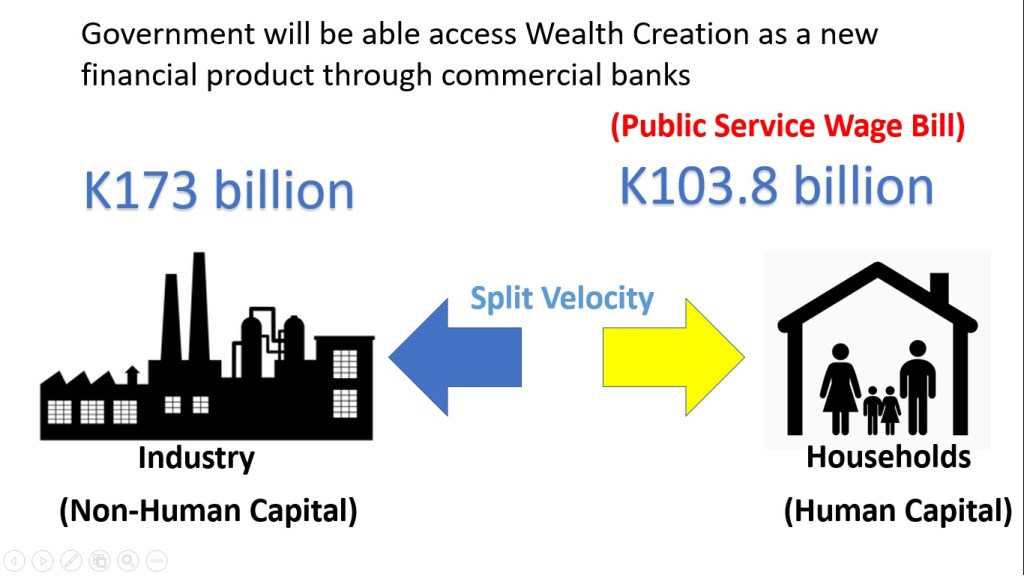
Split Velocity mobilizes resources by increasing efficiency. It upgrades accounting practice and procedures by updating a firm’s cost equation. This recovers finances being wasted in the CFI. This change allows a firm to spend 100% of its total revenue on non-human capital. The same procedure and benefits apply to government operations and the budget. For Zambia this would free up the equivalent of US$5.4bn in the 2022 budget. This is not a once off benefit or gain. It is a gain that is accessed by the budget and that grows in size every year, in tandem with the applied rate of acceleration.
As illustrated above losses to subtraction within government expenditure are recovered from the CFI by 60% (leaving 40% untapped). Losses to capital expenses created by human capital are recovered and vice versa. By accessing wealth creation government is now able to spend K103.8 bn on the civil service wage bill and K173 bn (the equivalent of the entire budget) on non-human capital. This increase in efficiency generates and frees up an additional K86.6 billion (US$5.4bn) for non-human capital expenses which can be allocated to priority areas such as servicing local and international debt as part of resource mobilization.
In real terms wealth creation as a financial product distributed by commercial banks would expand the 2022 budget in total to K276.8 bn as an immediate gain.
The fact that government can use these additional recurring revenues every year (US$5.4 bn) to repay its debts further demonstrates that Split Velocity moves a national economy from an Asynchronous financial system that is prone to high levels of credit risk and default to a Synchronous financial system with low credit risk and low levels of default because government, institutions, businesses and firms have increased income with which to pay off their old loans and take on new loans. In a Synchronous financial system as government and the private sector borrow more to spend and invest, the Split Velocity (SV-Tech) system through enhanced economic activity naturally generates more resources with which pay off loans consequently this begins to greatly lower credit risk in the economy safeguarding the banking sector and making it more lucrative. Credit creation enhances access to loans, while wealth creation naturally stimulates productivity generating the resources by which old loans are repaid and new loans are acquired with increased financial stability due to lower credit risk.
Corporate strategies with low barriers to entry
Government faces little or no barriers to entry in setting up a Split Velocity system due to the fact that it is able to introduce the service through the cooperation of its own institutions, that is, the Bank of Zambia and Ministry of Finance. There is also no technical barrier to entry since the technical knowledge and expertise for implementation is at hand in that it is a locally developed product. In addition to this the new resources are generated by increases in efficiency and a better understanding of the finance, business and economics suitable for poorer, resource constrained developing economies. These new resources are contained within the economy itself and are liberated by deploying a more advanced cost equation that counters losses in the CFI caused by blatant inefficiencies in its current design. It provides more ethical and accurate financial advisory and counters the low growth rates keeping poorer developing countries trapped in a never ending cycle of poverty, regardless of diverse interventions that have been applied for decade after decade.
Unlike attempts to end poverty in the past the Split Velocity system mobilizes new resources of significant scale comparable to GDP year after year. It does not let up, end or give up, these resources are mobilized year after year in a manner that is sustainable. Sustainability is key to the transformation of countries like Zambia, that have grappled with poverty for decade after decade, approach after approach and programme after programme.
It is not an inherently insufficient once off grant, or once off balance of payments support that lacks continuity and sustainability that will lead to the recurrence of the same problems when the resource is depleted.
Corporate strategies with high barriers to entry
Corporate strategy must take into account barriers to entry when formulating the most effective strategies for mobilizing resources with which to manage the national economy and for moving the economy forward. Approaches with the lowest barriers to entry need to be prioritized to avoid uncertainty and quagmire.
If the strategy relied upon for economic advancement has high barriers to entry then there is the risk of not being able to access it or accessing it too late and in an untimely manner which may not be in the interest of government.
[Its important to note that by 2032 in line with the new budget of 2022 Split Velocity would grow the Zambian economy to K11.6 trillion or US$725 bn and yet the per capita income position will be approximately US$30,000 at its base level. As admirable as this achievement may seem, this per capita income level represents only 50% of that of the United States (US$63,543.58). This underscores just how difficult generating meaningful economic growth is within a generation or less, even where a Split Velocity system can push growth rates to 42.98% over a 10 year period, even this growth in terms of baseline analysis is not sufficient to bring per capita income levels on par with the developed world. However, at this growth rate this can be done over 25 years]
…………….
30th October 2021
A Lesson in how to interpret growth rates
Economists often describe countries and their economies in terms of a growth rate, GDP and GDP per capta, inflation and so on. It is sometimes difficult to understand how a country worth many billions of dollars in GDP, is in fact poor. The fact that this data refers to countries entails that they are portrayed at a large scale such that it is difficult to relate to how the information being shown is relevant and how it affects ordinary people. The consequence of this is that it becomes difficult for the majority of people to understand what changes in the growth rate means. To get past this problem let us attempt to reduce countries to individuals, as a way of better understanding what the implications of these lofty terms are.
Instead of an economy lets reduce the concept to that of an individual so we can compare the growth rate between two economies. One is a large advanced developed economy and the other a developing economy. For the sake of example lets use the United States of America and Zambia. To simplify and humanize the concept of growth rates so that it is easier to understand lets view the two countries as two individuals or friends Uncle Sam and Uncle Zed.
In order to reduce the two economies to individuals an index will be used to shrink the economies down equally to a level where they can be humanized as individuals (GDP/11,511,784.8*) , with the base derived from the larger more advanced economy. This allows us to simplify the concept to “individuals” instead of “countries”, which is easier to convey and understand because they are more relatable.
With this done now Uncle Sam’s Stock of wealth as an individual is US$1,815,530.81 and Uncle Zed’s comparative stock of accumulated wealth is US$1,737.35. Basically Uncle Sam is worth US$1.8 m and Uncle Zed is worth US$1,737.35.
………
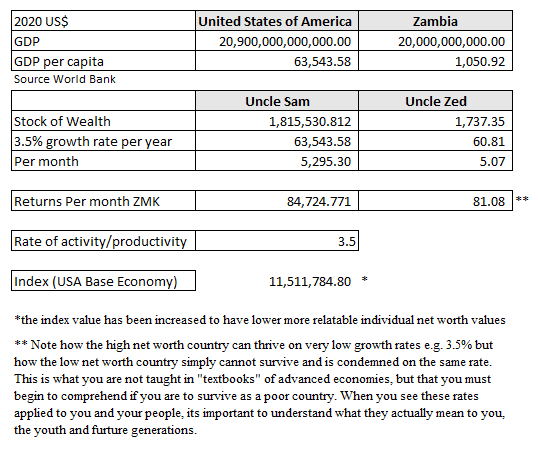
A Financial Advisor would almost immediately recognize the fact that the value of Uncle Zed’s annuity is wholly inadequate and that his financial planning has been improperly assessed. A yield at 3.5% will not work for him. In fact, this advice provided by highly educated experts will condemn him. What is interesting is that this same improper growth rate is what is being advised and proposed by reputable research, monitoring and policy formulation institutes for developing countries like Zambia. In other words these institutes are unable to distinguish between the growth rate appropriate for a developed and developing economy.
The correct and accurate advice from a professional body, advisory or institute would be for Zambia to set aside low growth rates more appropriate for developed economies by implementing a Split Velocity System, more appropriate for a developing economy, to increase its economic activity and thereby its growth rate from 3.5% to 32.8% and above in order to secure the country’s economic future.
In order to bridge the gap between developed and developing countries within a generation or less (10 – 25 years) Zambia needs a minimum annual growth rate of between 32.8% – 48%. This is the identification of the problem. If research, policy and monitoring institutions do not know how to achieve this, it is then their role to engage in study and the research that will identify how to make this possible in order to help government in its effort to serve the country and people, after all research is part of their role and mandate.
Out of his full capacity to work and be productive (100%) Uncle Sam chooses to only apply 3.5% of his effort. He leaves the remaining 97% idle. Uncle Sam recognizes that his net worth is US$1.8 m. In essence Uncle Sam is like a retiree. He has been active for a long time and has accumulated an impressive amount of wealth (US$1.8 m). He can now afford to sit back and do very little (3.5% economic activity or output). From 3.5% he is able to enjoy retirement benefits of US$63,543.58 per annum and live relatively comfortably for the rest of his life. Every month he receives a cheque for US$5,295.30. He is content in his lifestyle, his well deserved lack of activity, low productivity and earnings are the benefits of being retired and he has built universities to teach others how to achieve his success.
On the other hand Uncle Zed is very young, being only a few decades old he has only accumulated US$1,737.35. Uncle Zed admires his good friend Uncle Sam’s income and lifestyle. He has graduated from one of Uncle Sam’s universities and therefore tries his best to emulate how Uncle Sam manages his finances. Since Uncle Sam survives on 3.5% per annum, Uncle Zed, who is able to be 100% productive understandably also decides to apply the knowledge he has learned from Uncle Sam’s university to be advanced like him, he sets for himself, aspires to be and is therefore only 3.5% active.
The table above shows that the outcome of Uncle Zed’s applied knowledge is an annual income of US$60.81. He receives a cheque of US$5.07 per month for the rest of his life. By following Uncle Sam’s 3.5% growth rate and economics or financial methods Uncle Zed will very likely be impoverished for the rest of his life. Every time representatives from developed economies meet Uncle Zed, they give him a pat on the back for aspiring to the greatness of being advanced and developed and are genuinely pleased with Uncle Zed, this is understandable, because it is generally assumed that policy that works for wealthy developed economies automatically works for poorer developing economies. The table above shows that this assumption is flawed.
Realistically, in order to match Uncle Sam’s standard of living and life-style (per capita income of US$63,543.58 and monthly earnings of US$5,295.30) within his lifetime, Uncle Zed cannot have a growth rate of 3.5%, like Uncle Sam. To match Uncle Sam’s income within his lifetime, at his net worth, his growth rate must be a minimum of 32.8% per annum. But when Uncle Zed goes through his textbooks he received from universities from advanced economies there is no information on how any country can achieve an annual growth rate of 32.8%. Even though Uncle Zed is able and willing to work to increase his output and productivity the economic textbooks he reads tell him a rate of 3.5% is the best and should be aspired to. However, this is a rate that works for those who have already accumulated vast levels of wealth like Uncle Sam and it does not work for Uncle Zed, especially that his wife has just given birth to twins, Mulenga and Jelita. He feels he must now see how best to ensure that his children will have better life than his. Everyone can relate to Uncle Zed’s dilemma. He is every bit as capable, smart, ambitious and focused as Uncle Sam, but he is not at the same stage in his life-cycle.
In order to gain a productivity level of 32.8% and above Uncle Zed realizes he has no choice but to ditch textbooks and methods from “advanced economies” because they are made for the wealthy at much later stages in their life-cycle. He must improve upon the knowledge given to him from advanced economies and make it relevant to his own economic circumstances as a vibrant, youthful young man with plenty of energy, but no wealth to speak of.
The professional formulation of growth rates
The table above clearly shows that the practice of ascribing low growth rates suitable for wealthy developing economies to poorer developing countries by research, monitoring and policy institutes is in fact misinformed and can be considered a form of bad advice bordering on a form of malpractice, which becomes more evident when viewed from the perspective of financial advisory services related to pensions and annuities.
The table above shows that to be meaningful to a country the economic growth rate cannot be just an imaginary number or a number that appears to conform with the expectations of economics as it is understood to apply to developed economies. Rather, it must be time bound, targeted and characterized by an objective suitable for the life-cycle stage of the economy. The time frame should ideally be within a generation, that is, 10 to 25 years for its impact to be relevant to citizens of a country living at that time, especially the youth who represent citizens at the peak of their capacity to work and to be active in the economy. The professional advisory on the growth rate a country should have must be targeted, for example, the basic target should be one that bridges the per-capita income gap between countries. In the same way that the table above clearly requires different approaches to managing wealth, the growth rate prescribed for an economy is an immediate indicator of whether an economy is being managed by those who understand the ramifications of their decisions. Even a layperson should be able to see that setting a growth rate of 3.5% for a poor economy, condemns it citizens as surely as it condemns the low net worth individual. Sadly, this is precisely what the state of the art textbooks are instructing professionals managing poor developing countries to do, to the extent that they cannot see anything wrong with the approach they use to manage these economies, which is effectively condemning them to perpetual poverty.
There must be a “ditching of the text-books” if they cannot yield the advice and mechanisms developing countries require for transformation and if they are setting imaginary limitations on what humanity can achieve, after all, no one has a monopoly on knowledge not even the respected authors that shape what is understood about the world today. Where it does not exist the relevant business, economic and financial solution required to bridge this gap within prescribed parameters must be identified through research without compromise. It is not enough to simply predict the growth rate and try to conform with contemporary views. It is necessary to identify the problem and through relevant interventions put in place the mechanisms that will effectively determine the required growth rate. This growth rate must be sufficient enough to bridge the wealth gap between developed and less developed economies in a manner that is time bound and relevant to the generation existing at the time.
A Split Velocity system is the only known method for capturing and recovering as much as 100% of GDP per annum by correcting inefficiencies in the circular flow of income that make it possible to move a developing economy to a developed economy within a generation or less. This is why applying this knowledge to developing economies is not only practical but necessary for ending the seemingly perpetual cycle of scarcity and poverty they face.
It is hoped that by humanizing what an economy is from a country to something more tangible and relatable, like an individual, as has been illustrated above it is easier for laypersons, policy makers and those with knowledge about business and economics to understand why higher growth rates for developing economies is key to their future and low growth rates they have been taught to aspire to will lead inevitably to their exploitation, demise and entrenchment in perpetual poverty. This is the fact of the matter as surely as would be the case for a retiree whose pensions and annuities were improperly advised will face unnecessary hardship and suffering at a time in their lives when being advanced in age makes them vulnerable and helpless to do anything to change their economic circumstances. Setting growth rates and providing an advisory on them should ideally take place with this in mind.
24th October 2021
Happy Independence Day Zambia!
14th September 2021
SV-Tech Resource Mobilization for achieving free education and the 8th National Development Plan goals
The Split Velocity (SV-Tech) system is fully compatible with the role of the Bank of Zambia (BoZ) and is fully covered by the Laws of the Republic of Zambia as follows:
The Laws of Republic of Zambia,
The Bank of Zambia Act,
Chapter 360 of the Laws of Zambia,
Part IV Monetary Units, Notes and Coins,
Section 33, paragraph 2
(2) Whenever the Board thinks desirable, the Bank may, with the approval of the
Minister, issue coins or any denomination for purposes other than monetary use and
designate the same to be legal tender within the Republic and every such issue shall be
publicised in the Gazette and may be further published in such manner as the Minister
may determine.
The Bank of Zambia Act only requires the approval of the Minister of Finance and the cooperation of the Bank of Zambia Governor, for the central bank to proceed institutionally in facilitating the implementation of a Split Velocity system in Zambia.
In order to implement a Split Velocity system in Zambia what is initially required is for commercial banks [including non-bank financial institutions] to introduce a new financial product called wealth creation alongside credit creation (loans) and they will thrive because they have a new financial product from which to earn additional income and the financial system will change from being asynchronous to being synchronous. Businesses will access this new financial product through commercial banks and non-banks allowing output and productivity to increase significantly in the economy due to greater employment of factors of production (which pushes the production possibility frontier to generate new growth). The new financial product will allow businesses to advance the cost equation from Profit = Total Revenue – Total Cost to the more advanced SV-Tech cost equation Profit = Total Revenue = Total Cost that begins to counter financial losses caused by inefficiencies in the circular flow of income (CFI). This allows disequilibrium within the microeconomic system to begin to be balanced and losses due to inefficiencies inherent in the design of the CFI to be recovered. As explained earlier wealth creation is the SV-Tech product distributed through various channels. Split Velocity is protected under copyright [equated to patents] in national law. Split Velocity Solutions Ltd designed the SV-Tech approach and system from the ground up. Its role is the implementation of the new service, quality control, advisory on the new system, change management for institutions, the ongoing monitoring and evaluation of clients on the ground taking on the new service to ensure that their production and activity is contractually in line with the principles required in a Split Velocity model, as well as protecting the intellectual property rights of the new system that allows its export to other countries, which will earn Zambia hard currency.
The distribution structure of the service is envisioned as having a commission or fee structure as follows: the central bank gains a commission from issuing and supplying money into the economy through the SV-Tech system as part of its role in the economy (it currently loses income from issuing money into the economy). In conventional credit creation this is similar, in the monetary policy transmission hierarchy, to a monetary policy rate. This increase in money supply occurs through the SV-Tech cost equation and system and as a result creates growth without inflation. Commercial banks and non-banks earn a commission from issuing wealth creation to their portfolio of clients, just as they do when they issue loans through credit creation. In conventional credit creation this is similar, in the monetary policy transmission hierarchy, to interest rates or the lending rate, except this is not credit creation. Split Velocity Solutions Ltd gains a commission for its operations which include quality control, hands-on advisory, monitoring and evaluation of businesses engaged in the new system. This is the core business and it will be a hands on, labour intensive industry focused on ensuring supply chain factors on the ground and within firms function effectively towards sustaining productivity in the economy, basically ensuring that output meets money supply. The Ministry of Finance gains revenue from increased productivity in the economy through tax collection. These funds finance and increase the size of the budget allowing the government to meet its objectives. Money missing from firms and the economy in general is restored by addressing and recovering unaccounted for financial losses in the CFI.
Issuing a loan or credit creation is basically a simple financial product, however, when applied it yields a tool for managing financial system stability referred to as the monetary policy rate, similarly Split Velocity is basically a simple financial product called wealth creation that yields the same kind of benefits or tools. Wealth creation is designed to be distributed through banks and non-banks and like credit creation it can also be used as a new tool for managing financial system stability, since it provides greater control and dexterity over the velocity of money by being able to determine its direction and how it flows between capital and households. Splitting Velocity between factors neutralizes opportunity cost increasing the work done by money. In addition to this when it is signaled to the economy that the growth rate is being set, as a policy tool, this means that the minimum growth for a fiscal period is essentially guaranteed not to fall below the effected growth rate because, unlike in the past, this growth is not just a hit and miss forecast that is hoped for based on trying to read indicators, it means financing equivalent to a percentage of sequestered GDP will be recovered from losses in the CFI at constant price. Therefore, when SV-Tech is used to project that within a generation the government budget will grow to a certain value, this value will be achieved as a minimum target, it is fact not an assumption, as it is guaranteed by the financing recovered from the CFI required to achieve the objective. Therefore, the ability to set the growth rate is basically another tool for managing financial system stability, that becomes available when wealth creation is introduced to an economy. This is how Split Velocity on the one hand is financial product called wealth creation, yet on the other hand it is simultaneously a tool for managing financial system stability.
Technically the SV-Tech system represents a more powerful and advanced or more complete form of monetary policy that virtually guarantees the value of domestic currency, that is, the Kwacha, remains stable and that economic growth, essential for government objectives to be achieved, remains high. The cost of implementation of the service is paid for by a very affordable annual subscription fee paid by distributors of the new service, who recover this expense when they issue the new service to their clients. The pilot stage can be implemented at little or no cost to government and the central bank. This is a synopsis of how the service will be packaged.
The SV-Tech system will increase the Zambian economy’s growth rate by neutralizing inefficiencies and corresponding financial losses prevalent in the present design of the CFI currently unaccounted for. The recovered financial resources are what are applied to increase economic growth. Economic growth is what generates income and revenue with which to pay off national debt. Zambia’s current domestic and international debt stock can be settled from new growth in the economy within 2 years of the full implementation of Split Velocity. The new growth rate will also increase the government’s debt carrying or contraction capacity allowing it to borrow safely from international markets. These funds and increased activity in the export sector go toward backing the local currency, ensuring growth is protected by maintaining its value (.e.g. US$1:ZMK1 or US$1:ZMK3) with the target of increasing revenue to the national budget to $161.5 billion within a generation (using less than 50% of the resources the new system can raise). With the SV-Tech innovation in place and wealth creation distributed as a new financial product throughout commercial bank and non-bank networks countrywide, there will be a direct control over the growth rate in the economy. Control of the growth rate improves the country’s credit worthiness. Improvement of the country’s credit worthiness guarantees fair access to hard currency. In terms of methodology gaining the ability to have a direct control over the country’s growth rate is the key to the beginning of economic transformation. The wealth needed to do so already exists within the economy, what is required is simply to recover it from the CFI and put it to work in the economy. What makes this approach different is that its methodology is simple, its parameters and outcomes are sound, readily achievable and the results will be rapid. The government is able to achieve transformation with which to serve the country and people of Zambia because it is now projected to work with a budget 20 times larger than its current size over this period. The increased revenues earned by his excellency Hakainde Hichilema’s government would allow it to not only settle current debts with local and international creditors [which may or may not include what is expected will be owed to the IMF depending on whether it is engaged or not, the real risk here being conditions and uncertainty concerning whether this engagement is truly possible and can be depended on or not] within 1-2 years of implementation of the Split Velocity system, but to also implement its objectives which include mobilizing resources for free education, government objectives and achieving the 8th National Development Plan goals for attainment by 2030. Poverty in Zambia will be wiped out naturally within this generation through increased economic activity. These objectives are financed by new growth in the economy. The increased debt carrying capacity of the economy will reassure current creditors and any new credit being sought from local and international institutions of being settled by more robust and more reliable growth in the economy.
The first handful of initial clients of the SV-Tech system will pilot its introduction. Once procedures are ironed out the pilot can then go on to capture productivity in the entire economy, this includes both the private and informal sector. The informal sector will willingly want to become formal and pay taxes because of the benefits they gain from the Split Velocity service that exceed tax obligations. This further increases funds available to the national budget.
The implementation process of the SV-Tech model is very straight forward and it will raise billions of dollars worth of revenue for the Zambian government allowing it have the resources in its budget to achieve every single goal that it currently seeks to achieve in every sector of the economy.
The SV-Tech system is sound, cutting edge economics, it is legal, straight forward to understand and implement, and it complies with the Bank of Zambia Act under the Laws of Zambia.
……..
Quick Links 1
……….
6th September 2021
Impossible is Nothing: Free Education and Resource Mobilization for 2030

When it comes to resource mobilization for Zambia the Split Velocity system (SV-Tech) offers 3 scenarios for generating resources for the national budget. Acceleration of the Zambian economy by 10%, 20% and 42.5%. None of these rates of acceleration are impossible to achieve.
The resources with to achieve this are recovered from inefficiencies in the current design of the circular flow of income (CFI).
……….

government expenditure and planning
with which to meet national objectives
The upper curve in red at $161.5bn should be normal growth for any economy
where poverty is being completely wiped out, where
industry and businesses are thriving. Citizens in Zambia enjoy an ever
improving standard of living. There is no unemployment.
Losses and inefficiencies in the CFI are corrected.
(The economy is using less than half of
the resources for growth available to it.)
.
The bottom curve where GDP is at $8.6bn is for the economy
in its current state, where the CFI is left unchecked. The growth rate is
mediocre at 3%. The economy is losing tremendous
value and productivity currently unaccounted for in
neo-classical economics.
What this means is that there is tremendous hope for Zambia,
a chance to wipe out poverty and usher in an age of
prosperity and unparalleled transformation.
For explanation and a legally admissible examination of how the Split Velocity system works, scroll down below. At a rate of acceleration of 42.5% the SV-Tech leaves 57.5% of the resources available to the system untapped. The SV-Tech system methodology guarantees growth targets will be achieved.
If no effort is made to advance national economic management the average growth rate for the next 10 years for Zambia is expected to be approximately 3%, should there be no further unexpected shocks to the economy such as covid-19. This is shown by the black curve in the graph above. Expect persistently high levels of unmitigated poverty, no significant changes in standard of living and per capita income over this period. This is the current expectation, in terms of economic performance, without accelerated growth. Growth and poverty levels will worsen due to increased population size over this period.
At a 10% rate of acceleration the resources available to the national budget will grow to US$15.42bn after 10 years
At a 20% rate of acceleration the resources available to the national budget will grow to US$33.94bn after 10 years
At a 42.5% rate of acceleration the resources available to the national budget will grow to US$161.5bn after 10 years
The recommend rate of acceleration is 10% – 50%
See the table below
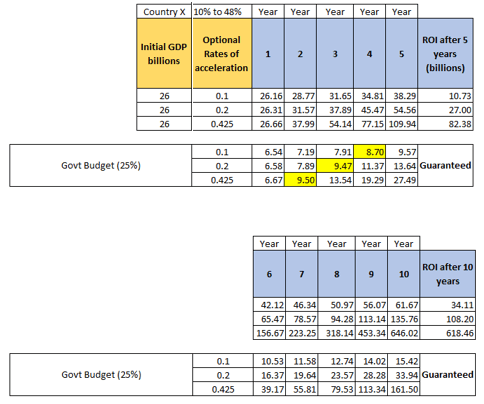
Resources available to government for budget expenditure is maintained at 25% of GDP.
Note that even at a rate of acceleration of 42.5% the SV-Tech system leaves 57.5% of the resources available for resource mobilization in the Zambian economy untapped.
The SV-Tech system is able to also maintain the exchange rate that is desirable by the Central Bank (BOZ) and can even achieve dollar parity US$1 to ZMK1 if this is deemed conducive for the economy.
The SV-Tech is a proprietary, no non-sense system designed using cutting edge approaches in economics and business to ensure that resources are mobilized for government objectives. It is essentially a tool or system for application and implementation primarily through the Central Bank.
Don’t waste time on outdated approaches to national development that have been used over and over without results.
Guarantee a future for the youth and keep the promise to secure their future.
For information on how this national economic management system was conceptualized and designed please feel free to peruse this website.
………..
14th September 2021
No need for “Trickle Down” economic theories
When a Split Velocity (SV-Tech) system is introduced into an economy, primarily by the central bank as the lead recipient institution, there is no need for trickle down theories concerning the distribution of income for the wealth that will be generated in the national economy.
The SV-Tech system is likely to be the only approach in business, finance and economics where the adage – “the rising tide lifts all boats” is true and genuine. SV-Tech is backed by and able to generate resources equivalent to GDP per annum for sustaining national development. This is not a trickle, but a strong flowing river, that brings important resources into an economy capable of lifting the standard of living of the entire population.
Problems of concern in the past such as the rich having too much and the disadvantaged having too little will no longer be a problem because they really only have meaning in resource constrained, scavenger economies seen in both the developed and developing world today where scarce resources are permanently grafted into the economy by hidden losses in the CFI. In this type of economy, no matter what strategies NGOs, international development agencies, government and the private sector do to mitigate against scarcity it cannot be done away with because it is an invisible part of the CFI. Income inequality will generally have little meaning in an economy managed on an SV-Tech system due to the fact that every citizen will have access to a reasonably high standard of living.
The problems that tend to characterize resource constrained economies such as jobless youth, general unemployment, low wages, people begging in the streets, children abandoned and forced to fend for themselves on the roadside, homelessness, lack of access to education, inadequate health services, slums, bankruptcy, high levels of credit risk, debts people find themselves unable to settle, rampant failure of businesses, low success levels for entrepreneurs, low levels of investment in the arts, sports and philanthropy, the inability to exploit natural resources and so on. All of these problems arise from the fact that the CFI is destroying 100% per annum of useful economic resources and human activity is only able to recover as little as 3% to 4% of growth on average in GDP per annum, whilst being led to believe by development agencies and policy makers that a 3%-4% growth rate is an astounding achievement, when in fact it is dismal and beyond mediocre.
If you understand this as a layperson, accountant, lecturer, student, lawyer, entrepreneur, leader or professional in any field, then it should make sense to you why human suffering and economic malaise continues to plague so many countries and negatively affect so many people to this day, despite extensive research, case studies, structural adjustment programs and interventions implemented by international organisations focused on development.
It should also make sense to you that the ability to use Split Velocity to recover as much as 100% per annum of these resources that are currently being dissipated and wasted for nothing other than just a defective and inefficient CFI, will have a transformative impact on the lives of the people who are suffering in your country.
……….
Quick Links 2
- Theory in contemporary economics
- Gold Standard
- Understanding how Split-Velocity compliments credit creation
- The Efficiency of Money
- Losses caused by subtraction
- Basic rules for planning development
- The need for stimulus: Monetary Policy
- Ministry of Finance
- Economics Association of Zambia
- Accelerated economic growth: Wa lala, wa shiala
- Reconciling Keynesian and Monetarist approaches
- Demand and Supply what do you really know about them?
- The Grand Myth about market forces and growth
- The advantages of managing your economy on an SV-Tech system
- The genuine reason why countries remain poor
- Ending poverty by default
- Is covid-19 the problem? Identifying the real epidemic
- Why we recommend SV-Tech
- Split Velocity is the best defence against shocks to the economy
………
25th August 2021
A New Dawn
Transformation In One Generation : 2030
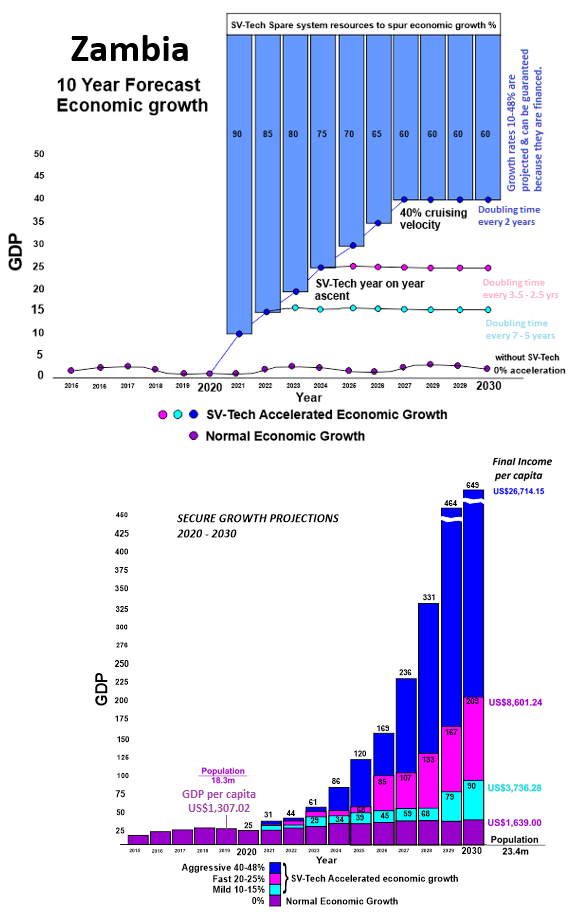
………..
1st October 2020
How SV-Tech Addresses Hyperinflation Paranoia
Usually printing or creating money and introducing it into an economy is shunned, ostracized and viewed with tremendous suspicion due to the fact that it is known to cause unwanted and unmanageable inflation, as has been witnessed in some countries recently such as Zimbabwe where the currency had bills denominated in trillions. Hyperinflation paranoia can be described as a sometimes irrational phobia that believes any form of increase in money supply and printing money will cause hyperinflation.
The fact that printing money is cheap, and for all intents and purposes the fact that introducing it arbitrarily into an economy makes it worthless because it will just cause inflation or hyperinflation, are in fact very important and useful characteristics of money that make it highly effective for accelerating economic growth.
You have to put your counterintuitive cap on to understand how what the public generally considers the worst traits of money, that is, being cheap, having no intrinsic value and being worthless because it causes the chaos of hyperinflation should it be over supplied actually make money a very useful resource. To do this you have to stop thinking of money as a store of value and think of it more as a natural resource or as just a raw material. When you elevate your view to seeing money as raw material, being unwanted because it is inflationary and cheap because it has no intrinsic value means it is a raw material that can be acquired at very low cost. If money were expensive this would be counter-productive to its utility value as a catalyst and means of accelerating economic growth.
The circle below represents money supply in Country X’s economy.
There are a number of ways a central bank can increase money supply. If a government is cash strapped and desperately in need of money, for instance, to pay salaries, buy fuel, pay off local and foreign debts, keep its operations going, the central bank may simply print money and use this to pay for government expenses. This is the worst use of money and will rapidly lead to inflation and hyperinflation which cause chaos in a national economy.
The other option is for the central bank to increase money supply by reducing the cost of borrowing by lowering the monetary policy rate. This will make credit cheaper and will place more money in the public’s hands. There will be more money in the economy potentially chasing fewer goods and services. Like printing money to pay bills or cover operations, this can cause a rise in inflation.
The other option at the disposal of a central bank is to use government instruments such as bonds and treasury bills to borrow from the public. Government instruments will tend to have high interest rates to make them attractive and will be purchased predominantly by institutional investors, such as commercial banks. Firstly, when the central bank raises these funds and begins to use them to pay bills and pay for government operations the impact of this will be more money chasing fewer goods and services and the rate of inflation will rise.
Secondly, when government instruments mature the central bank will have to honour its debt to subscribers of government instruments. Since the interest rates on these instruments were high, when the central bank honours its creditors money supply floods back into the economy, once again creating a condition in which more money is chasing potentially fewer goods and services. The consequence is more inflation.
Inflation takes money out of the pockets of every citizen in an economy, reducing their wealth, and the value of their earnings, they have to work harder for less. It makes life harder for citizens and is essentially a sinister betrayal of their trust. However, it is a soft option because most people are ignorant of how the value of their labour and purchasing power is being eroded because earnings stay the same while prices persistently rise.
The diagram below shows money supply increasing while goods and services in the economy remain constant. At this point the central bank is rapidly losing its control over the economy and financial system stability as the domestic currency depreciates with its operations. As a consequence, it must now look to the treasury for foreign exchange to act as a shield for a collapsing national currency.
The disadvantage of this approach is that it will put a strain on the treasury’s import cover.

If the central bank and monetary policy committee continue to apply these approaches, they can inevitably move the economy from creeping inflation, to full blown inflation and eventually into full blown hyperinflation that plunges a country into chaos should foreign exchange reserves and earnings fail to hold fort. As shown in the diagram below persistent increases in money supply can lead to hyperinflation, where too much money in the economy is chasing too few goods.
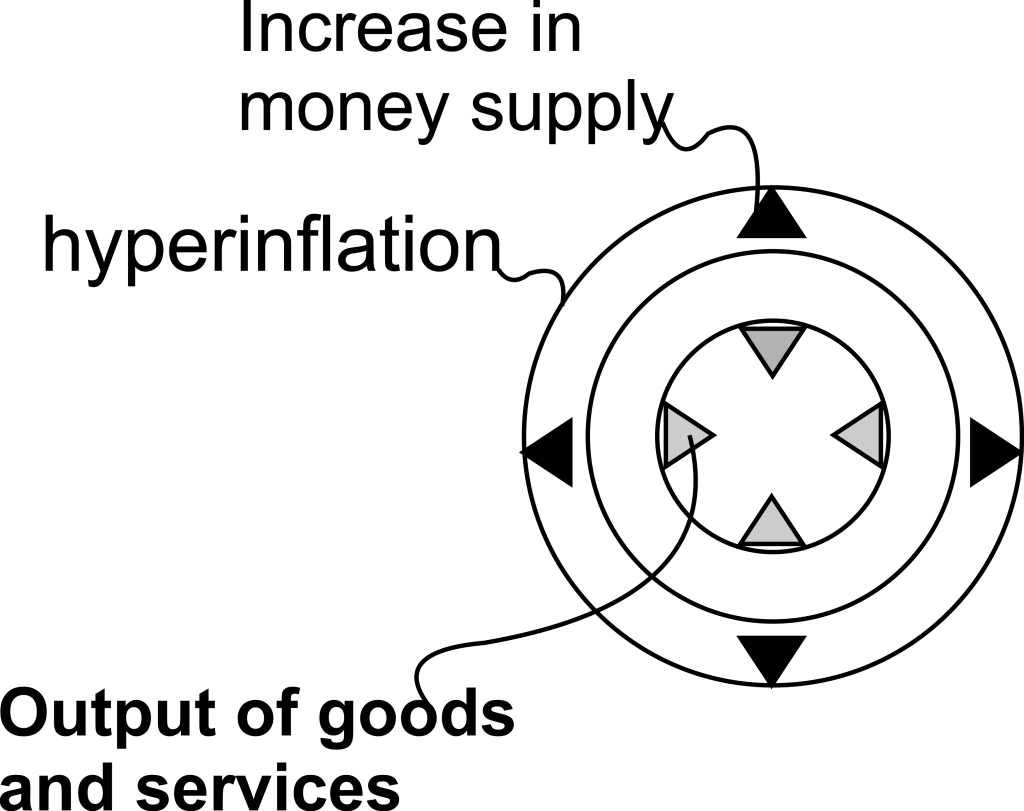
At this point the only device protecting the economy from hyperinflation is foreign exchange in the treasury and forex earnings from exports.
How Split Velocity (SV-Tech) accelerates economic growth without any inflation
To begin with Split Velocity (SV-Tech) applies its unique method to managing money supply. What SV-Tech does, is that it first increases the work money has to do in the economy. Inflation is a symptom of money being “lazy” or functioning inefficiently in an economy.
………

SV-Tech changes some accounting procedures and instead of one task at a time (linear transactions) SV-Tech requires money to perform more than one task per transaction, it thus splits the velocity of money. SV-Tech upgrades the cost equation from Profit = Total Revenue (TR) – Total Cost (TC) to Earnings = Total Revenue (TR) = Total Cost (TC), which forces money supply to work much harder. This causes money supply to shrink, contract or fall as shown by the smaller circle below.
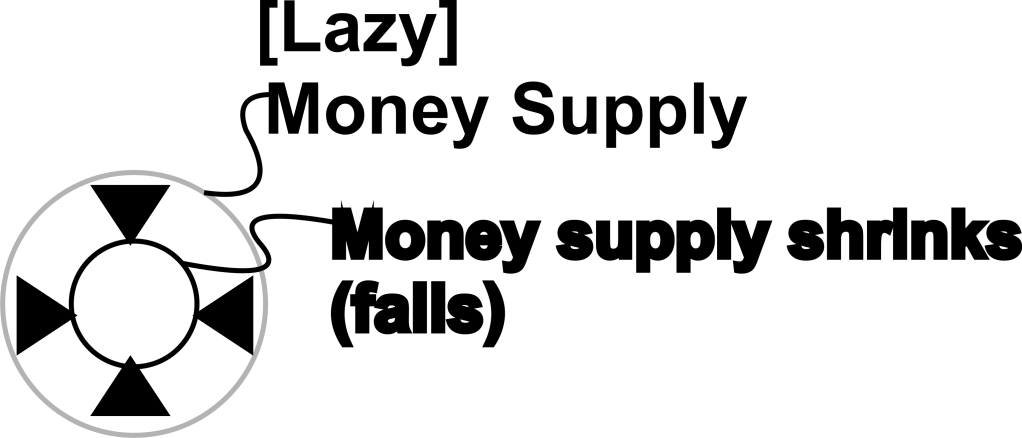
Money is now working harder to produce goods and services in the economy. Government has more money for its operations and for paying debts, firms have more income and are able to start to increase their output, exporters are generating more forex from increased sales/exports, firms are able to pay back their loans with commercial banks etc and take on bigger loans due to improvements in their creditworthiness. Note that at this point of implementing SV-Tech the central bank has not printed any money, it has not made any changes in the monetary policy rate, it has not issued government instruments. It has not done any of the activities that potentially trigger inflation in an economy at this stage, which are still available to it at a later stage when the economy is more stable. In fact, all it has done is increase the operating efficiency of money in the economy by requiring chartered accountants in firms to upgrade the cost equation in their public and private sector operations.

Government has funds to pay its debts, its has money to run its operations, money supply has shrunk not increased, firms have resources to pick up the pace of productivity, exports are increasing significantly as exporters in every industry operate in a more effective financial system, the output of goods and services increases to the extent that it is greater than money supply, the economy is functioning more efficiently and this causes the domestic currency to appreciate in value against the dollar and other hard currencies. The economy is beginning to boom.
Note that even with these dramatic changes in the economy the central bank still has not applied any of its policy tools. It has not printed money, and it has done nothing to increase money supply.
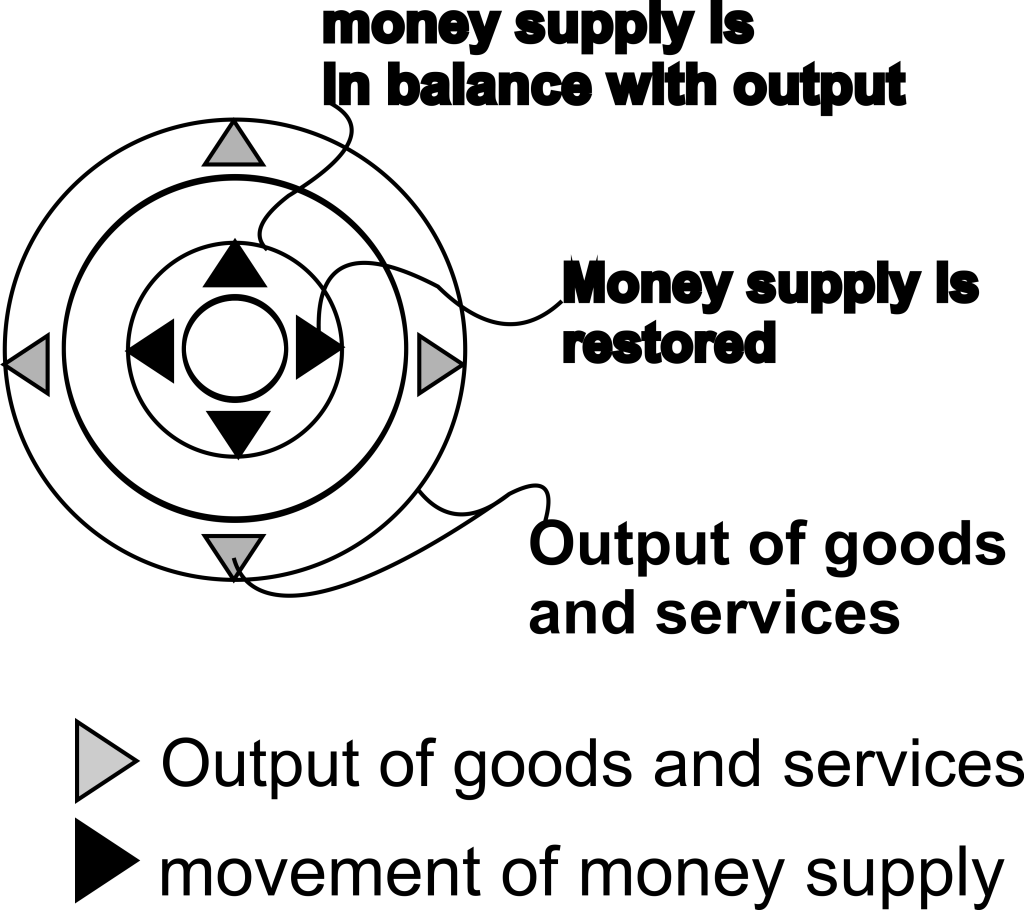
However, as shown in the diagram above goods and services in the economy are beginning to put pressure on money supply, in other words there are too many goods and services beginning to chase too little money in the economy, the local currency is appreciating to undesirable levels. Only at this time does the central bank ease this pressure by relaxing money supply using all the tools available to it including government instruments and reducing the cost of borrowing. The SV-Tech system allows money supply to settle at a predetermined growth rate, that is, 10% to 48% growth in GDP per annum. This new extraordinary growth is made possible by the SV-Tech upgrade to the cost equation firms introduce through accounting procedures that allow no unnecessary losses to the circular flow of income (CFI).
The central bank is now in full control of the economy, the value and exchange rate of its domestic currency. The economy is performing extraordinarily.
Using the SV-Tech system at no point in time during the implementation scenario described above, was there a threat of inflation or hyperinflation. These threats only remain with current “state of the art” methods being applied to manage the national economy described at the beginning.
………….
24th September 2020
Guaranteed Results……..
In one generation.
Accelerated growth can play a significant part in getting businesses back on their feet and pulling people who lost jobs during the Covid-19 induced slow down back into full employment. Businesses large and small, in any sector, including the mines, can also be rescued with this new system.
………
27th August 2020
Split Velocity offers Hope for Recovery
We tried to forewarn and inform about the weaknesses of current strategies.
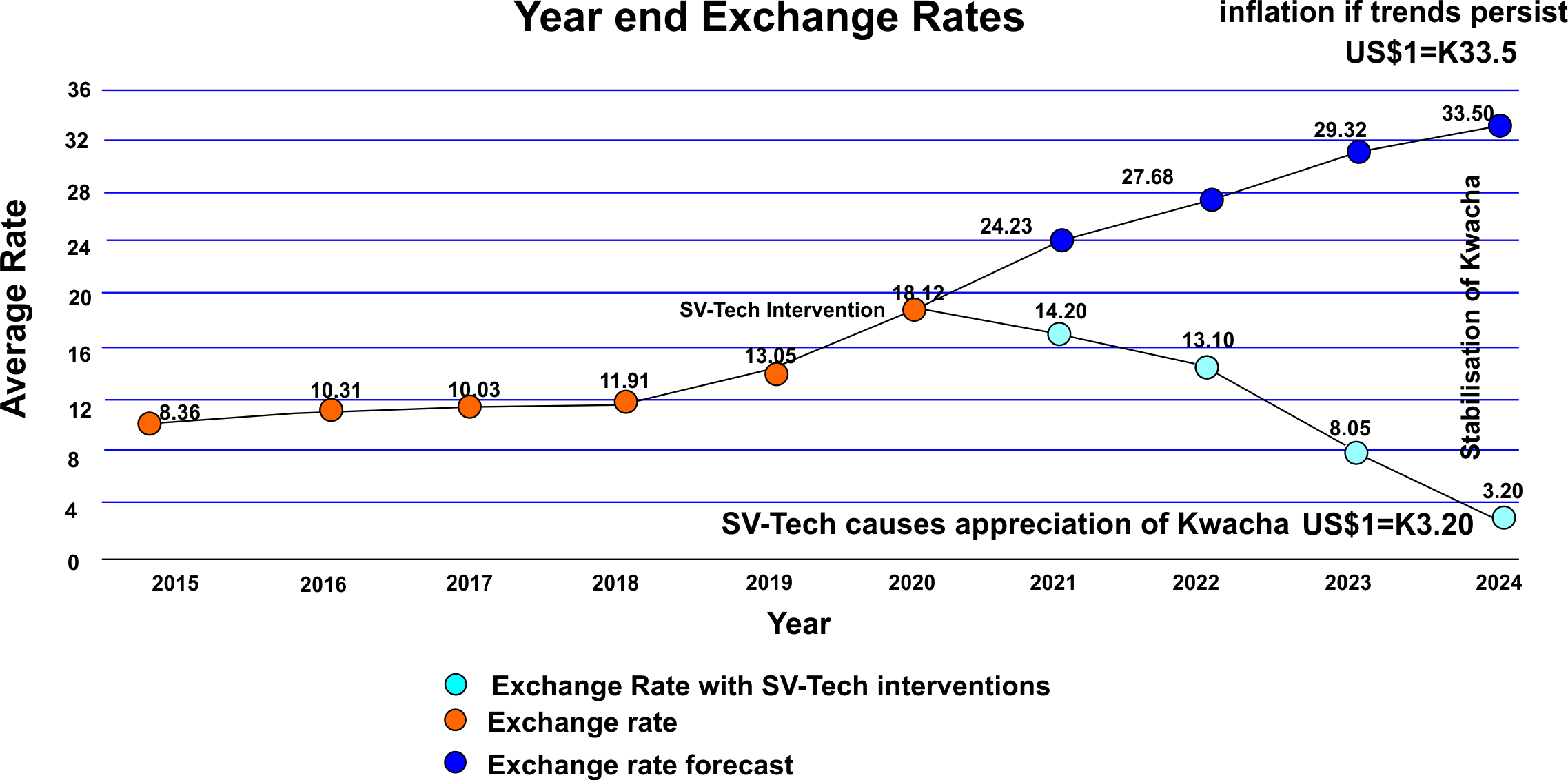
On Tuesday 25th June 2019 [a year ago] under the heading “Ending poverty by default: A challenge for this age” [scroll further down to read this] we alerted the central bank to the inadequacy of applying conventional monetary policy strategies initiated by the monetary policy committee at the time. An economy facing stagflation that is at the limits of its borrowing capacity (Zambia is at 70%) is generally out of options. Its only recourse is to find a benefactor to borrow from. It was hoped and it is still hoped one would be found for Zambia and being patriotic, like everyone else, we still hope this works out.
However, textbook approaches to economic management do not work for developing countries due to the fact that they are generally created for Western models where economies are wealthier and have access to hard currencies. For developed countries to doggedly follow the same style of management as developed countries when developing countries do not have hard currencies and are resource constrained rather than resource endowed does not make sense, in fact it defies logic. It is also important for African nations to be wary of the fact that even state of the art theories and understanding of economics in the world today applied by developed nations has not advanced to where they have identified the unconscionable and pointless waste or loss of income caused by a poorly designed circular flow of income.
Developed countries, at least by contemporary standards, are wealthy. This is evident in their much higher GDP and per capita incomes. Therefore, their primary concern for decades has been how to contain this wealth and not lose it. This has subconsciously influenced the knowledge paradigm that is economic theory today. Since the objective is to contain wealth, the focus is not wealth creation. Even mediocre annual growth rates are sufficient to maintain the status quo of existing wealth. Mediocre growth rates of 4% or 5% are sensible in the context of the huge sums in GDP they are applied to. It explains why they have never identified losses due to inefficiency of the CFI. They have never had a need to identify methods for rapid or accelerated growth. Developing countries are poor. In comparison they have much lower GDP and per capita incomes. Nevertheless, they implement the very same knowledge paradigm for economic theory and confidently pursue the same 4%-5% growth rates applied to insignificant GDP and therefore unsatisfactory economic gains that perpetuate their own underdevelopment whilst leaving them wondering why poverty does not seem to end. Since they don’t have any wealth to contain, what they are in effect containing and sustaining, in state of the art practice, is their own poverty perpetuated by a knowledge paradigm that believes slow or mediocre annual growth is accurate, worth aspiring to and they mistake this position for conventional wisdom to live by.
Resource constrained countries struggling with underdevelopment, poverty and debt simply cannot sit back and allow these lapses in theory and the valuable resources that could be put to good use laid waste, further ravage their economies. If this is the path that remains and continues then more inflation, underdevelopment, an unmanageable economy, difficulty and suffering may be the inevitable result. Nevertheless, there is always hope and ways to navigate the economy toward prosperity can be strategized.
Applying a Split Velocity system for managing a national economy is ideal for developing countries like Zambia because it assumes the nation has no resources, must rely on its own ingenuity and act within its own capacities. SV-Tech assumes any country applying the methodology is resource constrained and therefore must find alternative ways of generating its own internal financial resources to enhance productivity whilst maintaining price and financial system stability.
A Split Velocity model unlocks the equivalent of GDP at constant price. This revised strategy would unlock the equivalent of up to US$26 billion for the Zambian economy (that is, the equivalent of GDP per annum) as well as new monetary policy tools with which to wrestle the Zambian Kwacha from US$1 – K18 back down to US$1 – K1 if this kind of parity was desired by the central bank. It would do this with results gained in record time.
Unlike other strategies, though unconventional, a Split Velocity model is safe, guarantees its outcomes and is grounded in sound financial practice and productivity. Most importantly it is self-reliant, countries do not have to look for a benefactor to help bail them out of crisis, they can use their own tenacity and initiative to raise the resources they need sustainably to transform the lives of citizens.
It is important to note that even with current development strategies the forecast per capita income for Zambia in 2030 is US$1,639.00 – US$2,185 (MoF). This is an alarmingly low increase of US$300 – US$878 after 10 years of economic activity – (a gain of US$87 per year -Zambia may not meet the 7NDP goals and may be worse off in 2030 than it is today, except with a much bigger population notwithstanding unanticipated shocks for which there is currently little or no capacity for mitigation). There is a need to address what realistic difference a per capita income gain of only US$87 a year for 10 years will make in people’s lives, especially if there are unexpected shocks as a risk factor along the way, before this time is lost and can never be regained. On the other hand Split Velocity offers per capita income advances over the same period of up to US$26,714.15 per capita with guarantees, no unnecessary losses to inflation that make results redundant and provisos inherent within the system to deflect shocks to the economy that may interfere with objectives.
Let it be noted that this change in per capita income only deploys 42%-48% of the resources . made available by the Split Velocity System. In other words it does not stretch either the resources or imagination of this technology and its capacity to transform the Zambian economy. The only barrier is the mindset of technocrats. In fact the straight forward capacity of developing economies to achieve these results is demonstrative of how far behind the learning curve developing countries and managers have fallen by trying to implement approaches more suitable for wealthier economies than their own.
This means that a Split Velocity system continues to offer hope as a means that can be deployed for transforming the economy especially in the wake of unexpected shocks. It leaves no ambiguity as to where the resources are with which to achieve these gains. This is achieved without even maximizing or exhausting the resources generated by the Split Velocity system. It is not peddling fairy tales or fantasies, and is not based on guesstimations but provides hard facts and mechanisms for achieving results that will not disappoint implementors in both developed and developing countries.
See the tables below to see how much developing countries in Africa are losing daily and annually to an inefficient and faulty economic operating system in the circular flow of income (CFI). The recovery of these resources could be used to transform lives.
………..
………..
23rd June 2020
Enhancements SV-Tech can bring to the SDR system
A Split Velocity system manages price stability and is capable of wiping out chronic inflation for governments that struggle with either a depreciating or appreciating currency. The table below highlights the benefits SV-Tech can bring to the Special Drawing Rights (SDR) system.
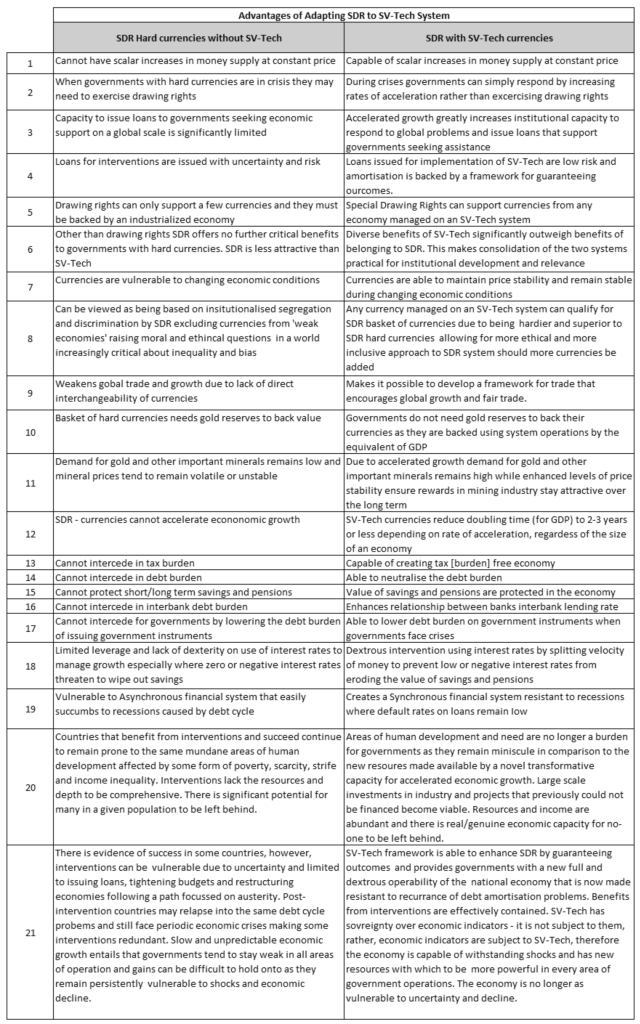
………..
8th June 2020
Discerning if Innovation and Technology adds Value to Precious Metals
nn

The options for maintaining price stability being observed here are innovation and technology (e.g. SV-Tech) as opposed to precious metal (e.g. gold). Which is the most useful?
If you have performed the Instruction Set for a Legally Admissible Empirical Test for Split Velocity then you have successfully evaluated Split Velocity by way of empirical test.
Let us now compare SV-Tech (Split Velocity) to Purchasing Gold as a means of maintaining price stability.
The Instruction Set for the Empirical Test revealed a money supply deficit equivalent to GDP [-(B+C)] caused by subtraction. It was further noted that this represented a correction of money supply and not an increase in money supply. Therefore, this enables a correction equivalent in domestic currency value to GDP at constant price.
This means that the empirical test shows that the Split Velocity system is able to support, hold or maintain the Zambian exchange rate, for example US$1 to K5 or US$1 to K1 by the equivalent of GDP per annum or US$25.8 billion in 2018. In essence SV-Tech allows a domestic currency to behave like and gain many of the attributes of a hard currency, a system that has never been possible prior to SV-Tech or achieved before in central banking history. In fact, even in terms of the scalar increase of money supply, an IMF reserve currency cannot be used to increase money supply in this way at constant price (without inflation). Furthermore, the supply of gold cannot be increased on a scalar level, at constant price (because the price of gold would fall as a result of over supply). In this regard a Split Velocity system outperforms both gold and hard currency, a feat currently regarded as impossible or improbable. Consequently, where credibility and currency stability are concerned it even outperforms the Special Drawing Rights (SDR) reserve currency system presently in use by the International Monetary Fund (IMF), which is much weaker than a Split Velocity system.
SV-Tech is at the very cutting edge of the Fintech space. The SDR system was introduced in 1969, a period when emoney, internet banking, debit and credit cards, cryptocurrencies and tech based financial innovations did not exist, therefore it should come as no surprise that innovations in the Fintech space will inevitably evolve that can achieve the same objectives as the SDR and that encourage a more inclusive approach to how currencies are managed and appraised. At the technical level, the fact that it can be demonstrated that where price stability, economic strength and reliability are concerned, a currency managed using a Split Velocity model outperforms a currency in the SDR system should be good news in that it complies with the merits for which the SDR system was created and exists in the first place. This development will allow for less discrimination when it comes to how domestic currencies are viewed.
For any central bank in the world, to be able to back its domestic currency with the same strength as a Split Velocity system it would have to be able to purchase and hold gold per annum equivalent to its annual national GDP. (To add some perspective to this, not even the United States Federal Reserve Bank has the capacity to back the US dollar at this level, to do this, it would have to upgrade to a Split Velocity System).
This means that for the central bank to be able to back the Zambian kwacha and exchange rate with the same capacity as Split Velocity, it would have to purchase and hold US$25.8 billion worth of gold and maintain the equivalent in GDP in gold as a reserve. ZCCM-IH and mines in general in Zambia are unable to produce this much gold, and even if they could produce and supply it, government could simply not afford to buy it all.
In addition to this, depending on market conditions, the price of gold rises and falls forcing a central bank to ride unpredictable trends, whereas a Split Velocity system maintains price stability even while economic conditions rise and fall. A Split Velocity model, when used to manage a national economy, is not subject to economic indicators, rather, economic indicators are subservient to a Split Velocity model. For instance, it does not wait to see what economic growth will be experienced, it sets and guarantees the growth rate.
Frankly, when it comes to price and financial system stability, gold and other precious metals need Split Velocity to maintain and sustain their value by sustaining higher levels of economic growth and maintaining a stable national economy. When it comes to financial system stability, this is one condition in which innovation is the more advantageous option.
Its important to understand that natural resources and mineral wealth are not a panacea for economic growth and national prosperity, the thought and strategy must delve much deeper and move far beyond this obstacle by appreciating that any price stability or grandiose economic benefit that any precious mineral like gold or other natural resource could deliver for the country would have already been delivered by copper, by now. There is a need to push beyond these limitations with the understanding that some countries with no natural resources have industrialized and formulate a strategy that scrutinizes the operational structure of the systems in place by which development objectives are achieved.
To discover minerals such as gold and other precious minerals is always beneficial to a country and its people and should receive as much attention and support as possible. An innovation like split Velocity ensures that gains from discovering and exploiting mineral resources are protected by a stable financial system where the demand for mineral resources being supplied by mining companies is kept robust by healthy levels of guaranteed annual growth. We live in a technical age in which innovations like SV-Tech represent safe hands when it comes to the direction to take towards creating a better life and a better world for the youth, without leaving anyone behind.
Mining and precious minerals are cardinal to development, have their uses and should be invested in, nevertheless, for a central bank, anywhere in the world, purchasing gold as a way of trying to maintain financial system stability, is in no uncertain terms, simply no comparison whatsoever to deploying a Split Velocity system.
The raw power, dynamic capacity for growth and agility of finance in a Split Velocity system means that any country managed on this system can enjoy the benefits of a domestic currency that performs at the same level of stability and reliability as that of a hard currency backed by a fully industrialized economy and with less of the kind of volatility seen in the currencies of developing economies.
The mechanisms it innovates to be able to do this are fairly easy to demonstrate.
When reference is made to a need to advance the knowledge paradigm in economics, finance, accounting and business it should be emphasized that retraining is required to understand the counter-intuitive processes of a Split Velocity system. For instance, if a student graduated today they would still be trained to believe the CFI is efficient and lossless. However, the empirical test for Split Velocity clearly shows that the CFI is dysfunctional and inefficient in a manner anyone, even laypersons, can see and understand, and it is creating monetary and fiscal instability, makes global poverty inherently unmanageable as well as costing governments billions of dollars.
Similarly, the generic tutelage in finance is that an increase in money supply will cause inflation, or the over supply of any product such as gold will cause a drop in price. If a student graduated from university today this is what they would believe. However, we can provide an empirical test to teach and demonstrate, even to laypersons, that a Split Velocity model allows increases in money supply to take place at constant price. Instead of inflation the economy experiences the inverse, that is, economic growth. No currency in the world today, not even that of industrialized nations or even a precious metal can maintain price stability in this way. This is very important for developing countries because it means in a Split Velocity system the domestic currency can technically perform more efficiently than any present day reserve currency belonging to an industrialized nation.
These are just the facts. Developing countries should not believe they are trapped by poverty and circumstance. Prosperity belongs to all nations and all people, not just a select few. The knowledge paradigm is key.
Most importantly, by acting diligently and expediently, this means that it is possible today to guarantee the youth a future without uncertainty, with opportunity and economic independence, not as a lofty or empty promise, but with a working strategy that will deliver within this generation.
…………
3rd June 2020
Instruction Set for Legally Admissible, Empirical Evidence Based Test for Split Velocity
1.1 This is a simple empirical test for law firms that will be admissible in a court of law before a Judge concerning systemic losses in income due to a defective economic operating system identified in the Circular Flow of Income (CFI) of a modern economy.
1.2 In addition, this empirical test is for CEOs, Directors, Managers, Lawmakers, office bearers and other leading implementors in organisations to ascertain, succinctly explain and provide justification for their decision to implement a Split Velocity system to a wider audience.
12.1 This test uses Zambian Kwacha, however, examiners are at liberty to replace this with the currency of their choice – K.
Empirical test diagram
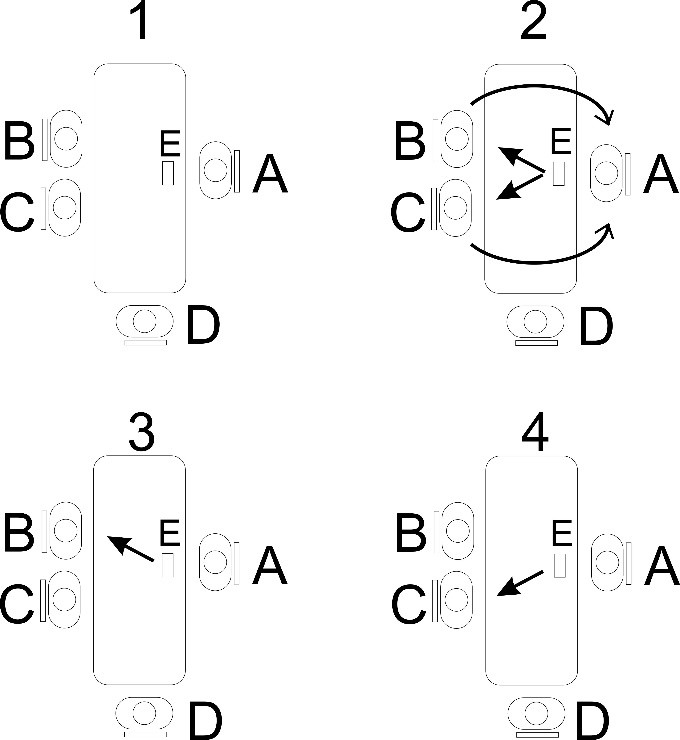
1.3 KEY:
A – Test subject A: the Firm
B – Test subject B: Non-human capital (factor of production)
C – Test subject C: Households (human capital)
D – Test subject D: (Auditor*/Central Bank/Reserve Bank/Federal Reserve Bank)
*An auditor (e.g. KPMG, Grant Thornton, PWC, Deloitte&Touche, McKinsey & Company, Boston Consulting Group etc) or other competent firm/person can be used for this part of the exercise)
E – Stack of 10*K100 notes/Representative of Money Supply & Circular Flow of Income
K – Your currency e.g. Rands, British Pound, Yen, Yuan, Shillings, US dollar etc (use appropriate denominations)
Diagram 1: National economy with simple CFI
Diagram 2: Flow of money between the firm and households
Diagram 3: Allocation of income to non-human capital
Diagram 4: Allocation of income to human capital
1.4 Perform the Empirical Test using the test subjects:
- Set the test subjects as shown in the diagram. Test subjects A, B & C represent an economy or simple circular flow of income.
- The first test that should be performed is for the movement of money in the circular flow of income (CFI) or economic operating system (EOS) of the contemporary economy (CE).
- The auditor should make note in the ledger provided that test subject A holds 10*K100 notes amounting to K1,000.
- Have the auditor record the revenue held by test subject A
- Instruct test subject A to allocate 6*K100 notes to test subject B which amounts to K600. This represents 60% of the income originally held by test subject A.
- Have the auditor record the revenue received by test subject B
- Instruct test subject A to allocate 4*K100 notes to test subject C. This amounts to K400. This represents 40% of the income originally held by test subject C.
- Have the auditor record the revenue received by test subject C
- Have the auditor record the total value of money held by test subjects B & C
- Have test subjects B and C return the money they held back to test subject A
- Have the auditor record the revenue received by test subject A.
1.5 The test subjects represent a simple economy and the money moving between them a simple circular flow of income.
1.6 The value of output in this economy is K1,000. (The K1,000 income test subject A holds represents GDP).
1.7 Test subject A represents the firm. When he allocates K400 to test subject C this represents the firm’s payments to labour which consists of 40% of its total income.
1.8 When he allocates K600 to test subject B this represents 60% of the firm’s income allocated to capital. The duration it takes for the K1,000 distributed by the firm or economy to the factors of production (test subject B and C) and back to test subject A represent 1 year.
1.9 What this simple empirical test shows is that the value of income circulating in the economy between firms and factors of production remains constant at K1,000. This is a measurement of GDP over time [yearly periods] and what, to date, is currently understood in contemporary economics (CE) or Neo-classical Economics where the simple CFI is considered efficient and lossless.
1.10 We will now examine the same economy under the scrutiny of operating level economics (OLE) from the book the Greater Poverty and Wealth of Nations (GPWN) where the CFI is considered an economic “operating system” whose outcomes can be used to identify inefficiencies and financial losses they bring about in an economy. By correcting these inefficiencies these financial losses can be recovered and used to configure an economy to yield any results desired by which to improve economic performance. Recovering these financial losses from the inefficient and defective CFI provides new resources put to use in a more effective system for managing a national economy. This examination includes an analysis of the CFI using the standard analogue approach, which is over time, but delves deeper by including a digital analysis, that is, an analysis of the operations of the CFI at any point in time.
- Have the auditor record the revenue held by test subject A
- Instruct test subject A to allocate 6*K100 notes to test subject B which amounts to K600. This represents 60% of the income originally held by test subject A.
- Have the auditor record the revenue received by test subject B
- Instruct test subject A to allocate 4*K100 notes to test subject C. This amounts to K400. This represents 40% of the income originally held by test subject C.
- Have the auditor record the revenue received by test subject C
- Now have the auditor record the income that test subject A allocated to test subject C as income denied (a loss) to test subject B. This loss is referred to as Subtraction or Implosion.
- Now have the auditor record the income that test subject A allocated to test subject B as income denied (a loss) test subject C.
- Let the auditor add the total income lost by test subject C and test subject B in the final year column.
- Have test subject B&C return their money to test subject A.
- Let the auditor now add the year end income with the year end loss. Using this data let the auditor record the net economic gain after 1 year of economic activity. The result for this should be Zero.
1.11 What we have demonstrated with this simple empirical test of a simple CFI is that at the end of the year it experiences a loss in income or value equivalent to the money in circulation or GDP (100% of GDP) that is not accounted for in contemporary economics (CE). It is identified when the utilization of finance in the CFI is measured at any point in time rather than just over time.
1.12 Since we know that K1,000 is a measure of the value of output in the economy (GDP) this also represents a loss of goods and services worth K1,000 effectively dropping the productivity of money to a ratio of 1:0, that is for every K1 in circulation the yield or value of output is 0.
1.13 Businesses cannot survive in this condition created by the CE architecture, they therefore add price mark ups to their products in order to escape this architecture’s attempt to [shut them down] push them down to Zero profits.
1.14 In essence businesses naturally operate at a productivity ratio of 1:1, that is, for every K1 worth of GDP moving through the CFI they should expect a yield of K1 worth of output or growth, but instead, because of subtraction, despite their rate of productivity remaining constant at 1:1 what they experience is a yield of 1:0, nothing or no yield. This is why the present day neo-classical or contemporary economy (CE) is referred to as a Zero Growth economy.
1.15 Businesses therefore have to escape [the flawed CFI] the economy to survive. If their yield is 1:1.04 the economy will only grow by 4% because (1:1) 100% of their productivity will be eroded by the inefficiency of money caused by a dysfunctional CFI. This loss is currently not accounted for in neoclassical economics (CE) but is corrected in operating level economics (OLE) identified in the GPWN. It is the reason why modern day economies annually experience what can be described as mediocre GDP growth rates below 10% per annum.
1.16 Correcting Subtraction: The (SV-Tech) Split Velocity of Money
1.17 At this point you should now understand that in a system run on Split Velocity the productivity ratio for money is 1:1. This means that for every K1 moving through the operating system or CFI there will be a yield of K1 worth of output or GDP. For this segment of the test you will need two stacks each with 10*K100 notes. The first stack will represent money currently in circulation. The second stack of 10*K100 will represent raw money. (In total K2,000 will be required for this empirical test).
- Give the first stack of 10*K100 notes to test subject A
- Have the auditor record the revenue held by test subject A
- Instruct test subject A to allocate 6*K100 notes to test subject B (Non-human capital) which amounts to K600. This represents 60% of the income originally held by test subject A.
- Have the auditor record the revenue received by test subject B
- Instruct test subject A to allocate 4*K100 notes to test subject C (human capital). This amounts to K400. This represents 40% of the income originally held by test subject C.
- Have the auditor record the revenue received by test subject C
- Now have the auditor record the income that test subject A allocated to test subject C (Non-human capital) as a deficit in money supply and income denied (a loss) test subject B. This loss is referred to as Subtraction or Implosion.
- Now have the auditor record the income that test subject A allocated to test subject B (human capital) as income denied (a loss) as a result of a deficit in money supply for test subject C.
- Let the auditor add the total income lost by test subject A and test subject B in the final year column. This amount represents the systemic financial losses caused by operational inefficiencies in money supply created by the CFI of the contemporary economy caused by a money supply deficit.
- Now let the auditor take K400 from the income he was given to hold and give it to test subject B this represents a correction or restoration of money supply or income missing from the system. This is a correction [not an increase, since there is a pre-existing existing deficit] in money supply and it will take place at constant price.
- Let the auditor also take K600 and allocate this money to test subject C. Let him record the introduction of this money into the economy or simple CFI. [Split Velocity: The allocation of money to test subject B&C by the auditor who represents the central bank, reserve bank or federal reserve in this test corrects the money supply deficit, recovers the financial losses and repairs the inefficiency allowing money to move in two directions (Split Velocity), that is, to test subject B&C simultaneously restoring the systemic financial losses caused by the operational inefficiencies in money supply when allocations are made to the two factors of production by the firm.] It is important to note that this is a correction of money supply [not an increase in money supply, since there is a pre-existing deficit it does not represent an increase]. It will take place at constant price (growth without any inflation). The economic growth is pre-existent in the economy, it is simply not realized because the money supply to qualify it is missing from the economy as a consequence of subtraction. Technically, this means the correction of money supply in and of itself is not what causes growth, this growth is pre-existent in the national economy. However, it is lost when the inefficient CFI fails to balance money supply by countering subtraction and the yield or output as described earlier in the ratio of 1:1. This is why a Split Velocity model is counter-intuitive since when a perceived increase in money supply [correction of money supply] is observed, instead of a rise in inflation, the general price level remains constant and there is instead an increase in output or growth. In the empirical test B&C experience a deficit in money supply due to subtraction. The money supply is introduced to fill this deficit, it is not introduced as a surplus – with no real increase in money supply there can be no increase in price and therefore no increase in inflation.
- Now let the auditor take stock of the results after this correction of subtraction/implosion has been made. Let the auditor add the financial gains and make note of the total new year end financing which should consist of original GDP from year 1 plus the new financing made available by correcting the systemic deficit in money supply caused by subtraction. GDP after 1 year of augmented Split Velocity applied to the national economy to recover financial losses in the CFI should now be K2,000, that is, original GDP of K1,000 plus the additional GDP generated by correcting subtraction using augmented Split Velocity, that is, an additional K1,000 bringing the year end productivity or GDP to K2,000 at constant price.
1.18 This very simple empirical test can be extrapolated to any economy in the world to find systemic financial losses induced by operational inefficiencies in money supply caused by a dysfunctional or defective CFI. As can be identified by this empirical test, these losses are real and can be audited to provide evidence that can be used in a court of law. They are equivalent to GDP. Every economy in the world today experiences this real loss in revenue or useful financial resources that could have gone to education, health, the budget, paying off government debt, building massive infrastructure, ending underdevelopment, poverty and unemployment etc Instead countries lose this income, duly recorded by auditors in the simple empirical test, as pure waste to nothing more than a defective CFI. This flaw in the CFI costs governments billions of dollars worth of useful income every day, year in year out. As brought into evidence in the first part of the empirical test, this loss is hidden, unseen and currently unaccounted for in neoclassical economic theory (CE). These losses in income caused by subtraction in the dysfunctional CFI are therefore generic, unaccounted for and experienced by every economy in the world today. These losses are directly responsible for loss of life due to insufficient access to services, and critical resources such as medical supplies, chronic poverty, unemployment and general strife experienced by citizens on a daily and annual basis.
…………..
It should be noted that these inefficiencies identified at both macro and micro levels create an ongoing deficit in money supply that causes disequilibrium within firms between capital and households. This is money currently missing from the accounting processes and balance sheet of firms the absence of which is identified by the audit process. The restoration of this income to the balance sheet is strictly not regarded as surplus income, subsidy, endowment or grant to firms because it is the removal of a structural deficit by way of the correction of the CFI leading to the restoration of missing income owed to firms, required by firms for the normalization of productivity and the effectiveness of their day to day operations. The absence of this income can be characterized as ongoing “financial malnutrition” leading to a mediocre or low economic growth rate that is causing stunting which is hampering or crippling the effectiveness of their operations. On the macroeconomic level and where monetary policy is concerned it is not an increase in money supply since audit reveals this money is missing from the CFI, and it is therefore a mandatory correction of money supply and a correction of relevant economic indicators which includes the normalization of GDP, growth and output levels in an economy.
1.19 Credit creation does not prevent subtraction. If injections and withdrawals from credit creation, taxation and government expenditure were added to move this CFI from simple to complex these finances would still circulate through businesses and subtraction would continue to take place making it redundant to add these to the simple CFI.
1.20 This method has been deliberately used to test through experimentation or a repeatable test how an inefficient CFI or operating system causes unseen financial losses to any modern-day economy. This simple method is ideal for this empirical test as it is easy to understand and can be digested by both professionals and laypersons of economics, accounts, finance and business. To apply this test to Country X swop K1,000 with Country X’s (your country’s whether developed, middle income or developing) current GDP.
1.21 Using the same basic principle that the simple K1,000 GDP replica economy we created for test purposes and its CFI was able to be financed by correcting subtraction, we will use the Split Velocity system to raise financing equivalent to GDP for country X (i.e. K249.6bn or $25.8bn) per annum, at constant price for the Country X economy. The funds the Split Velocity systems recovers from the inefficient CFI for country X exceeds all of country X’s current liabilities including both its domestic and international debt (US$14.7 billion) which could be paid off easily by upgrading the country X’s economy to a Split Velocity system. A debt liability of US$14.7 billion (60%) of GDP is nothing in comparison to the capacity of country X to recover as much as US$25.8 billion or the equivalent of GDP per annum from losses to the defective CFI for which evidence in provided in the empirical test.
1.22 A simple and effective empirical test that can be replicated in any setting
1.23 As much as we realise that much more sophisticated methods of testing, mathematics, statistics, equations and models are available and can be used to qualify what we have demonstrated here, it is felt this complexity would not be helpful as it would merely make a system that can be easily explained using basic fundamentals difficult to both convey and understand to laypersons. A simplified explanation divulged in an experiment, as has been provided here, that can be repeated for empirical analysis is expedient to express the required empirical evidence in a manner that is succinct and that can be understood by a wider audience which gasps simple functions of allocation, expenditure and loss .
1.24 We estimate that the daily losses to Country X’s economy caused by subtraction in 2018 at US$68.8m (K825.6m) per day. This represents a loss in finances that should be put to work in the economy. It represents loss of income for businesses. This is income that is taxable when recovered and it therefore represents a significant loss of revenue for government. These resources can be recovered to mitigate against the challenges currently faced by the Country X. It is therefore recommended that this condition receive immediate action by the Central Bank and National Treasuries/Ministries of Finance.
- There is a Legal basis and moral imperative for Split Velocity
2.1 A Legally admissible evidence based empirical test
2.2 This empirical test of a simple CFI can be introduced in court before a judge anywhere in the world as evidence of systemic financial losses caused by operational inefficiencies in money supply. Having been made aware of these losses, it is the legal, moral duty and fiduciary responsibility of office bearers to act to prevent, mitigate against and recover these losses.
2.3 No court, congress or parliament of law givers, anywhere in the world, would allow financial resources, on the scale being lost by the modern-day CFI to continue.
2.4 A simple CFI is representative of exactly the way the national economy operates. The losses observed in the empirical test are the very same losses being incurred by the national economy. Since these losses are systemic and caused by operational flaws they can be easily rationalized, analysed and empirically assessed by a simple model.
2.5 When a government makes a switch from the current neoclassical economic system to a Split Velocity system the changes and improvements in the economy will be profound.
2.6 No economy in the world today knows what its like to live and be active in an economy in which scarcity (as a systemic problem caused by inefficiencies in the CFI) has been removed or neutralized.
2.7 An end to poverty and strife caused by scarcity is anticipated.
2.8 A dramatic improvement in the quality of life of citizens is expected when this transformation occurs. The tables below show the current losses being incurred by African nations due to a dysfunctional or defective CFI. As demonstrated by the empirical test, the losses in the tables are not hypothetical losses, they are real financial losses that can be audited.
2.9 An Asynchronous financial system makes it exceptionally difficult to manage and repay debt for both individual borrowers as well as governments. A dysfunctional CFI offers a technical explanation for why despite debt cancellation through initiatives such as HIPC and access to domestic and international credit with which to create growth the flawed CFI places countries at a high risk for finding themselves back in distress when they try their very best to steer and manage a national economy toward prosperity for the people. It is also important to understand that the financial resources recovered from subtraction move an economy from having an Asynchronous system in which demand for credit is low and the default rate is high to having a Synchronous financial system where the demand for credit is much greater but is balanced by the growth in the economy required to amortize loans, thereby causing a reduction in the default rate and lower risk in the banking sector (to see Understanding why Split Velocity complements Credit Creation 26th May 2020, below click here). An SV-Tech system involves counter intuitive processes, and for some (even though they may have graduated very recently from university and other higher institutions of learning – at the highest or any level of qualification), retraining may be required for the outcomes to be clearly grasped.
………
Income loss to African Regions due to defective CFI
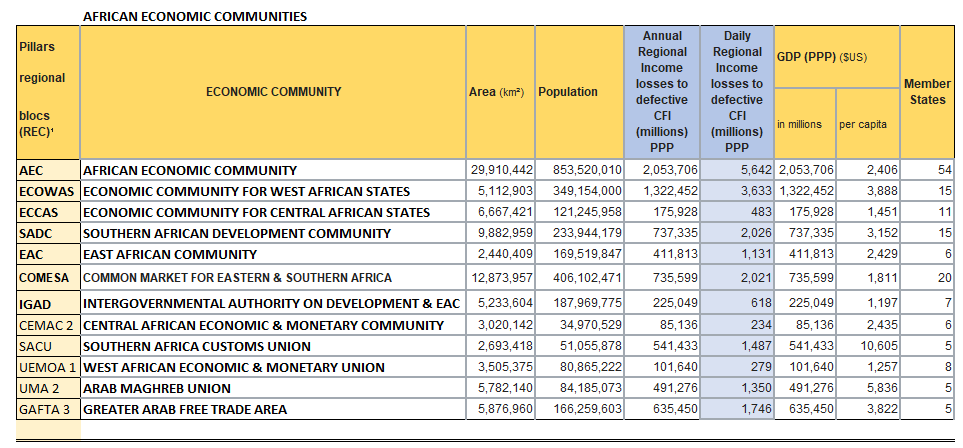
As mentioned earlier, these are not hypothetical or theoretical losses in revenue, these are real losses in revenue that can be verified using accountants and auditors, and by a simple empirical test as demonstrated earlier.
Losses to regional African governments due to a defective Circular Flow of Income (CFI) are alarming and there is a moral and legal imperative that these losses, having been identified, are mitigated against.
The fact that a poorly designed or defective CFI creates a daily loss of income for ECOWAS member states of US$3.633 billion (PPP) per day, SADC US$2.026 billion, African Economic Community (AEC) US$5.642 billion per day, COMESA US$2.021 billion per day is cause for concern.
These losses in income, that could empower governments to do more in terms of development and be applied to better the lives of the citizens of these regions, are cause for concern, especially in light of the fact that many African nations grapple with poverty, debt management problems and resource constraints. The fact that they are caused by a defective CFI and can be corrected with intervention makes it imperative that action to stem this loss in useful income be addressed by correcting the CFI.
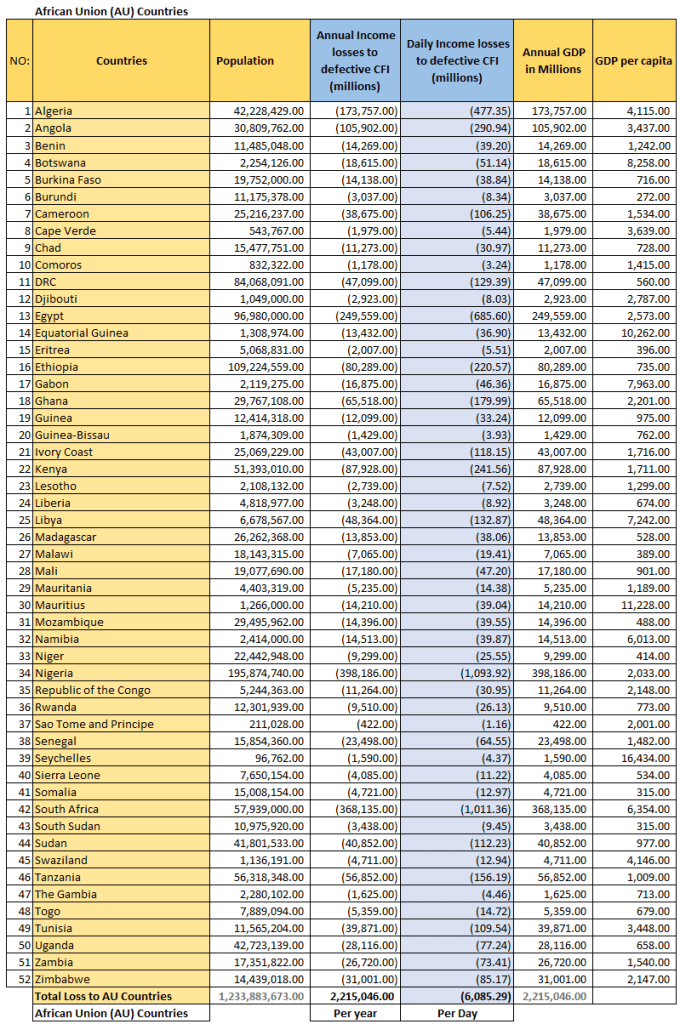
a Panamax every single day. The comparison to Panamax is made here to emphasize
to African leaders the loss in infrastructure development.
Countering these losses using Split Velocity (SV-Tech) can be used to solve many of the problems related to scarcity African countries face. These losses and their recovery provides a conclusive cause and solution concerning why African nations, despite political emancipation have struggled with persistent underdevelopment and with attaining economic liberation. Using SV-Tech this final frontier will be achieved.
The wealth that the SV-Tech model will bring African nations and their citizens will not only be profound, it will bring about a transformation unlike any other.
………
26th May 2020
Understanding why Split Velocity complements Credit Creation
When governments, businesses and people borrow from local banks and international creditors their spending power or income improves. However, since these are loans there comes a time when the debt must be paid back. To pay back debt debtors must dig into their income to settle what they owe, which means they may have little disposable income left.
There can be ongoing analysis and debates on debt accumulation and amortization. Unfortunately very little attention is paid to systemic weaknesses pre-existent in the financial system that negatively skew the capacity of governments, firms and households to manage debt. One of these weaknesses is the debt cycle, its tendency to compromise amortization and its capacity to trigger unnecessary recessions when growth in a national economy encounters a bump in the road. Continuous borrowing over time and repayment creates a debt cycle, as shown in the diagram below:
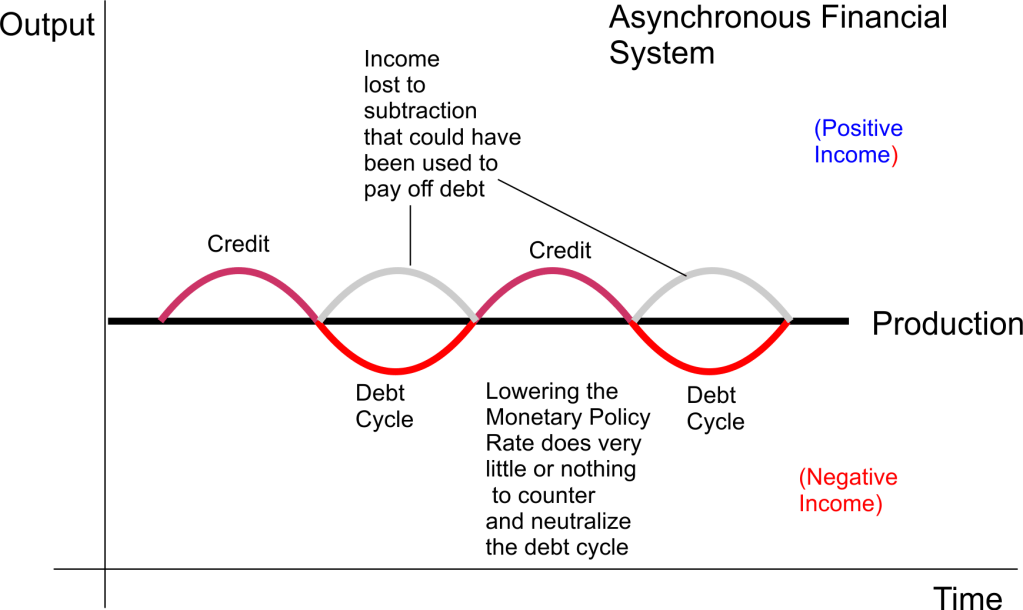
The relationship between credit and debt is Asynchronous since when credit is taken, debt is paid back at a later date. When borrowers pay back debts they experience a loss of disposable income. Its as though this income, which goes to settling debt does not exist to the household’s microeconomy and to governments domestic obligations. When we lift income lost to subtraction as shown by the gray arcs in the graph the Asynchronous relationship (shown in the red curve) becomes more visible. If we approach this the way we view epigenetics in the study of the structure of DNA (like DNA the underlying systemic or operating structure of an economy can make some of its outcomes predictable such as high default rates and recurring recessions), in essence it means that despite being visible sections of DNA are inactive. This inactivity or lack of activation, like subtraction in the circular flow of income (CFI) at the operational level, creates an imbalanced or Asynchronously functioning double helix or economy. As shown below with nothing to counter-balance the red curve (or single section of a helix) the economy becomes prone to debt related problems, such as those being experienced by a country like Zambia in 2020:
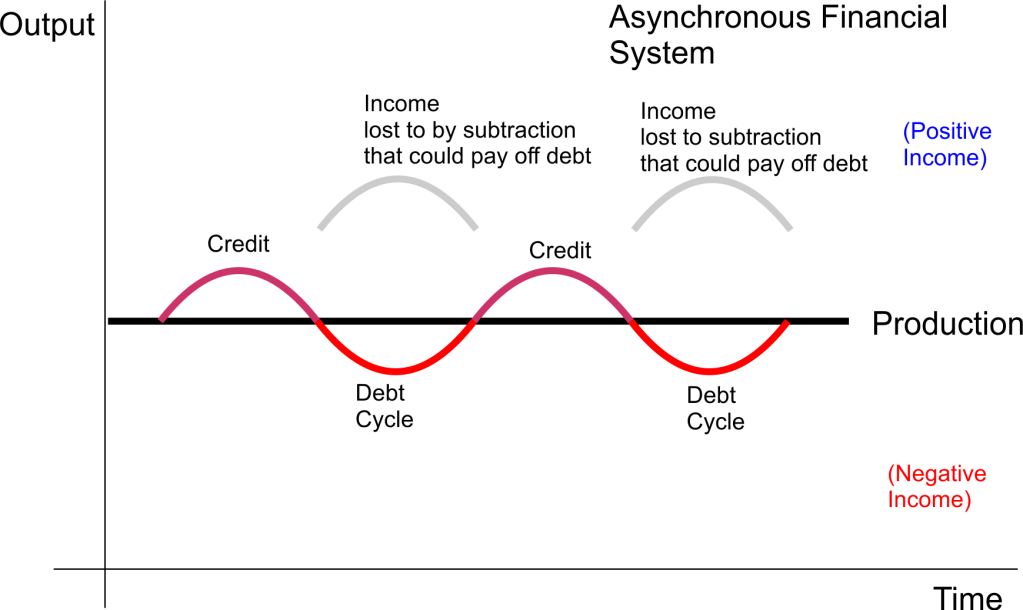
The Asychronous debt cycle curve above shows that if the amount of credit issued in the economy is equal to the principal owed and paid back at a later date then technically credit creation is injecting the equivalent value of money it receives. Therefore, the productivity curve is a straight line. Technically this means that credit creation is not directly responsible for economic growth. However, it is a common fact that debtors don’t just pay back the principle, they also pay interest on loans. This entails that credit creation during the debt cycle withdraws more money from productivity than it gives out. If this is the case, the weight of debt on the productivity curve or GDP is heavier thereby weighing down on rather than aiding economic growth.
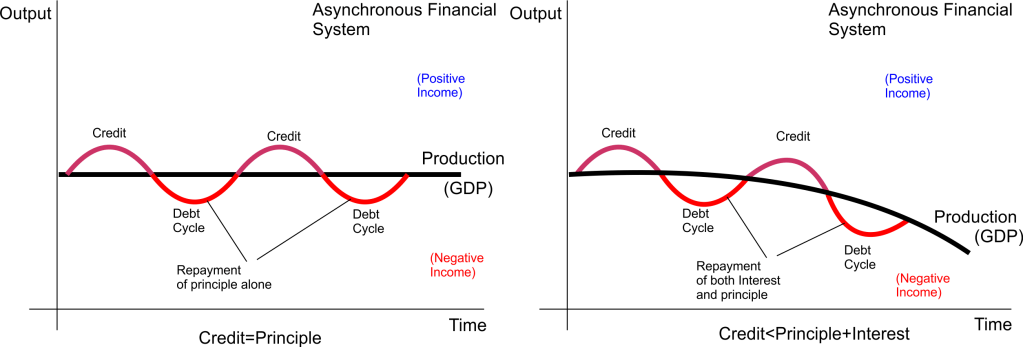
In an Asynchronous financial system for the economy to grow firms must
overcome the weight of the debt cycle in order for GDP to rise. If the
Return on Investment (ROI) is lower than the debt burden the economy
will experience negative growth. Technically, this illustrates
that though credit creation gives firms money for investment
it does not create economic growth, businesses have to work for this growth
against the weight of debt, uncertainty and risk prevailing in an economy. This explains
why Split Velocity is a critical piece of the puzzle required by the banking industry
expedient to how governments manage the national economy.
Split Velocity (or wealth creation as a financial product when experienced by the end user) works hand in hand with credit creation to create a much better performing environment for loans because it pushes growth, minimizes credit risk and reduces uncertainty in the financial sector, which is what credit creation needs to function properly allowing it to consistently create positive rather than negative growth.
When we introduce SV-Tech (Split Velocity) to an economy what it does is it restores the income being lost to subtraction. This means that income that government, businesses and people are losing that could be used to repay debt can be replenished or restored. During the periods in the cycle when government, businesses and households have no income to pay off debt this vacuum can be covered by income recovered by Split Velocity. This changes the economy from being Asynchronous and prone to debt cycles to being Synchronous and resistant to the negative impact of the debt cycle, thereby bringing an end to recessions triggered by debt. This neutralizes the default rate (rate at which loans become non-performing as a result of debtors being unable to repay their debts.)
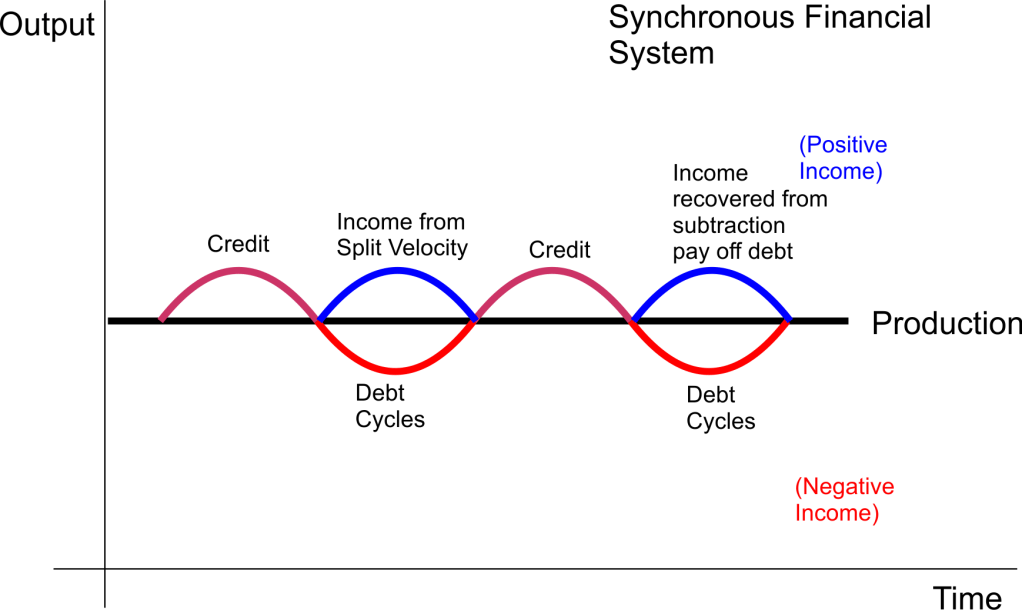
debt with the income gained to repay it consequently
protecting commercial banks from defaulting clients.
The income gained from correcting subtraction increases the credit worthiness of borrowers. The consequence is that they can now take on more debt. An SV-Tech system naturally leads to an increased demand for loans due to the fact that creditworthiness (rather than desperation or desperate circumstances) is what increases the demand for loans; government, businesses and people feel comfortable about taking on more debt due to the fact that they feel more capable of paying it back. The activation or increase in debt contraction is shown in the diagram below:
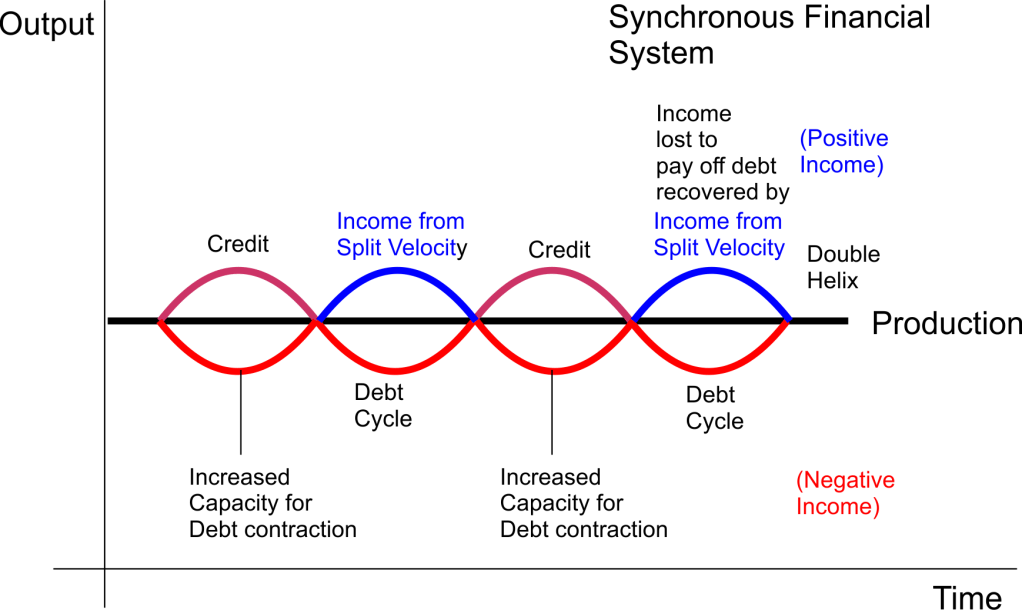
The effect of disharmony between strands (the operational level of the economy), the upper and lower structure or tension between income available for amortization and debt has a negative impact on output or the productivity curve as shown in the diagram below. When government, households and firms are unable to pay back debt because they do not have the [Synchronous] income the default rate rises pushing the economy and banking sector into deeper crisis. The negative consequence is a downward sloping production curve as goods and services remain on shelves due to a drop income caused by debt servicing or productivity slows due to debt not being amortized. This creates a catch 22 in that whether a debtor like government pays its debt or not there are negative repercussions. This pushes debtors to try to borrow yet again, now out of desperation, through government instruments, commercial banks or multilateral institutions such as the IMF. In essence, the sad reality is that the systemic problem that exasperates amortization of debt that helped create these hurdles in the first place is not being addressed. An Asynchronous financial system is poorly designed, inefficient, generally unhealthy and inadvertently makes it difficult for economies to manage debt.
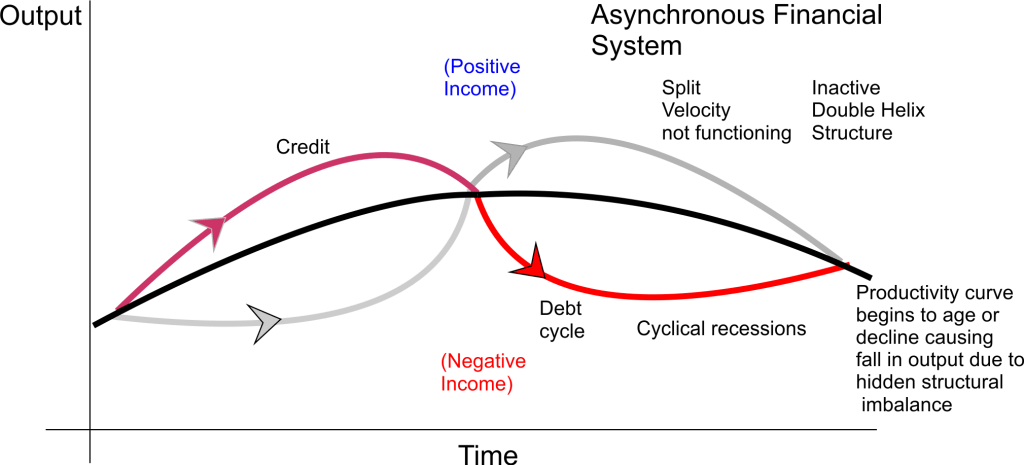
The Asynchronous nature of the economy and its impact on the production curve (GDP) is shown more clearly below. The negative impact of debt drags down productivity and output begins to decline because it is not being balanced with the productivity levels that finance amortization.
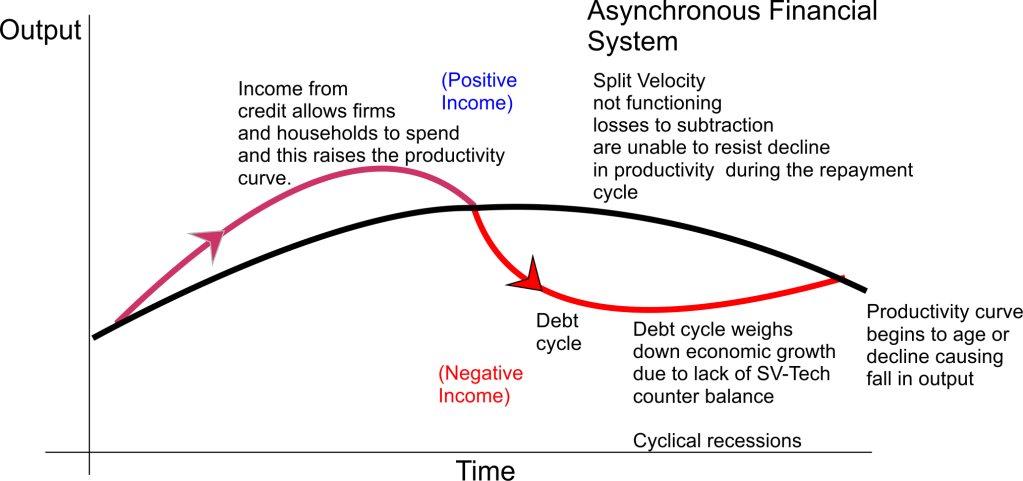
The diagram above shows that the central bank lowering the monetary policy rate is not always an appropriate stimulus for an economy facing a downturn as it tends to add more weight to the Asynchronous downside of the economy at a time when both firms and households are reluctant to borrow because they are afraid the deteriorating economy may hamper their ability to amortize loans. (This is like pouring more water [debt and inflation] into a half empty lake (recession) where people are drowning, in the hope that more water will make them better swimmers.) However, when Split Velocity is introduced to an economy it harmonizes the [Asynchronous] imbalance between credit and debt (upper and lower structure of the economy). By making it Synchronous this ensures that there is no income vacuum during any period in the short term or long term when income is required for servicing loans. The result is, instead of a decline in confidence in the economy, confidence rises and growth instead begins to increase leading naturally to a rise in demand for loans from commercial banks as shown in the diagram below. Government also faces no difficulty in settling its debt obligations with local and international creditors and can do so without disrupting domestic economic activity.
This demonstrates that SV-Tech is a far more powerful tool for getting an economy out of a recession and triggers a greater demand for loans from commercial banks than the central bank lowering the Monetary Policy Rate alone even to its lowest level (filling the lake with more water), which is likely to have the negative side effect of causing higher levels of inflation while an economy is already struggling with a downturn. The success of rate cuts such as this are firmly dependent on how the economy will perform in the future. The SV-Tech system alows the central bank to achieve the same objective without uncertainty and without causing any rise in inflation.
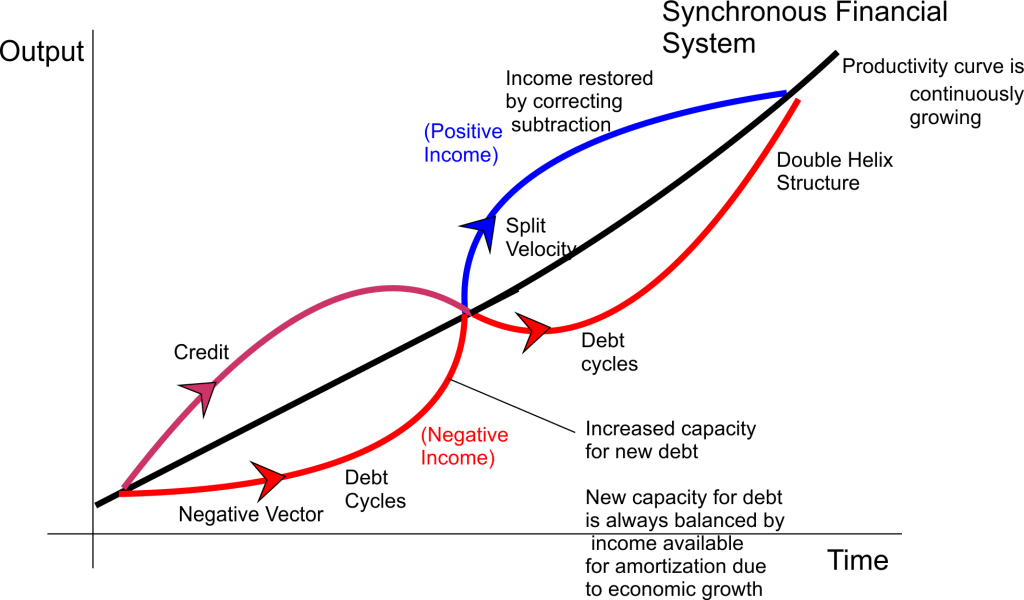
economy to amortize debt is persistently backed by
economic growth. In other words whenever commercial banks
issue credit the growth required to ensure the economy has
the capacity to repay it grows with the debt burden. This creates
a much safer economic environment for creditors as it has a low propensity
for default .i.e. for non-performing loans.
The diagram above demonstrates that when commercial banks begin to operate in an economy managed using Split Velocity economic growth remains resilient and consistent to the extent that there is rarely a vacuum in income required to service loans. In an economy managed using an SV-Tech system growth is guaranteed and predictable using projections. Therefore, commercial banks, by knowing the growth rate in advance, can determine safe levels of credit to issue in the economy. These safe levels will be much higher than those available today. At present commercial banks issue loans with no real idea of how the economy will perform. They have to rely on prevailing economic conditions, indicators or unreliable forecasts and never really know how the loan portfolio will perform. SV-Tech mitigates against the risk of issuing loans. This is why SV-Tech (or wealth creation to the end user) compliments credit creation. Wealth creation and credit creation are complimentary products that ideally should function in the same space to ensure financial system stability. However, Split Velocity is for now missing from this space.
8th May 2020
Growth in Government Budget over 10 years
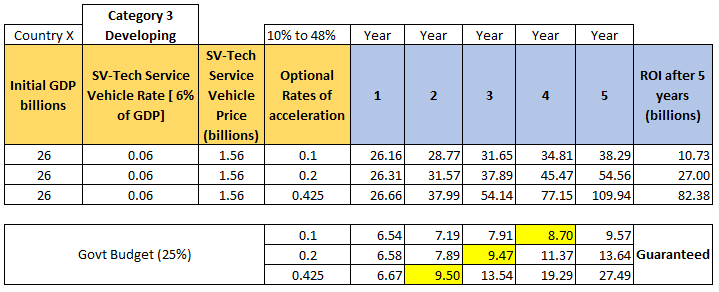
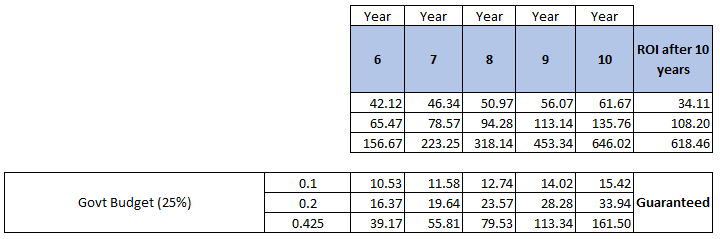
On a Split Velocity system at the highest rate of acceleration
which is recommended for developing countries, by 2030
government has 26 times more revenue for public expenditure
with which to manage the national economy.
The tables above show the growth of government revenue on a Split Velocity model showing the 3 different rates of acceleration Slow (10%), Mild (20%) and Aggressive (42.5%). By the 10th year government revenue for the budget has grown by US$15.42 bn, US$33.94 bn or US$161.5 bn respectively.
Unwanted inflation and deflation are a persistent problem that make it very difficult to manage businesses and central banks seem to have their hands full when it comes to keeping these stable. A Split Velocity system controls both inflation and deflation. There will no longer be persistent situations where the central bank is not in the driving seat when it comes to these two problems. It does not need to adjust the Monetary Policy Rate to achieve this price stability.
Improvements in government revenue are from economic activity and productivity. Unlike current methods available for managing a national economy an SV-Tech system does not leave expectations for economic growth to forecasts, guess work or chance. There is far greater certainty about how the economy will perform with significantly enhanced dexterity when it comes to the options available for ensuring price and financial system stability. Creditors can lend to government with much greater certainty the amortization process will be smooth. Credit rating agencies are able to encourage investors to invest in the economy due to the SV-Tech system’s capacity to enhance a government’s credit worthiness.
Even if unexpected economic shocks were to occur the system is designed to mitigate against these to ensure the impact on economic activity is kept to a minimum.
Even on its slowest rate of economic growth the Split Velocity system achieves growth in 5 years that normal growth forecasts estimate over 10 years.
All three settings on the SV-Tech system outperform expected revenue for the budget over the next 10 years to 2030. Applying current approaches the budget is forecast to grow to US$9.6 bn by 2030. However, since this is a forecast that is not financed achieving this result is absolutely not guaranteed.
Therefore, Split Velocity offers a more predictable, sound and safer way of ensuring governments have the revenues they need to manage a national economy.
4th May 2020
The Knowledge Paradigm is Key: The personality behind the author of the GPWN

At around the of age 10 Siize Punabantu was first introduced to Einstein’s Theory of Relativity. After having it explained to him and having set aside the afternoon to read through Unified Field Theory in his father’s library, where there was a collection of encyclopedias, despite Einstein being one of his science heroes, he concluded he didn’t agree with Einstein’s understanding of the universe and the physics on which it functioned. He pointed out that even Einstein’s use of the term Space-Time was an oxymoron and evidence of inaccurate avenues in analysis, in the sense that “Space” and “Time” as Einstein explained them cannot co-exist. He insisted that it can be explained how true Space [Space which is not governed by Distance as Einstein understood it] exists outside of Time and if these flaws were not corrected how to control gravity would prove difficult to understand. Early arguments like this give insights into his personality.
His arguments may have seemed untoward at the time. And yet, today there is an interesting documentary released only last year (January 2019) that now concurs with Siize Punabantu’s early analysis. Here is the link to it. It’s called Einstein’s Quantum Riddle. The Institute of Advanced Studies in the documentary is getting closer to the truth (at 46:34 in the video). When Robbert Dijkgraaf (Director of the Institute of Advanced Studies and Leon Levy Professor) talks about correcting Einstein’s model or understanding of the universe as the means to completing Unified Field Theory, he implies Space-Time is actually incorrectly interpreted by Einstein, something Siize identified shortly after the theory was first introduced to him in his early years.
The need for a paradigm shift: “People cannot sit around in markets and hang around on the roadside waiting for jobs and a better life for themselves and their children unable to move forward simply because it is a professional and intellectual inconvenience to the truths held dear that do not measure up to what is required to change their circumstances.” – Siize Punabantu
It is hoped the “Einstein episode” described above gives anyone who’s interested a little insight into the kind of person and attitude Mr Punabantu had even from a young age and why he would later challenge aspects of economics related to economic growth in the GPWN using Split Velocity. As you can see, if he disagrees with your thesis despite you being the expert, its nothing personal.
We no longer have the luxury of waiting a decade for our per capita income to grow by US$300 and have this as the underlying and acceptable objective of national planning. If the current knowledge paradigm is insufficient and inadequate then it must be advanced to one which brings humanity anywhere it is found, be it in the developing or developed world, the changes in business, economics and finance that deliver a better life in the shortest possible time, without leaving anyone behind.
Split Velocity provides real hope for changing the future and making sure it is able to provide the kind of developments in business, accounting, finance and economics that deliver a better life.
……….
21st May 2020
Which is the bigger epidemic?
Contributions to economics have been made by some of the greatest minds: Adam Smith (1723–1790), Milton Friedman (1912–2006), John Stewart Mill (1806–1873), Karl Marx (1818-1883), Joseph Schumpeter (1883-1950), John Maynard Keynes (1883-1946), Irving Fisher (1867–1947), Friedrich List (1789–1846), Thomas Malthus (1766–1834), Friedrich Hayek (1899–1992). The Nobel Prize has been awarded 51 times to 84 Laureates between 1969 and 2019. This collective knowledge forms and will continue to inform the foundation that constitutes the history of economic thought. It is unconscionable that this bastion of knowledge and collective intellect, to this day in the 21st Century, cannot comprehensively and consummately address the problem of poverty and inadequate resources. As Africans who bear the brunt of Western ideas in economics we must ask, despite this wealth of knowledge: why is it that poverty remains a challenge to humanity to this day? What is yet missing from this bastion of knowledge and collective intellect created by these great minds and highly credentialed and educated academics, as well as contributors who practice to this day, who are running key public and private institutions in areas such as currency, finance and development? What is at the heart of economics that over the decades and to this very day makes it permanently incapable of creating the wealth that lifts all of humanity out of poverty, strife and general economic malaise?
Missing from this history is the identification of flaws in the circular flow of income (CFI) that can be demonstrated empirically to cause financial losses referred to as subtraction or implosion identified in the Greater Poverty & Wealth of Nations (GPWN) that are equivalent to GDP per annum. Read how economics measures GDP over time (annually) and completely loses sight of losses in productivity that occur at any point in time – these losses are annually equivalent to GDP (read about this and understand it through an empirical test – here) .Because of the harm this over-sight causes humanity, it can legally be deemed professional mal-practice, once identified. Every student of finance, accounts, business and economics at any level, be it at secondary school, undergraduate, master’s degree, phd will graduate and enter a profession unaware of these losses in the CFI due to their identification being absent from the history of economic thought in which they are lectured and tutored. This in itself is a crisis of sorts. Without correcting and recovering these losses in the CFI they cannot in good conscience advise any government on how to create prosperity, without being disingenuous.
The GPWN shows that the underlying CFI has a flaw that creates an unaccounted for/invisible loss described as an Expenditure Fallacy (subtraction or implosion) equivalent to 100% of GDP per annum that occurs at any point in time. It diminishes useful economic resources for growth that leads to the phenomenon of cost plus pricing or the need for businesses to mark-up products by charging more for them than they are actually worth. The consequence of this loss is extremely low annual GDP growth rates observed in modern day economies.
According to the IMF Zambia’s economy will experience a contraction in growth of “2.6% in 2020 from the earlier projection of 3.6%”
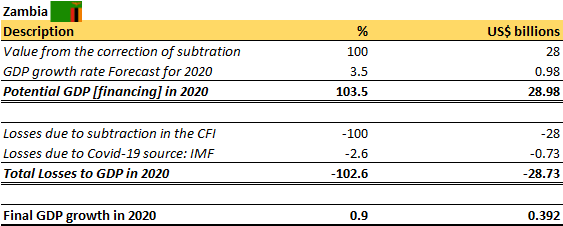
The table above shows financial losses caused by Covid-19 will be approximately 2.6% of GDP. Billions of kwacha have been earmarked to fight Covid-19, resources and man power have been mobilized and everyone is somehow involved in helping to prevent the epidemic.
This furor is for a problem with an economic loss to GDP of -2% to -2.6%.
Lets weigh this against the economic loss to GDP of subtraction in the CFI shown in the table which is -100% of GDP per annum. The value of this economic loss is almost 38x to 50x bigger than the economic loss caused by Covid-19.
Which begs the answer to the question:
Which is the bigger epidemic
People living in developing countries need to begin to provide answers to the problems related to poverty and underdevelopment the knowledge paradigm continues to fail to address.
……….
18th May 2020
Why we recommend SV-Tech
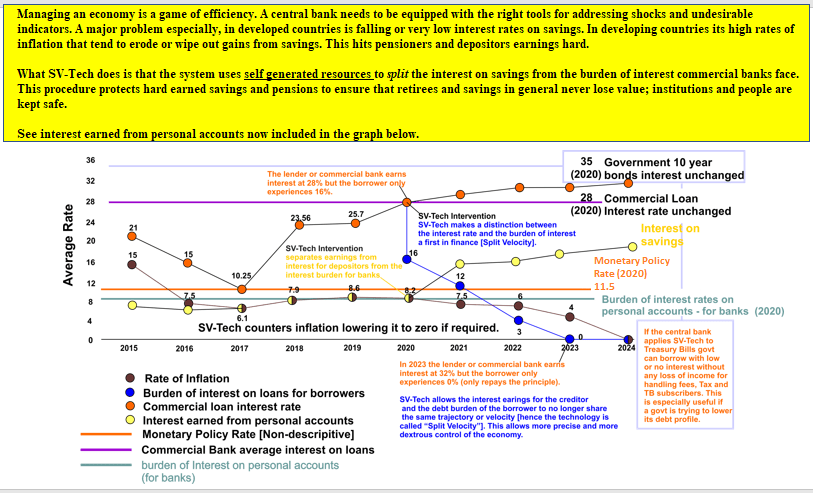
through the SV-Tech innovation every US$1 the US Fed spends to deter recession 98 cents will do the
required work and achieve the objective. This is simply due to the fact that the SV-Tech system
is designed specifically for driving economic growth with financial system stability.
In developing countries inflation tends to wipe out the benefits of savings and pension schemes. In developed countries a major problem during a down turn is how to revive the national economy. One of the methods applied to do this, that does work, is Quantitative Easing (QE). To prevent recession households and businesses need access to cheap money to encourage them to spend and produce. The dilemma that arises is that cheap money requires low interest rates 0% – 2%. When a central bank lowers interest and increases money supply it can have the desired effect, which is to stimulate economic activity. However, the casualties of this are pensions and long term savings. Pensioners can watch the value of pensions they’ve worked their whole lives for eroded to the point where they fear for their well-being after and during retirement, while long term depositors can watch the sacrifices they have made over the years to build savings disappear as a result of inflation. It should also not be forgotten that even if interest rates are reduced to 0% the greatest proportion of the debt load tends to always reside with the principle, therefore, adverse economic conditions can negate the impact of rate cuts by restoring an invisible ad-hoc debt burden that is not accounted for when assessing such interventions. [i.e. As interest rates drop due to rate cuts these cuts have to be weighted against the capacity of borrowers to repay loans – which is itself being continually eroded by a weakening economy]
A Spit Velocity model generates its own internal resources with which to separate [split] the burden of interest on savings faced by commercial banks from the interest on savings required by pensioners and savers [hence the innovation is called Split Velocity]. The SV-Tech intervention is shown in the graph above. This allows pensioners, annuities and savings to enjoy an interest rate above the inflation rate and well above low interest rates, protecting them from bearing the negative repercussions of any action a central bank needs to take to revive the economy. The sacrifices made by people to save their income is recognized by the economy and actively safeguarded. This enhancement ensures that pension schemes are protected and will never be allowed by the economy to lose the value retirees require to cover their present and future living expenses.
The United States Federal Reserve is currently (April 2020) spending US$80 billion a day [the highest on record] on increasing money supply through the purchase of Treasuries to counter the recessional impact of Covid-19. This is necessary to help prevent recession. However, we recommend an SV-Tech intervention to prevent economic shocks. The reason is very simple – efficiency. For every US$1 the Fed spends on QE the impact of the stimulus to drive back recession is likely to be US$0.02 (2 cents) or less, that is, the Fed loses 98 cents on every QE dollar; a processes that does not counter the inefficiency of money. This low rate of efficiency is why there is sometimes doubt about whether QE works. It does work, it just requires copious amounts of money supply to see results and it will only work if productivity of a unit of money is greater than zero (x>0). If the ratio is at zero or less the economy will not respond favourably to QE. The higher the ratio the more responsive to QE an economy will be.
During a recession Split Velocity allows people to safely both spend and save, this gives firms the confidence to continue pushing output and sales whilst it removes inflation from the economy, this continued economic activity and retention of savings in turn encourages banks to keep lending to the public and to themselves, consequently unclogging the main avenues that cause recession. Using a Split Velocity (SV-Tech) system instead of purchasing Treasuries with a low impact of 1:0.02 the Fed would purchase actual growth. Every US$1 the Fed might use to increase money supply by using SV-Tech would result in a push against recession of U$1 (1:1). This makes SV-Tech as much as 98% more effective and more efficient at generating growth and deterring or driving back a recession (such as that created by Covid-19) than conventional QE whilst obtaining the same objectives.
……….
14th May 2020
Per capita income in Zambia in 2030, If we do not act now
The need to act now to secure and protect the future for our youth and future generations
The need to act now by understanding weaknesses in the CFI and addressing them in the economy will determine whether we create progress for the youth and future generations or fail them.

US$331.98 after 10 years of economic activity from a population of 18.3m people. In this scenario
poverty levels in 2030 are still very high, unemployment is still a major problem and people continue to struggle to make ends meet. No meaningful improvement in per capita income takes place despite a decade of economic activity – Zambians living today, especially the youth, will experience little or no improvement in their lives.
Accelerating growth with Split Velocity offers much brighter
prospects for the future.
And will guarantee Zambia’s National Development Plan, Long term National 2030 Vision is achieved without failing to reach targets as is often the case. The National 2030 vision is for Zambia to become a prosperous middle-income country by the year 2030, underpinned by the principles of gender-responsive sustainable development; democracy;respect for human rights; good traditional and family values; a positive attitude to work; peaceful coexistence; and public-private partnerships.
A projection of economic growth on a Split Velocity (SV-Tech) managed economy is as good as a government bond or guarantee. This is due to the fact that growth targets are financed. When a growth projection is made it will be achieved. Any shocks or losses to growth caused by extraneous factors can be mitigated against by the same system to retain the growth projection. Commercial banks can depend on these projections when they lend to government and the private sector.
In an SV-Tech model every business in the economy benefits from the opportunity to grow regardless of its size, which sector it is in or which province in the country it is located.
12th May 2020
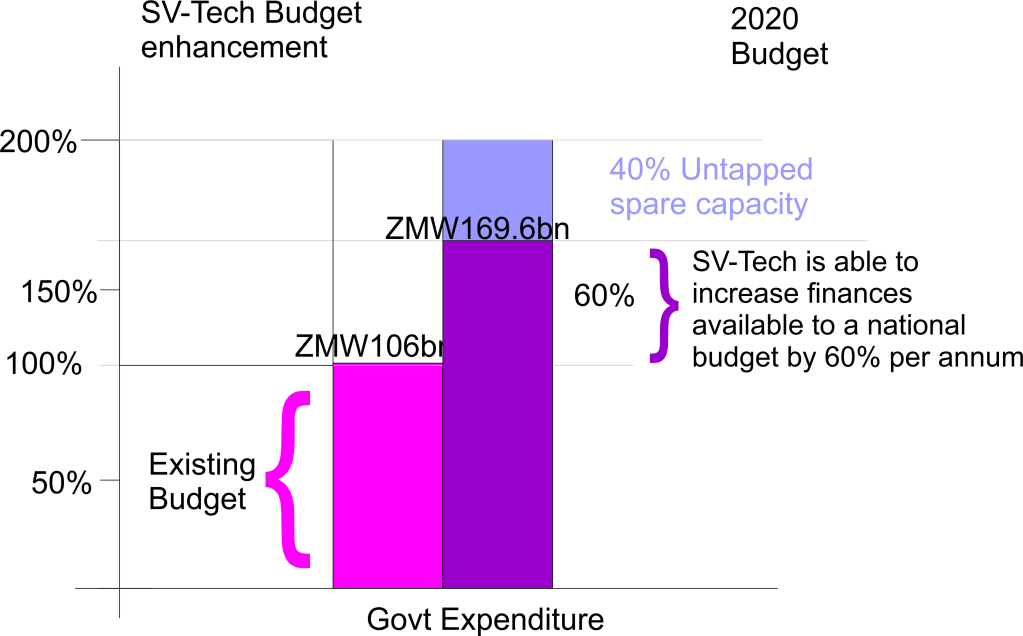
When SV-Tech is applied to a government budget the finances available for government expenditure during the course of the year increase by up to 60%. This leaves 40% of income available for the government budget (ZMW42.4 bn) on the system untapped. This spare capacity leaves room for any unexpected expenses that government may have to face during the course of the year. The bar graph shows the increase in spending power. Simply increase the desired governments budget (X) by 60% (your country’s budget-X*0.6). The new revenue is gained simply by recovering losses caused by subtraction. This is a straight forward benefit of fully applying the SV-Tech system to a national economy. As economies move to recover from Covid-19 these additional resources can prove useful to countering the pandemic.
………
11th May 2020
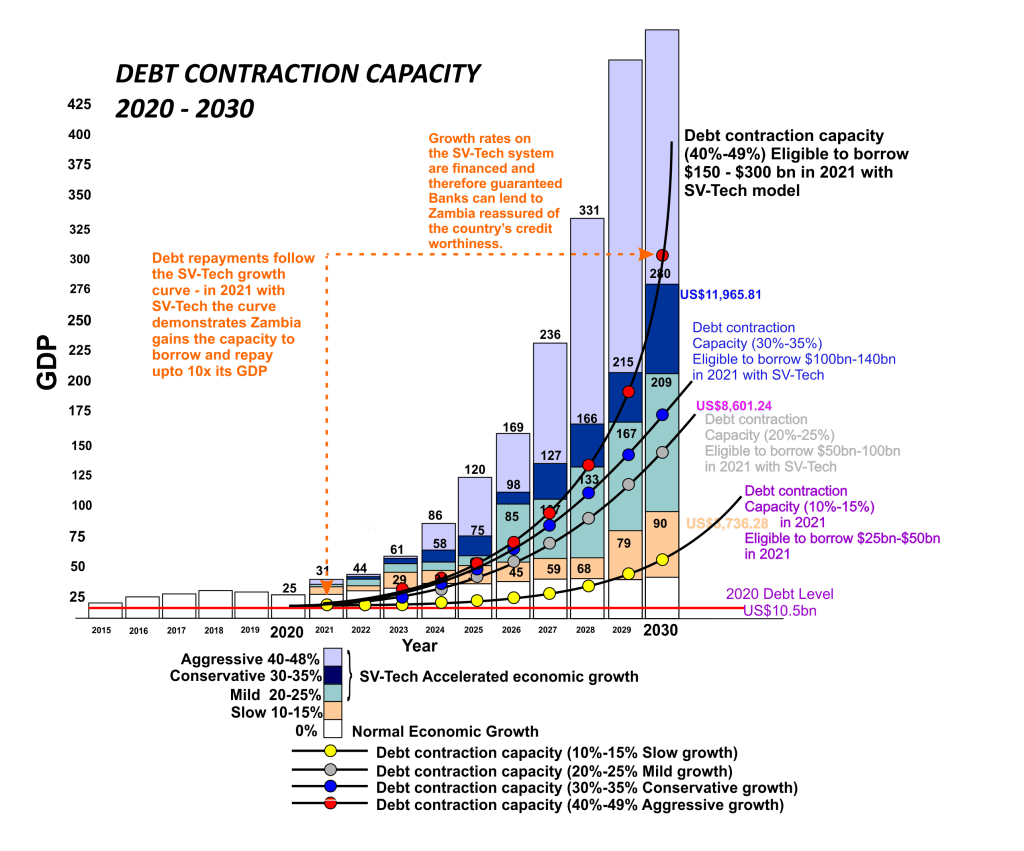
SV-Tech is able to shift debt contraction capacity from current GDP to projected GDP:
With SV-Tech governments can borrow with secure knowledge about how the national economy will perform. With growth rates set anywhere between 10% to 48% debts acquired have greater certainty of amortization.
Debt of this kind is “contracted”, meaning it is gained as a result of agreement [.i.e contract] between an entity seeking to acquire a loan (the debtor) and an entity that provides the service ( a creditor). The ability to take on more debt in this manner is therefore referred to here as “debt contraction capacity”, it can also be
referred to less technically as “debt carrying capacity”.
The enhanced debt contraction capacity shows that a Split Velocity model increases the demand for loans from local and international creditors due to the fact that borrowers will clearly see they are in a conducive economic environment to take on debt. [When banks receive money to distribute as loans in a downturn risk averse borrowers will tend to shun loans because they are afraid they can’t repay them. Even if they take loans the potential for default in a downturn is high. By using SV-Tech to improve the financial position of borrowers, they gain the confidence to take on more loans and actually repay them. An economy financed by SV-Tech will see increased demand for loans from commercial banks. This is a counter-intuitive process that works [see the advantages of an synchronous financial system here]
The diagram above shows that Zambia’s debt contraction problems are directly related to slow economic growth that is incapable of sustaining the economy’s needs. Recovering losses to subtraction which consequently accelerate growth leading to higher government revenue is the most practical method for addressing Zambia’s credit worthiness.
Since economic growth determines a county’s capacity to borrow from domestic and international markets, and SV-Tech has sovereignty or direct control of an economy’s level of productivity, this means developing countries have a pragmatic mechanism for guaranteeing the stability of the domestic currency. The diagram shows that by simply using SV-Tech to accelerate growth by 10%-15% Zambia’s debt position improves remaining consistently at 50% of GDP. This is however the slowest rate on the system. Accelerating growth to 20%-25% drops government debt to 25% of GDP through the decade. Should the central bank opt for an aggressive growth rate (which is what is recommended for poorer developing countries) the debt to GDP percentage becomes negligible or 10% and below. These improvements in debt contraction capacity open the doors to government renewed borrowing. If an aggressive setting were applied the Zambian government could look forward to issuing Euro-bonds for 2030 or later maturity valued at US$100 – US$150 billion and this would only be 10% – 23%of GDP. A Split Velocity model is much safer, recession resistant, more robust and significantly more secure than economies run without it.
Since the SV-Tech model predetermines the rate of economic growth the country’s credit worthiness can be based on the applied rate of acceleration with repayments following the growth curve. What this means is that despite Zambia’s GDP being US$28bn in 2020, should it have a Split Velocity model in place in 2021 its credit worthiness could rise depending on the growth rate applied, with the highest being an aggressive growth rate which implies the capacity to borrow and repay US$150bn – US$300bn in 2021, which is 10 times Zambia’s current GDP [see above curve where it shows “debt contraction capacity”] this ofcourse does not mean the country should borrow 10x its GDP, rather it demonstrates that credit-worthiness can be leveraged by the SV-Tech system allowing a more robust demand for loans that are now easier to repay, which in turn leads to a significant back-stop for balance of payments. This in turn will restore the value of the Kwacha and act as a buttress for the general price level that is now stable over the long term. The consequence of this is highly and effectively enhanced financial system stability. The ability to achieve these results are what exemplify best practice in central banking and they are achievable by central banks facilitating the introduction of an SV-Tech system to an economy”.
This demonstrates that the real problem is not debt per say but the creation of growth and economic conditions that are conducive for borrowing and repaying government debt such as that created by a Split Velocity system.
Few other (if any) approaches to economic management would yield results credit rating agencies such as Standard and Poor, Fitch Group and Moodys might find conducive for growth, stability and a robust international credit system.
………
9th April 2020
Split Velocity is the best defense against shocks to economy
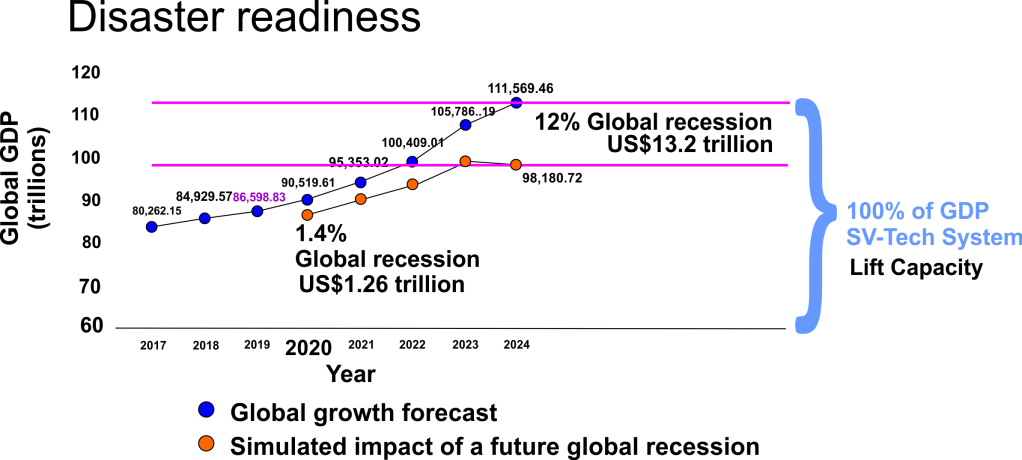
It is anticipated that Covid-19 will halve global growth slowing to approximately 1.5% of global GDP. A recession of a magnitude of 1.5% may be within the scope of current approaches to disaster management. The reality is that current systems are not prepared for future disasters and economic shocks with a potential major impact ranging from 10% to 30% of GDP or more. Institutions such as the IMF, World Bank, AfDB and so on are simply not prepared for shocks of this magnitude. On this scale it is not useful to only have strategies based on finances in reserve or that these institutions can raise from governments as it is unlikely they will be able to meet challenges on this scale. At this point the strategy has to shift from how much funding is available from reserves to the lift capacity inherent and available in the global economy itself.
The lift capacity can be regarded as the inherent growth in an SV-Tech system to roll back any serious economic shock or disaster. The lift capacity of an SV-Tech or Split Velocity system is assessed on the basis of countries that deploy the system to manage their economies. The burden carrying or lift capacity of an SV-Tech system is equivalent to a country’s GDP. Therefore, the more countries there are with economies managed using this approach the safer the global economy is from future shocks. As each country alters its rate of acceleration in unison with other countries any shock that impacts economic growth negatively is met with resilience and equal resistance enabling a much safer and speedier global recovery even before international development agencies begin to spend. This allows them to be more strategic and selective about how they spend their reserves during interventions.
3rd April 2020

This is an important upgrade to the tools central banks can have for implementing monetary policy and providing a stimulus.
In the wake of the Covid-19 Pandemic business will need relief from interest. This new system will enable banks to offer better interest rate conditions for their clients to help with recovery without having to bear the cost of doing so.
[What do we mean by a more dextrous and refined tool for monetary policy? Low interest rates help borrowers but they hurt the profitability of commercial banks. By using SV-Tech to de-couple earnings from interest and the burden of interest, for instance, the Federal Reserve Bank in the United States could maintain the burden of interest at 0%-2% but adjust the earnings from interest to 12% allowing banks in the US to sustain profitability without this negatively impacting on borrowers.]
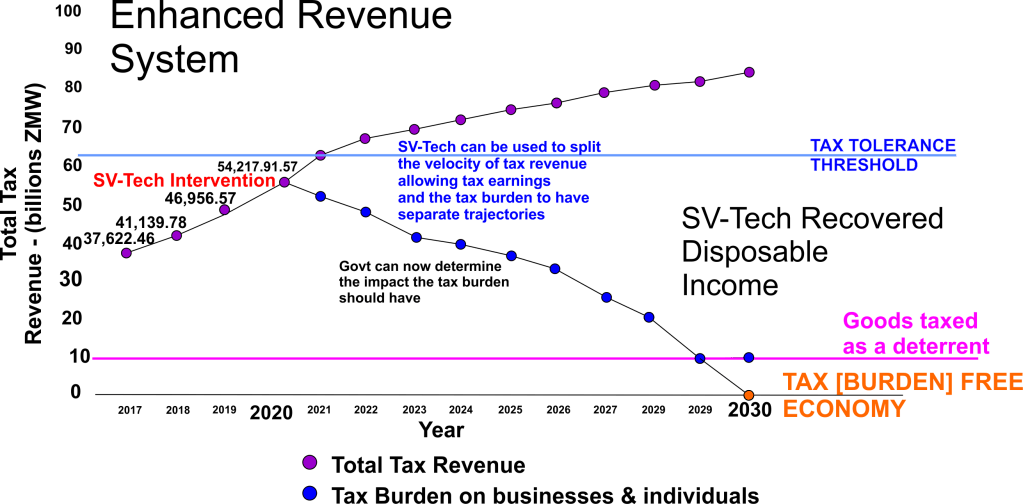
Tax revenue collection for 2020 in Zambia is expected to be approximately 20% of GDP. This is far below the spare capacity or burden carrying ability of the SV-Tech system. Essentially this means the 20% tax burden can be shifted onto the SV-Tech system at constant price creating a tax [burden] free economy. In 2020 the earnings from tax and the tax burden are coupled and must move in one direction. SV-Tech can be used to decouple them at constant price allowing tax earnings and the tax burden to have independent or “Split” velocities.
The graph above shows that in 2030 government collects K84 billion in taxes but businesses and individuals experience no tax burden. Normally any tax relief or rebates must come at the expense of government revenue. Applying SV-Tech spares governments this loss of revenue. This type of relief will be especially important to address economic growth and recovery in the wake of the COVID-19 pandemic.
The ability of governments to free individuals and businesses of the tax burden means people have more money to spend and businesses regardless of how large or small they are, be it the mining sector, manufacturing, transport, information technology (IT) and so on have more income with which to run their operations, both hire more people and invest. Shifting the burden of tax from businesses and individuals onto the SV-Tech system creates a lighter, more robust economy with the potential for greater commercial activity and is new to the Fintech space.
Split velocity essentially, neutralizes opportunity cost. Most professionals who are not familiar with the workings and dynamics of SV-Tech will need re-training.
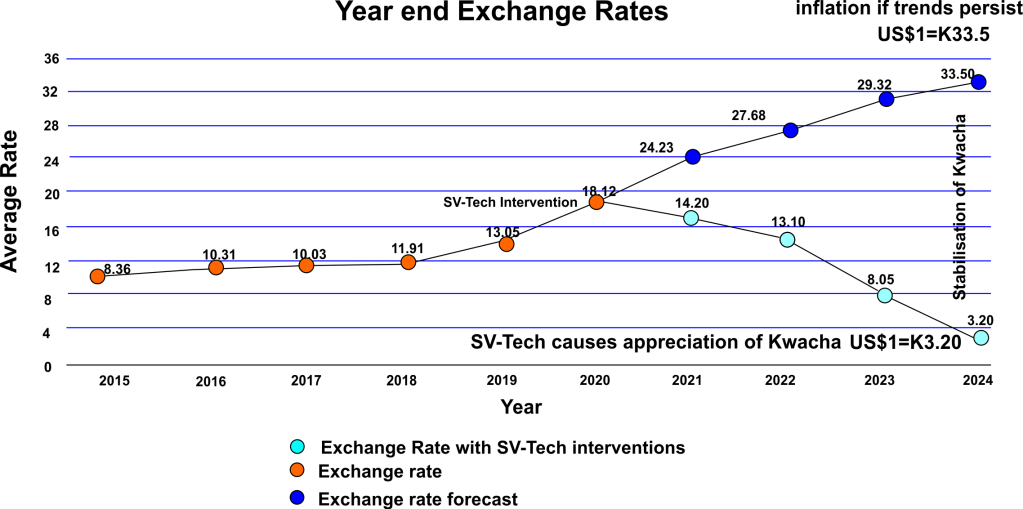
beginning of the end of unwanted deflation/inflation and price instability.
SV-Tech does not need forex reserves in the short term to increase before it acts to counter depreciation of the local currency. It creates multiple avenues for the central bank to regain the value of its currency. This will be useful to poor countries facing challenges with forex reserves.
Lower pricing for goods and services in an SV-Tech system makes having a weak or depreciating Kwacha to make local goods seem more attractive abroad obsolete. The tourism and export sector is therefore not affected by a strong local currency.
Accelerated growth can play a significant part in getting businesses back on their feet and pulling people who lost jobs during the Covid-19 induced slow down back into full employment. Businesses large and small, in any sector, including the mines, can also be rescued with this new system.
These rates of acceleration of GDP are not exaggerated. In fact they are understated. The projections are not forecasts of what the economy might achieve. These are guaranteed growth rates which once set will be financed by the SV-Tech system into existence as it moves to achieve the target set for it by scaling up productivity. [USA per capita income in 1820 was US$1,300 roughly Zambia’s per capita income today. It took 200 years for the economy to grow to where per capita income is US$56,200 – where it is today in 2020. Developing countries deploying an SV-Tech model should be able to accomplish, in a few decades, what developed countries took centuries to achieve.]
The table above shows extremely slow growth rates where after a decade of economic growth Zambia is currently expected to only gain an increase in per capita income of US$300. These very low growth rates occur due to the fact that losses to subtraction are not identified and accounted for in Neo-Classical Economic Theory from its inception. The recovery of losses from subtraction using Split Velocity creates accelerated growth. These resources are therefore pre-existent in every economy, they simply have to be harvested and harnessed to productivity thereby accelerating GDP growth rates. Instead of an increase in per capita income of only US$300 which is Zambia’s current course the diagram shows application of a slow SV-Tech growth rate 10%-15% that yields a per capita income of US$3,736.28 after 10 years, a mild SV-Tech rate of 25% yields US$8,601.24 over the same period and an aggressive SV-Tech rate of acceleration adjusts the projection to US$26,714.15. This reduces the period from 200 years to 20 years or less, consequently shortening the days required to move from low per capita income to high per capita income countries. Achieving this does not use up all the resources available to the SV-Tech system, 60% of which are left untapped, at least until a use for it is identified.
What do we do with idle untapped SV-Tech resources?
One option may be to use these spare resources to accelerate health and education sectors (since they are important to households) shifting the burden of these onto the Fintech consequently making them affordable or simply free without in any negative way affecting how they currently function in a free market system in both the private and public sector. As a non-intrusive catalyst this is something that may be worthwhile to consider applying idle unused SV-Tech resources to.
Shifting the burden of education and health onto the SV-Tech system and making these two specific burdens more affordable or simply free in this non-intrusive way will remove a great deal of stress from families and individuals. This increases their disposable income and allows them to improve their quality of life. With the installation of an SV-Tech system there will be a significant jump in both the quality and quantity of education as well as life expectancy. Very importantly there will be a tremendous improvement in healthcare due to the fact that pharmaceutical companies and the health industry will have significantly more resources to invest in daily operations as well as R&D. New treatments, medicines, medical devices and equipment should become available more quickly. The health care sector in general will have significantly more income and resources to work with. Having a healthy and well educated population that lives much longer leads to greater productivity and a more robust economy.
Shifting the burden of education and health onto the SV-Tech system to make use of spare, unused capacity is certainly worth considering.


The theme and focus for this year is to clearly align objectives with practical strategies for the implementation and deployment of Split Velocity Technology in order to bring its use into the mainstream, hence the caption “2020 Vision”.
Outreach 2019
29th November 2019
We have made remarkable progress. As we now move toward realizing objectives, for strategic reasons we will no longer offer extensive outreach posts on our progress.

…….
Monday 14th October 2019
Accelerated Economic Growth: Wa lala, wa shiala
The accelerated growth theory behind the GPWN was completed in 1994/1995 and initially debut as a Superconsumption model. The theory was continually improved upon, more succinctly explained further updated and officially published in 2010. In 2019 it is referred to as a Split Velocity Model.
A Split Velocity model currently represents the most advanced model or system in Business, Finance and Economics with which to achieve accelerated economic growth.
If understood and even mildly applied it will create extraordinary economic growth balanced with economic development moving an economy from average performance into a position where its growth begins to exceed economies following conventional economic growth strategies and policies.
An economy in which this theory is applied will eclipse and inevitably dwarf all other economies managed on weaker conventional approaches to economic and finance management.
The best application of this model will be one that that rapidly builds on domestic consumption by a steady and rapid increase in per capita incomes that lifts millions out of poverty and creates a new middle class that supports increasing levels of output reflected in higher GDP growth rather than dependence on exports..
The Superconsumption model recommended that central banks eventually have two official currencies – “A Tale of Two Currencies”. Each of these currencies would be managed in such a way that one pushed industrial growth while the other propelled consumption thereby working simultaneously to neutralize subtraction (implosion) in the process creating unprecedented accelerated economic growth. An example of the use of two currencies can be found in China, one of the only stable, rapidly industrialized economies in the world to sport two official currencies (since 2004) – namely the CNY and the CNH.
Although the book Greater Poverty and Wealth of Nations (GPWN) debuts the Superconsumption model it created and developed, it advances this model to the Split Velocity system which does not necessarily need two currencies, it can use one currency to perform the function of the dual currency system. The Split Velocity system is faster, much more powerful and more advanced than the dual currency Superconsumption model, as a tool for managing guaranteed economic growth.
Phenomenal economic growth similar to that achieved by China shown in the graphic below can be achieved using a Split Velocity system.
At its current pace predictions are that China’s economy will overtake that of the US by 2028-2034.
A dual currency Superconsumtion model is quite impressive and can achieve phenomenal growth. However, even this phenomenal growth does not compare to the speed, power and financial system stability evident in the more advanced Split Velocity system.
This is testimony to why governments today, like Zambia, must pay attention to losses and inefficiencies in the CFI. The economy determines every aspect of a government’s existence and there is a need to recover these losses to not only improve socio-economic development, but stay at the cutting edge of advances in national economic management. A nations very existence is dependent on paying attention to this facet of the economy.
Countries that embrace these advancements will move ahead, even eclipse and leave behind what may be considered the most advanced and most powerful nations in the world today.
As the African saying goes “Wa lala, wa shiala.”

………
Monday 2 September 2019
Excerpt, the Greater Poverty and Wealth of Nations (GPWN) 2010
Reconciling Keynesian and Monetarist Approaches
Macroeconomics, Implosion and Expansion
To date CE [neo-classical economic theory] has not been able to conclusively explain why poverty and scarcity exist. If it did provide a conclusive explanation poverty would be something students learn about in history books about a bygone era of strife ridden human existence. Operating Level Economics (OLE) introduced in the book the Greater Poverty and Wealth of Nations (GPWN) on the other hand explains poverty and the existence of scarcity as a syndrome (Systemic Dystopia or SyD in short) arising from the operating system [circular flow of income] of an economy caused by implosion [subtraction] that creates a persistent and consistent lack [poverty] of resources sufficient to meet humanity’s needs and wants. Economic implosion, [subtraction], scarcity and poverty are synonymous. The theory of economic implosion also explains why poverty and scarcity persist even in the midst of the appearance of great wealth as observed in the inner cities and slums of developed nations. [Before this there has been no genuine scientific explanation for why poverty or scarcity exist]
There are today two popular approaches to managing an economy namely the Keynesian and the Monetarist approaches. The Keynesian approach involves increasing aggregate demand in order to stimulate productivity along the lines of fiscal policy. This involves government expenditure. Very basically the Monetarist approach involves regulation of the economy through interest rates in order to encourage people to either save or to consume.
In a linear economy [neo-classical economy] the physical limit of resources is based on real volumes such as the number of tons of copper, the number of educators, the quantity of engineers and so on. This seems a very real limit that supply must take into account. In a dynamic economy [economy managed using Operating Level Economics – OLE] there is no real physical limit to resources. Human ingenuity is capable of creating infinite resources. Resource limits are in fact artificial and depend on the level of available creativity, ingenuity, and technology. The dynamic economy [economy managed using Split Velocity] therefore strongly relies on research and development and the exploration of old and new technologies that lead to socio-economic development.
Hence a clear distinction is drawn between linear economics (CE) [neo-classical economics] and dynamic economics [Operating Level Economics (OLE) which focuses on the circular flow of income (CFI)]. Dynamic economics takes into account the seven forms of scarcity (see GPWN) and ultimately relies on human ingenuity as the delimiting factor when it comes to scarcity. It therefore proposes that resource limits can be constantly and continually pushed forward by research and development. A dynamic economy is capable of financing research and technology while a linear economy is just barely able to provide it [because it works against businesses and experiences zero growth].

A Keynesian economist would suggest that aggregate demand be moved in relation to aggregate supply toward the physical limit in order to maximise productivity. When the physical limit of resources is reached any further extension of aggregate demand will lead to a rising general price level. A monetarist would argue that any increases in money supply would need to be directly proportional to growth to be justified.
The debate between Keynesians and Monetarists has been centred around the shape of the aggregate supply curve (AS) shown in the diagram. Keynesians would encourage governments to shift aggregate supply to the right through public expenditure when an economy experiences recession in order to maximise productivity. Monetarists who oppose manipulation of the AD curve as a means to creating employment believe in a vertical aggregate supply curve which clearly shows that any attempts to tamper with aggregate demand [using increases or reductions in money supply] will cause inflation or deflation. This debate can be resolved by appreciating that both economies indicate an equilibrium price level despite the fact that they may be in recession. Furthermore, Monetarists agree that money supply can be increased but only when it is in direct proportion to growth in productivity. It becomes quite clear that though Keynesians and Monetarists have different approaches they share the same fundamentals. An equilibrium price level is obtained where aggregate demand and aggregate supply meet and that there are circumstances under which aggregate demand can be increased without causing inflation. If money supply should grow then it should be directly equal or proportional to the level of growth in an economy. Since there is an agreement between the two it becomes possible to arrive at an acceptable merger of the two curves with the understanding that each shift in aggregate demand is in pace with growth and productivity in order to prevent recession [This illusive reconciliation of Keynisian and Monetary policy is effectively achieved by Split Velocity or the correction of Subtraction in the circular flow of income (CFI)].
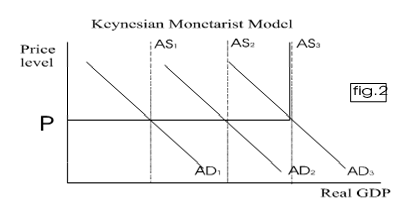
[Fig 1. shows two separate models which disagree on how
an economy should be managed. The debate between Keynesian and
Monetarist models is well documented in neoclassical economics. Fig 2 above does the unusual in that it merges the two opposing models into one functional system. How is this possible? The models oppose each other because of subtraction in the CFI. Subtraction causes curve tectonics or demand and supply to work against one another due to the fact that in the CFI human capital and non-human capital compete for the same
limited finances at any point in time. When a Split Velocity system is introduced this conflict
between demand and supply is effectively resolved. The result is not only unparalleled economic and financial system stability at constant price (P), but also accelerated economic growth at AS1, AS2, and AS3 which show that there is potentially no limit to growth in a Split Velocity model. This occurs due to the fact that the Keynesian limit of the L curve keeps shifting in tandem with the Monetarist limit of the AS curve. This kind of unlimited growth has never been demonstrated in neo-classical economic theory, but is offered as standard in Operating Level Economics proposed in the GPWN.]
Fig.2 shows that Monetarists and Keynesians share the same fundamentals and do in fact make reference to the same AS curve. As long as increases in aggregate demand are met with similar increases in aggregate supply the economy remains stable [this means that as long as subtraction in the circular flow of income (CFI) is countered or neutralized rapid and stable economic growth is achieved with price stability]. This brings out one very important issue and this is that economic instability is not necessarily caused by increases in aggregate demand. It is caused by imbalances or intolerances in the relationship between aggregate demand and aggregate supply referred to as Curve Tectonics in OLE [or known more popularly as Market Forces in neoclassical economics]. A linear economy [neoclassical economy] proposes that there is only one economy [human and non-human capital are one and the same] made up of an amalgamation of aggregate demand and supply [the consequence of this basic mistake in economics is that money cannot be used as a stimulus or catalyst to accelerate growth at constant price – something corrected by using Split Velocity] . A dynamic [Split Velocity] economy refutes this approach and instead proposes that there are two economies each capable of acting independently. The linear economy [neoclassical economy] ties the dual [human capital and non-human capital] economy together to create one economy through the use of a single currency that is exchanged between households and firms [effectively making a central bank incapable of using currency or money supply to accelerate growth as any attempt to do so will tend to cause inflation. Split Velocity reverses this condition allowing currencies to stimulate growth without inflation]. [In a neo-classical economy human capital and non-human capital bind resources from each other] – One has to wait for the other [due to subtraction] to allocate or spend before it can transact [creating the problem of curve tectonics]. Hence, whenever aggregate supply or aggregate demand move independently [since they are not liberated from one another by removing subtraction] curve tectonics [uncontrolled market forces seeking an equilibrium that is sticky downward, seeking stagnation instead of economic growth] takes place and this has a negative effect on the general price level [leading to a central bank’s lack of direct control of inflation and deflation]. Aggregate Demand and Aggregate Supply are competing for the same financial resources, which generates a resources vacuum that is evident in the CFI at any point in time. This perpetual vacuum is responsible for making scarcity and therefore poverty ever present in an economy regardless of whether it is that of a developed or developing country. [In geography when tectonic plates (market forces) move against once another they create earthquakes (periods of economic instability). Similarly, when aggregate supply and aggregate demand cannot be orchestrated (or synchronized) to move in tandem (through the correction of Subtraction – see fig.2) the consequence is economic shocks to an economy such as rising prices, for instance, higher mealie-meal (fuel, food, electricity etc) prices – demand and supply work against one another to create unnecessary price distortions. The only known method for preventing and controlling this problem, in absolute terms, to date is a Split Velocity system]

(Curve Tectonics)
[The rising inflation in the above diagram cannot be comprehensively controlled by any current approaches in economics due to the fact that presently no central bank in the world has a financial tool for wholly controlling demand and supply with which to independently counter inflation. This has only become possible using Split Velocity to independently control demand and supply using a technology and process that has never been available before this.]
This shows that the main cause of economic instability is the impact of aggregate consumption on aggregate expenditure on an economy at a given point in time. All the finances held by households finding its way into the hands of industry and back over the duration of a year is not necessarily a comprehensive equilibrium. Another important equilibrium to address is the volume of finances businesses hold for productivity and the volume of finances consumers hold for consumption at any specified point in time. Any disparity between these two will cause fluctuations in the price level due to increased tension between aggregate supply and aggregate demand [curve tectonics]. The linear fiscal year as a budgetary sum of economic management is therefore not a recommended way of regulating an economy. This problem is illustrated in the empirical evidence based test for Split Velocity.
At any point in the short run where aggregate supply and demand are not equal to each other the economy can become unstable due to variances in pressure between aggregate demand and aggregate supply. To minimise this problem aggregate demand and supply should therefore move in tandem. However, this is made impossible by the fact that a linear economy [neo-classical economy] ties consumers and producers to each other by forcing one to wait for the other before any transactions can take place [ Subtraction – see the youtube video that explains this cardinal problem in economics]. When firms pay households those funds are locked away from productivity until households spend them. When firms hold money to spend on capital investment, ceteris paribus, those funds are similarly locked away from households. The credit creation process helps, but perpetuates this when credit in the form of loans is allocated between households and capital by firms. Hence, aggregate demand and supply are [continually] unable to move in the same direction [despite the introduction of credit creation by commercial banks]. If demand increases it means more income is being paid to households, but this also means that a greater proportion of financial resources is being withheld from business, thus hampering productivity and creating a potential imbalance between demand and supply. When capital growth is achieved it means the economy may be growing, but more finances are being withheld from households. Aggregate demand and supply thus begin to play against one another [become tectonic]. This places a tremendous strain on the economy, which begins to show signs of fatigue through inflation or deflation. It cannot withstand a long duration where aggregate supply and demand move independently and when this occurs too frequently it leads to economic instability.
……….

[In a Split Velocity model demand (AD) and supply (AS) are constantly being re-balanced in the CFI therefore the price level in the economy remains consistently stable as shown in fig.4. X0, X1 and X2 show the capacity for rapid or accelerated economic growth at constant price when subtraction is corrected.]
When aggregate demand and supply move in the same direction and to the right [as shown in figure 4] it creates growth and development (see Economic Gain & Loss – GPWN). To distinguish between terminologies let us assume that economic expansion is differentiated from economic growth in the sense that expansion entails both growth [non-human capital] and development [human capital] are taking place simultaneously. It is important to be able to calculate the basic impact of a linear economy on economic expansion.
[If you understand the concept of curve tectonics explained above and how this relates to market forces in economics and how subtraction can subdue the natural instability and lack of growth caused by market forces, then its very easy for you to understand how a country like Zambia has the equivalent of GDP available to it to use as a stimulus to grow the economy at constant price.
When Split Velocity is introduced to an economy there is increased price and system stability. However, there is also accelerated economic growth. An economy moves from a zero growth setting characteristic of a neoclassical economy to growth rates between 14% – 48% without exhausting system capacity. These accelerated growth rates are hungry for money with which to facilitate growing transactions as well as to keep output and money supply equal [when the AD and AS curve move to the right in tandem (as shown in figure 4) due to the central bank countering subtraction in the CFI a significant deficit in money supply arises. This accelerated growth requires that money supply constantly increase in order to keep pace with the rapidly expanding economy].
Consequently, money or currency used to facilitate transactions becomes very much like a raw material required for this more advanced economy to work. As a result, the supply of money undergoes a revolution. From here onwards currency and its supply becomes an essential and lucrative industry. Incidentally, the ad hoc leaders in this industry are central banks. However, central banks at present supply money as a form of house keeping for the national economy. They incur significant costs to maintain money supply. Nevertheless, this activity places them in pole position for supplying currency required to run a Split Velocity system. Since the supply of money can now take place with financial returns rather than losses to a central bank a new business model can be applied to how money is supplied to the economy effectively creating a new specialized industry driven by currencies. Instead of having a product (money) that is a liability due to the costs associated with supplying it central banks now have an asset they can supply and earn significant sums of revenue by applying a new business model to the money supply process.
This change requires central banks to eventually introduce a new area for supervision in this new industry – namely the supply of currency, but also requires eventually setting up a new corporate structure separate from the central bank yet within its regulatory system that will work as a profitable corporate entity to supply money to the national economy. The issuing of currency may be moved from core operations to a separate corporate space simply because the supervision of the supply of currency and the issuing of currency in this new industry ideally require fiduciary distance to be managed effectively. Since national currencies are generally owned and supplied by governments, they now become a significant public sector asset governments can earn revenue from. However, the debut of cryptocurrencies has demonstrated that currencies can also be supplied by the private sector. Private sector participation is required to drive research and development as well as innovation in this new industry. In future market share in the supply of currency is likely to be a combination of both public and private sector participation and the industry is likely to grow to become one of the significant financial sector innovations in recent memory. This development is made possible, in large part, by Split Velocity as a new innovative entry into the Fintech space.
In terms of the search for best practice in economics, a Split Velocity system is without doubt the cutting edge and most advanced approach to managing national economic challenges that even the developed world, has not caught up to as yet.
Most importantly it is clear that the knowledge and know-how for ending poverty is at hand and the process for doing so is scientific.]
……
Monday 12th August 2019
Demand and Supply, What do you really know about them?
It is not rare to hear people in general, even the well educated, extol the benefits of market forces and the importance of the workings of demand and supply. However, a deeper analysis of market forces is that they are not designed to create growth but to contain it, which is not useful for poor countries: if there’s barely anything to contain and per capita incomes a are low, what is created is a ring fence in which poorer countries are trapped because they are taught to believe there’s nothing better beyond the fence. What free markets theories peddle, even in savvy sophisticated finance circles, is that a national economy does not need a stimulus to grow, because growth will come naturally from free markets. Therefore, there should be no government intervention in an economy, that is, leave economic growth to the free market or private sector to create this on its own.
Sadly, even education at tertiary levels reinforces this belief. Developing countries are persistently deceived by this kind of economics due to the fact that well learned policy makers are taught to think this way. For instance it’s easy to state that as demand for a product increases its price will rise or that as supply increases price will fall making a product cheaper and sell this magic mechanism in introductory economics as a wonderful self regulating device that should be left to itself to ignorant wide eyed listeners. However, if this mechanism is preventing growth rather than providing it how is it fundamentally useful in its current state to poor countries like Zambia, and why should it be left alone? The stagnation and deadlock created by market forces dictate the opposite, which is that the government through a central bank and ministry of finance cannot afford to manage an economy without providing a stimulus. If these institutions sit back and do nothing because this is what the text book says, the risk is slow growth and in a worst case scenario recession. Without a stimulus Zambia faces this very dilemma. More on the deadlock in economic growth created by market forces left to themselves is explained later, in the excerpt.
Its common sense that businesses position themselves in the free market to obtain the best or highest profits they can reasonably obtain in order to grow and yet a fundamental doctrine in neo-classical economics is an abhorrence for profit which is referred to as abnormal or super-normal. In other words neoclassical economic theory (SRT) by nature, inherently designs an economy where businesses are expected to cope with an income they can barely survive on [a hair above the break even point]. In other words it is neoclassical economics learned, yet somewhat deranged, desire for businesses not to stray far from debilitating zero growth whilst at the same time it applauds mediocre growth rates such as 4% or 7% per annum. A pertinent reason why viable industries in developing countries seem to flounder such as aviation [e.g. Zambia Airways] and mining is simply due to issues to do with economies of scale. These industries are highly capital intensive and without economies of scale to deliver the financing they need to run smoothly there is no level of management that can successfully run these industries. No one will tell an African management team this, instead they will say these industries fail because Africans, locals or developing countries in general are poorly qualified. When a Split Velocity system is engaged the financial sector gains the capacity to successfully fund industries that are generally capital intensive, operating costs fall and the myth that developing countries cannot participate in these sectors alongside FDI will be dispelled.
Technocrats in developing countries are simply not equipped to understand how inadequacies in neoclassical economics, even at such basic levels are working against them and the economies they manage, instead they are taught not to deviate from these flawed theories that inspire them to sit back and watch market forces melt down a potentially robust and healthy economy. They maintain policies related to these flawed theories for the sake of appearance, in order to conform and appear professional to the international financial community when these approaches are in fact hurting their economies. A change in mind set is long over-due.
Similarly, most of the solutions offered for Zambia’s domestic and international debt crisis are a boring parody of approaches to neoclassical economics developed countries would prescribe, blindly read in a textbook or garnered from some conventional research journal in the hope that repeating ideas from credible sources suspends the need to apply logic to them. Pundits do their best to remain in conformity with intellectually weak economic theory gained from developed countries when these same approaches are riddled with inadequacies and a mediocre understanding of economic growth they themselves are unaware of and just as readily trapped in. A Split Velocity system, which goes further than developed countries have ever gone, in recent times, to address poverty and accelerated growth would wipe out Zambia’s economic woes, with relative ease.
Excerpt from GPWN 2010
Contemporary Economics refers to profits as ‘abnormal‘….
A hint of the glaring systemic flaw in Contemporary Economics [neoclassical economics] (CE) can be identified by the term used to describe surpluses greater than total cost. CE refers to them as Abnormal Profits, as they disturb the market equilibrium (cause the wobble effect) and are quickly wiped out by the System through ‘new entrants’ into an industry.
Contemporary Economics (CE) refers to profitable gains above average total cost as abnormal or supernormal. Normal profits are gained where a businesses earns just enough to stay in an industry in the long run; basically close to zero profits.
When have businesses ever regarded profits as abnormal apart from when they were not anticipated for a particular period? When was the last time a business earned high profits or tripled them and its CEO made an announcement to reassure shareholders on CNN or in the Wall Street Journal or the Financial Times that –
“Ladies and gentlemen our company has done something it is not supposed to this quarter, it has gained profits, this is utterly abnormal, next quarter we must strive to drive the business back as close to zero profits as is possible for our earnings to return to normal. If we cannot do this ourselves we must allow the market to do this naturally for us. For the good of the shareholders we cannot afford to be an abnormal company and I urge all employees to make it less profitable in the next quarter.”
This doesn’t happen as it defies logic. It may sound amusing, but it isn’t. Simple incongruities such as this that exist between Contemporary Economics (CE) and Business Administration and the motives associated with the paradigms each discipline follows hint that there is an inherent and fundamental conflict between the market condition inherent in an economy and the objective of businesses.
The next heading explains how this flaw creates a conflict that hinders businesses and growth.
……….
The Myth About Markets Forces and Growth
Markets are useful tools for managing economies, but how they work needs to be better understood; there is a grand myth and misrepresentation surrounding them.
Resistance to growth in the SRT economy is very easy to identify. A zero growth equilibrium in macroeconomics will be established where aggregate supply equals aggregate demand. Should companies try to grow by increasing supply the aggregate economy will resist this growth by lowering price (deflation) by which profitability is killed off forcing firms to cut production thus returning the economy to the zero growth equilibrium or normal profits. Should growth be attempted by an increase in demand, the aggregate economy will naturally counter this by increasing price (inflation) until it becomes too costly to consume forcing consumers to stop buying; demand is forced back to the natural zero growth equilibrium. In CE this is referred to as ‘overheating’. Rising demand is countered by the economy’s natural resistance to growth using this approach as the economy attempts to grow rapidly against the market’s resistance, that is, its equilibrium or zero growth position. This phenomenon is common in fast growing economies that may inevitably have to slow themselves down despite the fact that they have not reached their desired per capita income and growth targets. To achieve growth increases in demand and supply need to take place simultaneously, however, the operating structure of the CE model [in the circular flow of income (CFI)] requires demand and supply factors to compete for the same scarce resources thus effectively heading off this avenue through which growth may take place.
Businesses backed into a corner may then attempt to increase profitability by reducing supply side costs – a common method for escaping the crunch of market forces. However, cutting supply to increase price or reduce costs and thus induce profitability will generally cause a decline in demand at the industrial level thus restoring zero growth. This is due to the fact that if a business cuts costs to lower TC (or the cost of supply) this raises internal profitability, but the external economy kills growth in this way by causing supply side factors to be dumped such as jobs, machinery, plants, factories and so on. Hence, unemployment levels begin to rise in the economy.
The market system is so efficient at preventing growth that no sooner is one hole plugged it opens another.
More Market Myths
Some may argue that when demand exceeds supply price goes up encouraging new businesses to enter the market hence stimulating growth. However, when it does, supply increases and price declines to original levels forcing them back out. Inevitably the economy’s equilibrium may close them down or force them to relocate due to lack of profitability. The so called equilibrium [of the free market left to itself] is never stable or able to sustain long run confidence in the market.
Similarly, there is a belief that excess supply is naturally discouraged by falling prices, which forces businesses out of industry. Supply is reduced by the equilibrium to a level equal to lower levels of demand, but how is this beneficial? Shrinking supply is an indication of declining growth. It means industries are closing, plants are shutting down, employees are being laid off and the economy is declining or contracting. The [free market] equilibrium is thus working against businesses and stunting growth yet the interpretation in CE is that it is achieving something desirable as it is maintaining a ‘balance’ [sic financial stability and therefore should not be interfered with .e.g. by providing a stimulus]. This reasoning is ill conceived.
Market forces in the economy naturally challenge growth at each level. It is strange that this limitation is not appreciated [or openly taught] in the laws of demand and supply.
Despite this CE continues to believe and teach that market forces and the equilibrium condition they maintain (that encourage zero growth) are a positive economic condition economies must strive to uphold.
This is a very serious myth or is simply a well propagated and respected mistake.
The aggregate economy creates a System that is a powerful enemy of businesses…
Are markets useful and what purpose do they serve? This can be answered with another question. Are brakes on a car useful, or do they just slow it down?
Market forces are and will remain very useful in managing economies for stalling or restraining and preventing them from growing when this growth may exceed recommended targets or is required to remain at the market equilibrium where growth is constant at zero.
The real problem today is that it is likely most policy makers are taught to believe free or liberal markets and the forces at work within them are the gas pedal, and the ‘good feeling’ of ‘perceived stability’ of an equilibrium equates to ‘growth’. Managing an economy is not this simplistic. This is a distortion of facts and a myth that needs busting if sources and causes of real growth are to be identified.
……..
Sunday 14th July 2019
Impossible is nothing: We can achieve development objectives
Advantages of an Economy Managed using an SV-Tech system
When it comes to the management of national economies anywhere in the world it is unlikely there is any approach, system or technology more effective than a Split Velocity system (SV system) that unlocks resources for economic growth in the circular flow of income (CFI). As mentioned earlier, governments should view any strategy for real growth that does not involve advancements to the CFI that counter subtraction with suspicion. They are not reliable as they represent the transfer of wealth rather than the genuine creation of new wealth in an economy.
Approaches to economic management offered by the IMF, World Bank or other development organisations presently in use or currently offered to countries are unlikely to match the effectiveness, lack of negative side effects, power and robustness of an SV system when it comes to driving growth with development. It is therefore only pragmatic for development agencies to seriously begin to consider engaging an SV system in their operations in the genuine effort to assist countries.
Cruising Velocity Scenarios 14%-48%
“Cruising velocity” is the preferred long-term rate of growth set for a Split Velocity system. Like cruise control in your car, when it comes to the national economy the cruising velocity can be adjusted, but is expected to be maintained at the desired growth rate or at a similar range for a period lasting one year.
For instance, if the SV system were running fully rolled out in the United States at a Cruising Velocity of 20%-25% the US economy would be expected to be able to double in size from US$20 trillion to US$40 trillion in 3.5 – 2.9 years. Applied in China, the economy of China would be expected to double in size from US$14.2 trillion to US$ 28.4 trillion in 3.5 – 2.9 years. If a more aggressive growth rate (36%-48%) is set on the system doubling time for these countries could be reduced to 2 to 1.5 years (this is dependent on the Technology Paradigm). A growth rate as low as 1.9% anticipated for 2020 in the United States caused by a zero growth position in the CFI of neoclassical economics is cause for great concern and a clear indication new more appropriate approaches to economic management are important and long overdue. The world needs faster growth rates in the USA.
Rather than ratings agencies like Standard and Poor or Moodys downgrading sovereign credit in African countries like South Africa and Zambia, what these ratings agencies should be doing, realistically, is downgrading the theory and implementation of neoclassical economics, where growth is concerned, to junk status. It is simply no longer pulling its weight, has become stagnant, redundant and is retarding economic growth unnecessarily in both developed and developing countries.
An SV system can grow an economy of any size. The size of the economy is not significant when it comes to accelerating growth. Large or developed countries and regions such as China, the US and EU today and their citizens are simply no-where near as wealthy as they could or should be and should consider an SV system. This is necessary for ensuring the good health of the global economy.
Developing countries in Africa, like Zambia, South Africa, Tanzania, Botswana and so on require faster and more reliable growth rates in developed countries to ensure the demand for copper, cobalt, iron ore, diamonds, emeralds, gold, silver, nickel, uranium, oil, tin, rare earth and other minerals are maintained at a good price and remain consistently in high demand when traded in international markets through agencies such as the LME. Current neoclassical economic management systems applied to national economies (with zero growth 0%-10%) cannot be relied upon to provide this kind of growth or stability.
Unlike the present ineffective method for economic management of national economies in use around the world the SV system growth rates are not estimations, they are expected to be as reliable as a government bond or guarantee.
After full roll out, when a Split Velocity system is available to the whole economy (a capture rate of 100%) and distributed as a financial product through commercial banks the growth rate in the economy is now controlled. It is not left to chance. The annual rate of economic growth on a Split Velocity system is not expected to fall below 14% p.a. which will be considered the slowest double-digit growth rate for any economy managed on the system. Nevertheless the SV system can drop growth to 0%, the setting of a normal CFI, if this is required.
Resistance to economic shocks
Even at what would presently be regarded as a “blistering-speed”, a growth rate of 25% per annum is effortlessly achieved by an SV system. Neoclassically trained economists would assume these growth rates are unrealistic only because they have been raised on the mediocre zero growth rates of a modern economy which works against businesses, commerce and productivity and would need to be re-trained. However, even at this speed the system is still only using a small value of its potential leaving 75% of its capacity to stimulate economic growth in the national economy untapped. This means that the risk of recessions be they man-made (e.g. subprime mortgages, epidemics, global warming, war, conflicts etc) or natural disasters (earthquakes, floods, droughts, etc) can be immediately addressed by generating more resources to counter them and shorten the time to recovery. To counter recessions the growth rate can simply be adjusted upward until the cause of recession is removed. Greater economic stability of this kind is good for business and ensures populations are protected from unnecessary hardship.
Basic Growth Projections or Scenarios for an economy managed on an SV system
Conservative (Slow) economic growth 14%-15%:
This is where the cruising velocity or economic growth rate is set between 14%-15%. This leaves 85% of the economic resources available to the national economy through the Split Velocity system untapped. At this speed with full roll out at 100% capture rate the economy is expected to double every 5.1 to 4.8 years. Neoclassical economists would be more comfortable with growth rates in this range, however, they represent the lower end and an unnecessary under-utilization of the SV system’s capacity to stimulate growth. Growth rates as low as 0%-10% are too slow and generally too mediocre to be realistic for an SV system.
Considering that the fastest growing economy in 2019 is at 7%, the growth rate on the SV system of 14% (considered slow on the SV system) is much faster. The system does away with mediocrity and is much more efficient and effective when it comes to managing growth in a national economy.
Mild economic growth 20%-25%:
This is where cruising velocity on the SV system is set between 20%-25%. This scenario on the SV system leaves as much as 75% of its capacity to stimulate growth untapped. At this speed with full roll out (at 100% capture rate) the economy is expected to double in size every 3.5 – 2.9 years.
Aggressive economic growth 36%-48%:
Cruising velocity is set between 36%-48%. The SV system leaves 52% of its capacity for growth unutilised. At this speed with full roll out at 100% capture rate the economy is expected to double in size every 2 – 1.5 years depending on the desired growth rate.
[It should be noted that growth in an SV System is scalar where every business unit in the economy is growing in a synchronized manner. Due to increased economic activity, the economy no longer working against commerce and continuous re-balancing of demand/supply the success rate of businesses in the economy is expected to rise dramatically. There can be thousands of businesses formally registered in an economy but only a small percentage of these actually functioning and contributing to growth. With the economy now working for businesses rather than against them, due to an SV system, the majority of these businesses are expected to turn around, become viable and begin contributing to the national economy. There is little or no pre-requisite waiting time to initiate growth and there are few bottlenecks created by time intervals observed in the current linear system of neoclasscial economics, most economists are used to, that are based on resource transfers, therefore economic growth takes place much more quickly than would be anticipated and expected of a normal modern day economy.]
It will be possible to have developing countries on a slightly more aggressive growth setting so they can play catch-up. This will allow per capita incomes and development to rise faster in disadvantaged regions until such a time global living standards become fairly even.
This growth is low risk
This faster economic growth is achieved through businesses and their productivity. An SV system powers commerce in an economy.
Projected SV growth rates on an SV system are expected to be as reliable and dependable as government bonds and guarantees. For instance, if the economy is set to run at a growth rate of 25% per annum businesses and stock markets can rely on this growth projection to plan their investment portfolios and earnings for their clients based on the projection for the prescribed period. An SV system is powerful enough to eradicate poverty and unemployment as well as improve income for all income groups in an economy. It not only distributes income in a national economy more effectively, but also rapidly raises per capita income levels ensuring growth takes place in tandem with development. No one is left behind.
Technology Paradigm
The technology paradigm is the rate at which an economy’s industrial and technical competence converts money into output. It should be noted that a well-financed technology paradigm is constantly shortening turnaround times thereby increasing the rate of productivity due to improvements in the learning curve as businesses continually find faster, cheaper and more efficient production methods. The rate of economic growth on an SV system has to be adjusted higher to maintain parity between the growth rate and technology paradigm, a feature impossible to achieve using current methods used for managing the national economy.
Financial Benefits of an SV system to Central Banks
Normally maintaining money supply can be an expensive exercise for a central bank. This includes general increases in money supply as well as the need to replace old or soiled bank notes with new notes. When a central bank increases money supply via a Split Velocity system it earns rather than loses income from the exercise of supplying money into the economy turning money supply (or currencies in general) from a liability into an asset. For instance, instead of the US Federal Reserve supplying the US economy with money at a cost to itself, it now uses an SV system to cover the cost of this supply and earns a profit of 1.8% for any money it supplies the US economy. The US Federal Reserve turns the need to supply money from a very costly liability into an asset for the central bank which will now earn rather than lose income from supplying money to the economy. This greatly improves the central bank’s balance sheet. The advantage of a central bank issuing money through a Split Velocity system is that:
- This money enters the economy without causing inflation (a cheaper and more efficient operation than buying and stocking gold to back national currency).
- The central bank gains a new revenue stream by earning income from the money it supplies to the economy through the SV system.
- An efficient and robust stimulus is applied to the economy
- The SV system is more stable and robust than a gold standard
The SV system makes currencies and their ownership a huge new asset class and source of income for the owners or developers of robust currencies. This is advantageous for central banks that have an obligation to ensure there is sufficient money in circulation. The standard rate for supplying money to the economy through the SV system is where the profit margin for the central bank is approximately 1.8% of the face value of money supplied. The lower the cost of the method the central bank uses to supply money to the economy through the SV system, the better for the economy and the more profitable it is for a central bank. Emoney is the preferred currency format for an SV system as it is unlikely fiat money alone can keep pace with the new enhanced rates of economic growth (14%-48%) which are hungry for efficient, robust and consistent money supply to support economic expansion. The higher growth rates on an SV system in comparison to a conventional neoclassical economy require a significant supply of money.
If central banks feel they cannot keep up with this supply, to encourage technology transfer, growth and diversity in this new industry, they can opt to offer portions or small segments of market share. For example, 1%-10% of the money supplied to the economy can be offered to private sector currencies owned by reputable financial institutions with proven token currencies so they can become mainstream institution as well as begin to participate and compete in this new market. This will allow the advancement of secure payment technologies such as those that use blockchain technology, which a central bank may adopt for its own secure operations in future. Blockchain, though secure, presently uses an energy intensive mining process to manage its ledger and still needs a great deal of investment in innovation for continuous improvements to be made to the technology to bring its processing costs down. By central banks allowing a choralled and supervised market share for private currencies to go public in terms of normal everyday use many of these new innovations and advancements in money can begin to earn the revenues they need to invest in research and development. Advancements in currency will in future likely be adopted by central banks in their own supply of a national currency to the economy. This sector would be supervised much the way central banks supervise banks and non-banks.
……….
Financial
Financial Benefits of an SV system to commercial banks
Commercial banks that distribute wealth creation alongside credit creation are expected to earn close to the same income from wealth creation that they currently earn from credit creation. This makes the SV-Tech system and the end user product, namely wealth creation, an important new source of revenue for commercial banks. Since wealth creation increases the demand for credit, and lowers credit risk, the two products complement one another.
This wealth is already inherent in the economy, however, it is locked away by flaws and inefficiencies in the CFI that cause financial losses due to subtraction taking place at any point in time, a loss that is currently unaccounted for in neo-classical economics. Wealth creation is a financial product that compliments credit creation that is designed to counter these flaws and generate new resources in the economy at constant price that lower credit risk by moving it from being an asynchronous to a synchronous financial system.
Wealth creation as a financial product that, by correcting flaws and inefficiencies in the CFI, will basically allow businesses, regardless of their size, to spend as much as 100% of their earnings or total revenue on non-human capital that enhances and increases the quality of goods and services, as well as increasing output and productivity.
…….
Monday 8th July 2019
The genuine reason why African countries and any nation in the world remains poor
Planning Paradoxes:
This excerpt from the GPWN (2010) urges African nations to be cautious when they attempt to analyse why they are poor or how economies grow and what creates growth. A careful study of the modern Circular Flow of Income or CFI referred to as an “operating system” or “economic operating system” in the GPWN shows that the modern economy does not create growth or does so in a very meager fashion. It fundamentally functions from a zero growth position and its allocation process between factors of production is in direct conflict with productivity which adversely affects commerce. This means that the distribution of wealth in the world today is transferred and has a benefactor. If nations are poor, it means they are not considered important, they do not have a benefactor that identifies with them or they do not tow a benefactors line and therefore have insignificant financial and other resources transferred to them. This is the reality. Developing nations need to revise their understanding of economics and developed countries need to be fair and less judgmental when it comes to their willingness to bring poor countries into their fold if international development and wealth is to truly become evenly distributed across the world. The simple rule is that any nation today that is not making progress by correcting losses in the CFI caused by subtraction that appears to be growing quickly or that is doing “great things” in its economy is not doing anything special, so don’t be fooled or avoid being too impressed: its gains are taking place because it is having financial and other resources transferred to it by a benefactor, and any nation doing badly is having those transfers or resources denied.
………………….
Excerpt GPWN (2010):
The 3rd Planning Paradox
3rd Rule of Planning (or 3rd Paradox)
Any economic approach, system, argument or school of thought that does not equate growth with financing, in its diverse forms, will be unable to provide a complete solution to the problem of sustainable growth and development. It will simply create a new opposing argument and a new approach or dispensation that is itself confined to the same operating system’s [circular flow of Income’s] resource constraints, except in an alternate more fashionable position of discomfort and resource limitation.
Like the spring collection on fashion runways in Paris CE economics goes through periods when everybody becomes fascinated by a new concept that is thought to have a reason and a solution for decline or success in economics. It might be aid that is the solution or doing away with it, or money market operations or restructuring and so on. However, as long as the operating system [circular flow of income] remains the same (CE) there is no real change in the economy only a reorganization of how resources are distributed. The 3rd Rule of planning identifies this paradox. The paradox creates economic stagnation in the midst of progressive economic theory and policy. It is also the reason why every so often there will be excitement about a new theory or approach in economics that takes people by storm only to either fizzle out or eventually bring about little or no real change to the poverty and suffering experienced in the world. Economic theory confined to a specific operating system [CFI] where scarcity has become a reality is like a closed economy where productivity flourishes as producers have learned to make do by producing and consuming with whatever internal resources they can find. Despite the fact that they are poor they remain productive and, as observed in developed countries, may believe themselves rich whilst in fact being much poorer than they may think they are and much less wealthy than the wealth they could have. Like urchins discussing how to invest the only penny amongst them, it is the Achille’s heal of all genius in economics.
Arvind Panagariya, professor of economics and co-director of the centre for International Economics at the University of Maryland (2003) explains that having open economies creates newly industrialised economies such as those of Hong Kong, Singapore, South Korea and Taiwan. It may be prudent to make note that contemporary economics (CE) is founded on resource transfers or allocation, not resource creation. These fundamentals are taught regularly in colleges and universities across the world. Certain aspects of what is taught are not consistent with the fundamentals of CE and in fact create a conflict within CE theory that make some of the assumptions in economics fallible.
To remain consistent with CE theory, resources must remain persistently scarce, as a result, wealth is created primarily by the transfer of resources. Unlike resource creation, the transfer of resources must have a benefactor. The benefactor must have a reason for transferring those resources to the recipient on the scale observed. The recipient should also have the capacity to absorb and retain the resources provided by its benefactor. Scarce resource theory therefore influences not only the behaviour of benefactors, but recipients of transferred resources. Transfer of resources will take the form of extensive grants, technology, technical aid, loans, FDI and ‘buying and selling’, that is, access to consumer markets offered by the benefactor until a permanent symbiotic relationship characterised as self sustained development is formed. In the case of the aforementioned countries their dramatic growth and elimination of poverty will be linked to a benefactor and their willingness to tow the benefactors political and ideological line, in this case, either that of the United States or Great Britain who for strategic military and or political reasons may have felt it necessary to initiate and sustain the transfer of wealth in the mentioned forms to these nations in the manner, format and volume experienced. The Marshall Plan used to resuscitate West Germany and Western Europe, the economic intervention in Japan after the 2nd World War and economic intervention in Russia after the collapse of the USSR provides historic evidence of this strategy. The rules of the 2nd Paradox where closely followed. The most recent example is likely to be the post war reconstruction of Iraq, if the political will and economic gains from this intervention are justified by United State’s capacity to retain post war economic and political influence over the country.
There is a great deal of ‘loose theory’ in economics that sounds and feels good, but does not actually create resources. It is generally believed that those countries that have achieved large reductions in poverty are those that have experienced rapid economic growth spurred in significant measure by openness to international trade. However, for this to be true the transfer of resources would need to be considered the same as the creation of resources. The obvious result is a conflict in theory since the two cannot be one and the same. Countries that follow the same prescriptions and open their economies, like Zambia, experienced an increase rather than a reduction in poverty, the exact inverse of what some theorists believed. The logical reason for the conclusion he makes being incomplete is due to the fact that the transfer of resources, required to make the statement true for African nations, has not closely followed liberalization, neither has it been on a scale commensurate with the needs of poor African nations, most likely for the reason that they are not of political or strategic importance to benefactors. The resources transferred to African less developed countries (LDCs) have been meagre in comparison to need and have lacked the political will to eliminate poverty, the loans have had debt burdens that exceed domestic productive yields, loans have had self defeating strings attached, FDI has been meagre, market access has been closely restricted, balance of payments support is chronically withheld and the domestic political ethos has not consistently towed the line of the benefactor, thus bringing into focus the arguments of people like Professor Dani Rodrik and Professor Joseph Stiglitz.
Though some ideas on growth are persuasive, within the scope of the logic applied to them, like Professor Rodrik’s ideas, caution is required. CE is limited by scarce resource theory. What does this mean? As an African who must on daily basis see street children walking the streets begging, unemployed youth vending at the roadside, and read of orphanages filled with children whose parents would still be alive had anti-retrovirals been made affordable, one must analyse what people like Professor Panagariya and Professor Rodrik explain with even and practical clarity, to see whether their theories are as workable as they are sound. The resources that are available to the impoverished in their persistent suffering are the national cake that sits upon the table. Professor Rodrik explains that one should cut the cake using an anti-globalisation approach and scholars like Professor Panagariya explain that the cake should be cut in an alternative neo-liberal way. Both appear to assure the impoverished that they will have more resources or be better off by cutting the cake in the manner prescribed. However, the 3rd Paradox clearly reveals that, regardless of which of the two professor’s approaches are used, the design of the slices of cake may be rendered different, but the volume of cake on the table will remain the same thus indefinitely prolonging and protracting their argument while poor nations like Zambia starve – an example of the 3rd Paradox failing the outcome of analysis in economics.
Secondly, both approaches inadvertently fail the 2nd Paradox, which reads, “No amount of planning will take the place of the resources or financing required for the successful implementation of what has been planned.” Both their approaches require full access to resources to become successful, but neither guarantees their availability. Once again the sound economic reason provided by the two professors fails the test. In the laborious process of describing the difference between compass directions west and east, it is futile to keep misrepresenting one direction with the other. The result is utter disorientation. For a businessman to claim that he has ‘created new resources’ for his company by sourcing a loan from a bank is technically wrong, since a bank will transfer the loan or this ‘growth’ to him, he has not created the loan independently. Wealthy and emerging markets transfer resources to one another, but keep poor nations out of their system, yet they expect the poor to grow outside it. When it was discovered that the former energy giant Enron transferred revenues from loans from external subsidiaries and claimed this as growth from earnings at its US headquarters this was considered a scandal of monstrous proportions, yet when contemporary economics claims that it can create resources (growth) it immediately contradicts its very founding principles, namely, scarce resource theory (SRT) [approaches to growth that do not correct economic losses caused by subtraction in the CFI] and opportunity cost [zero growth in the CFI], but nobody bats an eyelid when this serious contradiction is made. CE teaches that for anything gained, something must be foregone (real cost). Therefore, exchanges in CE are predominantly resource transfers. This is an error that is refuted by the expenditure fallacy (see the GPWN: the expenditure fallacy chapter 11) the financial loss it creates in economics are quite simple to show mathematically. It costs each developed and developing nation a yearly loss in potential resources for growth and development that is equivalent to its annual GDP (see theory of economic implosion). Hence, annual growth in modern economies is artificial, residual and phenomenally slow, often ranging between 0% to 10%. Clearly, scarce resources are not a genuine economic problem, albeit the brunt of the loss in resources caused by this approach is shouldered by poor resource constrained economies. It is simply of unacceptable proportions. What Operating Level Economic (OLE) theory does is strive to recover this loss before it causes irrecoverable damage, the “Operating Level” being simply the level where allocation to factors of production takes place in the circular flow of income.
……..
Tuesday 25th June 2019
Ending poverty by default: A challenge for this age
Where this innovation is concerned, we are implementation ready and have made submissions, any apparent delays to implement the pilot are not to do with us as we await the technocrats’ responses from whom action is required to facilitate the movement of this initiative.
It is not uncommon to hear lamentations about how countries like Singapore which were once at the same level of economic development as Zambia at independence in 1964 are now far ahead in terms of wealth and economic ranking in the present day. These comparisons are of course uninformed. The transfer of wealth should not be passed off or misrepresented as being the same as the creation of wealth. Anyone who is gullible enough to believe, has made themselves a willing victim of game theory. Unless they have learned to defy conventional laws of physics, countries considered wealthy today, across the world, that are presented as marvels of “special” management or other abilities have merely transferred wealth to one another and hope that disadvantaged nations will never gain the powers of discernment to identify this. The time is up for using “game theory” to create subservience and make developing countries think their problems are self created. Any growth and development plan or approach prescribed to a nation by any credible development organization, whether local or international, that does not address and counter financial losses caused by operational inefficiencies in the circular flow of income (CFI) is either inherently disingenuous or patently incompetent.
When the actual factors and modalities for economic growth are understood it will become evident how easily a country like Zambia can achieve and even surpass the remarkable achievements of a country like Singapore. A Split Velocity system is capable of accelerating growth in Zambia to the extent that it can achieve the same development status as Singapore and do so in a shorter space of time. This growth can even be guaranteed.
[Excerpt from GPWN (2010)] : The challenge our age faces today is to address poverty at its core and this is at the systemic or operating structure of economic models. It is as important to be able to distinguish between growth and development as it is to distinguish between an economic operating system and an economic (management) system. Capitalism and socialism are economic management systems based on ideological approaches to resource allocation. They are not an “operating system”, which is based on the working mechanics of an economic model at the circular income flow (CFI) level. Therefore, when reference is made to the Operating Level Economics as an ‘economic system’ or ‘system’ (explained in later chapters) it is not in relation to capitalism or socialism which are ideological, but the scientific or mechanical, technological and systemic structure of the allocation process. This is what is meant by the ‘core’ of the systemic structure of economic models. [A Split Velocity system is based on science, not ideology. Ideologies do not guarantee economic outcomes.]
The management of recession, stagnation, underdevelopment and poverty at present is focused on damage control, that is, dealing with the symptoms without addressing the operating system (flaws in the CFI) that actually causes them that have nothing or little to do with human behaviour. This is due to the sum and consequence of poverty (excluding the human factor); it is caused by a flawed economic operating system that annually deprives businesses and economies in general of billions of dollars in lost productivity. These systemically wasted resources are what, by default, create unusually high levels of scarcity that make the elimination of scarcity through the management of poverty practically impossible and an important lesson in futility. Human beings and governments are doing the best they can often in very difficult circumstances. [If technocrats take the time to understand the loss taking place in the CFI due to operational inefficiencies there, which can be as high as 93% of GDP it immediately becomes clear that poverty and dystopia is a problem to do with economic and financial literacy rather than ideology or human weaknesses. Governments need support to be able to do the best they can for a nation and its people. Split Velocity is possibly one of the first scientific approaches to finance and business able to guarantee both economic growth and development when applied. It means a change in mindset that addresses and corrects these inefficiencies can transform economies.] Essentially, it is this scarcity that creates Pandora’s Box that spreads unemployment, underproduction, poverty, hunger, debt, slums, ghettos, famine, inner cities, insufficient shelter, squalor and so on. The approach to poverty alleviation has been to do what is possible to arrest these symptoms without including an approach that actually corrects what causes them.
…….
The need for Stimulus: Monetary Policy and Free Markets
24th May 2019
The Bank of Zambia Monetary Policy Committee released its policy statement on 22nd May 2019. The statement was indicative of a steady hand at the wheel.
The two areas of concern raised in the BoZ policy statement are mainly inflation and slow growth, a condition generally referred to as stagflation in economics. How to address these is critical to how the economy will perform in the next quarter.
The need for stimulus
An area of note is stimulus, which is the primary role of the central bank especially in times of slow growth. Zambia is in dire need of a stimulus policy. The problem at hand, of course, is that Zambia is already facing an inflation rate of between 6-8%. A stimulus package would require a loosening of money supply. The quantity theory of money (QTM) places restrictions on interventions that involve increasing money supply as a stimulus. Consequently, the natural response to this would be the requirement for the central bank to contract rather than increase money supply. This can be observed by the increase in the monetary policy rate by 50 basis points to 10.25%.
Stagflation raises a unique problem. An increase of 50 basis points may make sense in that it reduces money supply by slightly increasing the cost of borrowing, which is intended to hold back inflation. The dilemma is that the economy requires stimulus from the central bank, which requires an increase in money supply or lowering of interest rates so business can access loans they can use to engage in higher levels of productivity and output. At this point monetary policy has been exhausted as a means for gaining traction and the central bank has done its best to maintain financial system stability.
Fundamentally, when monetary policy options or interventions are limited the simple way out of stagflation may be to borrow from an external source. Zambia has already pushed external borrowing to the outer limits of 70% of GDP. Therefore, resources have to be raised internally. The option to do this is through Government Securities. The MPC indicates that total outstanding stock of Government securities decreased by 0.2% to K58.2 billion. Though securities raise funds for Government the down side reality is that what they can raise is small and they represent an increase in the debt load.
The commercial bank lending rate rose from 23.6% to 24% and the average lending rate from 21.8% to 22.8%, this increase, is being used to lower demand for loans, consequently help rein in inflation.
An area of note is how to raise the resources to pay back creditors, how to rein in inflation and at the same time provide a stimulus for the economy that will kick start the economic growth required to address Zambia’s economic challenges.
The BoZ is making good headway in ensuring that these are addressed, that there is financial system stability and that the economy will be positioned to pay back its debts.
The Bank of Zambia is amongst the best in Africa and the Zambian economy is being steered in the right direction.
Alternative Suggestions: Other Monetary Policy options that can be considered for future use
Applying Advanced Monetary Policy
To create a stimulus for Zambia action at the structural level would entail managing money supply by adjusting its velocity thereby advancing the cost equation for businesses from:
Profit=Total Revenue (TR) -Total Cost (TC)
To the more advanced Split Velocity (SV-Tech) cost equation:
Profit (Return) = Total Revenue (TR)= Total Cost (TC)
What this change does is it contracts the velocity of money by the equivalent of 100% of GDP. In other words, it has the same effect as reducing money supply. This creates a deficit in money supply equivalent in value to GDP caused by adjusting the velocity of money (This is no different from, if someone owes you K1,000 when you give them back K1,000, you have not increased their income). Similarly, this means that money supply can now be increased or restored by the same deficit which results in no change in the real value of money supply [the stock of money remains the same] which remains in line with QTM and fiduciary rules a central bank is expected to follow by the international banking community. This provides an internally created stimulus value for Zambia equivalent to GDP or K249 billion at constant price (without triggering inflation) by applying a simple monetary policy reconfiguration.
This is not an increase in money supply, but in line with QTM, it is a correction of money supply due to the fact that the value of the stock of money in the economy has been deliberately kept constant by adjusting its velocity to create a deficit that is then restored as a stimulus or catalyst for growth.
The central bank now has K249 billion at constant price with which to stimulate growth in the Zambian economy. If the central bank restored 50% of this, the economy would be financed by ZMK124.5 billion in the course of the fiscal year with no inflationary trigger or pressure since, technically this does not represent an increase in money supply, the real value of which remains constant, it is in line with QTM rules. Therefore, by simply strategically altering the velocity of money K249 billion or the equivalent of GDP becomes available to the economy at constant price through businesses guaranteeing the next fiscal period will experience double digit growth. The fact that this stimulus is strategically moved through businesses without the risk of intermediaries increases systemic integrity of this approach ensuring that the impact is directly on output and productivity within the economy. Unlike other methods of stimulus this approach ensures that economic growth takes place in tandem with economic development. In other words, not only will there be growth in non-human capital such as infrastructure, there will be simultaneous enhancements in human capital seen through living standards and employment.
Since this is an intervention, the stimulus would lead to a potential doubling of resources in the economy for example instead of K75 billion the revenue collection for the budget would have the potential of doubling to K150 billion, in one year, at constant price by the end of the fiscal year. In addition to this it demonstrates the capacity to shrink the debt load from 70% to 35% of GDP in a very short space of time.
At this point the rate of economic growth in each fiscal period is now guaranteed and can be sustained internally, year on year, at a double-digit growth rate that moves at the pace of the technology paradigm. This guarantee is more formidable than a gold standard. Since the creation of money through fractional reserve banking and other credit creation methods with a debt load depend on economic growth to support amortization, it acts as a loan guarantee for creditors and can be relied upon to significantly reduce the risk local commercial banks face when issuing loans. This guarantee also reassures international creditors who would naturally be in a position to extend more credit to the economy based on its enhanced growth and capacity to repay loans (credit worthiness). The technology paradigm is simply the rate at which the Zambian economy converts finance into output.
This approach uses fundamental facets of monetary policy. In real terms it maintains a tight monetary policy stance whilst triggering rapid growth with development in an economy and being within the rules and controls of what is acceptable to the international community offers alternative options for maintaining financial system stability that can be considered and that are useful in times ahead.
A Split Velocity model is easily deployed and unlike other strategies the waiting time between implementation and gains is minimal as its benefits to the economy are immediate.
In all it shows that Zambia has many options with which to address its challenges and is an economy that has great potential.
Monday 20th May 2019
It’s only going to get better & better …
……with Split Velocity.
Don’t be overwhelmed. No matter what issues or problems your country is going through, you should not have sleepless nights. There is simply no economic problem, in any country today, that cannot be resolved comprehensively by the power of an economy run on a Split Velocity model.
Why does it get better and better?
It gets better when businesses, be it mining agriculture, manufacturing retail, regardless of how large or small, are able to function in an economy with an efficient circular flow of income (CFI) or operating system. When this happens they begin to operate in the best business environment that can possibly be created because losses caused by inefficiencies in the CFI are corrected. These businesses can now be run profitably with relative ease. Historically economies go through booms and busts, however, when a central bank introduces a Split Velocity system an economic boom becomes the natural position in terms of economic performance which henceforth should have sustained double digit growth. Businesses therefore thrive, productivity and output rise while unemployment is brought to an end.
When banks lend money they generally back this money with the rate of economic growth. In the past they used to back this money against gold until the gold standard was dropped. However, when the rate of economic growth fails to increase at the same pace as loans what inevitably happens is that the debt burden in the economy becomes too heavy to the extent that it cannot be amortized, that is, paid back and consequently an economy slides into recession. We saw this with the sub-prime mortgages in the United States. The risk of issuing or creating money through commercial banks giving out loans is that should slow growth or the rate of economic growth be unable to keep up, the economy naturally slides into recession.
The Solution: The solution is having the rate of growth guaranteed by a central bank applying Split Velocity, which is basically advanced monetary policy applied at the structural level of the economy. A Split Velocity system allows a central bank to back or guarantee economic growth by 100% or more in any given year. This means that whenever commercial banks issue loans the risk of default is now almost negligible; therefore, the risk of recession is almost completely removed from any economy. This is why we say a Split Velocity system is more powerful and more durable than a Gold Standard when it comes to protecting wealth.
When commercial banks issue loans today they do so in an environment in which conventional monetary policy applied by central banks is topical rather than structural and therefore limited in its capacity to ensure financial system stability. For instance, when interest rates on borrowing are high (25%-40%) commercial banks can make a profit but demand for loans will be low. When interest rates are too low and fall to 0% (as we see in the United States and the European Union) commercial banks can lend copious amounts of money because its cheap, but their profits will be low. Furthermore, interest on deposits will tend to be very low due the lack of profitability from issuing loans in both scenarios. Consequently, the public will feel placing their money in banks erodes rather than increases its value and their wealth. They will look for other ways of preserving their wealth other than savings and this will hurt commercial banks.
The Solution: The Solution is to use Split Velocity to allow a low rate of interest on loans (0%) and a high (ROCr) return on loans (100%) without a debt burden. Since loaning money now becomes very profitable and low risk commercial banks can now offer more lucrative interest rates on deposits. For instance with returns being as high as 100% commercial banks could offer depositors interest rates as high as 15% or more whether these are long term or short term deposits. This encourages pensioners and other people or institutions with idle money to keep it with banks as deposits, since their wealth is now protected. Confidence and value are restored to the economy and the general public will be more eager to bank their money.
Income inequality will generally arise from the fact that when loans are issued they will follow a low risk profile – which is of course common sense. They will not follow great business ideas, public need and so on if the risks are high. Therefore, money, assets or status attracts money in the form of credit worthiness. The problem that arises is good business proposals go unfunded, the rich get richer because they are generally more bankable and there is generally not enough value to go around. This position significantly weakens an economy.
The Solution: The Solution is to use Split Velocity to guarantee economic growth and consequently guarantee amortization. Split Velocity does not discriminate, it follows transactions. Whether it is a person selling vegetables in a market or beans in a stall that transaction is backed by Split Velocity. What this does is generate more wealth to go around in the economy without discrimination. What this does in turn is restore the capacity to have loans issued by banks guaranteed by economic growth eventually allowing what was only available to the 1% to now become available to 99%. This spells the end of income inequality, at least as it is understood in economics today.
At this point an economy begins to function normally and no one is left behind.
……
Monday 20th May 2019
Excerpt from the GPWN 2010
Basic Rules for Planning Development
Teleology can be defined as a structured method of planning that studies every component and process of a plan right down to its fundamentals. A telescope usually consists of a small eye piece (the origin), a lengthy part (process), important points along the length (hubs or linkages) and the larger front end which allows light to enter (the objective). Essential planning must intrinsically study a plan from the objective (complete form) right down to the origin of its components (smallest parts) pausing to study every hub or linkage in the plan. This is teleogical planning. For example, if a road is being built from Roma to Kabulonga in Lusaka, a simple plan may entail grading and laying a tarred surface between the two locations. However, a teleological plan will entail carefully studying the objective of a complete fully functioning road, every component or hub relevant to it. Hubs in this planning will be the drainage system, transport system (bus stops), speed humps near schools, filling stations, traffic signs, traffic lights, road maintenance after the project is complete, safety, equipment, work site requirements and so on. Each one of these represents a hub that is linked to the project. Teleological planning may also have to be applied to each hub to ensure that the end result is as close to the best possible result as is humanly possible. Teleological planning will not always account for every need or eventuality however, it will ask enough questions to ensure a higher level of effectiveness for a plan.
Support planning’s role is also to persistently identify how anything being implemented could be done more efficiently and how an employee can be assisted in such a way that any weakness is bridged. This is done without being an evaluation [of your staff that makes them feel ineffectual], but a methodology that smoothens out any kinks in working efficiency of capital and human factors, be they internal to the project or external. Support planning is second only to planning itself. Planning is the objective, implementation is the task to be carried out, support planning the key that gets the targets achieved.
[If you are not using support planning, you’re planning to fail. Support planning should be an institutional practice; your staff should get used to the idea experts are coming in to work with them and feel odd when this arrangement doesn’t occur. Your organisation does not know it all. Regardless of how great you may think it is. An institution should not be too proud or conceited to get help or be shown other ways of getting things done. Support planning states that if there are knowledge, role, behaviour, capacity or experience gaps in your organization’s committees, teams or departments then be brave and assertive enough to bring in temporary expert staff, people with the right exposure, skills and knowledge or consultants, even secondments from other organisations and so on, who can help the teams and departments in your institution to work with greater competency, confidence, expertise, efficacy and efficiency to achieve your goals.]
The Dilemma Encountered in National Planning
Planning has many advantages and a first rule of planning has to be observed and this is:
No amount of scarce or abundant resources will take the place of the planning required to put those resources to good and sustainable use.
Planning is therefore a necessary aspect of any level of economic development. Whether a nation is rich or poor, faced with a surplus or deficit, it still has to plan how to best utilise what it has or the hand it has been dealt.
However, when it comes to planning there are simple paradoxes to understand:
The 2nd Rule of Planning consists of two Planning Paradoxes
No amount of planning will take the place of the resources or financing required for the implementation of what has been planned.
[Basically, if you don’t have enough resources or financing, your plan will fail. Demand, scale-down, restrategise or find a way to ensure the resources you need will be in place for what you need to get done or it will not succeed.]
No amount of implementation will take the place of the resources or financing environment required for what is implemented to become sustainable.
………..
[The 2nd Planning Paradox basically states that a country cannot run its economy without advanced monetary policy where Split Velocity is used to ensure that there are sufficient resources in an economy to guarantee that businesses will thrive and there will be successful growth. This is the primary reason developing countries often find it difficult to build their own successful large scale industries such as mining.]
Strategic Innovation Attracts Respect
12th May 2019
Being open minded and demonstrating the capacity to innovate is an attractive quality that fosters collaboration. Innovation should be embraced and nurtured as it is how institutions across the globe attract the respect and admiration of their peers, because it shows a courageous and pioneering spirit as well as a willingness to seek answers to problems that shift the learning curve.
A Split Velocity model provides a solution to nearly all the current questions that frustrate policy makers around the world in both developed and developing countries when it comes to how to create an economy that is able to cater for everyone, without leaving anyone behind. For instance:
- How do we make it possible for industries to be able to grow rapidly and yet have a cleaner and greener environment?
- How do we maintain financial system stability, stop inflation and recover the strength of local currency?
- Where do we get the resources to accelerate agriculture, manufacturing, mining all at once?
- How do we create a commercial tax free economy and yet at the same time increase tax revenue collection with which to finance government?
- How do we end poverty and unemployment?
- How do we make borrowing and loans more accessible to households and businesses without the burden of interest rates hindering and undermining the profitability of commercial banks and the issuance of credit?
- How do we make it possible for everyone to access high quality healthcare and education for free – how could this possibly be paid for?
These goals need resources countries currently do not have. They will not be successfully achieved by taking resources from one hapless group and redistributing them to another. However, they can and will be achieved by generally creating more resources to go around in the economy. How to do this is straight forward. The answer is already available. And it’s simple: Split Velocity.
What is Split Velocity? Split Velocity is simply a deeper reaching and more extensive application of monetary policy that acts at the structural level of the economy. It is a tool that enables a central bank to gain greater control over the general price level, the rate of economic growth, financial system stability and economic outcomes allowing policies that were not possible before to be considered for implementation. Split Velocity acts as a catalyst that enables a central bank to accelerate [increase] the pace of economic activity such that it becomes equal to socio-economic needs thereby wiping out unemployment. It is useful to government as it can be used to generate new resources and be used to find a remedy for economic constraints for which there was no solution in the past.
The effort to develop Split Velocity began in 1992. It took 18 years to develop and test it through simulation. This new approach to economic and financial management was published in 2010. Its been here for 9 years.
We have the empirical evidence to back Split Velocity.
We can explain and justify every step in the theory and process for achieving the outcomes we offer.
Anyone who tells you that we can’t do this is simply uninformed, bring them to us and we’ll prove it publicly and officially.
We won’t let all the benefits out of the bag just yet, but there are many new and amazing advantages that were not available in the economy in the past that will become possible.
We are at the cutting edge and have the knowledge in economics, finance and business no other individual or institution anywhere in the world has today:
To get the job done.
And get it done right.
We are here for you.
We look forward to bringing your way, all the advantages of Split Velocity.
The search for growth with development:
We’re in this together….
23 April 2019
Excerpt from the preface section of the GPWN
“It is without a doubt that in the global perspective Africa is a continent amongst many that has faced the greatest challenges. However, these challenges should, when contrasted against the achievements of prosperous developed countries, not encourage people to believe that these nations are that much better off. In these wealthy nations there are many people who suffer, who endure great hardship, do not have a roof over their heads and who do not know where their next meal will come from. If one takes the time to look away from the sky scrapers, the highways and glamorous lifestyle of the few, beneath it all there are many whose struggle to survive in the developed world, whose ordeal, would rival any similar tale from another continent. The goal therefore is much more complex than the simple desire of developing countries to become as “prosperous” and “developed” as their peers. The analysis must delve much deeper than this simplistic objective.”
GPWN
……
Economic Losses in output caused by subtraction
April 7th 2019
A practical way of understanding how inefficiencies in the circular flow of income (CFI) of a neoclassical economy or contemporary economy (CE) affect productivity.
The systemic financial losses to the economy caused by operational inefficiencies in money supply are easily rationalized when how they affect output is analysed. The graph below shows a business’ performance over one month. Every business owner or manager knows that from day one of a new month when the business begins to record sales every dollar or kwacha earned must have a significant proportion set aside for “pay day”.
The business in the graph below pays its staff between the 26th and 30th of every month. But it must begin to prepare for this expense from day one. The business knows that it must set aside income from its earnings to pay workers and to provide income for the business owner and other shareholders. Therefore, for a full business cycle lasting a month a business experiences very significant losses in productivity.
Business owners and staff combined form human capital or “households”. Firms or businesses having to divert earnings from investment in productivity and output (non-human capital) “subtracts” or diverts income from productivity, a process referred to as economic “Implosion” in the GPWN. Consumption is the opposite of production and yet in the monthly business cycle, for close to “30 days”, on any one of those days (at any point in time) it retains or locks away financial resources from non-human capital that could have been contributing to growth in GDP by financing production. This retards industrialization by starving it of useful resources.
The Graph below shows the loss in output caused by an inefficient CFI

The graph below shows that businesses in the economy diverting earnings from non-human capital to ensure they have enough to cover the monthly pay-roll, the business owner and shareholders, under-perform. Over a twelve month period their capacity for productivity can be halved by this practice leading to a stunted annual GDP.

These simple graphs are a practical example and illustrate how subtraction in the circular flow of income (CFI) diminishes an economy’s capacity to grow, create jobs, end poverty and yield greater financial resources to government for its budget.
A Split Velocity system enables a central bank to correct this problem thereby accelerating growth and productivity in the national economy. Split Velocity (SVTech) solves this problem by advancing the cost equation from Profit = Total Revenue (TR) – Total Cost (TC) to the SVTech cost equation Profit = Total Revenue (TR) = Total Cost (TC).
……….
The Production Possibility Frontier

……….
The General Price level and General Currency Stability
Increases in money supply provided by the central bank to counter subtraction through the SV-Tech system do not cause inflation, instead they generate economic growth. Remember that technically this is not an increase in money because this money is actually missing from the CFI, causing a money supply deficit which causes the problem of pervasive scarcity (poverty) in an economy (see the empirical test to help you understand how and why this money supply deficit exists and must be corrected by the central bank).
Correcting flaws in the CFI generates microeconomic equilibrium, within each and every business that leads to general price and macroeconomic stability.
The SVTech cost equation shown earlier neutralizes subtraction. It ensures that finances available for expenditure on non-human capital can be equal to finances available for human capital creating an equilibrium within each and every firm or business that not only increases output, but also simultaneously increases demand. This means that from day 1 and for the rest of the month a business can expect to be able to spend close to 100% of its Total Revenue (TR) on non-human or capital expenses, without any fear of having to hold back revenue and without any fear of loss of this income to human capital. This is regardless of the size of a businesses enterprise. With efficiency restored to the CFI, and all of industry in an economy using SV-Tech, being able to spend close to 100% of Total Revenue on capital related expenditure, this not only leads to increased output, but goods and services of much higher quality. Businesses are in a much better financial position to manage operations, which include paying taxes to government, servicing old loans, taking on new loans, purchasing electricity, raw materials and equipment, including other capital-related variable and fixed costs businesses in general face. Not only is output and quality rising, so too is consumption, because income that the inefficient CFI was keeping from households is also being restored by the SV-Tech system. Businesses are not only able to pay workers and shareholders better, they are able to dramatically improve working conditions and conditions of service while taking on more employees. The economy naturally has abundant resources with which to care for every man, woman and child and with which to fend off unwanted scarcity and poverty that characterized the CFI in the past. With both output and consumption rising rapidly, not only does an economy experience accelerated economic growth [a consistent economic boom], the constant balance between output and money supply keeps the value of currency stable and free from inflationary pressures. This is because increases in money supply correspond with increases in output, while both capital growth and consumption move at an equal pace (see Keynesian/Monetarist equal increases in aggregate demand and supply). This is how a national economy should be managed. To achieve this growth and stability the SV-Tech cost equation has to be implemented and managed in an economy through a financial service distributed by commercial banks and non-banks. From being subjected to a defective economy where the default position was consistent loss, scarcity, poverty and austerity, government now presides over an economy where the default position is consistent gain, growth, abundance and prosperity.
It should not be forgotten that non-human capital subtracting finances from human capital reduces demand in the economy and causes a fall in consumption equally as significant. When these two losses are combined, it reveals tremendous inefficiencies in how the CFI operates in modern economies.
Human suffering and general economic malaise is caused by scarcity. This scarcity is ever-present at any point in time in an economy as a result of subtraction in the CFI. No matter what approach in economics, development and management is applied poverty persists, unless this flaw in the CFI is corrected. Humanity has tried everything in its power intellectually, financially and systemically to either counter or end poverty and bring about prosperous economies, such as structural adjustment programmes, development aid/donor aid, identifying the poverty line in every country, poverty reduction strategy papers – year after year since 2002, social cash transfer, unemployment benefits, welfare, pro-poor policies, farmer input support programmes, winter maize, rural resilience Initiative, multi-facility economic zones, enhancing international trade, common markets, guiding the exploitation of mineral resources, foreign direct investment, using eurobonds to finance projects, employment creation strategies, raising the minimum wage, Jubilee cancellation of debt (HIPC) and so on, however, no permanent solution has thus far ever been found, but the clock keeps ticking. The reason for this lack of success in ending poverty is that the magnitude of the problem that generates scarcity in the CFI is actually far much greater than anyone could ever have imagined. Poverty cannot be eradicated because the losses it generates are simply too great and too aggressive (the equivalent of GDP per annum) and they are grafted into the very structure of the economy in the CFI. These financial losses being equivalent to GDP per annum, means that technically no domestic or international effort leveled at ending poverty can realistically counter losses of this magnitude identified in the CFI. Despite being of truly monstrous proportions, this scarcity has remained hidden in plain sight and therefore made poverty seem indefatigable and inescapable. This is why subtraction is referred to in the GPWN as the first scientific explanation for poverty. This explanation has little or nothing to do with ideology, management style or approach applied in development. Technically, this means scarcity and therefore poverty can be countered in the CFI. However, doing so requires institutions and policy makers to begin to comprehend the sheer magnitude of the ongoing problem in the CFI. It does not matter how small or large an economy is, whether it is that of a developed country or developing country the magnitude of scarcity and therefore poverty being generated by the dysfunctional and dystopian CFI is equivalent to GDP. A dose of realism is required. Unless this is understood current strategies and finances applied to end poverty and create prosperity, even by reputable international organisations engaged in the fight against poverty will fail, because they are insufficient and inadequate in comparison to the problem. And for how long can you keep revising and basically doing the same thing over and over, yet keep expecting different results? How much longer can the youth wait for one initiative after another to add nothing substantive to their future? The most effective way to counter these dissipating resources, that are equivalent to GDP per annum, and recover them is to use the system itself to recoup and mobilize these resources using the CFI, taking direct control of the problem, reversing it and putting it work for the economy. This can be done. It means that human beings are not meant to suffer, poverty is not an indelible aspect of human socio-economic existence, in fact, the opposite of this is true: humanity is meant to prosper and has tremendous resources at its disposal to do so.
However, this wealth, these resources, abundance and tremendous prosperity is locked away from humanity and kept out of its reach by losses to subtraction in the CFI that neo-classical economics has not identified and cannot see. An analysis of the modern CFI shows that these combined financial losses are equivalent to a nation’s GDP. (Most people, even intelligent, highly educated neo-classically trained economists are unable to process or comprehend an annual loss of this magnitude (finances equivalent to GDP per annum); which means they also fail to process how recovering it can raise financing equivalent to GDP in one year at constant price, with which to accelerate economic growth.
For any government, private or public institution to sit back and allow useful economic resources to be lost on this scale while so many people are suffering, while people cannot get high quality treatment in hospitals because there are no resources for medicines and equipment, while children who should be in school and live in happy homes walk the streets at traffic lights begging for alms from motorists, while so many individuals and family’s fail to rent or buy homes, while development projects are standing still or workers are going unpaid for months due to inadequate funds and while businesses struggle to stay afloat is simply criminal. In any other industry or profession this failure would be classified as culpable professional malpractice. No court or justice system anywhere in the world would allow this to continue.
……….
This profound tragedy of economics which conceals and is unable to see a financial loss of this magnitude (equivalent to GDP) and the suffering it has caused businesses and humanity, will possibly be regarded as one of the single greatest failures in intellectual and financial analysis.
Neo-classical economics mistakenly perceives the CFI as efficient and lossless over time. However, when evaluated at any point in time the CFI is hemorrhaging useful economic resources. In the 250 year evolution of economics this tremendous loss in the CFI is neither identified nor accounted for to this day. Instead production and consumption, where human capital is concerned, are mistakenly assumed to serve the same financial function resulting in a tremendous drop in efficiency and loss referred to as implosion or subtraction valued as equivalent (100%) to GDP per annum. It is first identified in the GPWN where a solution to counter it and recover these financial losses in business, finance and economic theory is devised.
When an economy is left to itself to function without countering subtraction in the CFI with an SV-Tech system, it is constantly suffocating productivity and consumption making scarcity ever-present and inescapable. It turns modern day economies into what can be described as nothing less than “poverty generating machines”, where men, women and children must needlessly exist in perpetual want, suffering, insecurity and strife, with never enough to go around. Despite great technological progress this despair, suffering and strife has followed humanity relentlessly into the 21st Century, like an insatiable predator.
Economic thought originally believed that this problem only occurred over time. It was therefore regarded as “idle” money, that is, money not being used by firms and households. Therefore, economists believed that this money would be saved as a withdrawal from the CFI and banks would lend this money out in loans as an injection of money back in to the CFI.
However, an analysis of this process at “any-point-in time” made in the GPWN shows that subtraction continues to take place when this money flows through businesses. Therefore, credit creation, distributed by commercial banks and other lenders, creates more resources for businesses but does not correct this loss to the economy. Subtraction in the CFI also has a tremendous negative impact on credit creation. It makes banks less profitable and places them in a situation where they are constantly battling for survival due to credit risk. This is due to the fact that subtraction in the CFI creates an Asynchronous financial system that is a powerful enemy of the banking sector – read more on this and how it is countered here.
Split Velocity is designed to recover these losses and accelerate economic growth with development bringing an end to scarcity and the problems associated with it.
HOSTED BY THE ECONOMICS ASSOCIATION OF ZAMBIA

From right to left is EAZ President Dr Lubinda Haabazoka, EAZ Executive Director Ms Miriam Nachilima and Mahogany Air Chief Executive Officer Dr Jim Belemu.
Picture taken during the EAZ held media breakfast discussing the Forthcoming National Economic Summit
DETAILS:
The main objective of this conference is to offer a unique avenue as well as present a platform where key stakeholders can gather to discuss, evaluate and develop strategies aimed at strengthening the economic environment in Zambia in particular and across Africa in general in order to achieve sustainable economic development.
The conference will attract thought leaders, think tanks and academicians who will present thoroughly researched papers. The two-day Conference will provide a number of plenary sessions on the various themes. Keynote speakers will include His Excellency the President of the Republic of Zambia Mr Edgar Chagwa Lungu, Former Presidents, Ministers, Central Bank Governors, Business leaders, among others. The Conference will also feature breakout sessions that will provide more in-depth discussions and technical analyses of pertinent topics related to the thematic focus of the Conference. These will feature presentations and discussions by academics, policymakers, the private sector, opinion leaders, government officials, and representatives from the country’s developmental partners.
Share the News
……..
Split Velocity Solutions, Outreach 14th March 2019
Ground Breaking Presentation at Ministry of Finance






We would like to thank the Ministry of Finance, Economic Management and Planning department for being forward looking, responding to our letter and inviting us to give a presentation on accelerated growth. The meeting was very successful. After the presentation pertinent questions were asked about how the system would work, including modalities of changes in financial architecture that would allow the introduction of a new more efficient and business friendly cost equation. All the questions were answered and an animated discussion ensued. We are impressed by the staff and bright minds at the Ministry and look forward to further collaboration as we continue to embark on our outreach to gain further buy in for our new tools and approach that can be applied to managing a national economy.
Highlights
During the discussions a need for a pilot to test and provide proof of concept for the new financial model was brought up. The team from SVS Ltd was impressed when the Assistant Director sitting in for the Permanent Secretary suggested that a pilot need not be too wide in scope to begin with, but should ideally focus on one pertinent area of the economy. The area suggested was the fuel sector.
[Note: Applying the new model to the fuel sector would allow pump prices of fuel to fall by as much as 35%. This would drop the fuel price in Zambia from K15.20 to K9.88. The effect would be immediate. This improvement in the fuel price would be gained purely from the increase in the efficiency of money provided by the new Split Velocity model. Although the price of fuel would fall overnight the earnings per litre at the pump for filling stations would climb to K19.76 per litre. All the businesses in the petroleum industry in the supply chain would similarly benefit from this improved profitability. It is common sense that filling stations would rather earn K19.76 per litre of fuel than the current K15.20, meanwhile the end users, that is consumers buying fuel would benefit from buying it for K9.88 rather than K15.20. This reduced fuel price would have significant positive impact on the economy in that the general price level (inflation) should fall and the Kwacha strengthen in value, since transport affects the majority of goods and services on the market. Setting up this pilot to achieve this and gain proof of concept would be relatively easy.] Note that this simple analysis does not include comprehensive supply chain efficiency of a split velocity system therefore it may be possible to obtain even better results for both consumers (even lower pump price) and petroleum industry (even higher profitability) in the Zambian economy than illustrated by this simple example.

It was pointed out that the Split Velocity system was new and it would require buy in from technocrats for it to be implemented. The Bank of Zambia is one of the key institutions and stakeholders that would need to be convinced about the new system for a pilot to succeed. The potential benefits of the new system to the Zambian economy are also quite significant. More would need to be done to bring knowledge about how the new system works to stakeholders.
Split-Velocity Solutions, Outreach 7th March 2019
Financial Literacy: The Acceleration of Credit and Benefits to the Banking Industry
By far one of the most exciting aspects of our Split Velocity system when it is applied to managing a national economy is the advances it brings to the banking industry. Credit like any commodity can be accelerated.
If you recall earlier it was mentioned that the United States economy with its current population was 125 times smaller than it should be. Let’s illustrate why this may be the case using the banking sector. Commercial banks in the United States issue loans at an interest rate that is sometimes as low as 2%. When interest rates are too low, they make borrowing more attractive, but the reverse effect is that low interest rates compromise the earnings of lenders, making it difficult for them to cover the costs of managing and issuing credit.
Should we use a Split Velocity system to accelerate credit in the United States, as an example, the debtor is no longer burdened with interest when borrowing. Loans in a Split Velocity model are issued interest free, at 0% interest, which to the end user or loan applicant is a Wealth Creation financial product. A Split Velocity model achieves this by increasing the efficiency of money. Though commercial banks no longer charge interest, the new financial model now allows them to earn a Return on Credit (ROCr). In a Split Velocity model the standard rate for the ROCr is 100%. In the current inefficient system if a commercial bank issued loans with a 100% rate of interest the demand for loans would fall dramatically due to the interest rate burden being too heavy for borrowers. However, using Split Velocity this burden is shifted to the increase in the efficiency of money and is not felt by borrowers. Commercial banks can now issue loans with no interest, yet operate with a Return on Credit of 100%. Were our Split Velocity system introduced by the US Federal Reserve Bank today this improvement would make some aspects of the banking industry in the United States 50 times more profitable than they were in the old more inefficient and ineffectual system. This jump in efficiency and profitability helps explain why the current inefficient financial architecture has stunted growth over the years in the US. When credit is cheap it encourages borrowing. However, if this borrowing is taking place in the current inefficient economy it is not balanced with output. The result will be a disproportionate rise in domestic or national debt with no equal or balancing growth in output. A Split Velocity model does not allow this debt quagmire to emerge due to the fact that it would constantly balance expenditure on consumption with expenditure on output and productivity ensuring that the capacity to repay loans grows consistently alongside a nation like the United State’s economic growth.
If the Bank of Zambia (BoZ) introduced our Split Velocity system in Zambia where interest rates can average as high as 25% banks would be able to issue loans with no interest with the ROCr set at 100%. A ROCr of 100% has the same profitability profile as commercial banks issuing loans at an interest rate of 100% the difference being that the end user experiences no (0%) interest rate burden. This highly innovative approach complies with Islamic banking. Banks in Zambia would become 4 times more profitable and yet charge no interest on loans.
Firstly, commercial banks would be able to issue more loans thus driving growth in the economy, Secondly in this new financial architecture commercial banks would be able to invest significantly greater amounts in the work they do and the distribution of credit, for example they would now be able to:
- Spend more on improving and refining customer service
- Improve accessibility by opening more branches, extend branch networks to rural and other areas that are difficult to reach
- Invest in research and development (R&D) that advances technologies which improve the management and distribution of credit
- Invest in buildings, infrastructure, vehicles, ATMs and other capital equipment required to enhance banking
- Significantly increase the number of people they are able to employ in the countries where they operate
- Greatly improve on salaries and offer better conditions of service than have ever been able to before for those employed in commercial banks
A commercial bank’s baseline profit from issuing loans should ideally not be less than 100% of the loan amount issued. In a Split Velocity model this is the break-even margin for credit creation. Under the current financial architecture this means commercial banks are unable to reach their full earning potential mainly due to the fact that interest rates are operationally incapable of functioning in the current inefficient financial architecture as the burden on borrowers would be too high. At present commercial banks, the world over, are therefore operating well below their earning potential and this is weakening their capacity to provide credit to a broader spectrum of clients and they are at present less able to grow fast enough to fund high value investments.
Increasing the efficiency of money, forces it to do more work at constant price, placing the burden of growth on money rather than on people. When the burden of economic growth is placed on people rather than technology this creates what is referred to as an “austerity measure”.
The advances made in the use of finance such as Split Velocity cannot be understood without an improvement in financial literacy. Highly educated and well qualified professionals in economics, business and finance would still require training to fully grasp the new architecture and the benefits it can bring to the financial sector. This has little to do with skill. A change in architecture often entails a reconfiguration of norms, left becomes right and up becomes down and it becomes necessary for anyone to have to adjust to these new developments in order to navigate concepts successfully. Once these professionals have understood these reconfigured norms they should become the elite in economics, business and finance as they can provide operational solutions to financial problems and how to end poverty no one else today has concise answers to. They become the new elite also because they have freed themselves and shaken off the many shackles that restrain many professionals in these fields whose mind set is still trapped in the limitations of the current ineffectual and inefficient economy and financial system that prolongs and sustains poverty, shuts businesses down unnecessarily and is responsible for much of the suffering we see in the world today. While old school thinkers are perturbed by how to gain a 4% growth in GDP the new elite professionals should be able to demonstrate how to extract financing equivalent to GDP with which to enhance growth, while the old school thinkers are perplexed by how to counter poverty they should be able to detail systemic changes to the economy that will free resources that end scarcity, because their knowledge and understanding of economics, business and finance has eclipsed that of the old school. They will be able to achieve, in economics, business and finance, what old school thinkers thought was impossible and easily bring about financially liberating changes to economies old school thinkers once believed could never be done. Where old school thinkers have failed, they should succeed, where old school knowledge and theory has exhausted its purpose and can rise no further, they should take the mantle with renewed strength and implement the changes in economics, business and finance that liberate economies from scarcity and the strife it brings with it. They should be able to hold their ground in any intellectual setting, in any part of the world where state of the art or cutting edge theory and practice in economics, business and finance is contested or debated. This enhancement in financial literacy when achieved will lead to a dramatic increase in the profitability of banks and have a positive impact on output enhancing a country’s growth in GDP.
When a Split Velocity model is applied to businesses, it is unlikely that credit creation in its current inefficient and ineffectual design could cope with the demand for loans from businesses whose growth is being accelerated. Businesses operating in an economy where Wealth Creation is present are better positioned to repay loans, their capacity to grow is significantly enhanced therefore their appetite for loans will increase dramatically to the extent that for banks to keep up with the demand for loans credit itself would need to be accelerated, otherwise banks would be unable to keep up with the economy’s demand for loans.
This improvement in the banking industry is one that we look forward to unveiling through a pilot of a Split Velocity model to provide the necessary proof of concept for the system before it can become mainstream.
We refer to our Split Velocity System as “the most advanced economic and financial operating system for central banks and businesses in the world.” And hope you now understand why.
The advances in finance Split Velocity promises to bring attest to this.
This approach has never been tried before anywhere in the world. When it is applied, it will be a first in the banking industry. For a more visual and simple to understand explanation on how our Split Velocity system is designed to enable central banks like the Bank of Zambia (BoZ) to accelerate credit in a national economy watch Episode 4 in the video section.
…..
Split-Velocity Solutions, Outreach 28th February 2019
Successful meeting with the EAZ
Our Outreach 2019 strategy continues. After writing to the Economics Association of Zambia (EAZ) we were fortunate enough to be afforded an opportunity to meet with Dr Lubinda Haabazoka on the 28th of February. During the meeting my team was able to introduce Split Velocity Solutions Ltd and some of the fundamentals of our new system for managing an economy.
The first ever National Economic Summit being held in Livingstone and led by the EAZ in July this year was discussed. The theme of the Summit is the Future of Economic Diplomacy: Supporting inclusive growth and sustainable development in Africa.
One subject that came up is the concept of a transition from the current financial system based on the cost equation currently in use, that is, Profit=Total Revenue (TR) – Total Cost (TC) to the new more efficient financial architecture that we propose which advances the cost equation to Profit= Total Revenue (TR) = Total Cost (TC) for businesses. This change in financial architecture has never been attempted anywhere in the world. This new equation only becomes possible by correcting subtraction taking place beneath the circular flow of income which unlocks new resources for businesses and an economy, spelling new hope for business to operate in an economy that supports their operations.
These approaches are cutting edge, have never been done before and have the potential to transform the landscape of business and its relationship to financial resources, and more importantly to end poverty. The Executive Director of Split Velocity Solutions, Siize Gabriel Punabantu is pleased to have any opportunity to be able to give presentations on how this system is designed to work.
We would like to thank Dr. Haabazoka, President of the Economics Association of Zambia and Ms Miriam Nachilima the EAZ Executive Director for being open minded, interested in innovation and taking the time to meet with us as we continue our outreach and quest to make who we are, what we do and what we hope to achieve reach a wider audience.
We continue to be inspired by institutions such as the EAZ and hope that other institutions we have written to and reached out to will similarly be open minded and willing to meet and see what it is we have to bring to the table.
……….
Split-Velocity Solutions, Outreach 25th February 2019
Is there legal recourse for institutions failing to counter and recover financial losses in the CFI?
Recourse through the Justice System and Legal Framework in your country
Losses of finance caused by flaws in the CFI cause billions of dollars worth of lost income in a national economy leading to extensive damages that affect every area of human development for which there is both responsibility and culpability.
In order to have financial losses in the CFI addressed, recovered and applied to improve living standards, counter poverty and sustain the national economy, it is best to explore and exhaust all options and advocate for changes in national economic management and the financial system be made. It is best to write to officials and office bearers of relevant institutions who are professionals directly engaged with managing the national economy and ensuring the financial system is stable, in an effort to have these losses addressed and recovered, seek their engagement and explore all the amicable avenues available. Do your best to exhaust all the available avenues. Most professionals who are genuine, career driven and pro-active will be open minded, willing to meet, listen and see how to act to address the problem.
Where this fails or proves fruitless recourse through the justice system has several channels that can be pursued.
Culpable professional malpractice
This is where the dereliction of professional duty or a failure to exercise an ordinary degree of professional skill or learning by one rendering professional services which results in injury, loss, or damage.
[The injury, loss and damage created by failing to address financial losses caused by subtraction in the CFI are readily demonstrable. Failure by a trained, professional to act to counter and recover losses in the CFI caused by subtraction is culpable professional malpractice.]
Criminal Negligence
In criminal law, criminal negligence is a surrogate mens rea required to constitute a conventional as opposed to strict liability offense. It is not, strictly speaking, a mens rea because it refers to an objective standard of behaviour expected of the defendant and does not refer to their mental state.
Criminal negligence is conduct where a person ignores an obvious risk or disregards the life and safety of those around him or her. Both federal and state courts describe this behavior as a form of recklessness. The negligent person acts significantly different than most people would under similar circumstances.
[The financial losses in the CFI can be demonstrated and admitted into evidence in a court of law. They are critical to the national economy and once recovered would go to saving lives, purchasing life-saving medicines and medical equipment, rescuing people from poverty, improving services, health and safety, education, policing and crime prevention, paying off a country’s debt that have a great impact on livelihoods and the well-being of a given population. Failing to act to recover these losses is classified as both civil and criminal negligence]
How Criminal Negligence can become a Financial Crime
This brief article evaluates what constitutes the inability of an institution to act on financial loss caused by an inefficient design of an economy, that has been pointed out and reported to relevant offices, and how it will measure up to criminal negligence in a court of law.
Communities cannot stand by idly while so many people in both developed and developing countries, both rich and poor, suffer the negative effects of poverty and scarcity in their lives brought about by problems in economics for which there is an answer today. Economic justice and the right to live in an economy that uplifts businesses can only come about through a transformation. If there are obstacles to required change that stand in the way of economic emancipation that liberates humanity from inordinate levels of scarcity, then, as it is with most forms of justice, the recourse to bringing about this change shall be the courts of law.
Legal recourse
Criminal negligence when it comes to finance and financial crimes appears to be in the same vein as gross corruption, abuse of authority, money laundering, pyramid schemes and other financial crimes, except, when it comes to comparison with the financial loss being caused by subtraction or an inefficiently designed national economy, it will be considered a more serious abrogation of the law than the latter due to the magnitude of the loss; which will overshadow any loss due to negligence in human history. Having been reported or been informed of this financial loss, an office bearer’s inability to act to prevent it and the tremendous negative consequences this has on human life and livelihood will add to the gravity of this offense, described as a form of gross negligence well beyond the charge of simple misdemeanour.
When there is evidence in any country that a central bank or other relevant authorities are made aware of the real financial loss being incurred by the economy be it through the ministry of finance, governor or deputy governor of the central bank or other relevant offices; the central bank must act to stop this loss of public or national finance to the economy. A failure to do so by office bearers will inadvertently constitute a financial crime that is prosecutable by law as criminal negligence. The inability to act on a matter of this magnitude that has been reported and requires action would need to be investigated.
Criminal negligence is an abrogation of law recognised in both national and international law. For instance, in the Federal Laws of Canada Penal Code Section 219 states that:
The daily financial loss caused by failing to address an inefficient economic design can attract value from the date the loss or benefit of correcting the loss is reported. The Zambian economy in 2018 grew by 4% (source: African Development Bank – AfDB). This means that the inefficient design of the national economy caused a loss equivalent to 96% of Zambia’s GDP. In 2018 Zambia’s GDP was pegged at US$25.81 billion. The daily loss for Zambia in 2018 due to subtraction was therefore US$68.8 million per day. If this loss was reported on the 17th of December to the central bank for action, for the sake of example, the damages caused due to inaction or negligence to date in a court of law could be valued at 68 days, that is, 68*US$68.8 million or US$ 4.6 billion.
As financial literacy concerning subtraction grows business managers and owners will come to the realization that they suffer and pay the price for the daily hemorrhage of these useful financial resources. Recovering these resources, estimated at US$68.8 million per day for Zambia in 2018 would make profound improvements to all the sectors of the Zambian economy both public and private. The same simple procedure for assessing daily loss can be applied to most countries. This colossal loss of income to the national economy is purely a waste of financial resources caused by nothing more than a technical inefficiency in how money works or moves in the circular flow of income.
Correcting this flaw and recapturing these useful resources is achieved through advancing our understanding of economics and finance, then applying innovation that introduces changes to financial architecture that enhances the performance of businesses in an economy. The innovation and technology with which to do this is available today, straight forward to implement and only require the foresight and will to begin to be applied.
These losses can of course be set aside or wavered where institutions step up to address the problem. However, this extraordinary loss of recoverable useful financial resources should help to illustrate why institutions to whom this loss is made known should act expediently. When the financial loss as a result of the inefficiency of money supply, created by subtraction taking place beneath the circular flow of income are reported to office bearers who oversee the economy at a central bank or other relevant offices, be it anywhere in the world, by law, it is advisable that the office bearers act diligently, expediently and within the law by taking the actions required to prevent this financial loss from taking place within the economy they oversee otherwise they may show a reckless disregard for the lives and safety of other persons the daily value of which can be assessed before a court of law through a process of evaluation described above. Having been made aware of this financial loss, failing to act to prevent it can constitute criminal negligence.
Why is failing to act on this potentially a serious crime?
Citizens of a country rely on the income prevalent in an economy not simply for sustenance and for their livelihoods, but for their very existence. This includes the infirm who rely on the availability of this income to provide medicines and access to medical care who will die without it. It includes those who require food, shelter and clothing who are unable to acquire it due to poverty who may fall ill or die; those who seek employment and steady jobs but cannot find them. The death, pain, anguish and suffering caused by the lack of resources in an economy is not only felt by both rich and poor, it is also experienced by businesses and business owners that fail to operate, experience low demand, watch as fast moving consumer goods (FMCGs) remain endlessly on shelves, are forced to lay off workers and close down, which is the equivalent of corporate death. This death and anguish amongst human beings constitute a heinous crime, when the cause is reported and made evident to office bearers, it is their professional duty to act to prevent it in the interest of lives and safety of the people. Since this negligence affects diverse categories of people or groups in the economy, they may in their diverse groups engage separate class action law suits against the central bank or institutions involved in a bid to recover needlessly lost income caused by criminal negligence.
Subtraction taking place beneath the circular of income creates a 100% loss of value in an economy. This public financial loss is equivalent to GDP. Basically, the economy is flawed in that its financial architecture is inherently designed to subvert the operability of businesses. The financial architecture of the economy has to change, advancing the cost equation from:
Current cost equation: Profit = Total Revenue (TR) – Total Cost (TC)
to a position where this loss caused by subtraction is recovered namely;
Corrected cost equation: Profit = Total Revenue (TR) = Total Cost (TC)
The economy in every country today currently pushes business constantly towards the shut-down point. Businesses fight back against this loss-making position that exists in the financial architecture of the economy by charging more for products they sell than their real value, creating what is referred to as profit or a “profit margin”. Though the profit margin created by businesses (banks included through interest rates) rallies against the tremendous financial loss being caused by the inefficiency of money due to poor design of the economy, in aggregate, on average they rarely recover more than 3% or 4% of this loss. This recovery becomes what is known in contemporary economics (CE) as the annual GDP growth rate.
This financial loss once identified and made known to the offices that oversee workings of a nation’s economy must be stopped and recovered as a functioning part of due diligence. To fail to do so when it has been identified amounts to criminal negligence, which is not only an abrogation of justice, by law, it is prosecutable.
Although financial loss caused by subtraction or an economy operating inefficiently are a recently identified phenomenon, the magnitude of this loss makes it a serious matter that demands immediate action by authorities it is reported to that have a professional duty to respond to it.
If this loss is reported to your office or institution, it is therefore advisable that it receives a prioritised response and is acted upon diligently.
…..
The Efficiency of Money
Split-Velocity Solutions, Outreach 6th February 2019
In this excerpt from the (GPWN) Siize Punabantu analyses how poor growth rates in developed countries created by an inadequate understanding of finance and economics have developed nations currently satisfied with underperforming economies which in turn encourages poverty in developing nations. Developed countries need to improve their economic performance.
Developed countries have become too complacent when it comes to their economic growth rates and need to embrace new strategies, solutions and innovations for accelerating economic growth if they are to help developing economies escape poverty. The book proposes that the economy of the United States today is possibly and astoundingly 125 times smaller than it should be. This level of underperformance or underachievement is presently hidden by defficiencies in our approaches to economic theory, finance and business that are yet to be addressed.
In 1984 China achieved a GDPgrowth rate of 15.2%. This in turn had a positive impact on the demand for natural resources which many developing economies depend on. A growth rate this high may be considered exceptional in contemporary economics.
However, the GPWN demonstrates that advancing our understanding of finance, economics and business to operating level economics (OLE) makes 15.2% the lower end of growth in economics. No developed country today, be it the United States, the European Union, the United Kingdom and so on should be growing at less than 26% per annum. This is necessary to boost global demand for raw materials and other goods in the global economy.
For instance, were the US and EU GDP Growth rate in 2018 at 26% instead of 3.1% and 2.1% respectively what impact would this have had on the global demand for raw materials? What impact would this demand have had on the price of copper on the London Metal Exchange (LME)? And how would this price and effective demand have impacted Zambia’s copper production levels and earnings from copper? Apply this train of thought to the demand for gold, oil, steel, diamonds, platinum and so on. What effect would this have on incomes in Zambia and other resource dependent countries? How would it accelerate sales in the fast moving consumer goods (FMCG) industry? Supermarkets would see goods moving many times faster off their shelves. What would the impact of this be on employment? This dramatic change in fortunes is why an innovative solution like Split Velocity needs to be considered by governments in the developed world, as surely as it does in the developing world.
In an OLE model where governments can harness as much as 100% of GDP, a 26% growth rate in the developed world is quite easily attainable. Growth rates this high are easily attainable by increasing the efficiency of money to enhance productivity through Wealth Creation and a Split Velocity economic model.
If the problem that prevents nations from achieving growth with development is not effort then what is going wrong? The key to understanding the answer to this question lies in the efficiency of money. GDP growth rates measure the capacity of money, as a catalyst, to convert expenditure into output. The most common notion is that GDP output measures how productive a nation has been over a year. When GDP falls or when recession hits it is often blamed on either a decline in consumption or a decline in productivity or both. Herein lies the dilemma. Can it not be proposed that if the efficiency of money increases GDP will rise, if its efficiency falters GDP will fall and the impact will be an apparent rise or fall in productivity and or consumption, which cause a poor or good economic performance? The efficiency of money is a problem not primarily focussed on, instead the focus remains predominantly on corporate ethics, how ‘hard’ labour and industry are working, interest rates, monetary policy or fiscal policy. These provide a relief from the symptoms created by modern day economic and financial system, but not a cure. Even if these aspects of performance were kept constant, it is possible that a change in the efficiency of money will create a change in aggregate productivity. This means that no matter what the UNDP, IMF or World Bank prescribes to developing nations based on these approaches the possibility remains symptoms of malaise in economies will still recur. A cure will involve revisiting not only the functions and characteristics of money, but the systemic processes by which it is used in transactions. Furthermore, the disease will first have to be treated where it is hurting the global economy the most namely, in developed countries. In other words development institutions need to turn back to developed nations and help re-organise not only their economic system, but also their understanding of economics which at present is hurting not only the poor, but growth with development in wealthy nations included. Can it not be proposed that developing countries are being misinformed, mis-educated and underdevelopment with poverty is being inadvertently encouraged? Can it also not be proposed that developed countries, though at what CE may consider peek levels of size and performance, are presently functioning so inefficiently that they are dragging the rest of the world down, it is not the other way round? The surge of growth in China and corresponding increase in demand for natural resources that lead to faster growth in 2006 in some developing countries can imply that lack-lustre growth rates in developed economies, often misinterpreted as worthwhile in contemporary economics (CE), are weakening the capacity of developing economies to grow, keeping them in a whirlpool of poverty and underdevelopment.
The productive efficiency of money in the economies of developed nations is retrogressively low. To give a graphic example of how deeply regressive economic and financial systems developed countries have are, one need only observe annual GDP growth rates that rarely exceed 10% except in exceptional cases. Though considered adequate in CE, these growth rates are classified as superslow in OLE and may be considered wholly inadequate. Since the Industrial Revolution took off in the 18th Century the productivity of wealthy nations may on the whole only have averaged as little as a 10% gain in aggregate output per annum. Compounded over the years this tiny gain has built the sky-scrapers, cities and industries we marvel at today, but look carefully – it took a very, very long time. People entrenched in poverty, dying of famine, living in squalor, who are jobless, industries shutting down in both the developed and developing world simply do not have the luxury of waiting a hundred years or so for development to take place or per capita income to quadruple. Misconceptions in economic theory and inadequately structured fundamentals may be the cause of the loss of lives and livelihoods on a daily basis. It may take only a bourgeoisie group of intellectuals in academic institutions and policy making organisations who refuse to appreciate the gravity of this to make it a permanent feature of human existence. To worsen this problem as a result of a linear economic system developed countries are today close to 90% less wealthy than they should be. They use an economic operating system that wastes as much as 90% of its productive potential and have been using this flawed system for centuries, long before the agricultural revolution. Global demand influences the pace of global economic growth and development. If the per capita income in the US and other developed nations were supposed to be close to US$5.334 million (at constant price) but languished at around US$50,000 then what impact would this have on the global economy. This would entail that the US economy is presently around 125 times smaller than it should be based on the ratios between the per capita incomes of poorer countries of approximately US$500. To remain satisfied and impressed with a per capita income of around US$50,000 is therefore a mistake and to begin to understand why and how this kind of satisfaction with economic indicators in the developed world is retarding the developing world is critical to finding new solutions going into the next millennium. Developed countries are not as rich or advanced as they think they are, they only appear better off in comparison to poorer countries, however, the fact that this differentiation exists has led to an all encompassing complacency in economics and it has led to satisfaction with mediocrity. Developed countries may believe they are wealthy and in a good place in comparison with poorer countries but they are much less wealthy than they should be, and in setting improper targets and objectives for economic growth and development are retarding not only themselves, but the rest of the world that is locked together in economic dependency. It’s good to be optimistic, but stressing the cup is ten percent full and only ninety-percent empty is stretching it by far. Despite this flawed core CE concepts are being taught in schools, colleges and universities in both developed and developing countries as the road to riches, stability and growth unknowingly creating a lock-down that traps humanity in a prison of suffering, unnecessary exploitation and underdevelopment. The idea here is not to point fingers or play the blame game, but to get the reader to see the subject matter from another vantage point. Conditions experienced in countries can be transformed when economics and the way the world views resources changes and it is here where both more and less developed countries can make a major difference.
…….
A Split-Velocity Model is more efficient than a Gold Standard and more powerful than Monetary Policy currently in use by central banks
Split-Velocity Solutions, Outreach 1st February 2019
To begin with anyone familiar with central banking history will know that there was a time that central banks kept gold in their vaults to back the value of currency in circulation. However, the gold standard was inevitably discarded for the simple fact that the value of gold may itself fluctuate over time, furthermore a system like this restricts a central bank’s capacity to issue new notes and coins to the availability of gold and can be quite costly to manage especially when a government needs to apply monetary policy to manage growth in an economy.
The gold standard was abandoned for good reason. Instead of measuring the value of a local currency against gold, central banks today instead monitor natural fluctuations in economic growth and increase or reduce money supply. This controls inflation levels and maintains the stability of a local currency. But as can be observed in Zambia where in the past few years the value of the Kwacha has fallen from US$1 – ZMK8 to US$1-ZMK12. This system is not perfect. In fact, it doesn’t really work, simply due to the fact that the Zambian Kwacha, in this system, is indexed against the natural propensity for the economy to grow over a period of time. Consequently, any shocks to the economy, such as drought, electricity deficits, a drop in copper prices, fall in forex reserves will hammer the value of the Kwacha and BOZ will be forced to ride these trends. It will only be able to mitigate against them using monetary policy, which is why the Kwacha must inevitably lose value as a buffer against declining economic performance. Put simply this places BOZ at the mercy of trends in the economy since the value of the Kwacha in the current system is indexed against economic performance, in the same way that a fall in the international gold price would affect local currency were it on the gold standard. Furthermore, increases in money supply using monetary policy must be supported by economic growth. In other words before BOZ can increase money supply it must first observe an increase in productivity or output in the economy.
Why Split Velocity technology is more valuable than the Gold Standard and more efficient than conventional Monetary Policy
The Gold Standard limits the capacity to back a national currency to the volume of gold held in the vaults of a reserve bank, the price of gold and other economic factors. Monetary policy limits a government’s capacity to back its national currency to the economic performance which can be quite poor when growth in GDP is minimal as is common in today’s economies. A Split-Velocity model backs a government’s national currency with economic value equivalent to 100% of GDP. Neither the Gold Standard nor current Monetary Policy come anywhere near this kind of strength and stability. Consequently governments are better able to and have the resources at hand to withstand shocks to the economy and easily counter shocks that would push an economy into recession. Whether these shocks are caused by natural disasters such as floods, earthquakes or are technical such as shortages of electricity, unemployment and poverty that governments may have trouble resolving today a Split-Velocity model on the other hand will be able to thenceforth counter these kinds of economic shocks with relative ease giving central banks the tools they need to support government.
A Split-Velocity Model is the first system or technology that allows central banks to control economic outcomes. For instance, whereas the Gold Standard is limited by the value of gold and amounts of it held in reserve; and Monetary Policy is dictated to by natural trends in economic growth over time, a Split Velocity model is not as weak or redundant as any of these approaches. It does not wait for a “price level” to be set by economic trends such as a natural growth of 3% experienced by the economy in one year. A Split Velocity model can allow a central bank to stimulate growth at constant price anywhere between 0 to 100% of GDP in one year. In other words, the central bank does not wait to see how the economy will perform, it now dictates how fast it wants that economy to grow over a given time frame.
This is unique in that no other technology/system offers central banks this kind of power over an economy. Mediocre natural growth rates such as 3% or 6% are now thrown out the window as the central bank can now harness as much as 100% of an economy’s capacity to grow over time [due to ending inefficiencies causing losses as a result of subtraction or implosion in the circular flow of income]. Since the central bank now controls the growth rate, it is no longer at the mercy of economic indicators, it now dictates them and can raise or slow down economic growth at will. Consequently, it now has near perfect control of the value of the national currency. For the Bank of Zambia, this means that the Zambian government, for the first time in Zambia’s history, would have at its disposal enough financial resources to end poverty in Zambia in just a few years. This is why we have made a submission to the Bank of Zambia for the introduction of a Split-Velocity system in Zambia.
This makes a Split Velocity Model more valuable than a Gold Standard when it comes to managing a national economy. It also means a Split Velocity Model or system is far more powerful, efficient, effective and advanced than any aspect of Monetary Policy currently being used by the Bank of Zambia [or any central bank in the world today for that matter] to manage a national economy.
This is why we want to run the pilot and eventually fully implement and deploy our Split Velocity system and showcase what it can do.
A Precautionary Note: Beware of uniformed nay sayers.
We have enough confidence that our innovation works that we would be brazen enough to suggest that even if you have a Master’s degree or PhD in Economics and/or Finance etc. it is unlikely that you are qualified to understand how split velocity works without allowing yourself to quantify it above and beyond your academic credentials and professional experience. If you were poverty would not exist today and this model would already be commonly in use to manage national economies. This is consequently outside the scope of what you have been taught or exposed to professionally over the years. To understand a split-velocity model and how it works to generate growth at constant price and be able to explain this to someone else you will have to apply yourself, otherwise you would probably do it a disservice by dismissing it or laughing it off. We are not saying this to seem superior, to be rude or to denigrate anyone’s qualifications. To understand it off the bat requires real intelligence not just a higher education. You may be well educated, but in regard to this era and area of knowledge it is likely you are not informed enough to understand it without some intellectual effort [above and beyond your qualifications] to do so.
To understand this model, you cannot rely solely on your tertiary education. There is no component of this that you were taught. Instead you must rely more on your intelligence, puzzle solving capacity, problem solving ability, capacity for analysis and abstract thought, basically your IQ. As has been mentioned, in the 250 or so years since the debut of economics the most brilliant minds in the world have failed to identify subtraction in the circular flow of income and formulate a commensurate solution to it that ends poverty. Credit creation doesn’t solve this problem. It is a problem for which the solution is counter-intuitive, making it difficult to rationalize. Therefore, this is not as easy a problem to solve as anyone might presume, if it was, it would have been solved before this. Therefore you may underestimate it at the peril of your own future professional competency, when it runs and proves beyond all reasonable doubt that it works.
If you don’t understand how a split velocity model works, it quite literally may mean you are uninformed and that you have to try a little harder [we recommend you watch the videos, go through the math and read the book again]. In our view a split-velocity model is more reliable than a gold standard used in central banking and more efficient than monetary policy currently in use. The model does not need to be backed by gold, technically the technology or system is more stable than a system based on a gold standard when properly applied. This is due to the fact that a split velocity model can take money which is of little or no value and apply it in the economy in a distribution pattern or in such a way that it creates productivity, which in turn generates raw materials, goods and services of a measurable value at constant price making the need to hold gold to back a currency redundant and an unnecessary expense. Wealth creation solves the puzzle of how to increase money supply and stimulate growth at constant price and presents the solution in an economic model.
If you do not have a background in economics, business or finance etc. and someone who does cannot explain how a split velocity model works to you, or they tell you it doesn’t work, in all likelihood what they are revealing to you is they have not really understood how the model works, are too incompetent to explain it and are using your trust in their ability or qualifications to hide the fact that they have no genuine competence in this area. This is the plain truth. We have to be blunt about this. It is why we want to run the pilot, because quite frankly, why waste time on debate when the system can demonstrate what it does beyond the egoistic tendency of people blinded by their academic qualifications and professional experience to disregard new innovations. As Frank Herbert once wrote, “Education is no substitute for intelligence.” The adage certainly applies here.
 Split Velocity Solutions Ltd