Which is the bigger epidemic?

21st May 2020

Contributions to economics have been made by some of the greatest minds: Adam Smith (1723–1790), Milton Friedman (1912–2006), John Stewart Mill (1806–1873), Karl Marx (1818-1883), Joseph Schumpeter (1883-1950), John Maynard Keynes (1883-1946), Irving Fisher (1867–1947), Friedrich List (1789–1846), Thomas Malthus (1766–1834), Friedrich Hayek (1899–1992). The Nobel Prize has been awarded 51 times to 84 Laureates between 1969 and 2019. This collective knowledge forms and will continue to inform the foundation that constitutes the history of economic thought. It is unconscionable that this bastion of knowledge and collective intellect, to this day in the 21st Century, cannot comprehensively and consummately address the problem of poverty and inadequate resources. As Africans who bear the brunt of Western ideas in economics we must ask, despite this wealth of knowledge: why is it that poverty remains a challenge to humanity to this day? What is yet missing from this bastion of knowledge and collective intellect created by these great minds and highly credentialed and educated academics, as well as contributors who practice to this day, who are running key public and private institutions in areas such as currency, finance and development? What is at the heart of economics that over the decades and to this very day makes it permanently incapable of creating the wealth that lifts all of humanity out of poverty, strife and general economic malaise?

Missing from this history is the identification of flaws in the circular flow of income (CFI) that can be demonstrated empirically to cause financial losses referred to as subtraction or implosion identified in the Greater Poverty & Wealth of Nations (GPWN) that are equivalent to GDP per annum. Read how economics measures GDP over time (annually) and completely loses sight of losses in productivity that occur at any point in time – these losses are annually equivalent to GDP (read about this and understand it through an empirical test – here) .Because of the harm this over-sight causes humanity, it can legally be deemed professional mal-practice, once identified. Every student of finance, accounts, business and economics at any level, be it at secondary school, undergraduate, master’s degree, phd will graduate and enter a profession unaware of these losses in the CFI due to their identification being absent from the history of economic thought in which they are lectured and tutored. This in itself is a crisis of sorts. Without correcting and recovering these losses in the CFI they cannot in good conscience advise any government on how to create prosperity, without being disingenuous.

The GPWN shows that the underlying CFI  has a flaw that creates an unaccounted for/invisible loss described as an Expenditure Fallacy (subtraction or implosion) equivalent to 100% of GDP per annum that occurs at any point in time. It diminishes useful economic resources for growth that leads to the phenomenon of cost plus pricing or the need for businesses to mark-up products by charging more for them than they are actually worth. The consequence of this loss is extremely low annual GDP growth rates observed in modern day economies.

According to the IMF Zambia’s economy will experience a contraction in growth of “2.6% in 2020 from the earlier projection of 3.6%”
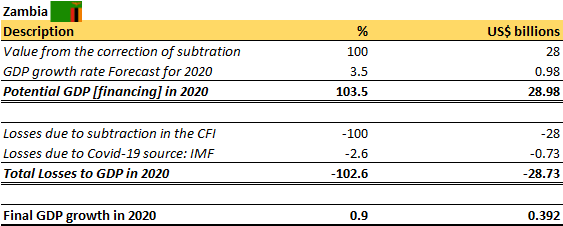
The table above shows financial losses caused by Covid-19 will be approximately 2.6% of GDP. Billions of kwacha have been earmarked to fight Covid-19, resources and man power have been mobilized and everyone is somehow involved in helping to prevent the epidemic.

This furor is for a problem with an economic loss to GDP of -2% to -2.6%.

Lets weigh this against the economic loss to GDP of subtraction in the CFI shown in the table which is -100% of GDP per annum. The value of this economic loss is almost 38x to 50x bigger than the economic loss caused by Covid-19.

Which begs the answer to the question:

Which is the bigger epidemic

People living in developing countries need to begin to provide answers to the problems related to poverty and underdevelopment the knowledge paradigm continues to fail to address.
Return to Quick Links 2

……….

Why we recommend SV-Tech

18th May 2020

Why we recommend SV-Tech: For every U$1 the US Fed spends to fight back recession using conventional QE only 2 cents will actually do the required work, where as when the same is applied
through the SV-Tech innovation every US$1 the US Fed spends to deter recession 98 cents will do the
required work and achieve the objective. This is simply due to the fact that the SV-Tech system
is designed specifically for driving economic growth with financial system stability.

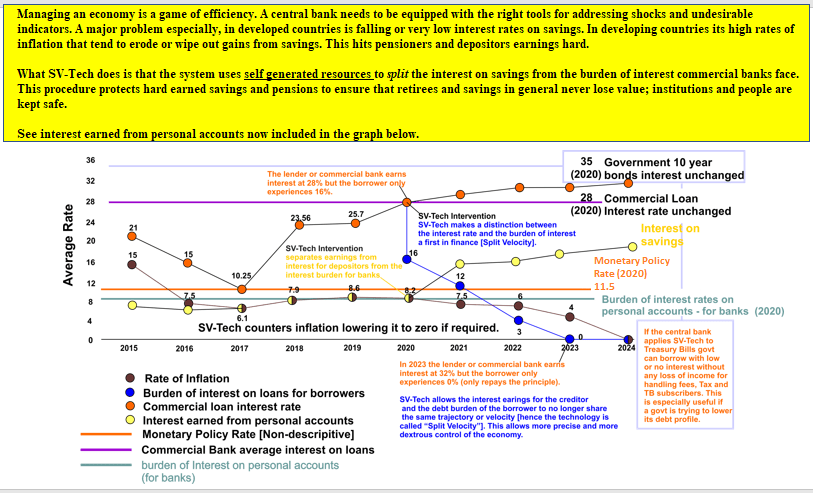
In developing countries inflation tends to wipe out the benefits of savings and pension schemes. In developed countries a major problem during a down turn is how to revive the national economy. One of the methods applied to do this, that does work, is Quantitative Easing (QE). To prevent recession households and businesses need access to cheap money to encourage them to spend and produce. The dilemma that arises is that cheap money requires low interest rates 0% – 2%. When a central bank lowers interest and increases money supply it can have the desired effect, which is to stimulate economic activity. However, the casualties of this are pensions and long term savings. Pensioners can watch the value of pensions they’ve worked their whole lives for eroded to the point where they fear for their well-being after and during retirement, while long term depositors can watch the sacrifices they have made over the years to build savings disappear as a result of inflation. It should also not be forgotten that even if interest rates are reduced to 0% the greatest proportion of the debt load tends to always reside with the principle, therefore, adverse economic conditions can negate the impact of rate cuts by restoring an invisible ad-hoc debt burden that is not accounted for when assessing such interventions. [i.e. As interest rates drop due to rate cuts these cuts have to be weighted against the capacity of borrowers to repay loans – which is itself being continually eroded by a weakening economy]

A Spit Velocity model generates its own internal resources with which to separate [split] the burden of interest on savings faced by commercial banks from the interest on savings required by pensioners and savers [hence the innovation is called Split Velocity]. The SV-Tech intervention is shown in the graph above. This allows pensioners, annuities and savings to enjoy an interest rate above the inflation rate and well above low interest rates, protecting them from bearing the negative repercussions of any action a central bank needs to take to revive the economy. The sacrifices made by people to save their income is recognized by the economy and actively safeguarded. This enhancement ensures that pension schemes are protected and will never be allowed by the economy to lose the value retirees require to cover their present and future living expenses.

The United States Federal Reserve is currently (April 2020) spending US$80 billion a day [the highest on record] on increasing money supply through the purchase of Treasuries to counter the recessional impact of Covid-19. This is necessary to help prevent recession. However, we recommend an SV-Tech intervention to prevent economic shocks. The reason is very simple – efficiency. For every US$1 the Fed spends on QE the impact of the stimulus to drive back recession is likely to be US$0.02 (2 cents) or less, that is, the Fed loses 98 cents on every QE dollar; a processes that does not counter the inefficiency of money. This low rate of efficiency is why there is sometimes doubt about whether QE works. It does work, it just requires copious amounts of money supply to see results and it will only work if productivity of a unit of money is greater than zero (x>0). If the ratio is at zero or less the economy will not respond favourably to QE. The higher the ratio the more responsive to QE an economy will be.

During a recession Split Velocity allows people to safely both spend and save, this gives firms the confidence to continue pushing output and sales whilst it removes inflation from the economy, this continued economic activity and retention of savings in turn encourages banks to keep lending to the public and to themselves, consequently unclogging the main avenues that cause recession. Using a Split Velocity (SV-Tech) system instead of purchasing Treasuries with a low impact of 1:0.02 the Fed would purchase actual growth. Every US$1 the Fed might use to increase money supply by using SV-Tech would result in a push against recession of U$1 (1:1). This makes SV-Tech as much as 98% more effective and more efficient at generating growth and deterring or driving back a recession (such as that created by Covid-19) than conventional QE whilst obtaining the same objectives.

……….

Per capita income in Zambia in 2030, If we do not act now

14th May 2020


The need to act now to secure and protect the future for our youth and future generations

The need to act now by understanding weaknesses in the CFI and addressing them in the economy will determine whether we create progress for the youth and future generations or fail them.

Expected normal growth in per capita income is only US$33 every year or
US$331.98 after 10 years of economic activity from a population of 18.3m people. In this scenario
poverty levels in 2030 are still very high, unemployment is still a major problem and people continue to struggle to make ends meet. No meaningful improvement in per capita income takes place despite a decade of economic activity – Zambians living today, especially the youth, will experience little or no improvement in their lives.

Accelerating growth with Split Velocity offers much brighter
prospects for the future.


And will guarantee Zambia’s National Development Plan, Long term National 2030 Vision is achieved without failing to reach targets as is often the case. The National 2030 vision is for Zambia to become a prosperous middle-income country by the year 2030, underpinned by the principles of gender-responsive sustainable development; democracy;respect for human rights; good traditional and family values; a positive attitude to work; peaceful coexistence; and public-private partnerships.

A projection of economic growth on a Split Velocity (SV-Tech) managed economy is as good as a government bond or guarantee. This is due to the fact that growth targets are financed. When a growth projection is made it will be achieved. Any shocks or losses to growth caused by extraneous factors can be mitigated against by the same system to retain the growth projection. Commercial banks can depend on these projections when they lend to government and the private sector.

In an SV-Tech model every business in the economy benefits from the opportunity to grow regardless of its size, which sector it is in or which province in the country it is located.

12th May 2020

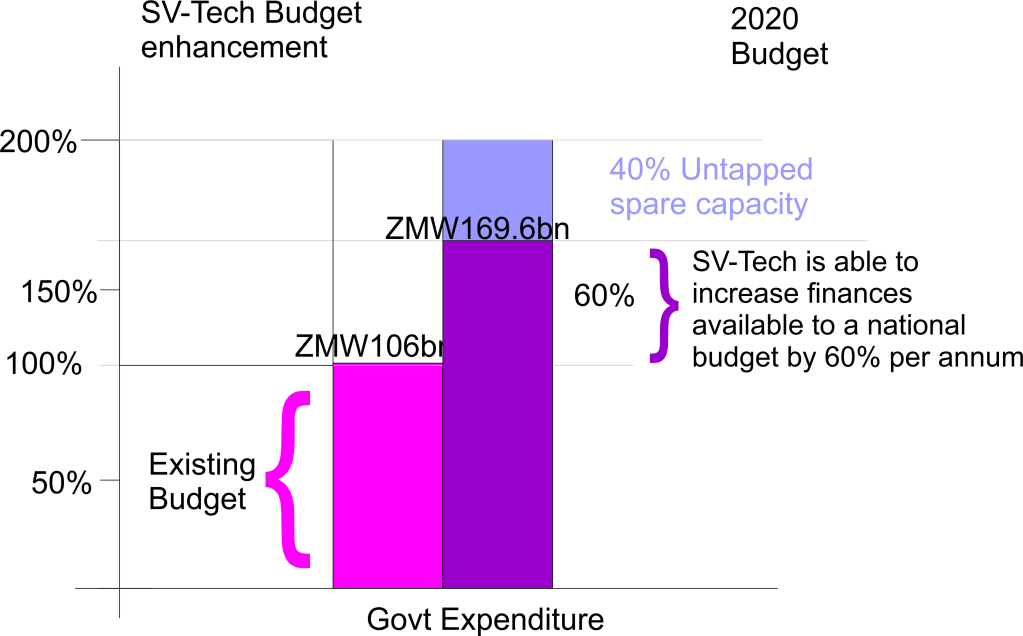
A 60% per annum increase in spending power.

When SV-Tech is applied to a government budget the finances available for government expenditure during the course of the year increase by up to 60%. This leaves 40% of income available for the government budget (ZMW42.4 bn) on the system untapped. This spare capacity leaves room for any unexpected expenses that government may have to face during the course of the year. The bar graph shows the increase in spending power. Simply increase the desired governments budget (X) by 60% (your country’s budget-X*0.6). The new revenue is gained simply by recovering losses caused by subtraction. This is a straight forward benefit of fully applying the SV-Tech system to a national economy. As economies move to recover from Covid-19 these additional resources can prove useful to countering the pandemic.

………

SV Debt Contraction Capacity

11th May 2020

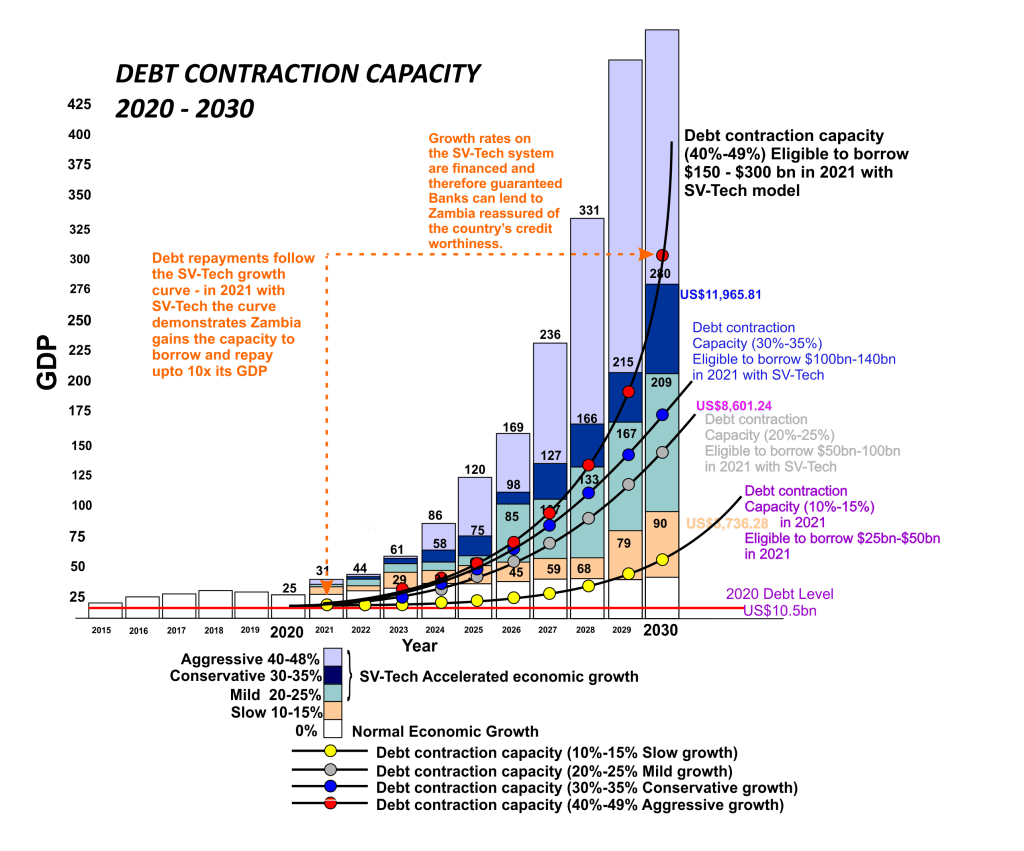
Despite having a small economy valued at US$28 bn in 2020, SV-Tech demonstrates, using the graph above, that even the economy of a developing country like Zambia with a per capita income of US$1,307.02 can project a GDP of US$649 bn realized over a decade. These secure growth projections will be powerful enough for international banks to lend to developing countries, not based on where they are, but where the projection guarantees their economy will be over a prescribed period of time. This allows us to lift hundreds of millions of people, anywhere in the world who are currently living below global living standards, out of poverty into a standard of living comparable to that enjoyed by the developed world, and to move the developed world itself to new economic heights. As an innovation just beginning to enter the Fintech space, this makes SV-Tech an exciting development for all of humanity.

SV-Tech is able to shift debt contraction capacity from current GDP to projected GDP:
With SV-Tech governments can borrow with secure knowledge about how the national economy will perform. With growth rates set anywhere between 10% to 48% debts acquired have greater certainty of amortization.

Debt of this kind is “contracted”, meaning it is gained as a result of agreement [.i.e contract] between an entity seeking to acquire a loan (the debtor) and an entity that provides the service ( a creditor). The ability to take on more debt in this manner is therefore referred to here as “debt contraction capacity”, it can also be
referred to less technically as “debt carrying capacity”.

The enhanced debt contraction capacity shows that a Split Velocity model increases the demand for loans from local and international creditors due to the fact that borrowers will clearly see they are in a conducive economic environment to take on debt. [When banks receive money to distribute as loans in a downturn risk averse borrowers will tend to shun loans because they are afraid they can’t repay them. Even if they take loans the potential for default in a downturn is high. By using SV-Tech to improve the financial position of borrowers, they gain the confidence to take on more loans and actually repay them. An economy financed by SV-Tech will see increased demand for loans from commercial banks. This is a counter-intuitive process that works [see the advantages of an synchronous financial system here]

The diagram above shows that Zambia’s debt contraction problems are directly related to slow economic growth that is incapable of sustaining the economy’s needs. Recovering losses to subtraction which consequently accelerate growth leading to higher government revenue is the most practical method for addressing Zambia’s credit worthiness.

Since economic growth determines a county’s capacity to borrow from domestic and international markets, and SV-Tech has sovereignty or direct control of an economy’s level of productivity, this means developing countries have a pragmatic mechanism for guaranteeing the stability of the domestic currency. The diagram shows that by simply using SV-Tech to accelerate growth by 10%-15% Zambia’s debt position improves remaining consistently at 50% of GDP. This is however the slowest rate on the system. Accelerating growth to 20%-25% drops government debt to 25% of GDP through the decade. Should the central bank opt for an aggressive growth rate (which is what is recommended for poorer developing countries) the debt to GDP percentage becomes negligible or 10% and below. These improvements in debt contraction capacity open the doors to government renewed borrowing. If an aggressive setting were applied the Zambian government could look forward to issuing Euro-bonds for 2030 or later maturity valued at US$100 – US$150 billion and this would only be 10% – 23%of GDP. A Split Velocity model is much safer, recession resistant, more robust and significantly more secure than economies run without it.

Since the SV-Tech model predetermines the rate of economic growth the country’s credit worthiness can be based on the applied rate of acceleration with repayments following the growth curve. What this means is that despite Zambia’s GDP being US$28bn in 2020, should it have a Split Velocity model in place in 2021 its credit worthiness could rise depending on the growth rate applied, with the highest being an aggressive growth rate which implies the capacity to borrow and repay US$150bn – US$300bn in 2021, which is 10 times Zambia’s current GDP [see above curve where it shows “debt contraction capacity”] this ofcourse does not mean the country should borrow 10x its GDP, rather it demonstrates that credit-worthiness can be leveraged by the SV-Tech system allowing a more robust demand for loans that are now easier to repay, which in turn leads to a significant back-stop for balance of payments. This in turn will restore the value of the Kwacha and act as a buttress for the general price level that is now stable over the long term. The consequence of this is highly and effectively enhanced financial system stability. The ability to achieve these results are what exemplify best practice in central banking and they are achievable by central banks facilitating the introduction of an SV-Tech system to an economy”.

This demonstrates that the real problem is not debt per say but the creation of growth and economic conditions that are conducive for borrowing and repaying government debt such as that created by a Split Velocity system.

Few other (if any) approaches to economic management would yield results credit rating agencies such as Standard and Poor, Fitch Group and Moodys might find conducive for growth, stability and a robust international credit system.

Return to Quick Links 2

………