
1st October 2020
How SV-Tech Addresses Hyperinflation Paranoia
Usually printing or creating money and introducing it into an economy is shunned, ostracized and viewed with tremendous suspicion due to the fact that it is known to cause unwanted and unmanageable inflation, as has been witnessed in some countries recently such as Zimbabwe where the currency had bills denominated in trillions. Hyperinflation paranoia can be described as a sometimes irrational phobia that believes any form of increase in money supply and printing money will cause hyperinflation.
The fact that printing money is cheap, and for all intents and purposes the fact that introducing it arbitrarily into an economy makes it worthless because it will just cause inflation or hyperinflation, are in fact very important and useful characteristics of money that make it highly effective for accelerating economic growth.
You have to put your counterintuitive cap on to understand how what the public generally considers the worst traits of money, that is, being cheap, having no intrinsic value and being worthless because it causes the chaos of hyperinflation should it be over supplied actually make money a very useful resource. To do this you have to stop thinking of money as a store of value and think of it more as a natural resource or as just a raw material. When you elevate your view to seeing money as raw material, being unwanted because it is inflationary and cheap because it has no intrinsic value means it is a raw material that can be acquired at very low cost. If money were expensive this would be counter-productive to its utility value as a catalyst and means of accelerating economic growth.
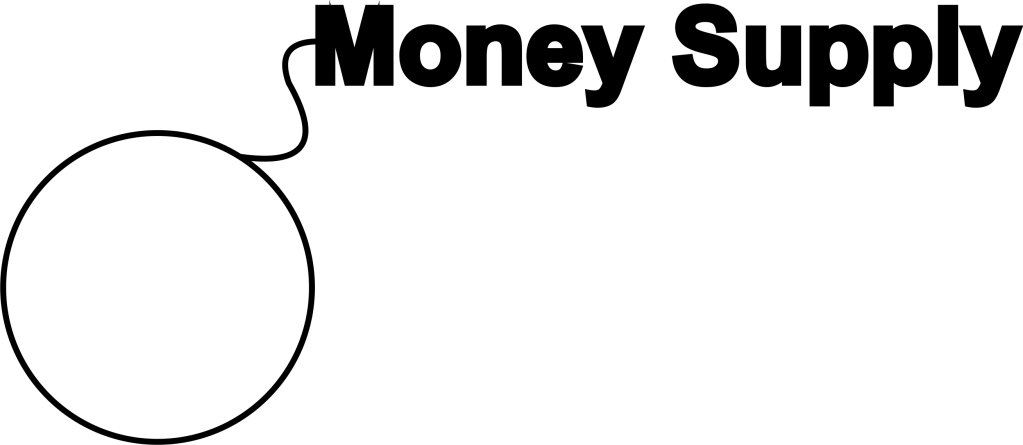
The circle below represents money supply in Country X’s economy.
There are a number of ways a central bank can increase money supply. If a government is cash strapped and desperately in need of money, for instance, to pay salaries, buy fuel, pay off local and foreign debts, keep its operations going, the central bank may simply print money and use this to pay for government expenses. This is the worst use of money and will rapidly lead to inflation and hyperinflation which cause chaos in a national economy.
The other option is for the central bank to increase money supply by reducing the cost of borrowing by lowering the monetary policy rate. This will make credit cheaper and will place more money in the public’s hands. There will be more money in the economy potentially chasing fewer goods and services. Like printing money to pay bills or cover operations, this can cause a rise in inflation.
The other option at the disposal of a central bank is to use government instruments such as bonds and treasury bills to borrow from the public. Government instruments will tend to have high interest rates to make them attractive and will be purchased predominantly by institutional investors, such as commercial banks. Firstly, when the central bank raises these funds and begins to use them to pay bills and pay for government operations the impact of this will be more money chasing fewer goods and services and the rate of inflation will rise.
Secondly, when government instruments mature the central bank will have to honour its debt to subscribers of government instruments. Since the interest rates on these instruments were high, when the central bank honours its creditors money supply floods back into the economy, once again creating a condition in which more money is chasing potentially fewer goods and services. The consequence is more inflation.
Inflation takes money out of the pockets of every citizen in an economy, reducing their wealth, and the value of their earnings, they have to work harder for less. It makes life harder for citizens and is essentially a sinister betrayal of their trust. However, it is a soft option because most people are ignorant of how the value of their labour and purchasing power is being eroded because earnings stay the same while prices persistently rise.
The diagram below shows money supply increasing while goods and services in the economy remain constant. At this point the central bank is rapidly losing its control over the economy and financial system stability as the domestic currency depreciates with its operations. As a consequence, it must now look to the treasury for foreign exchange to act as a shield for a collapsing national currency.
The disadvantage of this approach is that it will put a strain on the treasury’s import cover.

If the central bank and monetary policy committee continue to apply these approaches, they can inevitably move the economy from creeping inflation, to full blown inflation and eventually into full blown hyperinflation that plunges a country into chaos should foreign exchange reserves and earnings fail to hold fort. As shown in the diagram below persistent increases in money supply can lead to hyperinflation, where too much money in the economy is chasing too few goods.
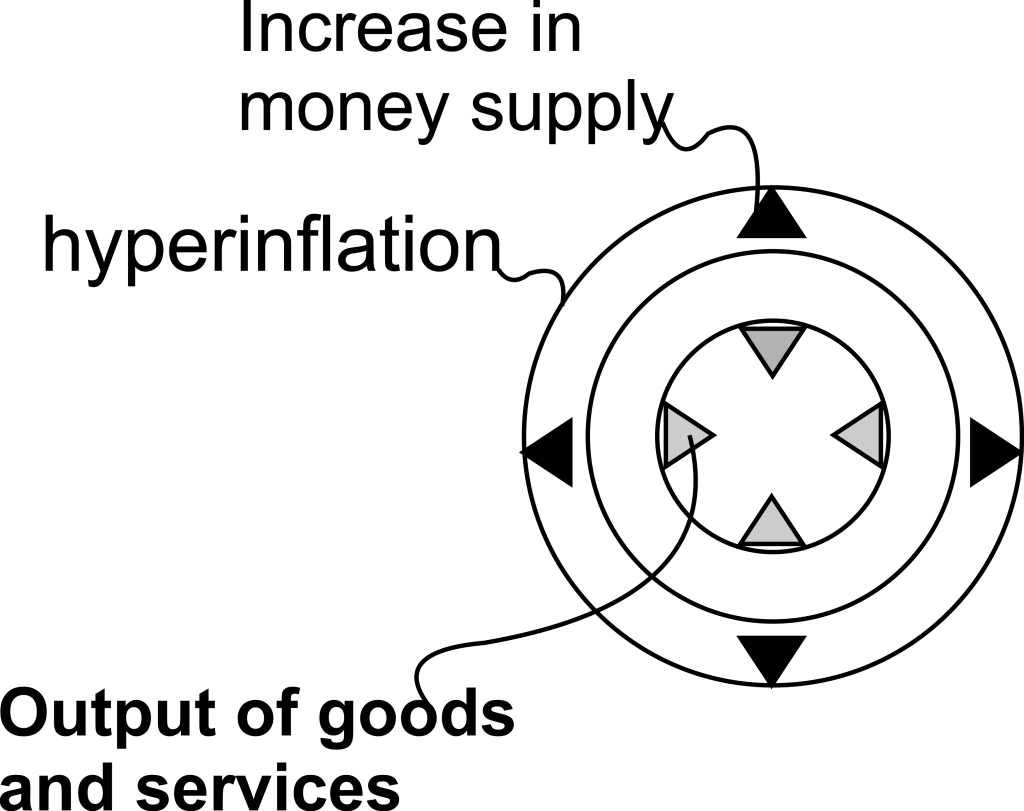
At this point the only device protecting the economy from hyperinflation is foreign exchange in the treasury and forex earnings from exports.
How Split Velocity (SV-Tech) accelerates economic growth without any inflation
To begin with Split Velocity (SV-Tech) applies its unique method to managing money supply. What SV-Tech does, is that it first increases the work money has to do in the economy. Inflation is a symptom of money being “lazy” or functioning inefficiently in an economy.
………

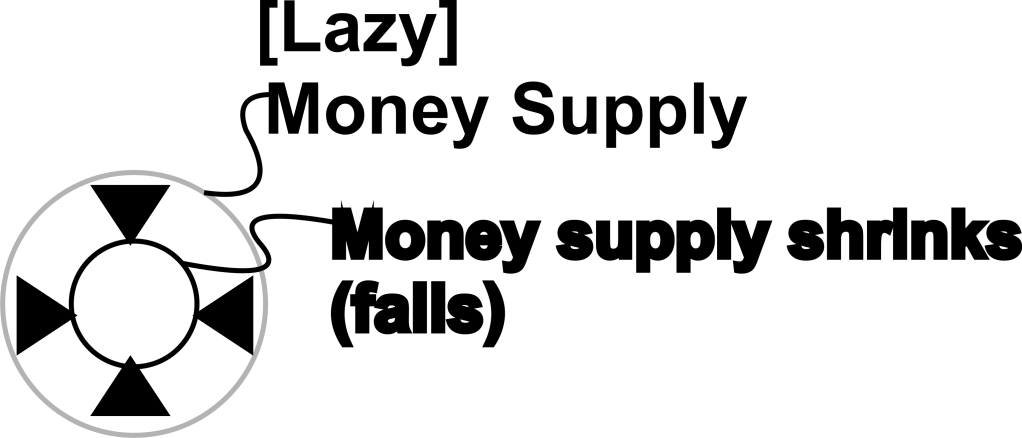
SV-Tech changes some accounting procedures and instead of one task at a time (linear transactions) SV-Tech requires money to perform more than one task per transaction, it thus splits the velocity of money. SV-Tech upgrades the cost equation from Profit = Total Revenue (TR) – Total Cost (TC) to Earnings = Total Revenue (TR) = Total Cost (TC), which forces money supply to work much harder. This causes money supply to shrink, contract or fall as shown by the smaller circle below.
Money is now working harder to produce goods and services in the economy. Government has more money for its operations and for paying debts, firms have more income and are able to start to increase their output, exporters are generating more forex from increased sales/exports, firms are able to pay back their loans with commercial banks etc and take on bigger loans due to improvements in their creditworthiness. Note that at this point of implementing SV-Tech the central bank has not printed any money, it has not made any changes in the monetary policy rate, it has not issued government instruments. It has not done any of the activities that potentially trigger inflation in an economy at this stage, which are still available to it at a later stage when the economy is more stable. In fact, all it has done is increase the operating efficiency of money in the economy by requiring chartered accountants in firms to upgrade the cost equation in their public and private sector operations.

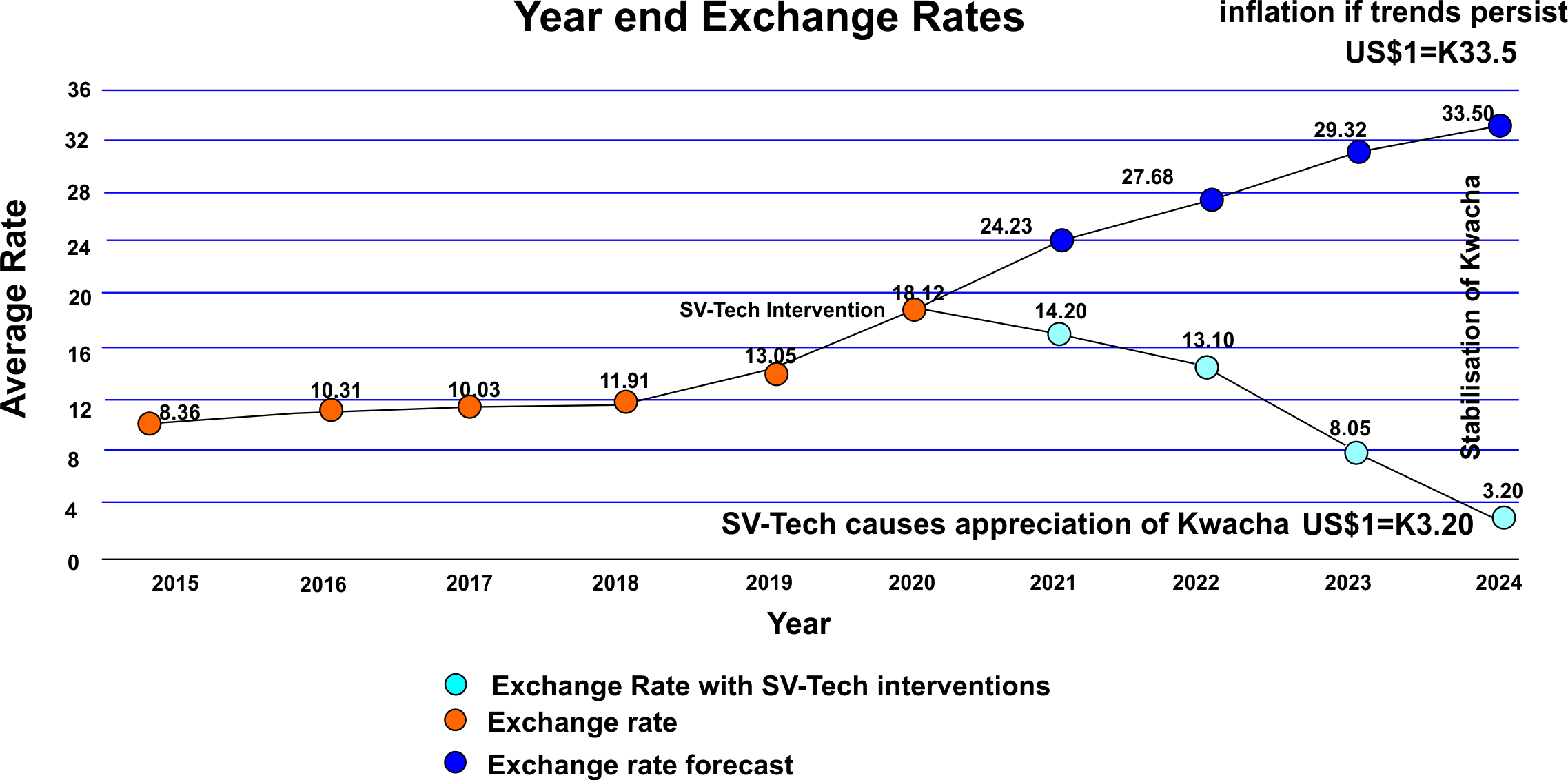
Government has funds to pay its debts, its has money to run its operations, money supply has shrunk not increased, firms have resources to pick up the pace of productivity, exports are increasing significantly as exporters in every industry operate in a more effective financial system, the output of goods and services increases to the extent that it is greater than money supply, the economy is functioning more efficiently and this causes the domestic currency to appreciate in value against the dollar and other hard currencies. The economy is beginning to boom.
Note that even with these dramatic changes in the economy the central bank still has not applied any of its policy tools. It has not printed money, and it has done nothing to increase money supply.
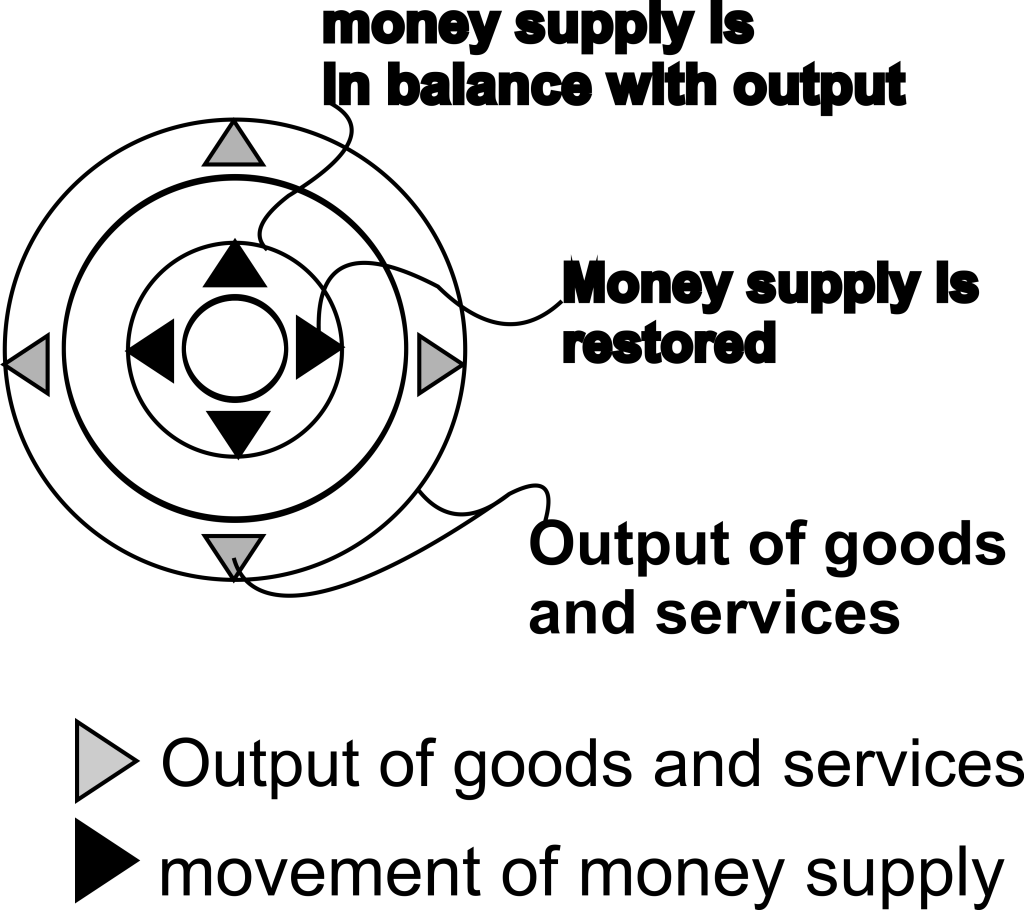
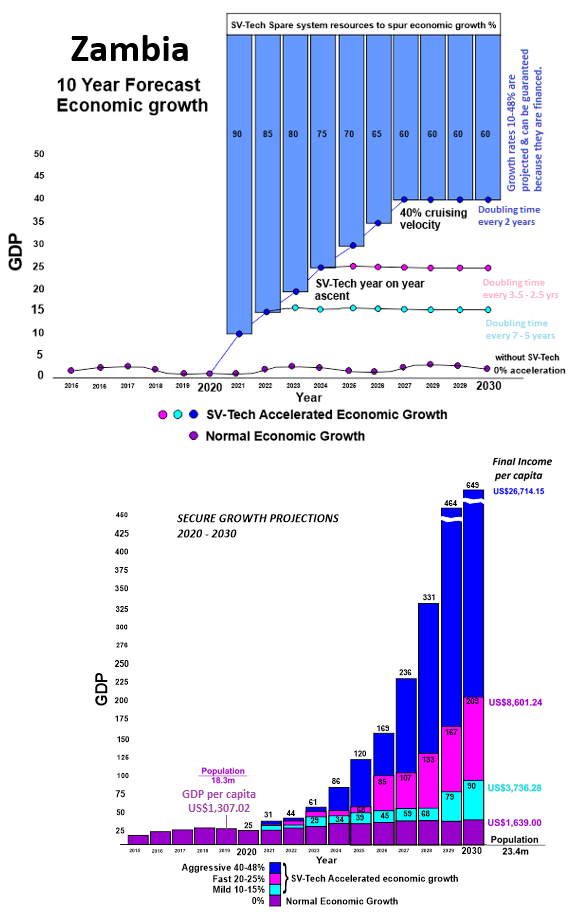
However, as shown in the diagram above goods and services in the economy are beginning to put pressure on money supply, in other words there are too many goods and services beginning to chase too little money in the economy, the local currency is appreciating to undesirable levels. Only at this time does the central bank ease this pressure by relaxing money supply using all the tools available to it including government instruments and reducing the cost of borrowing. The SV-Tech system allows money supply to settle at a predetermined growth rate, that is, 10% to 48% growth in GDP per annum. This new extraordinary growth is made possible by the SV-Tech upgrade to the cost equation firms introduce through accounting procedures that allow no unnecessary losses to the circular flow of income (CFI).
The central bank is now in full control of the economy, the value and exchange rate of its domestic currency. The economy is performing extraordinarily.
Using the SV-Tech system at no point in time during the implementation scenario described above, was there a threat of inflation or hyperinflation. These threats only remain with current “state of the art” methods being applied to manage the national economy described at the beginning.

 Split Velocity Solutions Ltd