Operationalizing the Money Supply Industry

15th August 2022

Operationalizing Split Velocity creates the money supply industry. Technically, even though cryptocurrencies (private money supply – sometimes referred to as decentralized finance) and fiat (public money supply – sometimes referred to as centralized finance) exist, there is no industry.

As has been mentioned the money supply industry should ideally compliment the commercial banking industry, but is currently missing from the financial sector. Split Velocity corrects the defective CFI and restores the hidden/unseen losses and restores them to businesses, government, private and public sector institutions.

This effectively brings an end to scarce resources, high levels of credit risk, underdevelopment and poverty whilst at the same time ushers in unprecedented new levels of growth, improvements in the standard of living, advancements in infrastructure development and leap forward in socio-economic development, possibly greater than has ever been possible in human history.

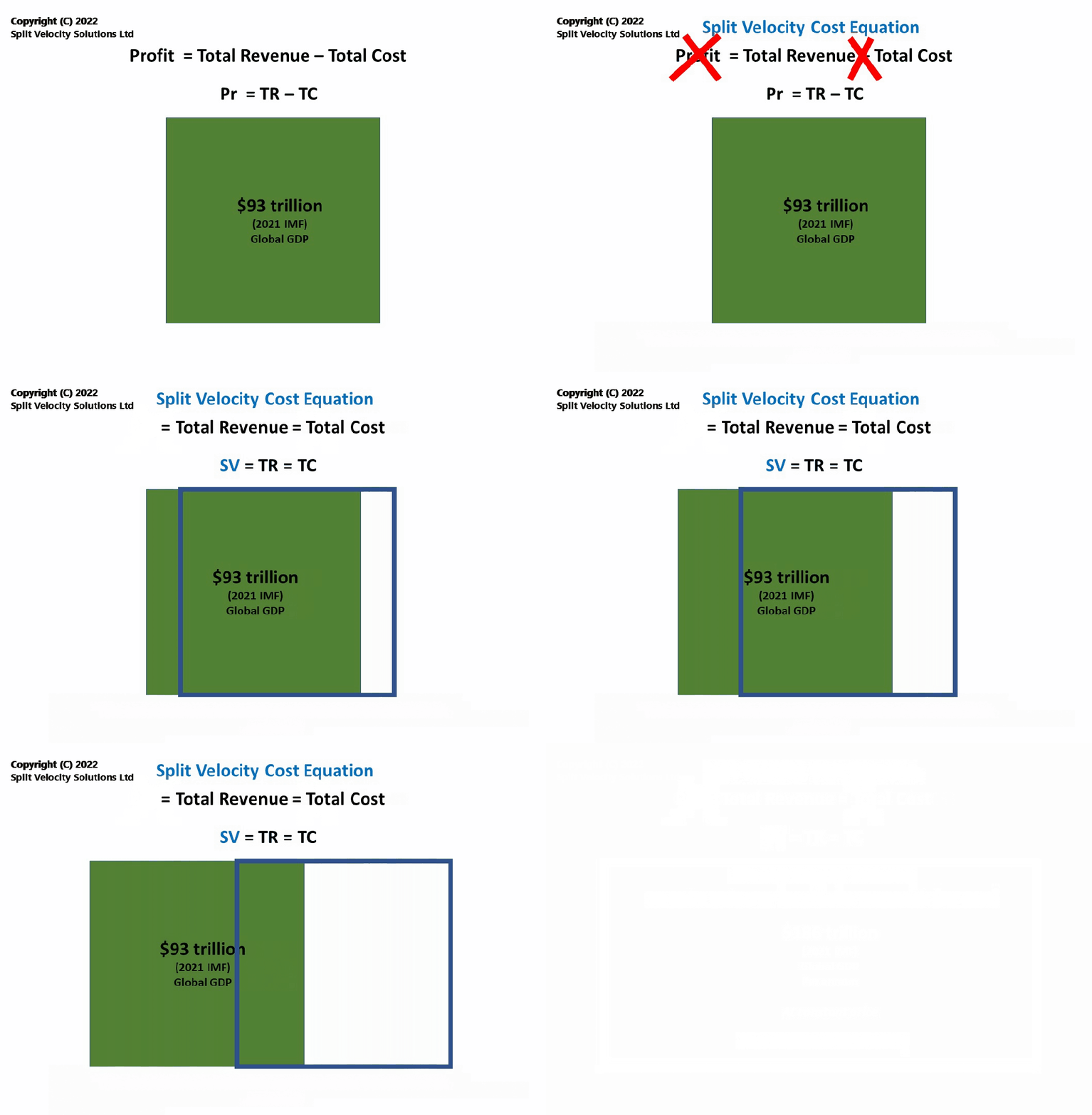
Losses equivalent to annual TR must be restored to all businesses and institutions:
Split Velocity identifies and draws out the hidden financial loss and
and decline in productivity caused by
the defective, poorly designed CFI restoring it to stakeholders

Contrary to conventional belief maintaining constant price
is relatively easy in a Split Velocity model. With the Cost Equation upgraded or corrected
to the Split Velocity Cost Equation shown above, the Fisher Equation is upgraded to the Split Velocity model’s
equation of Exchange, referred to in the GPWN as the Punabantu Equation of Exchange.
The equation shows that a Split Velocity model establishes a “price plane” and will resist
both inflation and deflation when changes in money supply take place. Technically,
because the velocity is “Split” there is no real increase in money supply (i.e. $186 tn/2=$93 tn)
this increases the efficiency of money observed in increases in output (businesses and institutions have
more income to allocate to non-human capital expenses consequently shifting the production possibility frontier to the right and driving output upward maintaining constant price, meanwhile households experience an increase in income with which to consume higher levels of output. A Split Velocity model is a well oiled machine expertly designed to achieve what an economy is expected to achieve and represents best practice. This is ideally how an economy should be managed, how it should operate and correctly function to obtain the best and most efficient and effective results, with no unnecessary losses to the CFI – see how the Punabantu Equation of Exchange supersedes the Fisher Equation in the GPWN 2010).

As demonstrated by the animation above the poorly designed, defective CFI wasted $93 trillion in 2021. The most affected by this loss are households, that is, employers, business owners, owners of factors of production, shareholders and labour, that is, employees engaged with with activity related to production. This is one situation where both shareholders and employees have a common problem. The CFI subtracts tremendous value from the economy worsening returns on dividends, earnings and conditions of service.

Incredibly this $93 trillion loss, that can be recovered, is not addressed as it is not identified at postgraduate and doctoral levels of economics and finance. It is not identified at the highest levels of thought, academic qualifications and professional practice today.

This loss is revealed in an audit of the CFI. The damage this loss has done, the suffering it has caused humanity to endure and continues to impose on development in the presence of inadequate resources needs to be corrected for the function of economies to be normalized and to allow businesses and institutions in both the private and public sector to begin to function optimally.

What this illustrates is that cryptocurrencies and fiat: the money supply industry in general, is in its infancy. There is is tremendous potential waiting in the wings to be deployed. Extensive skill and a shift in the knowledge paradigm is required to unlock this wealth, the need to learn and understand a Split Velocity model cannot be understated, neither should it be taken for granted as something easy to do. There is a need to step out of the comfort zone and embrace the changes and transformation a better understanding can bring. The learning curve is steep, but not insurmountable.

Split Velocity Growth has the advantage of being based on Science not Ideology

When Split Velocity is operationalised in an economy it will achieve its objectives. It is possibly the first and only economic strategy capable of lifting an economy comprehensively out of poverty. The perpetual failure of past policies and strategies is evidence of gaps in the knowledge paradigm for how to mobilize resources and achieve rapid growth that is transformative. These mistakes should not be repreated in perpetuity. Fortunately Split Velocity fills the gaps offering a strategy, methodology and technology that will not dissapoint implementors.

Split Velocity processes and technology is based on science not ideology. In terms of resource mobilisation for development, Ceteris paribus, it is capable of reducing doubling time for GDP to 1 year at constant price. Depending on its needs, from this an economy can choose what proportion of these resources it wants to apply by determining a growth rate . e.g. 40%, 50%, 60%, 70% and so on. This is regardless of the current size of an economy.

Its common knowledge that every aspect of socio-economic existence, including whether an economy is a superpower or fundamentally a weakling is dependent on economic performance. The strategic importance of Split Velocity technology, ceteris paribus, is its ability to double GDP in one year at constant price. To achieve this feat a Split Velocity model does not even need to apply its full resource mobilization capacity since the rule of 72 reduces the duration required for this threshold to be achieved achieved. Rates of acceleration can be lower, yet suitable, for example, optimized between 40% to 70% or less. This leaves spare capacity to address economic shocks, where productivity has to be ramped up to compensate for slow growth witnessed during recessions.

Economies unable to access Split Velocity will risk not having access to these guaranteed accelerated growth rates and associated doubling times, therefore early adoption of the innovation is advantageous.

Split Velocity NFTs: The Debut of Ingots

6th June 2022

This image has an empty alt attribute; its file name is nft-ingots.jpg

Africa is very much a part of the history of FINTECH. When the very first Ingots where minted thousands of years ago in ancient times in the Zambezi area, this Iron Age innovation would have been no different from the entry of blockchains and cryptocurrencies today. The Asterisk or Star is the symbol used to represent Split Velocity NFT Ingots chosen as the platform for implementing Split Velocity.

The very first catalogue of NFTs and its theme can be viewed on the links provided below.

This catalogue of NFTs are a founder’s collection designed and conceptualized by the founder of Split Velocity. It will consist of a limited number of ND Ingot NFTs and will only be available once, offering a once in lifetime opportunity to own a founder’s edition NFT. These can be viewed now but will only go on offer after building awareness, marketing and other modalities are in place. Nevertheless, there is an option to make an offer right now for anyone who is ready to do so. Once these first collections are sold out you may never get the opportunity to acquire one of these NFT assets from this specific collection. ND Ingots have both artistic and will have utility value.

To gain some information on ND *Ingots, the theme chosen and reason for variation and use of simple child centric/child friendly colours, how they work – read the summary of Split Velocity NFT Ingot white paper etc click here

To view the first entries on the Founder’s Collection of NFT *Ingots: Tier 1 Ingots click here, Tier 2 Ingots click here, for Tier 3 Ingots click here, please like, share, help circulate the Ingots and the Founder’s Collection.

Ghana supports introduction of an ECH process in West Africa (2021)

Monday 14th January 2022 – Wishing you a Happy Valentines Day, Zambia!

Normalising International Trade

Source: GPWN (2010)

How to build a better International Trade System with no trade deficits

Using the International Trade System to create a permanent solution to currency instability would strengthen economies and currencies like the Zambian Kwacha.

A fundamental governing principle of monetary theory is that when goods and services enter or leave a fixed medium of money supply (retention) within an economy they respectively cause an appreciation or depreciation of a currency that can be restored or regulated by increasing or decreasing money supply in proportion to goods and services in circulation. When currencies are confined to their respective borders goods and services can move against this retention. A new and well-organised international trading system based on this principle can begin with Central Banks playing a key supervisory role in the relationship between international trade and currency. In this system when external goods enter an economy they inevitably cause an imbalance between the volume of domestic currency in circulation and aggregate goods and services. In monetary terms, imported goods create a deficit effect on money supply. At the same time there are industries within an economy externalising a nation’s resources by exporting goods and services creating a surplus effect on money supply. The deficit created by goods and services entering an economy can be balanced by Central Banks receiving these payments and reintroducing this liquidity using the surplus effect. This liquidity can be re-injected into the economy by paying it to domestic exporters using local currency leaving no doubts as to the cycle of monetary receipts and allocations in international trade. Hence, exports naturally pay for imports when they create a surplus in liquidity and vice versa. The economy remains balanced. Nothing could be simpler. The global trading system is thus allowed to act like an efficient self regulating organism made up of balanced self-regulated domestic macro-economies. There is less complexity, less clutter, less monetary chaos.


In this example the entry into an economy of imports empowers a Central Bank to increase liquidity, which facilitates payments to exporters in domestic currency. With this relationship there is absolutely no need for an importing country to have to source the national or domestic currency of the economy from which it imports goods and services or some internationally accepted trading currency. Having to do this is an unnecessary barrier to international trade that hurts both the exporting and the importing country. Its partner Central Bank already has the domestic currency to effect payment. In fact, no domestic currency whatsoever would need to leave its borders and no foreign currency has to enter them. For example, in this condition there are absolutely no currency exchange barriers to trade that would injure industries in the US that need export markets; the same applies to consumers and industries in Zambia that need to import and vice versa. Both Zambia and the US would face absolutely no currency reserve problems as there would be no need to hold foreign reserves in the first place. Currencies remain territoriality bound and constant (retention) while goods and services move. In essence each nation’s individual currency would act like a single currency that automatically transmutes itself through Central and/or Federal Bank currency supervision partnerships. This facilitates the tranquil movement of goods and services between economies. Commercial banks already follow this approach. Why should a commercial bank physically move money to another country when its subsidiary there already has the facility and resource to make a payment in local currency? For instance, it receives a payment in dollars in the US then instructs its subsidiary in Zambia to make the same payment in Kwacha, vice versa. If it works for commercial banks it can work for the IMF, WTO and Central Banks. The US Federal Reserve Bank (FRB) and the Bank of Zambia (BoZ), or any central bank for that matter, can have a partnership that facilitates and catalyses trade without currencies as barriers that stunt growth. This is what global partnerships are about.


Trade deficits and surpluses can be handled just as easily using this policy. In the United States in 2002 a trade deficit of US$435.2 billion of imported goods threatened the US economy. With GDP at US$10trillion this caused a deficit that could have been solved at the US Federal Reserve simply by balancing its internal liquidity were the international trade system different. Not a single dollar would have escaped the US economy and the FRB due to its partnerships with other central banks. Financial stability in the US, and other individual economies, would mean stability in the rest of the world. The domestic balance between the stock of money and stock of goods and services would be manageable. The US Federal Reserve’s ability to internally control balance of payments and retain a stable economy would increase dramatically. There is a need to see that a general trend in economies today is toward trade deficits due to the ever-increasing complexities of specialisation, comparative advantage and interdependence in the midst of a stagnant international trade system. The current global trade system and mechanisms are ‘pre-historic’ and show a lack of innovation on the part of policy makers.


In a new supervisory partnership of Central Banks supported by the WB, WTO and IMF, and the proper use of monetary policy, even if a country like Japan experienced a trade surplus it would be able to internally regulate the effects of this condition thus protecting itself, its trading partners and the global economy. At present trade deficits and surpluses uncontrollably spill over borders and translate into fluctuating internal and external exchange rates, which create a sickly and now archaic global trade system that destabilises economies. Currencies and goods run amok, hence, nations anxiously horde each other’s currencies in fear of inadequate trading capacity. Within a few months global speculation or induced devaluation can wipe out the value of foreign reserves in a country despite the torturous effort of governments to build them up. Shortages in domestic currency due to it spilling over into neighbouring countries can lead to CBs having to print new money at high costs; or an economy can be destabilised by its own externalised domestic currency being channelled back into its economy by exports or transfers. FDI is threatened as investors fear inadequate hard currency to meet obligations. An export company cannot export as there is inadequate foreign exchange in circulation to buy raw materials which leads back to the problem of insufficient hard currency. A Zambian producer cannot purchase equipment as the economy has no foreign currency or due to the fact that a very high price has to be paid for it that deters productivity and renders growth incapable of repaying national debt. Meanwhile, across the Atlantic manufacturers in the US may sit idle and lay off workers, though warehouses are full of unsold goods, waiting to be hit by the full effect of a recession as potentially vast external markets either do not have access to the dollar, cannot acquire it, find it too expensive to buy or as it is in the case of Zambia, are standing by for copper export revenues to arrive from the LME on 56 Leadenhall Street. All this friction contributes to a global economy slowing down.


Currencies proliferating all over the globe crossing borders and running amok outside the statutory jurisdiction of central banks (CBs) and an attempt to regulate them has become a poor rather than a prudent application of free markets and monetary policy that has increased the vulnerability, risk and exposure of economies to financial instability. There is an alternative to this chaos and the method for operationalising the process by which this takes place is to create an electronic clearing house facility for international trade.

ECH Trade System

The globalisation of money was introduced in Chapter One. The globalisation of money is as important to international development as free trade. In the present system major trading currencies such as the US dollar or Euro have to be obtained before countries are able to acquire imports. To do this they themselves must find exportable products and earn the foreign exchange with which to pay for imports. The capacity to produce exportable goods and services is thus a fundamental barrier to a country’s capacity to acquire foreign exchange and therefore its capacity to participate in international trade. Foreign exchange, though readily available on international markets can therefore be considered a significant barrier to international trade due to the hurdles countries must overcome to be able to acquire it.


There are two possible ways of overcoming this barrier. The less attractive method is to attempt to create a continental currency or internationally acceptable currency owned and controlled by developed countries that overcomes these barriers. The more attractive method is to introduce an electronic clearing house (ECH) for facilitating international trade. An electronic clearing house for international trade entails that when goods and services are traded between countries, exported and imported goods move whilst domestic currencies stay put. This method is more practical and brings with it many new potential benefits.


Using an ECH process, when a country imports goods and services the payments from domestic exports accrue to the Central Bank or an agency appointed by the CB to manage the ECH process. In other words imports entering a country have a positive effect on the balance of payments and are a direct source of income that accrues to government. These funds are then placed in an ECH Import Account. When a country exports goods and services domestic exporters are paid for their exports from funds in the ECH Import Account. Therefore, if imports exceed exports the remaining balance of trade is a surplus to add to government expenditure. Should exports exceed imports the country is not disadvantaged as its exporters are still earning income and a government is able to move toward a positive trade balance with little effort. Therefore, currencies remain domestic whilst goods and services are allowed to move between countries.

In the conventional trade process the formula for Net Trade is as follows

Net Trade = Exports (Ex) – Imports (Im)*
Trade Surplus = Ex > Im
Trade Deficit = Ex < Im

  • Under the current trade system there are no direct earnings from trade gained by governments. Direct earnings are only gained by exporters. An example that may be used here is of the United States. Let us assume that in 2005 the United States, as a result of having an open economy, received US$1,036.25 bn in imports and exported US$207.25 bn. The US’s current balance would be as follows:

Net Trade = US$207.25bn – US$ 1,036.25bn = US$829bn (Trade Deficit)

Under the current trade system the United States is punished for allowing imports by having a trade deficit of US$829bn rather than rewarded for having an open economy. This is a contradiction of free markets and open economies encouraged in the modern economy. Furthermore , there are no direct earnings.


In the trade architecture proposed by OLE the formula for Net trade (ECH Balance) is as follows:

ECH Balance (Direct Earnings) = Import Account – Export Account

ECH Balance = ImA – ExA
ECH deficit : ImAExA

Using an ECH system the US’s current account would be worked out as follows:

ECH Balance = ImA – ExA
Net Trade = US$ 1,036.25bn-US$207.25bn = US$829bn (Trade Surplus)

Direct Earnings = US$829 bn
In this system an economy and its government is rewarded by being more open, in the US’s case with US$829 bn in direct earnings. This is profit from economic trade that accrues to government. The CE trade system offers no direct earning benefits of this kind as they all accrue to importers and exporters.

[At present the concept and use of foreign exchange is not smart because it acts as a barrier to international trade. Forcing countries to earn hard currencies through exports before they are able to demand foreign goods and services is moribund, not just poor policy, but poor or shallow thinking at an international level. Imagine the goods and services around the globe that go unsold as a result of this backward pre-historic currency system. Imagine the goods and services in the United States that go unsold every year simply because governments do not have the US dollar to purchase American made goods and services or because the lack of US dollar reserves drives depreciation of domestic currencies making US exports too expensive because the local currency is too weak to-buy-the-dollar to-buy-US-goods-and-services. International trade at present functions with shackles on its hands and feet. Its the main reason why the US remains uncompetitive and unable to outperform other export countries despite being the most powerful economy in the world. The US has difficulty being a leader in exports simply because its own currency is a barrier to selling its goods and services abroad. An ECH Trade System allows domestic currencies from different central banks and governments to act as a single currency, even though the currencies themselves are different nationalities. Not only are governments no longer crippled by shallow reserves, international trade is unfettered and released to explode in increased sales thereby driving global growth as well as spurring economic growth, especially in countries whose potential is being limited by currency barriers.]

.Managing an ECH Trade System

An ECH international trade system should be easier for governments and the World Trade Organisation (WTO) to manage than a conventional CE trade system.
When imports exceed exports this is the ideal condition in an ECH model as it enables governments to earn income directly from imports and supports free market theory and policy. However, the ultimate objective in the management of international trade is a balance between imports and exports. In a global system where some of the surpluses are shared between governments more can be done to improve international trade.
When exports exceed imports and a country faces a deficit governments have better options for dealing with this problem than they have for a deficit experienced in a conventional economy.

[Central banks in the group can create a common foreign exchange reserve and administer a policy that allows any country with surpluses at any one time to lend to countries with deficits at any one time, fortifying the economies of members. Since the members allow international trade and purchases directly in each others currencies, they only require forex for transactions outside the group, reducing their dependence on it. As the membership of the group grows, the lower the dependency on forex. Member countries do not mind purchases in the currencies of other members as they share a common reserve, and their individual currencies behave as though they are a single currency. Creating a common foreign exchange reserve managed by members is essential to the success of this kind of ECH. There is still likely to be some play in exchange rates leaving room for speculation and currency trading, however, in this new trade and currency architecture CBs are better equipped to accommodate this activity because they can shrug of the negative aspects of currency speculation]

[Once an ECH system is in place, its important for CBs to pool together the management of member’s forex reserves. The reason for this is very simple. Before the ECH each member’s domestic currency is only backed by its national reserves. However, when the ECH is formed and members agree on policy to manage their forex reserves in each others interest (one for all, and all for one), then each member’s domestic currency is now backed by the groups forex reserve. The simple fact that each member has reduced the risk associated with its domestic currency by default multiplies not only the confidence in the domestic currency but also technically strengthens the value of local currency. This creates a matrix where each member states that its local currency is backed by the group reserve which has a multiplier effect in terms of the total value of the reserve. This value is real due to how this system mitigates against risk in each member country, thereby multiplying the strength of the ECH group as a whole, in real terms. For the sake of example, from each member’s domestic currency being backed by a national reserve worth just a few billion dollars, each member’s domestic currency is now backed by hundreds of billions of dollars held by the group to which each member is entitled to state its domestic currency is fortified. This backing is real, because it lowers the risk profile of each member. Technically the size of the reserve will consist of the value of the collective reserve multiplied by the number of members, because this is how it will behave. For instance, if the collective forex reserve is worth $100bn and there are 50 members and each member quotes their domestic currency against the reserve, then the $100bn functions and does the work of $5 trillion. This approach to increasing wealth and value as a well managed financial tool or instrument is no different from fractional reserve banking or insurance as well as the risk management that goes with these financial products. It allows the collective forex reserve to do much more work than forex reserves isolated to each individual member. Even though a member may have $2bn in reserve, its domestic currency is now backed by the $100bn collective reserve in terms of risk, even though the collective reserve is $100bn it multitasks for 50 members, in terms of work done and presence, giving it a regional real value of $5 trillion.]

An ECH Trade System Allows for More Stable Currencies

Since money does not move between economies Central Banks have to agree to honour foreign demand for the products they produce. This agreement might resemble the promise made by the Governor of the CB commonly found on notes which reads I promise to pay the bearer on demand except that now as an agreement between governments it might read I promise to pay the bearer of any currency (party to the ECH process) on demand. It allows domestic currencies to function as though they are a single currency and can remove the need for often damaging appreciation or depreciation resulting from changes in the balance of payments between aggregate exports and imports.

The essential result is that it appears as though there exists a single currency between trading partners. In other words not holding foreign currency can no longer prevent a country from obtaining imports from another country. As long as consumers and producers in a domestic economy hold sufficient local currency to demand foreign commodities and finished goods, which they can pay for via the CB they are able to naturally acquire imports. Foreign exchange (forex) is no longer a barrier to international trade.

[History is is one of the most important subjects in the world, because to lose sight of and fail to learn from the past, is to fail to understand how best to secure the future. Currencies hold cultural value and can often be a source of history, national pride, culture and identity. By each member central bank maintaining its national currency this is preserved, however, through the membership the individual currency is no different from any other currency in the collective basket creating a multi-national and multi-cultural single currency able to preserve the history and national heritage of each central bank.]

………….

A Lesson in how to interpret growth rates

30th October 2021

Economists often describe countries and their economies in terms of a growth rate, GDP and GDP per capta, inflation and so on. It is sometimes difficult to understand how a country worth many billions of dollars in GDP, is in fact poor. The fact that this data refers to countries entails that they are portrayed at a large scale such that it is difficult to relate to how the information being shown is relevant and how it affects ordinary people. The consequence of this is that it becomes difficult for the majority of people to understand what changes in the growth rate means. To get past this problem let us attempt to reduce countries to individuals, as a way of better understanding what the implications of these lofty terms are.

Instead of an economy lets reduce the concept to that of an individual so we can compare the growth rate between two economies. One is a large advanced developed economy and the other a developing economy. For the sake of example lets use the United States of America and Zambia. To simplify and humanize the concept of growth rates so that it is easier to understand lets view the two countries as two individuals or friends Uncle Sam and Uncle Zed.

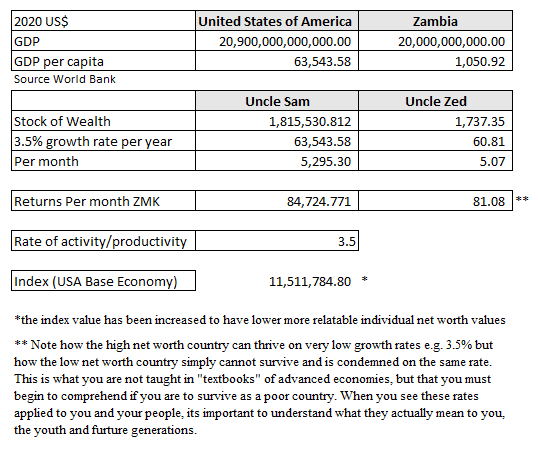
In order to reduce the two economies to individuals an index will be used to shrink the economies down equally to a level where they can be humanized as individuals (GDP/11,511,784.8*) , with the base derived from the larger more advanced economy. This allows us to simplify the concept to “individuals” instead of “countries”, which is easier to convey and understand because they are more relatable.

With this done now Uncle Sam’s Stock of wealth as an individual is US$1,815,530.81 and Uncle Zed’s comparative stock of accumulated wealth is US$1,737.35. Basically Uncle Sam is worth US$1.8 m and Uncle Zed is worth US$1,737.35.

………

Humanizing an economy: A trained Financial Planner or Financial Advisor knows that payments from a client’s pension or annuity are dependent on the accruals and sacrifices a client has made to set aside income. The future value of an annuity determines whether the income it pays out is suitable for a client. Advice that applies to a wealthy client at a more mature stage in his or her income, productivity and work life-cycle cannot be appropriate for a lower income client in the early stages of his or her life-cycle. Humanizing an economy makes this problem in economics more relatable and evident to the public and to laypersons to whom a GDP of US$20 bn (World Bank) appears huge, but when humanized is representative of a low net worth individual as seen in the table above.

A Financial Advisor would almost immediately recognize the fact that the value of Uncle Zed’s annuity is wholly inadequate and that his financial planning has been improperly assessed. A yield at 3.5% will not work for him. In fact, this advice provided by highly educated experts will condemn him. What is interesting is that this same improper growth rate is what is being advised and proposed by reputable research, monitoring and policy formulation institutes for developing countries like Zambia. In other words these institutes are unable to distinguish between the growth rate appropriate for a developed and developing economy.

The correct and accurate advice from a professional body, advisory or institute would be for Zambia to set aside low growth rates more appropriate for developed economies by implementing a Split Velocity System, more appropriate for a developing economy, to increase its economic activity and thereby its growth rate from 3.5% to 32.8% and above in order to secure the country’s economic future.

In order to bridge the gap between developed and developing countries within a generation or less (10 – 25 years) Zambia needs a minimum annual growth rate of between 32.8% – 48%. This is the identification of the problem. If research, policy and monitoring institutions do not know how to achieve this, it is then their role to engage in study and the research that will identify how to make this possible in order to help government in its effort to serve the country and people, after all research is part of their role and mandate.

Out of his full capacity to work and be productive (100%) Uncle Sam chooses to only apply 3.5% of his effort. He leaves the remaining 97% idle. Uncle Sam recognizes that his net worth is US$1.8 m. In essence Uncle Sam is like a retiree. He has been active for a long time and has accumulated an impressive amount of wealth (US$1.8 m). He can now afford to sit back and do very little (3.5% economic activity or output). From 3.5% he is able to enjoy retirement benefits of US$63,543.58 per annum and live relatively comfortably for the rest of his life. Every month he receives a cheque for US$5,295.30. He is content in his lifestyle, his well deserved lack of activity, low productivity and earnings are the benefits of being retired and he has built universities to teach others how to achieve his success.

On the other hand Uncle Zed is very young, being only a few decades old he has only accumulated US$1,737.35. Uncle Zed admires his good friend Uncle Sam’s income and lifestyle. He has graduated from one of Uncle Sam’s universities and therefore tries his best to emulate how Uncle Sam manages his finances. Since Uncle Sam survives on 3.5% per annum, Uncle Zed, who is able to be 100% productive understandably also decides to apply the knowledge he has learned from Uncle Sam’s university to be advanced like him, he sets for himself, aspires to be and is therefore only 3.5% active.

The table above shows that the outcome of Uncle Zed’s applied knowledge is an annual income of US$60.81. He receives a cheque of US$5.07 per month for the rest of his life. By following Uncle Sam’s 3.5% growth rate and economics or financial methods Uncle Zed will very likely be impoverished for the rest of his life. Every time representatives from developed economies meet Uncle Zed, they give him a pat on the back for aspiring to the greatness of being advanced and developed and are genuinely pleased with Uncle Zed, this is understandable, because it is generally assumed that policy that works for wealthy developed economies automatically works for poorer developing economies. The table above shows that this assumption is flawed.

Realistically, in order to match Uncle Sam’s standard of living and life-style (per capita income of US$63,543.58 and monthly earnings of US$5,295.30) within his lifetime, Uncle Zed cannot have a growth rate of 3.5%, like Uncle Sam. To match Uncle Sam’s income within his lifetime, at his net worth, his growth rate must be a minimum of 32.8% per annum. But when Uncle Zed goes through his textbooks he received from universities from advanced economies there is no information on how any country can achieve an annual growth rate of 32.8%. Even though Uncle Zed is able and willing to work to increase his output and productivity the economic textbooks he reads tell him a rate of 3.5% is the best and should be aspired to. However, this is a rate that works for those who have already accumulated vast levels of wealth like Uncle Sam and it does not work for Uncle Zed, especially that his wife has just given birth to twins, Mulenga and Jelita. He feels he must now see how best to ensure that his children will have better life than his. Everyone can relate to Uncle Zed’s dilemma. He is every bit as capable, smart, ambitious and focused as Uncle Sam, but he is not at the same stage in his life-cycle.

In order to gain a productivity level of 32.8% and above Uncle Zed realizes he has no choice but to ditch textbooks and methods from “advanced economies” because they are made for the wealthy at much later stages in their life-cycle. He must improve upon the knowledge given to him from advanced economies and make it relevant to his own economic circumstances as a vibrant, youthful young man with plenty of energy, but no wealth to speak of.

The professional formulation of growth rates

The table above clearly shows that the practice of ascribing low growth rates suitable for wealthy developing economies to poorer developing countries by research, monitoring and policy institutes is in fact misinformed and can be considered a form of bad advice bordering on a form of malpractice, which becomes more evident when viewed from the perspective of financial advisory services related to pensions and annuities.

The table above shows that to be meaningful to a country the economic growth rate cannot be just an imaginary number or a number that appears to conform with the expectations of economics as it is understood to apply to developed economies. Rather, it must be time bound, targeted and characterized by an objective suitable for the life-cycle stage of the economy. The time frame should ideally be within a generation, that is, 10 to 25 years for its impact to be relevant to citizens of a country living at that time, especially the youth who represent citizens at the peak of their capacity to work and to be active in the economy. The professional advisory on the growth rate a country should have must be targeted, for example, the basic target should be one that bridges the per-capita income gap between countries. In the same way that the table above clearly requires different approaches to managing wealth, the growth rate prescribed for an economy is an immediate indicator of whether an economy is being managed by those who understand the ramifications of their decisions. Even a layperson should be able to see that setting a growth rate of 3.5% for a poor economy, condemns it citizens as surely as it condemns the low net worth individual. Sadly, this is precisely what the state of the art textbooks are instructing professionals managing poor developing countries to do, to the extent that they cannot see anything wrong with the approach they use to manage these economies, which is effectively condemning them to perpetual poverty.

There must be a “ditching of the text-books” if they cannot yield the advice and mechanisms developing countries require for transformation and if they are setting imaginary limitations on what humanity can achieve, after all, no one has a monopoly on knowledge not even the respected authors that shape what is understood about the world today. Where it does not exist the relevant business, economic and financial solution required to bridge this gap within prescribed parameters must be identified through research without compromise. It is not enough to simply predict the growth rate and try to conform with contemporary views. It is necessary to identify the problem and through relevant interventions put in place the mechanisms that will effectively determine the required growth rate. This growth rate must be sufficient enough to bridge the wealth gap between developed and less developed economies in a manner that is time bound and relevant to the generation existing at the time.

A Split Velocity system is the only known method for capturing and recovering as much as 100% of GDP per annum by correcting inefficiencies in the circular flow of income that make it possible to move a developing economy to a developed economy within a generation or less. This is why applying this knowledge to developing economies is not only practical but necessary for ending the seemingly perpetual cycle of scarcity and poverty they face.

It is hoped that by humanizing what an economy is from a country to something more tangible and relatable, like an individual, as has been illustrated above it is easier for laypersons, policy makers and those with knowledge about business and economics to understand why higher growth rates for developing economies is key to their future and low growth rates they have been taught to aspire to will lead inevitably to their exploitation, demise and entrenchment in perpetual poverty. This is the fact of the matter as surely as would be the case for a retiree whose pensions and annuities were improperly advised will face unnecessary hardship and suffering at a time in their lives when being advanced in age makes them vulnerable and helpless to do anything to change their economic circumstances. Setting growth rates and providing an advisory on them should ideally take place with this in mind.

Impossible is Nothing: Free Education and Resource Mobilization for 2030

6th September 2021

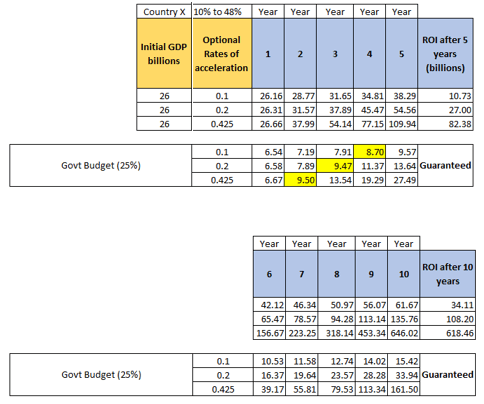
When it comes to resource mobilization for Zambia the Split Velocity system (SV-Tech) offers 3 scenarios for generating resources for the national budget. Acceleration of the Zambian economy by 10%, 20% and 42.5%. None of these rates of acceleration are impossible to achieve.

The resources with to achieve this are recovered from inefficiencies in the current design of the circular flow of income (CFI).

……….

New resources for budget created by implementing SV-Tech for
government expenditure and planning
with which to meet national objectives


The upper curve in red at $161.5bn should be normal growth for any economy
where poverty is being completely wiped out, where
industry and businesses are thriving. Citizens in Zambia enjoy an ever
improving standard of living. There is no unemployment.
Losses and inefficiencies in the CFI are corrected.
(The economy is using less than half of
the resources for growth available to it.)
.
The bottom curve where GDP is at $8.6bn is for the economy
in its current state, where the CFI is left unchecked. The growth rate is
mediocre at 3%. The economy is losing tremendous
value and productivity currently unaccounted for in
neo-classical economics.

What this means is that there is tremendous hope for Zambia,
a chance to wipe out poverty and usher in an age of
prosperity and unparalleled transformation.

For explanation and a legally admissible examination of how the Split Velocity system works, scroll down below. At a rate of acceleration of 42.5% the SV-Tech leaves 57.5% of the resources available to the system untapped. The SV-Tech system methodology guarantees growth targets will be achieved.

If no effort is made to advance national economic management the average growth rate for the next 10 years for Zambia is expected to be approximately 3%, should there be no further unexpected shocks to the economy such as covid-19. This is shown by the black curve in the graph above. Expect persistently high levels of unmitigated poverty, no significant changes in standard of living and per capita income over this period. This is the current expectation, in terms of economic performance, without accelerated growth. Growth and poverty levels will worsen due to increased population size over this period.

At a 10% rate of acceleration the resources available to the national budget will grow to US$15.42bn after 10 years

At a 20% rate of acceleration the resources available to the national budget will grow to US$33.94bn after 10 years

At a 42.5% rate of acceleration the resources available to the national budget will grow to US$161.5bn after 10 years

The recommend rate of acceleration is 10% – 50%

See the table below

Resources available to government for budget expenditure is maintained at 25% of GDP.

Note that even at a rate of acceleration of 42.5% the SV-Tech system leaves 57.5% of the resources available for resource mobilization in the Zambian economy untapped.

The SV-Tech system is able to also maintain the exchange rate that is desirable by the Central Bank (BOZ) and can even achieve dollar parity US$1 to ZMK1 if this is deemed conducive for the economy.

The SV-Tech is a proprietary, no non-sense system designed using cutting edge approaches in economics and business to ensure that resources are mobilized for government objectives. It is essentially a tool or system for application and implementation primarily through the Central Bank.

Don’t waste time on outdated approaches to national development that have been used over and over without results.

Guarantee a future for the youth and keep the promise to secure their future.

For information on how this national economic management system was conceptualized and designed please feel free to peruse this website.

………..