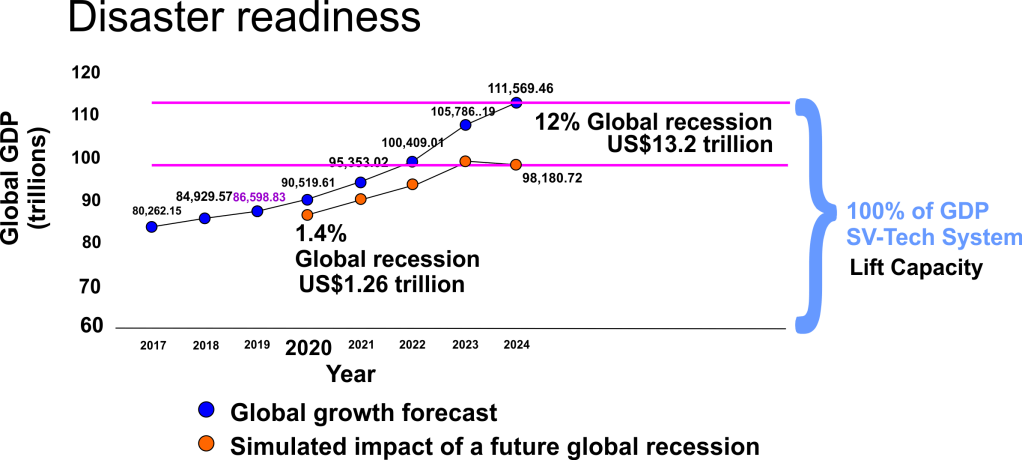
It is anticipated that Covid-19 will halve global growth slowing to approximately 1.5% of global GDP. A recession of a magnitude of 1.5% may be within the scope of current approaches to disaster management. The reality is that current systems are not prepared for future disasters and economic shocks with a potential major impact ranging from 10% to 30% of GDP or more. Institutions such as the IMF, World Bank, AfDB and so on are simply not prepared for shocks of this magnitude. On this scale it is not useful to only have strategies based on finances in reserve or that these institutions can raise from governments as it is unlikely they will be able to meet challenges on this scale. At this point the strategy has to shift from how much funding is available from reserves to the lift capacity inherent and available in the global economy itself.
The lift capacity can be regarded as the inherent growth in an SV-Tech system to roll back any serious economic shock or disaster. The lift capacity of an SV-Tech or Split Velocity system is assessed on the basis of countries that deploy the system to manage their economies. The burden carrying or lift capacity of an SV-Tech system is equivalent to a country’s GDP. Therefore, the more countries there are with economies managed using this approach the safer the global economy is from future shocks. As each country alters its rate of acceleration in unison with other countries any shock that impacts economic growth negatively is met with resilience and equal resistance enabling a much safer and speedier global recovery even before international development agencies begin to spend. This allows them to be more strategic and selective about how they spend their reserves during interventions.
3rd April 2020
Split Velocity leverages the efficiency of money transferring the burden of interest from the borrower onto the Fintech or system. This is an important upgrade to the tools central banks can have for implementing monetary policy and providing a stimulus. In the wake of the Covid-19 Pandemic business will need relief from interest. This new system will enable banks to offer better interest rate conditions for their clients to help with recovery without having to bear the cost of doing so.
[What do we mean by a more dextrous and refined tool for monetary policy? Low interest rates help borrowers but they hurt the profitability of commercial banks. By using SV-Tech to de-couple earnings from interest and the burden of interest, for instance, the Federal Reserve Bank in the United States could maintain the burden of interest at 0%-2% but adjust the earnings from interest to 12% allowing banks in the US to sustain profitability without this negatively impacting on borrowers.]
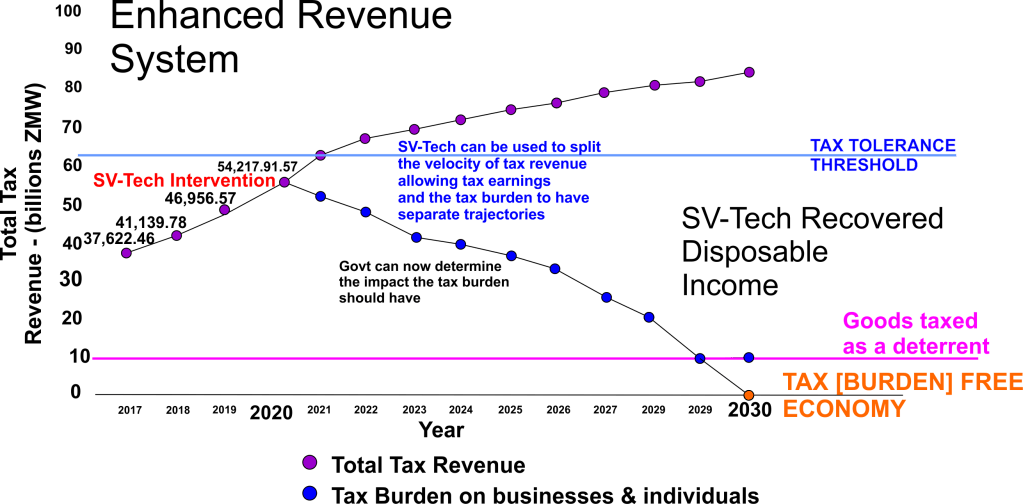
By separating tax earnings from the tax burden governments will be able to offer tax relief to businesses and individuals with no loss in revenue to government. This will help significantly with recovery from the Covid-19 pandemic.
Tax revenue collection for 2020 in Zambia is expected to be approximately 20% of GDP. This is far below the spare capacity or burden carrying ability of the SV-Tech system. Essentially this means the 20% tax burden can be shifted onto the SV-Tech system at constant price creating a tax [burden] free economy. In 2020 the earnings from tax and the tax burden are coupled and must move in one direction. SV-Tech can be used to decouple them at constant price allowing tax earnings and the tax burden to have independent or “Split” velocities.
The graph above shows that in 2030 government collects K84 billion in taxes but businesses and individuals experience no tax burden. Normally any tax relief or rebates must come at the expense of government revenue. Applying SV-Tech spares governments this loss of revenue. This type of relief will be especially important to address economic growth and recovery in the wake of the COVID-19 pandemic.
The ability of governments to free individuals and businesses of the tax burden means people have more money to spend and businesses regardless of how large or small they are, be it the mining sector, manufacturing, transport, information technology (IT) and so on have more income with which to run their operations, both hire more people and invest. Shifting the burden of tax from businesses and individuals onto the SV-Tech system creates a lighter, more robust economy with the potential for greater commercial activity and is new to the Fintech space.
Split velocity essentially, neutralizes opportunity cost. Most professionals who are not familiar with the workings and dynamics of SV-Tech will need re-training.
Once an SV-Tech model is implemented this marks the beginning of the end of unwanted deflation/inflation and price instability.
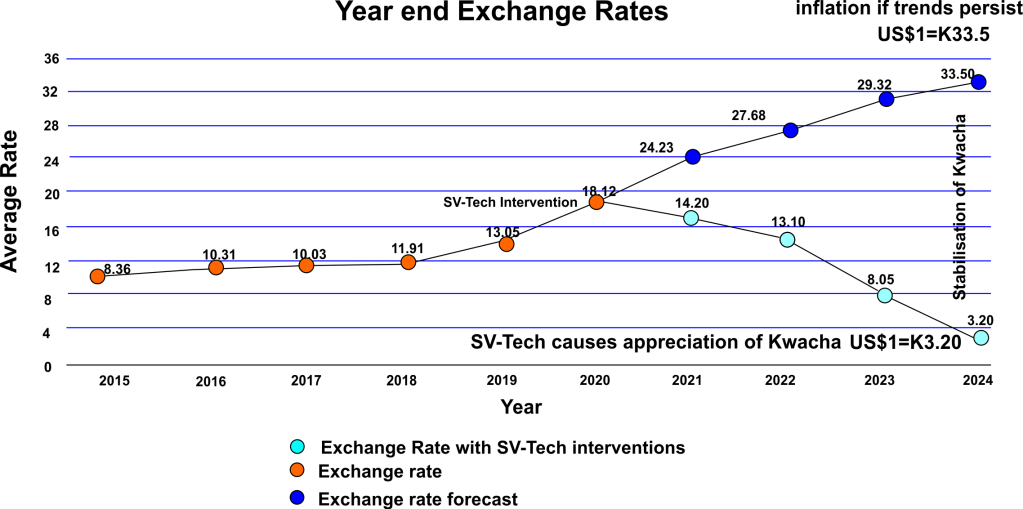
SV-Tech does not need forex reserves in the short term to increase before it acts to counter depreciation of the local currency. It createsmultiple avenues for the central bank to regain the value of its currency. This will be useful to poor countries facing challenges with forex reserves.
Lower pricing for goods and services in an SV-Tech system makes havinga weak or depreciating Kwacha to make local goods seem more attractive abroad obsolete.The tourism and export sector is therefore not affected by a strong local currency.
Using SV-Tech (Split Velocity ) wiping out poverty in any low income country is not only easy to do, but fairly easy to implement in the economy. Businesses are also more resilient in the wake of crises that cause an economy to slow down. The improvement in per capita income takes place in less than one generation – Zambians living today, especially the youth, would experience this improvement and have a much better life.
Accelerated growth can play a significant part in getting businesses back on their feet and pulling people who lost jobs during the Covid-19 induced slow down back into full employment. Businesses large and small, in any sector, including the mines, can also be rescued with this new system.
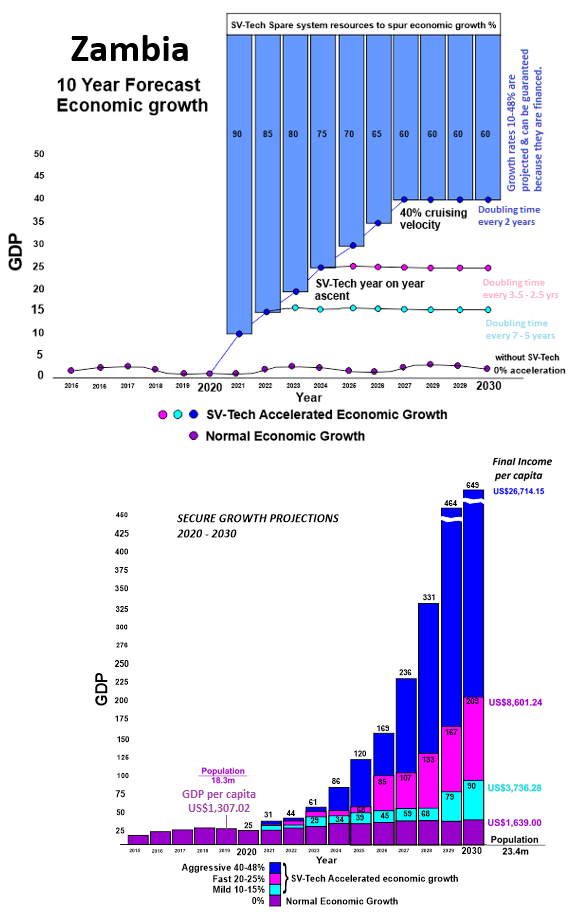
These rates of acceleration of GDP are not exaggerated. In fact they are understated. The projections are not forecasts of what the economymight achieve. These are guaranteed growth rates which once setwill be financed by the SV-Tech system into existence as it moves to achieve the target set for it by scaling up productivity.[USA per capita income in 1820 was US$1,300 roughly Zambia’s per capita income today. It took 200 years for the economy to grow to where per capita income is US$56,200 – where it is today in 2020. Developing countries deploying an SV-Tech model should be able to accomplish, ina few decades, what developed countries took centuries to achieve.]
The table above shows extremely slow growth rates where after a decade of economic growth Zambia is currently expected to only gain an increase in per capita income of US$300. These very low growth rates occur due to the fact that losses to subtraction are not identified and accounted for in Neo-Classical Economic Theory from its inception. The recovery of losses from subtraction using Split Velocity creates accelerated growth. These resources are therefore pre-existent in every economy, they simply have to be harvested and harnessed to productivity thereby accelerating GDP growth rates. Instead of an increase in per capita income of only US$300 which is Zambia’s current course the diagram shows application of a slow SV-Tech growth rate 10%-15% that yields a per capita income of US$3,736.28 after 10 years, a mild SV-Tech rate of 25% yields US$8,601.24 over the same period and an aggressive SV-Tech rate of acceleration adjusts the projection to US$26,714.15. This reduces the period from 200 years to 20 years or less, consequently shortening the days required to move from low per capita income to high per capita income countries. Achieving this does not use up all the resources available to the SV-Tech system, 60% of which are left untapped, at least until a use for it is identified.
What do we do with idle untapped SV-Tech resources?
One option may be to use these spare resources to accelerate health and education sectors (since they are important to households) shifting the burden of these onto the Fintech consequently making them affordable or simply free without in any negative way affecting how they currently function in a free market system in both the private and public sector. As a non-intrusive catalyst this is something that may be worthwhile to consider applying idle unused SV-Tech resources to.
Shifting the burden of education and health onto the SV-Tech system and making these two specific burdens more affordable or simply free in this non-intrusive way will remove a great deal of stress from families and individuals. This increases their disposable income and allows them to improve their quality of life. With the installation of an SV-Tech system there will be a significant jump in both the quality and quantity of education as well as life expectancy. Very importantly there will be a tremendous improvement in healthcare due to the fact that pharmaceutical companies and the health industry will have significantly more resources to invest in daily operations as well as R&D. New treatments, medicines, medical devices and equipment should become available more quickly. The health care sector in general will have significantly more income and resources to work with. Having a healthy and well educated population that lives much longer leads to greater productivity and a more robust economy.
Shifting the burden of education and health onto the SV-Tech system to make use of spare, unused capacity is certainly worth considering.
The accelerated growth theory behind the GPWN was completed in 1994/1995 and initially debut as a Superconsumption model. The theory was continually improved upon, more succinctly explained further updated and officially published in 2010. In 2019 it is referred to as a Split Velocity Model.
A Split Velocity model currently represents the most advanced model or system in Business, Finance and Economics with which to achieve accelerated economic growth.
If understood and even mildly applied it will create extraordinary economic growth balanced with economic development moving an economy from average performance into a position where its growth begins to exceed economies following conventional economic growth strategies and policies.
An economy in which this theory is applied will eclipse and inevitably dwarf all other economies managed on weaker conventional approaches to economic and finance management.
The best application of this model will be one that that rapidly builds on domestic consumption by a steady and rapid increase in per capita incomes that lifts millions out of poverty and creates a new middle class that supports increasing levels of output reflected in higher GDP growth rather than dependence on exports..
The Superconsumption model recommended that central banks eventually have two official currencies – “A Tale of Two Currencies”. Each of these currencies would be managed in such a way that one pushed industrial growth while the other propelled consumption thereby working simultaneously to neutralize subtraction (implosion) in the process creating unprecedented accelerated economic growth. An example of the use of two currencies can be found in China, one of the only stable, rapidly industrialized economies in the world to sport two official currencies (since 2004) – namely the CNY and the CNH.
Although the book Greater Poverty and Wealth of Nations (GPWN) debuts the Superconsumption model it created and developed, it advances this model to the Split Velocity system which does not necessarily need two currencies, it can use one currency to perform the function of the dual currency system. The Split Velocity system is faster, much more powerful and more advanced than the dual currency Superconsumption model, as a tool for managing guaranteed economic growth.
Phenomenal economic growth similar to that achieved by China shown in the graphic below can be achieved using a Split Velocity system.
At its current pace predictions are that China’s economy will overtake that of the US by 2028-2034.
A dual currency Superconsumtion model is quite impressive and can achieve phenomenal growth. However, even this phenomenal growth does not compare to the speed, power and financial system stability evident in the more advanced Split Velocity system.
This is testimony to why governments today, like Zambia, must pay attention to losses and inefficiencies in the CFI. The economy determines every aspect of a government’s existence and there is a need to recover these losses to not only improve socio-economic development, but stay at the cutting edge of advances in national economic management. A nations very existence is dependent on paying attention to this facet of the economy.
Countries that embrace these advancements will move ahead, even eclipse and leave behind what may be considered the most advanced and most powerful nations in the world today.
To date CE [neo-classical economic theory] has not been able to conclusively explain why poverty and scarcity exist. If it did provide a conclusive explanation poverty would be something students learn about in history books about a bygone era of strife ridden human existence. Operating Level Economics (OLE) introduced in the book the Greater Poverty and Wealth of Nations (GPWN) on the other hand explains poverty and the existence of scarcity as a syndrome (Systemic Dystopia or SyD in short) arising from the operating system [circular flow of income] of an economy caused by implosion [subtraction] that creates a persistent and consistent lack [poverty] of resources sufficient to meet humanity’s needs and wants. Economic implosion, [subtraction], scarcity and poverty are synonymous. The theory of economic implosion also explains why poverty and scarcity persist even in the midst of the appearance of great wealth as observed in the inner cities and slums of developed nations. [Before this there has been no genuine scientific explanation for why poverty or scarcity exist]
There
are today two popular approaches to managing an economy namely the Keynesian and the
Monetarist approaches. The Keynesian approach involves
increasing aggregate demand in order to stimulate productivity along the lines
of fiscal policy. This involves government expenditure. Very basically the
Monetarist approach involves regulation of the economy through interest rates in order
to encourage people to either save or to consume.
In a linear economy [neo-classical economy] the physical limit of resources is based on real volumes such as the number of tons of copper, the number of educators, the quantity of engineers and so on. This seems a very real limit that supply must take into account. In a dynamic economy [economy managed using Operating Level Economics – OLE] there is no real physical limit to resources. Human ingenuity is capable of creating infinite resources. Resource limits are in fact artificial and depend on the level of available creativity, ingenuity, and technology. The dynamic economy [economy managed using Split Velocity] therefore strongly relies on research and development and the exploration of old and new technologies that lead to socio-economic development.
Hence a clear distinction is drawn between linear economics (CE) [neo-classical economics] and dynamic economics [Operating Level Economics (OLE) which focuses on the circular flow of income (CFI)]. Dynamic economics takes into account the seven forms of scarcity (see GPWN) and ultimately relies on human ingenuity as the delimiting factor when it comes to scarcity. It therefore proposes that resource limits can be constantly and continually pushed forward by research and development. A dynamic economy is capable of financing research and technology while a linear economy is just barely able to provide it [because it works against businesses and experiences zero growth].
The Keynesian /Monetarist Model
A Keynesian economist would suggest that aggregate demand be moved in relation to aggregate supply toward the physical limit in order to maximise productivity. When the physical limit of resources is reached any further extension of aggregate demand will lead to a rising general price level. A monetarist would argue that any increases in money supply would need to be directly proportional to growth to be justified.
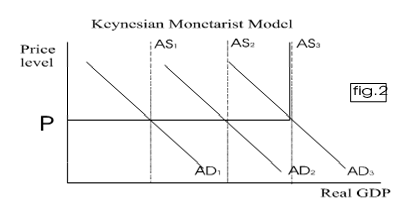
The debate between Keynesians and Monetarists has been centred around the shape of the aggregate supply curve (AS) shown in the diagram. Keynesians would encourage governments to shift aggregate supply to the right through public expenditure when an economy experiences recession in order to maximise productivity. Monetarists who oppose manipulation of the AD curve as a means to creating employment believe in a vertical aggregate supply curve which clearly shows that any attempts to tamper with aggregate demand [using increases or reductions in money supply] will cause inflation or deflation. This debate can be resolved by appreciating that both economies indicate an equilibrium price level despite the fact that they may be in recession. Furthermore, Monetarists agree that money supply can be increased but only when it is in direct proportion to growth in productivity. It becomes quite clear that though Keynesians and Monetarists have different approaches they share the same fundamentals. An equilibrium price level is obtained where aggregate demand and aggregate supply meet and that there are circumstances under which aggregate demand can be increased without causing inflation. If money supply should grow then it should be directly equal or proportional to the level of growth in an economy. Since there is an agreement between the two it becomes possible to arrive at an acceptable merger of the two curves with the understanding that each shift in aggregate demand is in pace with growth and productivity in order to prevent recession [This illusive reconciliation of Keynisian and Monetary policy is effectively achieved by Split Velocity or the correction of Subtraction in the circular flow of income (CFI)].
Combined Keynesian-Monetarist Model
[Fig 1. shows two separate models which disagree on how an economy should be managed. The debate between Keynesian and Monetarist models is well documented in neoclassical economics. Fig 2 above does the unusual in that it merges the two opposing models into one functional system. How is this possible? The models oppose each other because of subtraction in the CFI. Subtraction causes curve tectonics or demand and supply to work against one another due to the fact that in the CFI human capital and non-human capital compete for the same limited finances at any point in time. When a Split Velocity system is introduced this conflict between demand and supply is effectively resolved. The result is not only unparalleled economic and financial system stability at constant price (P), but also accelerated economic growth at AS1, AS2, and AS3 which show that there is potentially no limit to growth in a Split Velocity model. This occurs due to the fact that the Keynesian limit of the L curve keeps shifting in tandem with the Monetarist limit of the AS curve. This kind of unlimited growth has never been demonstrated in neo-classical economic theory, but is offered as standard in Operating Level Economics proposed in the GPWN.]
Fig.2 shows that Monetarists and Keynesians share the same fundamentals and do in fact make reference to the same AS curve. As long as increases in aggregate demand are met with similar increases in aggregate supply the economy remains stable [this means that as long as subtraction in the circular flow of income (CFI) is countered or neutralized rapid and stable economic growth is achieved with price stability]. This brings out one very important issue and this is that economic instability is not necessarily caused by increases in aggregate demand. It is caused by imbalances or intolerances in the relationship between aggregate demand and aggregate supply referred to as Curve Tectonics in OLE [or known more popularly as Market Forces in neoclassical economics]. A linear economy [neoclassical economy] proposes that there is only one economy [human and non-human capital are one and the same] made up of an amalgamation of aggregate demand and supply [the consequence of this basic mistake in economics is that money cannot be used as a stimulus or catalyst to accelerate growth at constant price – something corrected by using Split Velocity] . A dynamic [Split Velocity] economy refutes this approach and instead proposes that there are two economies each capable of acting independently. The linear economy [neoclassical economy] ties the dual [human capital and non-human capital] economy together to create one economy through the use of a single currency that is exchanged between households and firms [effectively making a central bank incapable of using currency or money supply to accelerate growth as any attempt to do so will tend to cause inflation. Split Velocity reverses this condition allowing currencies to stimulate growth without inflation]. [In a neo-classical economy human capital and non-human capital bind resources from each other] – One has to wait for the other [due to subtraction] to allocate or spend before it can transact [creating the problem of curve tectonics]. Hence, whenever aggregate supply or aggregate demand move independently [since they are not liberated from one another by removing subtraction] curve tectonics [uncontrolled market forces seeking an equilibrium that is sticky downward, seeking stagnation instead of economic growth] takes place and this has a negative effect on the general price level [leading to a central bank’s lack of direct control of inflation and deflation]. Aggregate Demand and Aggregate Supply are competing for the same financial resources, which generates a resources vacuum that is evident in the CFI at any point in time. This perpetual vacuum is responsible for making scarcity and therefore poverty ever present in an economy regardless of whether it is that of a developed or developing country. [In geography when tectonic plates (market forces) move against once another they create earthquakes (periods of economic instability). Similarly, when aggregate supply and aggregate demand cannot be orchestrated (or synchronized) to move in tandem (through the correction of Subtraction – see fig.2) the consequence is economic shocks to an economy such as rising prices, for instance, higher mealie-meal (fuel, food, electricity etc) prices – demand and supply work against one another to create unnecessary price distortions. The only known method for preventing and controlling this problem, in absolute terms, to date is a Split Velocity system]
Economic Instability (Curve Tectonics)
[The rising inflation in the above diagram cannot be comprehensively controlled by any current approaches in economics due to the fact that presently no central bank in the world has a financial tool for wholly controlling demand and supply with which to independently counter inflation. This has only become possible using Split Velocity to independently control demand and supply using a technology and process that has never been available before this.]
This shows that the main cause of economic instability is the impact of aggregate consumption on aggregate expenditure on an economy at a given point in time. All the finances held by households finding its way into the hands of industry and back over the duration of a year is not necessarily a comprehensive equilibrium. Another important equilibrium to address is the volume of finances businesses hold for productivity and the volume of finances consumers hold for consumption at any specified point in time. Any disparity between these two will cause fluctuations in the price level due to increased tension between aggregate supply and aggregate demand [curve tectonics]. The linear fiscal year as a budgetary sum of economic management is therefore not a recommended way of regulating an economy. This problem is illustrated in the empirical evidence based test for Split Velocity.
At any point in the short run where aggregate supply and demand are not equal to each other the economy can become unstable due to variances in pressure between aggregate demand and aggregate supply. To minimise this problem aggregate demand and supply should therefore move in tandem. However, this is made impossible by the fact that a linear economy [neo-classical economy] ties consumers and producers to each other by forcing one to wait for the other before any transactions can take place [ Subtraction – see the youtube video that explains this cardinal problem in economics]. When firms pay households those funds are locked away from productivity until households spend them. When firms hold money to spend on capital investment, ceteris paribus, those funds are similarly locked away from households. The credit creation process helps, but perpetuates this when credit in the form of loans is allocated between households and capital by firms. Hence, aggregate demand and supply are [continually] unable to move in the same direction [despite the introduction of credit creation by commercial banks]. If demand increases it means more income is being paid to households, but this also means that a greater proportion of financial resources is being withheld from business, thus hampering productivity and creating a potential imbalance between demand and supply. When capital growth is achieved it means the economy may be growing, but more finances are being withheld from households. Aggregate demand and supply thus begin to play against one another [become tectonic]. This places a tremendous strain on the economy, which begins to show signs of fatigue through inflation or deflation. It cannot withstand a long duration where aggregate supply and demand move independently and when this occurs too frequently it leads to economic instability.
……….
Economic Gain & Loss [In a Split Velocity model demand (AD) and supply (AS) are constantly being re-balanced in the CFI therefore the price level in the economy remains consistently stable as shown in fig.4. X0, X1 and X2 show the capacity for rapid or accelerated economic growth at constant price when subtraction is corrected.]
When aggregate demand and supply move in the same direction and to the right [as shown in figure 4] it creates growth and development (see Economic Gain & Loss – GPWN). To distinguish between terminologies let us assume that economic expansion is differentiated from economic growth in the sense that expansion entails both growth [non-human capital] and development [human capital] are taking place simultaneously. It is important to be able to calculate the basic impact of a linear economy on economic expansion.
[If you understand the concept of curve tectonics explained above and how this relates to market forces in economics and how subtraction can subdue the natural instability and lack of growth caused by market forces, then its very easy for you to understand how a country like Zambia has the equivalent of GDP available to it to use as a stimulus to grow the economy at constant price.
When Split Velocity is introduced to an economy there is increased price and system stability. However, there is also accelerated economic growth. An economy moves from a zero growth setting characteristic of a neoclassical economy to growth rates between 14% – 48% without exhausting system capacity. These accelerated growth rates are hungry for money with which to facilitate growing transactions as well as to keep output and money supply equal [when the AD and AS curve move to the right in tandem (as shown in figure 4) due to the central bank countering subtraction in the CFI a significant deficit in money supply arises. This accelerated growth requires that money supply constantly increase in order to keep pace with the rapidly expanding economy].
Consequently, money or currency used to facilitate transactions becomes very much like a raw material required for this more advanced economy to work. As a result, the supply of money undergoes a revolution. From here onwards currency and its supply becomes an essential and lucrative industry. Incidentally, the ad hoc leaders in this industry are central banks. However, central banks at present supply money as a form of house keeping for the national economy. They incur significant costs to maintain money supply. Nevertheless, this activity places them in pole position for supplying currency required to run a Split Velocity system. Since the supply of money can now take place with financial returns rather than losses to a central bank a new business model can be applied to how money is supplied to the economy effectively creating a new specialized industry driven by currencies. Instead of having a product (money) that is a liability due to the costs associated with supplying it central banks now have an asset they can supply and earn significant sums of revenue by applying a new business model to the money supply process.
This change requires central banks to eventually introduce a new area for supervision in this new industry – namely the supply of currency, but also requires eventually setting up a new corporate structure separate from the central bank yet within its regulatory system that will work as a profitable corporate entity to supply money to the national economy. The issuing of currency may be moved from core operations to a separate corporate space simply because the supervision of the supply of currency and the issuing of currency in this new industry ideally require fiduciary distance to be managed effectively. Since national currencies are generally owned and supplied by governments, they now become a significant public sector asset governments can earn revenue from. However, the debut of cryptocurrencies has demonstrated that currencies can also be supplied by the private sector. Private sector participation is required to drive research and development as well as innovation in this new industry. In future market share in the supply of currency is likely to be a combination of both public and private sector participation and the industry is likely to grow to become one of the significant financial sector innovations in recent memory. This development is made possible, in large part, by Split Velocity as a new innovative entry into the Fintech space.
In terms of the search for best practice in economics, a Split Velocity system is without doubt the cutting edge and most advanced approach to managing national economic challenges that even the developed world, has not caught up to as yet.
Most importantly it is clear that the knowledge and know-how for ending poverty is at hand and the process for doing so is scientific.]
It is not rare to hear people in general, even the well educated, extol the benefits of market forces and the importance of the workings of demand and supply. However, a deeper analysis of market forces is that they are not designed to create growth but to contain it, which is not useful for poor countries: if there’s barely anything to contain and per capita incomes a are low, what is created is a ring fence in which poorer countries are trapped because they are taught to believe there’s nothing better beyond the fence. What free markets theories peddle, even in savvy sophisticated finance circles, is that a national economy does not need a stimulus to grow, because growth will come naturally from free markets. Therefore, there should be no government intervention in an economy, that is, leave economic growth to the free market or private sector to create this on its own.
Sadly, even education at tertiary levels reinforces this belief. Developing countries are persistently deceived by this kind of economics due to the fact that well learned policy makers are taught to think this way. For instance it’s easy to state that as demand for a product increases its price will rise or that as supply increases price will fall making a product cheaper and sell this magic mechanism in introductory economics as a wonderful self regulating device that should be left to itself to ignorant wide eyed listeners. However, if this mechanism is preventing growth rather than providing it how is it fundamentally useful in its current state to poor countries like Zambia, and why should it be left alone? The stagnation and deadlock created by market forces dictate the opposite, which is that the government through a central bank and ministry of finance cannot afford to manage an economy without providing a stimulus. If these institutions sit back and do nothing because this is what the text book says, the risk is slow growth and in a worst case scenario recession. Without a stimulus Zambia faces this very dilemma. More on the deadlock in economic growth created by market forces left to themselves is explained later, in the excerpt.
Its common sense that businesses position themselves in the free market to obtain the best or highest profits they can reasonably obtain in order to grow and yet a fundamental doctrine in neo-classical economics is an abhorrence for profit which is referred to as abnormal or super-normal. In other words neoclassical economic theory (SRT) by nature, inherently designs an economy where businesses are expected to cope with an income they can barely survive on [a hair above the break even point]. In other words it is neoclassical economics learned, yet somewhat deranged, desire for businesses not to stray far from debilitating zero growth whilst at the same time it applauds mediocre growth rates such as 4% or 7% per annum. A pertinent reason why viable industries in developing countries seem to flounder such as aviation [e.g. Zambia Airways] and mining is simply due to issues to do with economies of scale. These industries are highly capital intensive and without economies of scale to deliver the financing they need to run smoothly there is no level of management that can successfully run these industries. No one will tell an African management team this, instead they will say these industries fail because Africans, locals or developing countries in general are poorly qualified. When a Split Velocity system is engaged the financial sector gains the capacity to successfully fund industries that are generally capital intensive, operating costs fall and the myth that developing countries cannot participate in these sectors alongside FDI will be dispelled.
Technocrats in developing countries are simply not equipped to understand how inadequacies in neoclassical economics, even at such basic levels are working against them and the economies they manage, instead they are taught not to deviate from these flawed theories that inspire them to sit back and watch market forces melt down a potentially robust and healthy economy. They maintain policies related to these flawed theories for the sake of appearance, in order to conform and appear professional to the international financial community when these approaches are in fact hurting their economies. A change in mind set is long over-due.
Similarly, most of the solutions offered for Zambia’s domestic and international debt crisis are a boring parody of approaches to neoclassical economics developed countries would prescribe, blindly read in a textbook or garnered from some conventional research journal in the hope that repeating ideas from credible sources suspends the need to apply logic to them. Pundits do their best to remain in conformity with intellectually weak economic theory gained from developed countries when these same approaches are riddled with inadequacies and a mediocre understanding of economic growth they themselves are unaware of and just as readily trapped in. A Split Velocity system, which goes further than developed countries have ever gone, in recent times, to address poverty and accelerated growth would wipe out Zambia’s economic woes, with relative ease.
A hint of the glaring systemic flaw in Contemporary Economics [neoclassical economics] (CE) can be identified by the term used to describe surpluses greater than total cost. CE refers to them as Abnormal Profits, as they disturb the market equilibrium (cause the wobble effect) and are quickly wiped out by the System through ‘new entrants’ into an industry.
Contemporary Economics (CE) refers to profitable gains above average total cost as abnormal or supernormal. Normal profits are gained where a businesses earns just enough to stay in an industry in the long run; basically close to zero profits.
When have businesses ever regarded profits as abnormal apart from when they were not anticipated for a particular period? When was the last time a business earned high profits or tripled them and its CEO made an announcement to reassure shareholders on CNN or in the Wall Street Journal or the Financial Times that –
“Ladies and gentlemen our company has done
something it is not supposed to this quarter, it has gained profits, this is
utterly abnormal, next quarter we must strive to drive the business back
as close to zero profits as is possible for our earnings to
return to normal. If we cannot do this ourselves we must allow the
market to do this naturally for us. For the good of the shareholders we cannot
afford to be an abnormal company and I urge all employees to make it less
profitable in the next quarter.”
This doesn’t happen as it defies logic. It may sound amusing, but it isn’t. Simple incongruities such as this that exist between Contemporary Economics (CE) and Business Administration and the motives associated with the paradigms each discipline follows hint that there is an inherent and fundamental conflict between the market condition inherent in an economy and the objective of businesses.
The next heading explains how this flaw creates a conflict that hinders businesses and growth.






 Split Velocity Solutions Ltd