
A No-Nonsense approach to economic growth with development
Wealth creation or resource creation is a financial service conceptualized in the book the Greater Poverty and Wealth of Nations (GPWN) authored by Siize Gabriel Punabantu. It can be considered the first scientifically verifiable approach or financial service designed essentially to wipe out poverty and unemployment in any economy through the acceleration of business activity.
In this book Siize G Punabantu identifies the scientific origin of wealth and/or poverty. How to identify and create wealth as a science has long eluded policy makers. By being able to identify the scientific origin of wealth we are able to know and understand the scientific origin of poverty and thereby design an economy and financial service that is able to accelerate economic growth with development as well as end poverty, hunger, unemployment and homelessness by generating the wealth an economy needs to thrive!
That service is wealth creation.
This is a non-partisan initiative to move wealth creation from concept to reality!
Wealth creation will make use of a proprietary synergistic carefully timed weaving-like technology called split velocity from the book the Greater Poverty & Wealth of Nations to neutralize economic losses and inefficiencies caused by subtraction (implosion). It will constantly accelerate economic activity and output throughout the year keeping it in constant balance with money supply maintaining constant price whilst pushing economic growth faster than has been possible before. The pilot will test this specialized system.
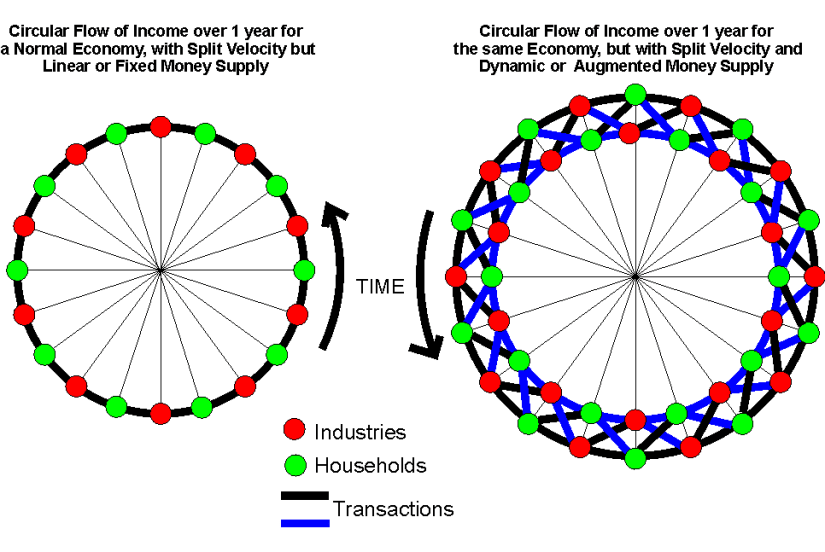
An illustration of how wealth creation accelerates business activity…
The diagram below on the left illustrates transactions in an economy over one year where subtraction is taking place below the circular flow of income. There are much fewer transactions per year and business is generally sluggish and easily prone to recession.
The second diagram shows wealth creation introduced to the same economy over the same period at constant price. There is a dramatic increase in business activity, the economy moves from sluggish to vibrant and remains in a sustained boom state that allows businesses to naturally generate more than enough resources to wipe out poverty. This is possibly the first scientific method for accelerating growth with development in an economy with the potential for guaranteed results that can be replicated in other countries.
Intellectual hurdles
When the circular flow of income is approached as an operating system, rather than just a circular flow of income or the traditional movement of money supply, (as is shown in the GPWN which introduces operating level economics [OLE]) the behaviour or characteristics of money can be changed using technology to alter the movement or direction (velocity) in which money moves in time, per transaction, allowing an increase in money supply to cause appreciation rather than inflation, productivity instead of stagnation. Blindly increasing money made sterile by subtraction into an economy causes inflation or hyper-inflation because it cannot stimulate growth as we have seen happen in many countries where operating level technology was not applied due to ignorance of the inner workings of the circular flow.
However, increasing re-productive money creates growth. How this happens is clearly explained in Episode 4. This discovery is such a wide departure from public knowledge and what is conventionally and traditionally understood by both professional and laypersons of economics, business and finance that they often fail to process how this could possibly be true or valid. It defies the logic they have been fed by contemporary economics crippling their ability to think creatively therefore they easily dismiss the viability and credibility of wealth creation. This is not prudent, just because a dog can’t learn new tricks doesn’t mean it deserves to continue to be starved by scarcity.
This mental impasse in and of itself is interesting to observe because it becomes a social experiment that reveals how and why modern day thought has utterly failed to resolve something as mundane as the basic economic problem, and consequently the pertinent issue of scarcity and poverty. Fortunately wealth creation is a concept that can be proved through a pilot or an actual demonstration of it working. When it can be shown easily achieving what is mistakenly thought impossible then this is good for progress to be able to get past this hurdle. It is the reason why an overhaul of the philosophy and fundamental theory used in contemporary economics is not only simply overdue, but imperative.
Please sign the petition to implement a pilot for wealth creation.
What inspired writing the The Greater Poverty & Wealth of Nations (GPWN)

Finding a business model, financial system and economic design that will comprehensively wipe out the suffering and disadvantages caused by poverty has been my passion from a very young age, something my father Joseph Cyprian Milimo Punabantu inspired in me in the discussions we would have as he drove me to the International School of Lusaka (ISL) in the morning. My father at the time served in the government of Dr Kenneth Kaunda as his Special Assistant for Politics and Economics. It was a time when humanism was a popular philosophy that placed people at the centre of development.
I vividly remember one particular morning as we drove along Los Angeles Bvd just before Municipal Sports club my father gestured pointing a finger. He said to me, Siize, do you see that little boy? I looked across the car out his window. Walking on the footpath was a little boy slightly younger than I was, I was around eight years old at the time. The boy was smothered in brown dust. Both his dirty kaki shirt and shorts were badly torn. His feet were bare as he walked. All I could see was a disadvantaged little boy not very different from myself, but who was clearly impoverished. I wondered what my Dad wanted me to see. Then he said,“You see that little boy walking there….he could be the future president of Zambia.” As the car moved on in the traffic my head turned to gaze at the youngster. My Dad said nothing more, kept his eyes on the road and kept driving. But in that moment he made me realize that he was right. No person deserves to suffer the disadvantages caused by poverty and just because a person comes from or is in difficult circumstances we should never discount who they are and what they can become or what they can achieve. Greatness often comes from people and places you may least expect, even from a person or country you may tend to look down upon or think is less than you are. We are all often at some point in our lives a few decisions away from greatness, where all that is required is the need to believe, make the right choice and remain determined.
During these drives he would often point out what it meant to come from a disadvantaged background. Many times he would illustrate challenges he faced by giving examples from his own life and childhood. Though he was raised in my grandfather’s own Punabantu Village, in a good home and well taken care of as a child, he would walk many kilometers through the bush every morning to get to the Catholic mission school he attended every morning with lunch his mother had prepared for him bundled in a little bag. She was one of the very few who early on felt education was important and encouraged him to work hard at school. Later he would become one of the first 100 graduates at Zambia’s independence in 1964.
Everyone has a dream, an ambition, something they would like to accomplish. Sometimes life throws so many challenges at you that its easy at some point to lose hope and to become too preoccupied with the more mundane needs of everyday life to stay the course such that sometimes what we really need to do, which is make a difference, eventually eludes us.
From the time I had my first lecture in economics as a course of study finding a solution to poverty has still remained the single most desirable and important objective I would like to accomplish, and I worked very hard, dedicated countless hours deciphering where and how this could be done in what we understood about economics; dissecting each part and analyzing it as I went along beginning with the very definition and philosophy that underlies economics [you can read the 1st chapter of the book here]. What I found was a knowledge base, theory and brand of economics that did not live upto my expectations because it did not comprehensively end poverty or scarcity but encouraged everyone to simply live with it. I wrote the book the Greater Poverty and Wealth of Nations, where I believe I conceptualized and achieved the philosophy, business, finance and economic theory, practice and technology that would be required to achieve the objective of ending poverty as its is experienced today, that is caused by scarcity. Naively I thought writing the book many years ago would be enough, but clearly more needs to be done.
Unfortunately I believe most people will simply not understand or appreciate what was accomplished in the book the GPWN. It may very well be that the accomplishment is something no person in the 250 year history of economics since Adam Smith has managed to achieve thus far. The basic economic problem, until the GPWN remained unsolved. If it were solved poverty and scarcity would not continue to plague economies today. This is by no means an exaggeration. Therefore, it is not a mean feat to have theorized and conceptualized a potential solution as was done in the GPWN. Nevertheless, it has thus far been difficult to get people to see what was accomplished. You simply cannot approach the GPWN with a mindset belonging to the era of contemporary economics. You have to be prepared to step out of that lackluster era into a new one where what was thought impossible becomes achievable and the means to do so at hand. I hope the concepts within it can materialize into an actual service that achieves what it was designed to do so that it can transform lives.
Furthermore, economies run on wealth creation will allow governments and businesses to take on projects on a size and scale previously unheard. Dramatic increases in government revenue and businesses being able to invest their total revenue will bring about change. What we call cities and other structures, science and technology based projects are likely to move to a whole new level altogether as entities flex their financial muscles with bolder and bolder ventures they could not possibly afford in the past.
It is my hope that Africa will get special recognition for this achievement and what contributions it can make to international development.
My Dad’s inspiration and guiding hand in my upbringing played a significant role in both my ability to think outside the box, develop empathy and my interest in addressing poverty comprehensively that authored the GPWN. In my eyes he was a both a great father and a great man.
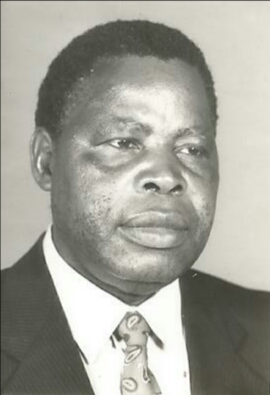
Joseph Cyprian Milimo Punabantu
3.10.1932 – 28.01.1999
MHSRIEP
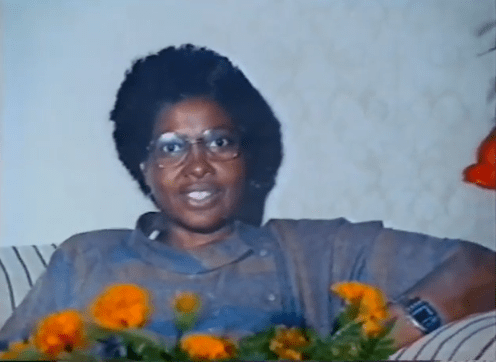
28.02.39 – 21.10.89
MHSRIEP
My respect for women and belief they are as capable as men came from being raised by an extraordinary mother. She set the example for why I believe equal representation of men and women is the society we should strive to build. It is inspiring to see that in Zambia today we have both a female Vice President – Ms Inonge Wina and Minister of Finance – Ms Margaret Mwanakatwe.
This tribute would be incomplete without mentioning the influence of both my parents. While my father was the guide who taught me empathy, kindness and how to think out of the box my mother Mary Nawa Punabantu was the tough disciplinarian, devoted wife, doting mother, stellar home maker, often frightening when you were out of line, a very tough, discerning, hardworking and very successful business woman who taught us to help run her businesses when we were on vacation, as early as primary school. She is certainly the influence that encouraged hard work, getting quickly to the point, to just keep going even when the odds are against you, to be sure to make hey when the sun is shining and stay strong when the chips are down, to fulfil the objective no matter how long it takes and try to stick to the bottom line. One of her favourite and defining phrases when she insisted she wanted something done and done properly, said in both English and vernacular was: “I don’t want any non-sense”. And this must be where the “No nonsense approach” to finding a solution to poverty that became Split Velocity came from.
Sadly she passed away in my second year at university shortly after my nineteenth birthday. She died on the 21st of October, the same day my daughter Luyando would later be born in 2014. She was the pillar of the family and losing her at such a young age was traumatic for the family.
Having tested Split Velocity through computer simulation, and the maths in the new Equation of Exchange I personally have no doubt that the technology works. Putting it through a pilot with the support of the central bank, finance ministry and financial sector is, however, still necessary to reassure stakeholders. Once wealth creation is fully implemented and begins to run the positive impact it will have on economies, Zambia included, will simply be profound, and the benefits will be unlike anything humanity has experienced in a long while. I say this because there is currently no country on earth that does not experience poverty in some shape or form. As long as subtraction exists beneath the circular flow of income depriving the economy of resources then a country must by scientific definition be considered to still exist in the grip of different stages of scarcity or poverty whether it is a developed or developing country. Wealth creation will therefore have a transformative impact on both developing and developed countries allowing them to progress to new heights of economic greatness and success where no-one is left behind. That said, new innovations, are often not easy to introduce and considerable time will sometimes have to be spent winning hearts and minds. Staying positive, relentless and inspiring those with the means to bring about change is the best way ahead.
 Split Velocity Solutions Ltd