
A much needed reality check.

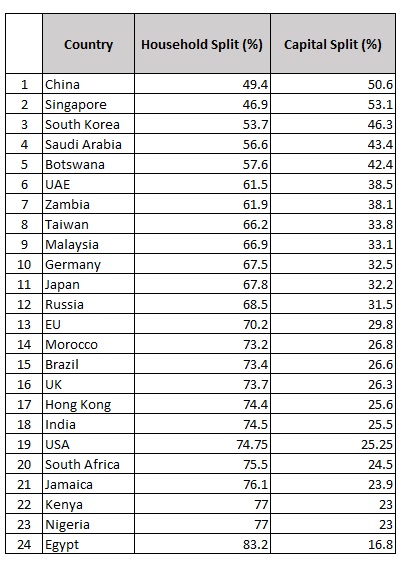
The Split Velocity Test of a sample of 24 countries.
It tells us something that we have known for some time now, but have not had the metric to point at. Your wellbeing is much greater living in some “poor developing countries” like Zambia and Botswana than when you are living in what are considered “better off” or the wealthiest and most developed countries in the world.
When consumption by households has grown disproportionately to the extent that it places tremendous pressure on capital the competition for resources in a given population between individuals and groups begins to move toward intolerance, hegemony, crime, underhandedness, and inevitably hate. There develops a “who is eating my lunch” mentality that, like water finds a crack through which to leak its contents and will emerge in all kinds of negative behaviour depending on the prevailing divisions and weaknesses in an economy. If the cracks are between foreigners and locals, xenophobia will begin to agitate within a country, if its between rich and poor social groups may riot against their own elected government, if its between racial groups racism will begin to stoke divisions, if there are no clear divides the cracks may begin to appear within groups in unexpected ways. Often the animosity between human beings may seem to have no source or may seem inhumane, bordering on insanity, however, the split, being consumption heavy, is placing any given population under duress leading to a high potential for internal mental strife and social conflict due to the competition for scarce resources being unnaturally high. This problem remains difficult to see or explain without a Split Velocity test.
Resourcism and a “Who’s Eating My Lunch Mentality”
Split Velocity requires countries to aim for a 50:50 balanced or “ying and yang” like split between Households and Capital, or to where the split is heavier on the Capital side in order for the availability of resources in an economy to adequately satisfy a population. However, an emphasis is placed on balance since a situation where Capital overwhelms Households can also have negative socio-economic effects on a population.
The book the Greater Poverty & Wealth of Nations [ Siize Punabantu], introduces the term “resourcism”. Resourcsim refers to how individuals and groups of any kind position themselves to attract and gain resources of any kind which they feel are necessary and important for the type of life or lives they want to have.
The 24 countries surveyed indicate where a person or group’s sense of well-being and happiness is higher. When the Household metric becomes too high against investment in Capital it means too many people are competing for proportionally smaller availability of wealth and resources be it money, food, health, housing, hospitals, clinics, jobs and so on. The undercapitlised economy is unable to offer these in sufficient quantities. These economies whether rich or poor, developed or developing are classified as being in a constant and persistent state of distress, its like the population being inside an invisible socio-economic pressure cooker. The behavior of their populations will begin to reflect this distress wherever socio-economic cracks may exist creating some kind of general unease, disregard for laws and rules as survival instinct takes precedence or it may grow into outright open confrontation between people and groups.
Transformation
Though countries with a disproportionately large Household or consumption split against Capital may be gravely disadvantaged they offer the greatest hope. This is because they also have the opportunity to experience the greatest shift to higher living standards and the greatest increase in wellness, happiness and general socio-economic wellbeing when Split Velocity is used to re-balance their economies by recovering the tremendous amount of resources being wasted by the defective CFI equivalent to GDP.
Split Velocity is a scalar tool that recovers losses in total revenue (TR) being wasted by a poorly designed Circular Flow of Income (CFI). It is able to restore TR to business of any size, be it a corner grocery store or a multinational mining conglomerate. Being a scalar economic tool means it is able to commandeer GDP and moves resources at macroeconomic levels, like earth moving equipment, yet at the same time processes each individual microeconomic input with the necessary dexterity that ensures economies can turn the tables on scarcity, moving from high levels of duress to abundance and prosperity capable of satisfying the needs of any given population.
Leaders who drive the implementation of our Split Velocity model will be responsible for the greatest increase in wealth, wellness and wellbeing in history and will be forever remembered for the transformation they brought to their people and the economy.

 Split Velocity Solutions Ltd