
Why can businesses not sell normal goods at cost price and prosper? They can and should be. In fact businesses can sell normal goods at cost price and make as much as a 100% profit. They can even mark up products in a Split Velocity model and not worry about inflation because the model works constantly to counter it. They can do so in an economy that has little to no inflation or deflation and have the opportunity to grow with much greater certainty.
Once they can do so inflation caused by the pressure to increase prices tails off and moves into a “price plane”. A price plane is the tendency of the general price level to remain the same or constant for long durations of time bringing problems such as creeping inflation to an end. Ceteris paribus, a loaf of bread or mealie meal in 2025 will have the same price in 2505.
So why do they mark up?
There are two reasons why businesses mark up goods and services they sell. The first reason is obviously they are profit seeking. However, we have shown that in a Split Velocity model businesses can sell their products at cost price (hence with no profit) and still make a 100% gain as well as operate in an economy free of inflation. This is how a normal economy should function. If this is true then why do businesses mark up their products? The systemic reason why businesses mark-up goods and services is because of the defective CFI. As explained, the defective CFI is losing or wasting 100% of GDP per annum. This is an insane amount of useful finance. This hidden loss is part of the Western Knowledge Paradigm (WKP) which has mistakes nearly every country in the world applies and downloads into how its economy operates and is managed. The WKP is treated by African and other nations as the stuff of legendary genius studded with accolades and prizes to boot. However, it is riddled with flaws, misconceptions, bad decisions and outright mistakes, like the hidden annual losses caused by the CFI. These flaws, mistakes and misconceptions are also found in the WKP’s sciences. Nations need to be wary of the WKP and its flaws.
bound to poverty and scarcity, if you don’t know, can’t recognize what it is doing or understand your enemy, you cannot defeat it.
Central banks trained by the WKP are unaware of inefficiencies in the CFI, referred to as implosion or subtraction in the book Greater Poverty and Wealth of Nations (2010), they do not act to counter it. For example, in Zambia there is ZMK700 billion in liquidity missing from the economy (US$28bn), .i.e. equivalent to GDP in 2024 that represents useful financial resources that could have been introduced by the central bank at constant price if a Split Velocity model were introduced (this is enough finance to pay off all of Zambia’s debt in one go, without batting an eyelid). These useful resources are arbitrarily lost to the CFI every year. Central banks are generally not aware that this liquidity needs to be restored by minting or creating new money and channeling it through a Split Velocity model as an economic stimulus at constant price. Therefore, they do nothing to correct money supply. Like everyone else the WKP makes them assume the CFI over time is perfect, when in fact at any point in time it is losing the equivalent of GDP to nothing more than the inefficient design of the CFI. This is an insane, dumbfounding amount of money and resources especially when many countries face great want, poverty and underdevelopment. [Accounting & Audit firms where are you? Its time you woke up. Your clients need you.]
Businesses find they have to step in and start “printing” or creating their own money
As a consequence of this finance (equivalent to annual GDP) missing from the economy (due to the CFI being faulty) businesses are forced to step in and play the role of clueless central banks, which is to create money in the economy. How are business “printing” or creating money out of thin air? This is how: If a good costs $100 and a business sells it for $120, internally or from the micro-view it appears to simply be marking up its goods and services, the truth is that from the systemic or macro-view it is attempting to do the work of a central bank. Central banks led by the WKP are dumbfounded and have no idea that this is their role. The consequence of this is that businesses must take matters into their own hands and begin to “print”, create or mint their own new money. Hence, the mark up is introduced. In an economy worth only $100, and therefore with only $100 in circulation, the business in our example prices its product with a $20 mark up. There is only $100 in circulation. The business is charging $120 for its product. The mark-up of $20 is the business creating new money that does not exist in the economy. Why?, because the central bank under a WKP has no idea this is its job to do.
We call this attempt to create or “print” money cost-plus-pricing, marking up or the more popular term is “profit”. However, creating money is a role that is meant to be exclusively under the jurisdiction of a central bank. The Fisher Equation MV=PY cannot play this role, its not designed to do this as it creates a financial system that cannot contain inflation, which is why the new Punabantu Equation of Exchange KV(MS/E)=PYR is introduced to create a more robust system that can handle the increase in money supply at constant price, referred to as a Split Velocity model. Businesses, unbeknownst to themselves, are trying to recover money the economy is losing to the CFI equivalent to GDP per annum using mark ups, a role that belongs to central banks.
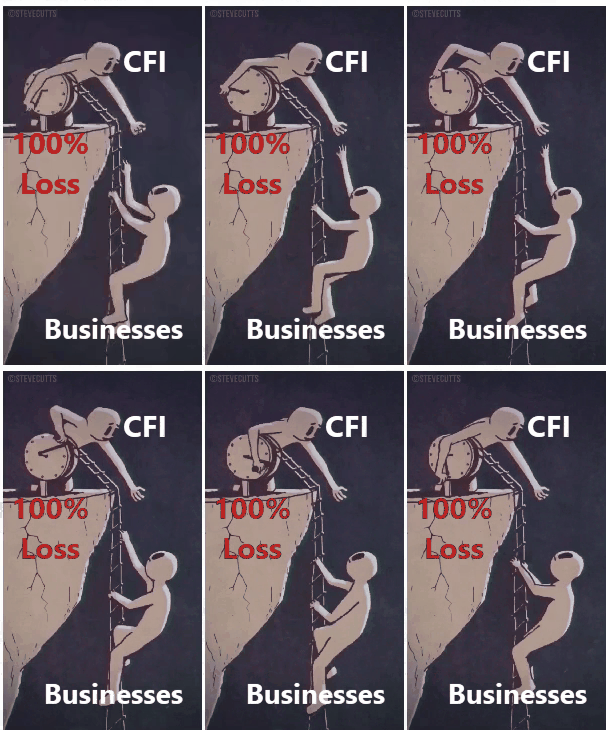
If businesses tried to sell a product at $100, the defective CFI would claim this value using subtraction in the CFI, and instead of seeing this loss is being caused by a 100% drop in efficiency caused by the faulty CFI businesses, instead of rejecting this loss, out of error, embrace it and refer to this loss to the business as the “cost of production” or “the cost of doing business”. This is a huge mistake on the part of enterprise and where the term “sleight of the hand” applies as we saw earlier with the shuffling of cups and palming of the ball. The palming of the ball is used to illustrate a 100% loss of revenue by businesses to the CFI for absolutely no reason other than that it is of defective design. Businesses at present are completely unaware of this huge loss from their balance sheet equivalent to 100% of revenue occurring at any point in time. They are clueless and continue operating with the ignorance of this loss or deduction of finance from their operations, of which the only indication is usually how difficult it is to finance operations that keep their going concern afloat and how difficult it is to move their businesses toward growth. Under the strain of losses equivalent to annual total revenue, running a businesses becomes like trying to run and move through molasses, many businesses wind up, shut down and the founders or team of entrepreneurs give up, without ever knowing what they were really up against. Similarly, in the same way that businesses struggle, as a result of the WKP central banks are unaware that they have a primary role of resolving inefficiencies in the CFI to recover and restore this finance to the operations of businesses. The lack of efficiency in the CFI pushes back the production possibility frontier significantly in real time. It is a genuine loss in finance that triggers a loss in productivity that severely retards economic growth. This vacuum of income that should be in the hands of productivity is why countries experience remarkably slow single digit rates of economic growth each year. This process triggers world-wide scarcity, poverty and stifles genuine prosperity.
Therefore, businesses and entrepreneurs are being fooled by the economy or CFI in two critical ways. First is the belief that they need to add a markup to realise a gain when they trade. This gain, when aggregated is miniscule and becomes the mediocre 1%-7% gain in GDP we observe in many economies. The example we used is the 20% mark-up of $20*. This mark up, in real terms, is an attempt to create money due to central banks misled by the present day WKP failing to play their role because they are led to believe the economy is functioning normally over time .e.g. a period of 1 year.
The second manner in which businesses and entrepreneurs are being fooled by the CFI is that when they allocate income earned to factors of production, which we represented with $100**, they are unaware that this is in fact an allocation to subtraction or implosion in the CFI, which the central bank not businesses is supposed mitigate using a Split Velocity model. This overlap makes it nearly impossible to see the loss taking place in front of their eyes, in broad daylight – hence it is referred to as the “sleight of hand trick” played by the CFI and the shuffling of cups where the ball is palmed is used as a method for illustrating how businesses and entrepreneurs lose total revenue (TR) annually to the CFI right before their eyes and are clueless about this real loss because their own “eye to hand” co-ordination and observation tells them they are paying for the cost of production (they see the ball go under a specific cup), when in fact, in real terms, they are allocating this finance to the faulty CFI where it is simply wasted (the ball is palmed). When entrepreneurs try to operate their business with this finance (the cup is lifted and there is nothing but air underneath it) they accept the loss because they think the payment went to the cost of production, unable to determine they have been “scammed” by the CFI they operate their going concerns wondering why running a business is so hard.
The faulty CFI and its hidden loss equivalent to 100% of GDP per annum would imply that the present civilization that applies it has to be the “dumbest civilization in the universe”, or if it is seen as a deliberate tool for economic oppression then it can be described as “the smartest, most diabolical method for human economic subjugation ever conceived” so evil and pervasive that it can function right before human eyes and intellect, in broad daylight and yet defy detection.
A result of the WKP is that every business and institution in the world, in operation today, loses the equivalent of its total revenue (TR) annually to the CFI, for no reason whatsoever, other than its 100% inefficient and ineffective design.
African nations and leaders must familiarize themselves with the WKP’s substandard economic and financial system proliferated by the CFI, because it is they and their people who, facing the worst circumstances, bare the brunt of its negative outcomes and vulnerabilities.
* It is easily shown that in a Split Velocity model a business can sell a product at cost price and still make a 100% gain that is equivalent to profit [even though technically it is not referred to as profit]
** Businesses and entrepreneurs remain completely clueless about this loss because the CFI masterfully, in the most sinister and evil way acts to hide this loss by using costs of production to shadow subtraction (palms the ball) which robs businesses annually of the equivalent of their total revenue every year.
When a business spends $100 to produce a product, then technically there is only $100 in the economy to buy it. When this business marks up its product to $20, it is trying to create new money by asking for money that does not exist in the economy to buy its wares. The next time you see products lined up on shelves, remember that what you are seeing from the macro-view is businesses trying to create or print money that does not exist in the economy because of a weak WKP. If a central bank does not act, the absence of the $20 will cause deflation (which can be just as disruptive as inflation). The other option is for the central bank to increase money supply over time by $20 to solve this problem. However, in doing so it facilitates the continuity of trade but then inadvertently supports a process that has come to be identified as creeping inflation. This is due to the fact that in a normal economy run on the Fisher Equation (MV=PY) any increase in money supply without a corresponding increase in goods will cause inflation.
Creeping inflation then becomes ongoing as it is grafted into the very manner in which a WKP economy operates since the business is selling a product for $20 more than the system has been designed to accommodate, with no increase in production. Hence, generally over time goods and services become more and more expensive and the domestic currency loses value in a manner that is fundamentally outside the control of a central bank. A loaf of bread or bag of mealie meal in 1975 will not cost the same in 2025. People find they have to work harder to afford the same basket of goods. They have to take on more jobs to maintain the same life-style and they eventually begin to suffocate under living conditions where affordability persistently escapes their attempts to hold onto it.
However, if businesses do not mark up products they cannot survive due to the fact the hemorrhage of resources being wasted pointlessly by the CFI is pushing them down toward or keeping them below break even until they are forced to eventually shut down. Businesses are therefore today, unbeknownst to themselves, literally in a life and death struggle against the economy they operate in. They are groomed to believe the economy they operate in is helping them, when in fact it is trying to kill or shut them down – every hour, every single day. This is due to the inordinate yet unaccounted for losses taking place in the defective CFI of which even businesses themselves are completely unaware. These losses apply to businesses of any size, be they the corner grocery store, ntemba or multi-billion dollar conglomerate. They remain dumb about it due to the “sleight of the hand trick” played by the CFI which forces all business to lose 100% of their total revenue (TR) per annum as a hidden loss to their operations, when you add up this loss to all businesses or productivity in an economy it becomes equivalent to GDP. There cannot be a more sinister or more evil system than this as it robs humanity of sorely needed income and resources like a pierced jugular bleeding profusely that is draining the life out of humanity, hindering productivity, destroying businesses and entrepreneurs.
This is a sophisticated loss that requires exceptionally astute minds to identify. However, as mentioned earlier due to the limitations of the widely accepted and applied WKP central banks are presently unaware of losses taking place at any point in time in the CFI that are equivalent to GDP and assume the economy is perfect (study the Empirical Test for Split Velocity to understand this). Hence they assume the life and death struggle of business is “normal”, and like a public hanging of businesses by the faulty CFI, sometimes the public comes to watch the spectacle in the town square or on social media as a form of entertainment or news. Central banks are not to blame for this problem, the blame falls squarely on the WKP being applied today.
In this sense the central bank is like the life guard, who is supposed to be supplying the economy with money (in a Split Velocity model) at constant price equivalent to the deficit caused by the CFI so businesses can operate normally. However, because of a substandard WKP it is unaware that the CFI is defective and that losses equivalent to GDP are taking place and nothing is done to intervene. Therefore, the WKP, as it stands at the shore views and describes the desperate businesses with hands waving for help and in need of rescue as excitement, attention seeking and revelry; businesses are making hand gestures in rough waters for fun and attention, and when businesses drown its assumed they have just gone down into the water scuba diving. This ongoing ignorance brought about by the WKP, that has been ongoing for 250 years since Adam Smith, is the brutal tragedy and reality of economics, accounting and finance that is the origin of strife in the 21st Century. Over the last 250 years it estimated that $3,120 trillion in global GDP has been lost to the defective CFI. Global GDP flounders at around $110 trillion today with a global per capita income of $13,900, when in reality it should be at around $3,230 trillion with a per capita income of $398,765 per person. The progress humanity has lost over the past 250 years is truly mind boggling.
Every economy in the world has the latent internal resources with which to finance the doubling of GDP in one year at constant price. In order to exploit this we must move ahead of the current WKP, realize that it is fallible and avoid its pitfalls. What difference would being able to recover 100% of GDP from the faulty CFI make to your country applied over the next 50 years? How much more could you do and achieve if being able to recover 100% of total revenue every year from the faulty CFI were restored to your business or institution?
This is what we designed Split Velocity to achieve.

 Split Velocity Solutions Ltd