
18th May 2020
through the SV-Tech innovation every US$1 the US Fed spends to deter recession 98 cents will do the
required work and achieve the objective. This is simply due to the fact that the SV-Tech system
is designed specifically for driving economic growth with financial system stability.
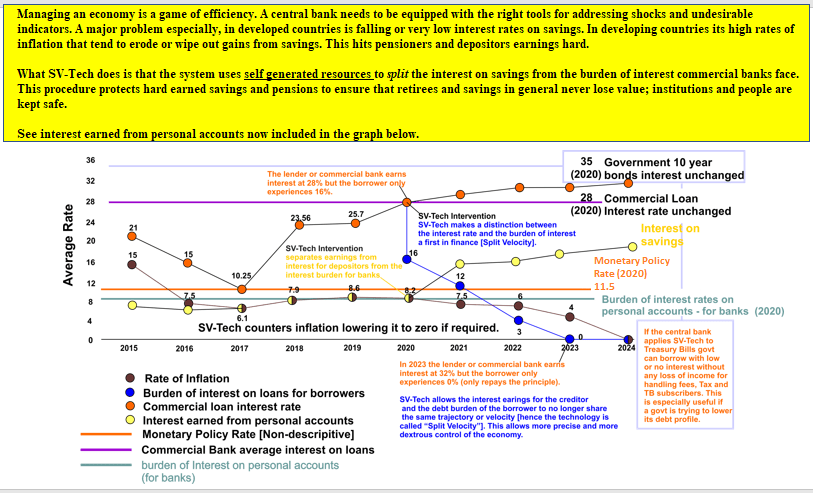
In developing countries inflation tends to wipe out the benefits of savings and pension schemes. In developed countries a major problem during a down turn is how to revive the national economy. One of the methods applied to do this, that does work, is Quantitative Easing (QE). To prevent recession households and businesses need access to cheap money to encourage them to spend and produce. The dilemma that arises is that cheap money requires low interest rates 0% – 2%. When a central bank lowers interest and increases money supply it can have the desired effect, which is to stimulate economic activity. However, the casualties of this are pensions and long term savings. Pensioners can watch the value of pensions they’ve worked their whole lives for eroded to the point where they fear for their well-being after and during retirement, while long term depositors can watch the sacrifices they have made over the years to build savings disappear as a result of inflation. It should also not be forgotten that even if interest rates are reduced to 0% the greatest proportion of the debt load tends to always reside with the principle, therefore, adverse economic conditions can negate the impact of rate cuts by restoring an invisible ad-hoc debt burden that is not accounted for when assessing such interventions. [i.e. As interest rates drop due to rate cuts these cuts have to be weighted against the capacity of borrowers to repay loans – which is itself being continually eroded by a weakening economy]
A Spit Velocity model generates its own internal resources with which to separate [split] the burden of interest on savings faced by commercial banks from the interest on savings required by pensioners and savers [hence the innovation is called Split Velocity]. The SV-Tech intervention is shown in the graph above. This allows pensioners, annuities and savings to enjoy an interest rate above the inflation rate and well above low interest rates, protecting them from bearing the negative repercussions of any action a central bank needs to take to revive the economy. The sacrifices made by people to save their income is recognized by the economy and actively safeguarded. This enhancement ensures that pension schemes are protected and will never be allowed by the economy to lose the value retirees require to cover their present and future living expenses.
The United States Federal Reserve is currently (April 2020) spending US$80 billion a day [the highest on record] on increasing money supply through the purchase of Treasuries to counter the recessional impact of Covid-19. This is necessary to help prevent recession. However, we recommend an SV-Tech intervention to prevent economic shocks. The reason is very simple – efficiency. For every US$1 the Fed spends on QE the impact of the stimulus to drive back recession is likely to be US$0.02 (2 cents) or less, that is, the Fed loses 98 cents on every QE dollar; a processes that does not counter the inefficiency of money. This low rate of efficiency is why there is sometimes doubt about whether QE works. It does work, it just requires copious amounts of money supply to see results and it will only work if productivity of a unit of money is greater than zero (x>0). If the ratio is at zero or less the economy will not respond favourably to QE. The higher the ratio the more responsive to QE an economy will be.
During a recession Split Velocity allows people to safely both spend and save, this gives firms the confidence to continue pushing output and sales whilst it removes inflation from the economy, this continued economic activity and retention of savings in turn encourages banks to keep lending to the public and to themselves, consequently unclogging the main avenues that cause recession. Using a Split Velocity (SV-Tech) system instead of purchasing Treasuries with a low impact of 1:0.02 the Fed would purchase actual growth. Every US$1 the Fed might use to increase money supply by using SV-Tech would result in a push against recession of U$1 (1:1). This makes SV-Tech as much as 98% more effective and more efficient at generating growth and deterring or driving back a recession (such as that created by Covid-19) than conventional QE whilst obtaining the same objectives.

 Split Velocity Solutions Ltd