
4th May 2020
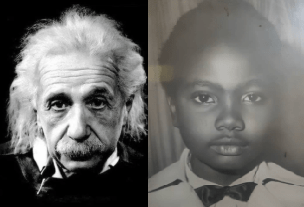
At around the of age 10 Siize Punabantu was first introduced to Einstein’s Theory of Relativity. After having it explained to him and having set aside the afternoon to read through Unified Field Theory in his father’s library, where there was a collection of encyclopedias, despite Einstein being one of his science heroes, he concluded he didn’t agree with Einstein’s understanding of the universe and the physics on which it functioned. He pointed out that even Einstein’s use of the term Space-Time was an oxymoron and evidence of inaccurate avenues in analysis, in the sense that “Space” and “Time” as Einstein explained them cannot co-exist. He insisted that it can be explained how true Space [Space which is not governed by Distance as Einstein understood it] exists outside of Time and if these flaws were not corrected how to control gravity would prove difficult to understand. Early arguments like this give insights into his personality.
His arguments may have seemed untoward at the time. And yet, today there is an interesting documentary released only last year (January 2019) that now concurs with Siize Punabantu’s early analysis. Here is the link to it. It’s called Einstein’s Quantum Riddle. The Institute of Advanced Studies in the documentary is getting closer to the truth (at 46:34 in the video). When Robbert Dijkgraaf (Director of the Institute of Advanced Studies and Leon Levy Professor) talks about correcting Einstein’s model or understanding of the universe as the means to completing Unified Field Theory, he implies Space-Time is actually incorrectly interpreted by Einstein, something Siize identified shortly after the theory was first introduced to him in his early years.
The need for a paradigm shift: “People cannot sit around in markets and hang around on the roadside waiting for jobs and a better life for themselves and their children unable to move forward simply because it is a professional and intellectual inconvenience to the truths held dear that do not measure up to what is required to change their circumstances.” – Siize Punabantu
It is hoped the “Einstein episode” described above gives anyone who’s interested a little insight into the kind of person and attitude Mr Punabantu had even from a young age and why he would later challenge aspects of economics related to economic growth in the GPWN using Split Velocity. As you can see, if he disagrees with your thesis despite you being the expert, its nothing personal.
We no longer have the luxury of waiting a decade for our per capita income to grow by US$300 and have this as the underlying and acceptable objective of national planning. If the current knowledge paradigm is insufficient and inadequate then it must be advanced to one which brings humanity anywhere it is found, be it in the developing or developed world, the changes in business, economics and finance that deliver a better life in the shortest possible time, without leaving anyone behind.
Split Velocity provides real hope for changing the future and making sure it is able to provide the kind of developments in business, accounting, finance and economics that deliver a better life.

 Split Velocity Solutions Ltd