
9th April 2020
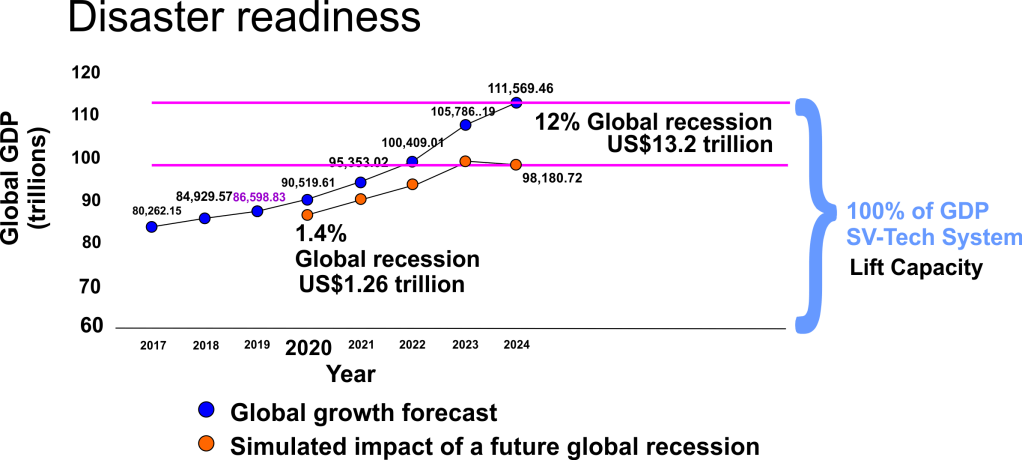
It is anticipated that Covid-19 will halve global growth slowing to approximately 1.5% of global GDP. A recession of a magnitude of 1.5% may be within the scope of current approaches to disaster management. The reality is that current systems are not prepared for future disasters and economic shocks with a potential major impact ranging from 10% to 30% of GDP or more. Institutions such as the IMF, World Bank, AfDB and so on are simply not prepared for shocks of this magnitude. On this scale it is not useful to only have strategies based on finances in reserve or that these institutions can raise from governments as it is unlikely they will be able to meet challenges on this scale. At this point the strategy has to shift from how much funding is available from reserves to the lift capacity inherent and available in the global economy itself.
The lift capacity can be regarded as the inherent growth in an SV-Tech system to roll back any serious economic shock or disaster. The lift capacity of an SV-Tech or Split Velocity system is assessed on the basis of countries that deploy the system to manage their economies. The burden carrying or lift capacity of an SV-Tech system is equivalent to a country’s GDP. Therefore, the more countries there are with economies managed using this approach the safer the global economy is from future shocks. As each country alters its rate of acceleration in unison with other countries any shock that impacts economic growth negatively is met with resilience and equal resistance enabling a much safer and speedier global recovery even before international development agencies begin to spend. This allows them to be more strategic and selective about how they spend their reserves during interventions.
3rd April 2020

This is an important upgrade to the tools central banks can have for implementing monetary policy and providing a stimulus.
In the wake of the Covid-19 Pandemic business will need relief from interest. This new system will enable banks to offer better interest rate conditions for their clients to help with recovery without having to bear the cost of doing so.
[What do we mean by a more dextrous and refined tool for monetary policy? Low interest rates help borrowers but they hurt the profitability of commercial banks. By using SV-Tech to de-couple earnings from interest and the burden of interest, for instance, the Federal Reserve Bank in the United States could maintain the burden of interest at 0%-2% but adjust the earnings from interest to 12% allowing banks in the US to sustain profitability without this negatively impacting on borrowers.]
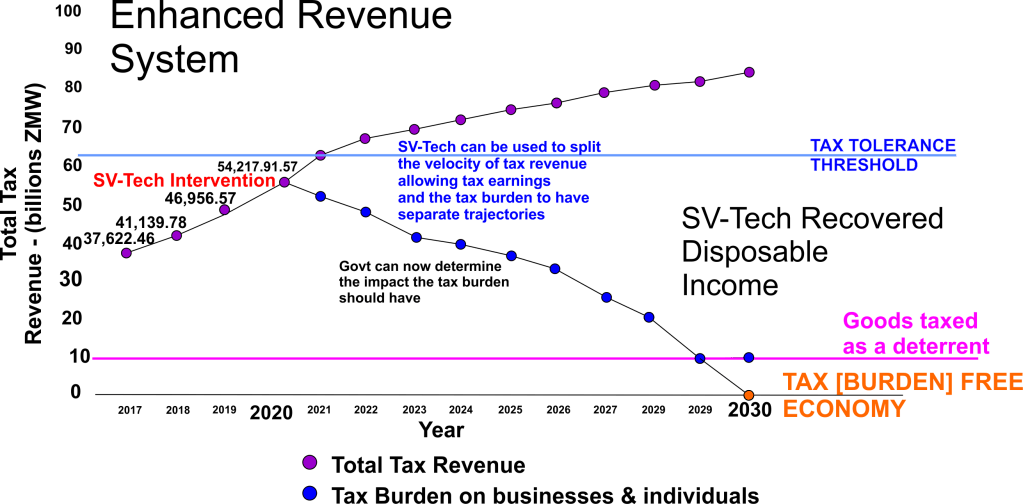
Tax revenue collection for 2020 in Zambia is expected to be approximately 20% of GDP. This is far below the spare capacity or burden carrying ability of the SV-Tech system. Essentially this means the 20% tax burden can be shifted onto the SV-Tech system at constant price creating a tax [burden] free economy. In 2020 the earnings from tax and the tax burden are coupled and must move in one direction. SV-Tech can be used to decouple them at constant price allowing tax earnings and the tax burden to have independent or “Split” velocities.
The graph above shows that in 2030 government collects K84 billion in taxes but businesses and individuals experience no tax burden. Normally any tax relief or rebates must come at the expense of government revenue. Applying SV-Tech spares governments this loss of revenue. This type of relief will be especially important to address economic growth and recovery in the wake of the COVID-19 pandemic.
The ability of governments to free individuals and businesses of the tax burden means people have more money to spend and businesses regardless of how large or small they are, be it the mining sector, manufacturing, transport, information technology (IT) and so on have more income with which to run their operations, both hire more people and invest. Shifting the burden of tax from businesses and individuals onto the SV-Tech system creates a lighter, more robust economy with the potential for greater commercial activity and is new to the Fintech space.
Split velocity essentially, neutralizes opportunity cost. Most professionals who are not familiar with the workings and dynamics of SV-Tech will need re-training.
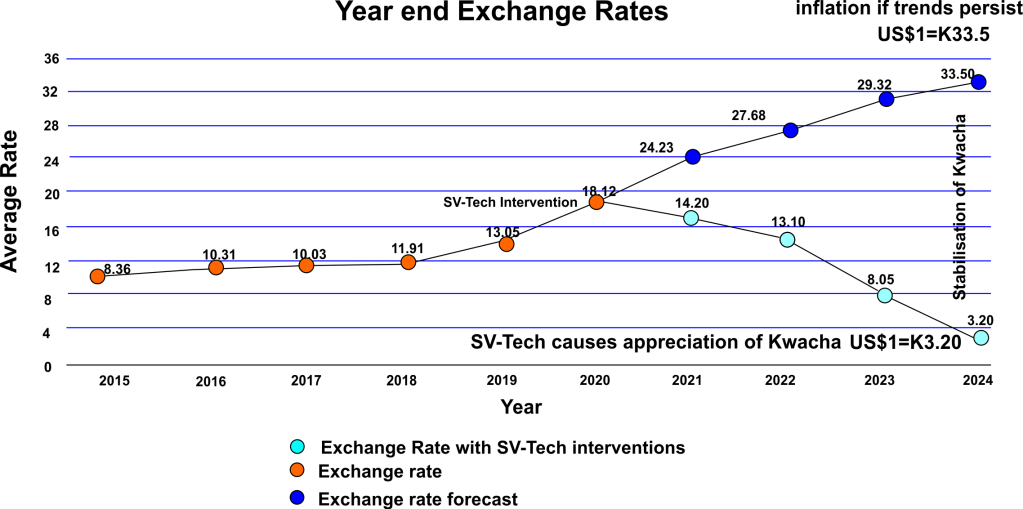
beginning of the end of unwanted deflation/inflation and price instability.
SV-Tech does not need forex reserves in the short term to increase before it acts to counter depreciation of the local currency. It creates multiple avenues for the central bank to regain the value of its currency. This will be useful to poor countries facing challenges with forex reserves.
Lower pricing for goods and services in an SV-Tech system makes having a weak or depreciating Kwacha to make local goods seem more attractive abroad obsolete. The tourism and export sector is therefore not affected by a strong local currency.
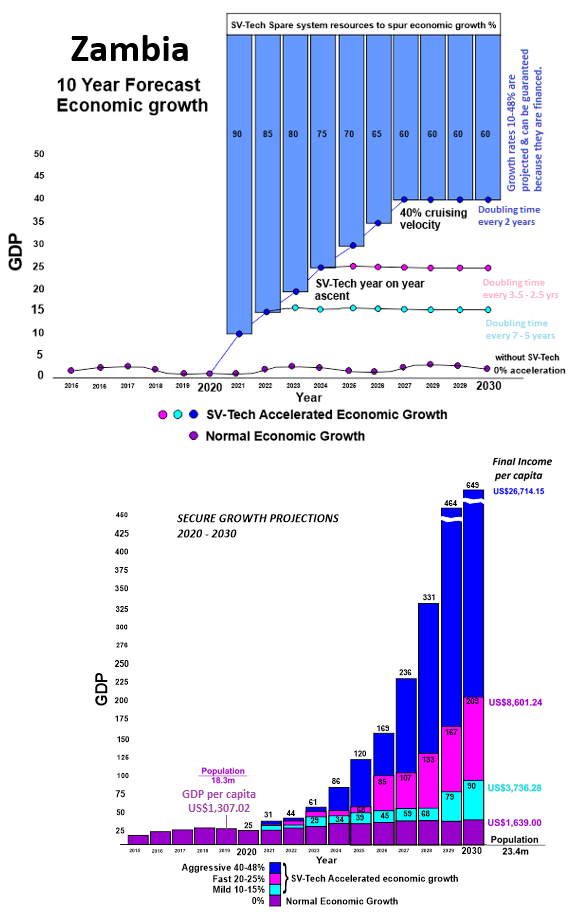
Accelerated growth can play a significant part in getting businesses back on their feet and pulling people who lost jobs during the Covid-19 induced slow down back into full employment. Businesses large and small, in any sector, including the mines, can also be rescued with this new system.
These rates of acceleration of GDP are not exaggerated. In fact they are understated. The projections are not forecasts of what the economy might achieve. These are guaranteed growth rates which once set will be financed by the SV-Tech system into existence as it moves to achieve the target set for it by scaling up productivity. [USA per capita income in 1820 was US$1,300 roughly Zambia’s per capita income today. It took 200 years for the economy to grow to where per capita income is US$56,200 – where it is today in 2020. Developing countries deploying an SV-Tech model should be able to accomplish, in a few decades, what developed countries took centuries to achieve.]
The table above shows extremely slow growth rates where after a decade of economic growth Zambia is currently expected to only gain an increase in per capita income of US$300. These very low growth rates occur due to the fact that losses to subtraction are not identified and accounted for in Neo-Classical Economic Theory from its inception. The recovery of losses from subtraction using Split Velocity creates accelerated growth. These resources are therefore pre-existent in every economy, they simply have to be harvested and harnessed to productivity thereby accelerating GDP growth rates. Instead of an increase in per capita income of only US$300 which is Zambia’s current course the diagram shows application of a slow SV-Tech growth rate 10%-15% that yields a per capita income of US$3,736.28 after 10 years, a mild SV-Tech rate of 25% yields US$8,601.24 over the same period and an aggressive SV-Tech rate of acceleration adjusts the projection to US$26,714.15. This reduces the period from 200 years to 20 years or less, consequently shortening the days required to move from low per capita income to high per capita income countries. Achieving this does not use up all the resources available to the SV-Tech system, 60% of which are left untapped, at least until a use for it is identified.
What do we do with idle untapped SV-Tech resources?
One option may be to use these spare resources to accelerate health and education sectors (since they are important to households) shifting the burden of these onto the Fintech consequently making them affordable or simply free without in any negative way affecting how they currently function in a free market system in both the private and public sector. As a non-intrusive catalyst this is something that may be worthwhile to consider applying idle unused SV-Tech resources to.
Shifting the burden of education and health onto the SV-Tech system and making these two specific burdens more affordable or simply free in this non-intrusive way will remove a great deal of stress from families and individuals. This increases their disposable income and allows them to improve their quality of life. With the installation of an SV-Tech system there will be a significant jump in both the quality and quantity of education as well as life expectancy. Very importantly there will be a tremendous improvement in healthcare due to the fact that pharmaceutical companies and the health industry will have significantly more resources to invest in daily operations as well as R&D. New treatments, medicines, medical devices and equipment should become available more quickly. The health care sector in general will have significantly more income and resources to work with. Having a healthy and well educated population that lives much longer leads to greater productivity and a more robust economy.
Shifting the burden of education and health onto the SV-Tech system to make use of spare, unused capacity is certainly worth considering.

 Split Velocity Solutions Ltd