
Monday 2 September 2019
Excerpt, the Greater Poverty and Wealth of Nations (GPWN) 2010
Reconciling Keynesian and Monetarist Approaches
Macroeconomics, Implosion and Expansion
To date CE [neo-classical economic theory] has not been able to conclusively explain why poverty and scarcity exist. If it did provide a conclusive explanation poverty would be something students learn about in history books about a bygone era of strife ridden human existence. Operating Level Economics (OLE) introduced in the book the Greater Poverty and Wealth of Nations (GPWN) on the other hand explains poverty and the existence of scarcity as a syndrome (Systemic Dystopia or SyD in short) arising from the operating system [circular flow of income] of an economy caused by implosion [subtraction] that creates a persistent and consistent lack [poverty] of resources sufficient to meet humanity’s needs and wants. Economic implosion, [subtraction], scarcity and poverty are synonymous. The theory of economic implosion also explains why poverty and scarcity persist even in the midst of the appearance of great wealth as observed in the inner cities and slums of developed nations. [Before this there has been no genuine scientific explanation for why poverty or scarcity exist]
There are today two popular approaches to managing an economy namely the Keynesian and the Monetarist approaches. The Keynesian approach involves increasing aggregate demand in order to stimulate productivity along the lines of fiscal policy. This involves government expenditure. Very basically the Monetarist approach involves regulation of the economy through interest rates in order to encourage people to either save or to consume.
In a linear economy [neo-classical economy] the physical limit of resources is based on real volumes such as the number of tons of copper, the number of educators, the quantity of engineers and so on. This seems a very real limit that supply must take into account. In a dynamic economy [economy managed using Operating Level Economics – OLE] there is no real physical limit to resources. Human ingenuity is capable of creating infinite resources. Resource limits are in fact artificial and depend on the level of available creativity, ingenuity, and technology. The dynamic economy [economy managed using Split Velocity] therefore strongly relies on research and development and the exploration of old and new technologies that lead to socio-economic development.
Hence a clear distinction is drawn between linear economics (CE) [neo-classical economics] and dynamic economics [Operating Level Economics (OLE) which focuses on the circular flow of income (CFI)]. Dynamic economics takes into account the seven forms of scarcity (see GPWN) and ultimately relies on human ingenuity as the delimiting factor when it comes to scarcity. It therefore proposes that resource limits can be constantly and continually pushed forward by research and development. A dynamic economy is capable of financing research and technology while a linear economy is just barely able to provide it [because it works against businesses and experiences zero growth].

A Keynesian economist would suggest that aggregate demand be moved in relation to aggregate supply toward the physical limit in order to maximise productivity. When the physical limit of resources is reached any further extension of aggregate demand will lead to a rising general price level. A monetarist would argue that any increases in money supply would need to be directly proportional to growth to be justified.
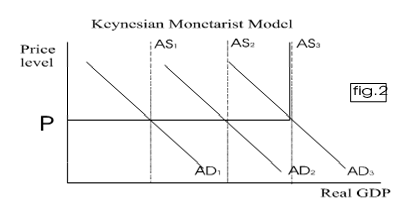
The debate between Keynesians and Monetarists has been centred around the shape of the aggregate supply curve (AS) shown in the diagram. Keynesians would encourage governments to shift aggregate supply to the right through public expenditure when an economy experiences recession in order to maximise productivity. Monetarists who oppose manipulation of the AD curve as a means to creating employment believe in a vertical aggregate supply curve which clearly shows that any attempts to tamper with aggregate demand [using increases or reductions in money supply] will cause inflation or deflation. This debate can be resolved by appreciating that both economies indicate an equilibrium price level despite the fact that they may be in recession. Furthermore, Monetarists agree that money supply can be increased but only when it is in direct proportion to growth in productivity. It becomes quite clear that though Keynesians and Monetarists have different approaches they share the same fundamentals. An equilibrium price level is obtained where aggregate demand and aggregate supply meet and that there are circumstances under which aggregate demand can be increased without causing inflation. If money supply should grow then it should be directly equal or proportional to the level of growth in an economy. Since there is an agreement between the two it becomes possible to arrive at an acceptable merger of the two curves with the understanding that each shift in aggregate demand is in pace with growth and productivity in order to prevent recession [This illusive reconciliation of Keynisian and Monetary policy is effectively achieved by Split Velocity or the correction of Subtraction in the circular flow of income (CFI)].
[Fig 1. shows two separate models which disagree on how
an economy should be managed. The debate between Keynesian and
Monetarist models is well documented in neoclassical economics. Fig 2 above does the unusual in that it merges the two opposing models into one functional system. How is this possible? The models oppose each other because of subtraction in the CFI. Subtraction causes curve tectonics or demand and supply to work against one another due to the fact that in the CFI human capital and non-human capital compete for the same
limited finances at any point in time. When a Split Velocity system is introduced this conflict
between demand and supply is effectively resolved. The result is not only unparalleled economic and financial system stability at constant price (P), but also accelerated economic growth at AS1, AS2, and AS3 which show that there is potentially no limit to growth in a Split Velocity model. This occurs due to the fact that the Keynesian limit of the L curve keeps shifting in tandem with the Monetarist limit of the AS curve. This kind of unlimited growth has never been demonstrated in neo-classical economic theory, but is offered as standard in Operating Level Economics proposed in the GPWN.]
Fig.2 shows that Monetarists and Keynesians share the same fundamentals and do in fact make reference to the same AS curve. As long as increases in aggregate demand are met with similar increases in aggregate supply the economy remains stable [this means that as long as subtraction in the circular flow of income (CFI) is countered or neutralized rapid and stable economic growth is achieved with price stability]. This brings out one very important issue and this is that economic instability is not necessarily caused by increases in aggregate demand. It is caused by imbalances or intolerances in the relationship between aggregate demand and aggregate supply referred to as Curve Tectonics in OLE [or known more popularly as Market Forces in neoclassical economics]. A linear economy [neoclassical economy] proposes that there is only one economy [human and non-human capital are one and the same] made up of an amalgamation of aggregate demand and supply [the consequence of this basic mistake in economics is that money cannot be used as a stimulus or catalyst to accelerate growth at constant price – something corrected by using Split Velocity] . A dynamic [Split Velocity] economy refutes this approach and instead proposes that there are two economies each capable of acting independently. The linear economy [neoclassical economy] ties the dual [human capital and non-human capital] economy together to create one economy through the use of a single currency that is exchanged between households and firms [effectively making a central bank incapable of using currency or money supply to accelerate growth as any attempt to do so will tend to cause inflation. Split Velocity reverses this condition allowing currencies to stimulate growth without inflation]. [In a neo-classical economy human capital and non-human capital bind resources from each other] – One has to wait for the other [due to subtraction] to allocate or spend before it can transact [creating the problem of curve tectonics]. Hence, whenever aggregate supply or aggregate demand move independently [since they are not liberated from one another by removing subtraction] curve tectonics [uncontrolled market forces seeking an equilibrium that is sticky downward, seeking stagnation instead of economic growth] takes place and this has a negative effect on the general price level [leading to a central bank’s lack of direct control of inflation and deflation]. Aggregate Demand and Aggregate Supply are competing for the same financial resources, which generates a resources vacuum that is evident in the CFI at any point in time. This perpetual vacuum is responsible for making scarcity and therefore poverty ever present in an economy regardless of whether it is that of a developed or developing country. [In geography when tectonic plates (market forces) move against once another they create earthquakes (periods of economic instability). Similarly, when aggregate supply and aggregate demand cannot be orchestrated (or synchronized) to move in tandem (through the correction of Subtraction – see fig.2) the consequence is economic shocks to an economy such as rising prices, for instance, higher mealie-meal (fuel, food, electricity etc) prices – demand and supply work against one another to create unnecessary price distortions. The only known method for preventing and controlling this problem, in absolute terms, to date is a Split Velocity system]

(Curve Tectonics)
[The rising inflation in the above diagram cannot be comprehensively controlled by any current approaches in economics due to the fact that presently no central bank in the world has a financial tool for wholly controlling demand and supply with which to independently counter inflation. This has only become possible using Split Velocity to independently control demand and supply using a technology and process that has never been available before this.]
This shows that the main cause of economic instability is the impact of aggregate consumption on aggregate expenditure on an economy at a given point in time. All the finances held by households finding its way into the hands of industry and back over the duration of a year is not necessarily a comprehensive equilibrium. Another important equilibrium to address is the volume of finances businesses hold for productivity and the volume of finances consumers hold for consumption at any specified point in time. Any disparity between these two will cause fluctuations in the price level due to increased tension between aggregate supply and aggregate demand [curve tectonics]. The linear fiscal year as a budgetary sum of economic management is therefore not a recommended way of regulating an economy. This problem is illustrated in the empirical evidence based test for Split Velocity.
At any point in the short run where aggregate supply and demand are not equal to each other the economy can become unstable due to variances in pressure between aggregate demand and aggregate supply. To minimise this problem aggregate demand and supply should therefore move in tandem. However, this is made impossible by the fact that a linear economy [neo-classical economy] ties consumers and producers to each other by forcing one to wait for the other before any transactions can take place [ Subtraction – see the youtube video that explains this cardinal problem in economics]. When firms pay households those funds are locked away from productivity until households spend them. When firms hold money to spend on capital investment, ceteris paribus, those funds are similarly locked away from households. The credit creation process helps, but perpetuates this when credit in the form of loans is allocated between households and capital by firms. Hence, aggregate demand and supply are [continually] unable to move in the same direction [despite the introduction of credit creation by commercial banks]. If demand increases it means more income is being paid to households, but this also means that a greater proportion of financial resources is being withheld from business, thus hampering productivity and creating a potential imbalance between demand and supply. When capital growth is achieved it means the economy may be growing, but more finances are being withheld from households. Aggregate demand and supply thus begin to play against one another [become tectonic]. This places a tremendous strain on the economy, which begins to show signs of fatigue through inflation or deflation. It cannot withstand a long duration where aggregate supply and demand move independently and when this occurs too frequently it leads to economic instability.
……….

[In a Split Velocity model demand (AD) and supply (AS) are constantly being re-balanced in the CFI therefore the price level in the economy remains consistently stable as shown in fig.4. X0, X1 and X2 show the capacity for rapid or accelerated economic growth at constant price when subtraction is corrected.]
When aggregate demand and supply move in the same direction and to the right [as shown in figure 4] it creates growth and development (see Economic Gain & Loss – GPWN). To distinguish between terminologies let us assume that economic expansion is differentiated from economic growth in the sense that expansion entails both growth [non-human capital] and development [human capital] are taking place simultaneously. It is important to be able to calculate the basic impact of a linear economy on economic expansion.
[If you understand the concept of curve tectonics explained above and how this relates to market forces in economics and how subtraction can subdue the natural instability and lack of growth caused by market forces, then its very easy for you to understand how a country like Zambia has the equivalent of GDP available to it to use as a stimulus to grow the economy at constant price.
When Split Velocity is introduced to an economy there is increased price and system stability. However, there is also accelerated economic growth. An economy moves from a zero growth setting characteristic of a neoclassical economy to growth rates between 14% – 48% without exhausting system capacity. These accelerated growth rates are hungry for money with which to facilitate growing transactions as well as to keep output and money supply equal [when the AD and AS curve move to the right in tandem (as shown in figure 4) due to the central bank countering subtraction in the CFI a significant deficit in money supply arises. This accelerated growth requires that money supply constantly increase in order to keep pace with the rapidly expanding economy].
Consequently, money or currency used to facilitate transactions becomes very much like a raw material required for this more advanced economy to work. As a result, the supply of money undergoes a revolution. From here onwards currency and its supply becomes an essential and lucrative industry. Incidentally, the ad hoc leaders in this industry are central banks. However, central banks at present supply money as a form of house keeping for the national economy. They incur significant costs to maintain money supply. Nevertheless, this activity places them in pole position for supplying currency required to run a Split Velocity system. Since the supply of money can now take place with financial returns rather than losses to a central bank a new business model can be applied to how money is supplied to the economy effectively creating a new specialized industry driven by currencies. Instead of having a product (money) that is a liability due to the costs associated with supplying it central banks now have an asset they can supply and earn significant sums of revenue by applying a new business model to the money supply process.
This change requires central banks to eventually introduce a new area for supervision in this new industry – namely the supply of currency, but also requires eventually setting up a new corporate structure separate from the central bank yet within its regulatory system that will work as a profitable corporate entity to supply money to the national economy. The issuing of currency may be moved from core operations to a separate corporate space simply because the supervision of the supply of currency and the issuing of currency in this new industry ideally require fiduciary distance to be managed effectively. Since national currencies are generally owned and supplied by governments, they now become a significant public sector asset governments can earn revenue from. However, the debut of cryptocurrencies has demonstrated that currencies can also be supplied by the private sector. Private sector participation is required to drive research and development as well as innovation in this new industry. In future market share in the supply of currency is likely to be a combination of both public and private sector participation and the industry is likely to grow to become one of the significant financial sector innovations in recent memory. This development is made possible, in large part, by Split Velocity as a new innovative entry into the Fintech space.
In terms of the search for best practice in economics, a Split Velocity system is without doubt the cutting edge and most advanced approach to managing national economic challenges that even the developed world, has not caught up to as yet.
Most importantly it is clear that the knowledge and know-how for ending poverty is at hand and the process for doing so is scientific.]
……

 Split Velocity Solutions Ltd