
15th August 2022
Operationalizing Split Velocity creates the money supply industry. Technically, even though cryptocurrencies (private money supply – sometimes referred to as decentralized finance) and fiat (public money supply – sometimes referred to as centralized finance) exist, there is no industry.
As has been mentioned the money supply industry should ideally compliment the commercial banking industry, but is currently missing from the financial sector. Split Velocity corrects the defective CFI and restores the hidden/unseen losses and restores them to businesses, government, private and public sector institutions.
This effectively brings an end to scarce resources, high levels of credit risk, underdevelopment and poverty whilst at the same time ushers in unprecedented new levels of growth, improvements in the standard of living, advancements in infrastructure development and leap forward in socio-economic development, possibly greater than has ever been possible in human history.
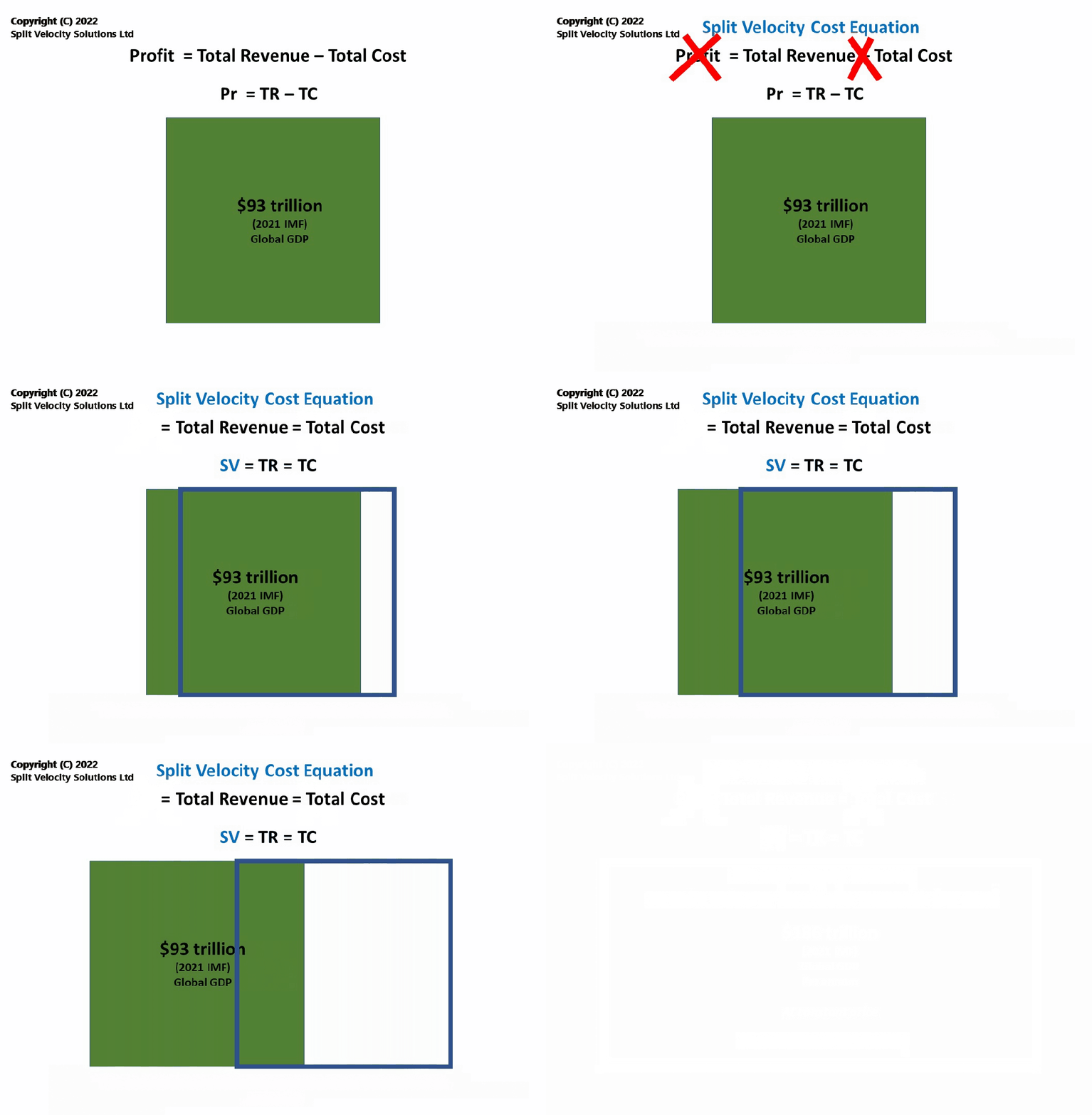
Split Velocity identifies and draws out the hidden financial loss and
and decline in productivity caused by
the defective, poorly designed CFI restoring it to stakeholders
Contrary to conventional belief maintaining constant price
is relatively easy in a Split Velocity model. With the Cost Equation upgraded or corrected
to the Split Velocity Cost Equation shown above, the Fisher Equation is upgraded to the Split Velocity model’s
equation of Exchange, referred to in the GPWN as the Punabantu Equation of Exchange.
The equation shows that a Split Velocity model establishes a “price plane” and will resist
both inflation and deflation when changes in money supply take place. Technically,
because the velocity is “Split” there is no real increase in money supply (i.e. $186 tn/2=$93 tn)
this increases the efficiency of money observed in increases in output (businesses and institutions have
more income to allocate to non-human capital expenses consequently shifting the production possibility frontier to the right and driving output upward maintaining constant price, meanwhile households experience an increase in income with which to consume higher levels of output. A Split Velocity model is a well oiled machine expertly designed to achieve what an economy is expected to achieve and represents best practice. This is ideally how an economy should be managed, how it should operate and correctly function to obtain the best and most efficient and effective results, with no unnecessary losses to the CFI – see how the Punabantu Equation of Exchange supersedes the Fisher Equation in the GPWN 2010).
As demonstrated by the animation above the poorly designed, defective CFI wasted $93 trillion in 2021. The most affected by this loss are households, that is, employers, business owners, owners of factors of production, shareholders and labour, that is, employees engaged with with activity related to production. This is one situation where both shareholders and employees have a common problem. The CFI subtracts tremendous value from the economy worsening returns on dividends, earnings and conditions of service.
Incredibly this $93 trillion loss, that can be recovered, is not addressed as it is not identified at postgraduate and doctoral levels of economics and finance. It is not identified at the highest levels of thought, academic qualifications and professional practice today.
This loss is revealed in an audit of the CFI. The damage this loss has done, the suffering it has caused humanity to endure and continues to impose on development in the presence of inadequate resources needs to be corrected for the function of economies to be normalized and to allow businesses and institutions in both the private and public sector to begin to function optimally.
What this illustrates is that cryptocurrencies and fiat: the money supply industry in general, is in its infancy. There is is tremendous potential waiting in the wings to be deployed. Extensive skill and a shift in the knowledge paradigm is required to unlock this wealth, the need to learn and understand a Split Velocity model cannot be understated, neither should it be taken for granted as something easy to do. There is a need to step out of the comfort zone and embrace the changes and transformation a better understanding can bring. The learning curve is steep, but not insurmountable.
Split Velocity Growth has the advantage of being based on Science not Ideology
When Split Velocity is operationalised in an economy it will achieve its objectives. It is possibly the first and only economic strategy capable of lifting an economy comprehensively out of poverty. The perpetual failure of past policies and strategies is evidence of gaps in the knowledge paradigm for how to mobilize resources and achieve rapid growth that is transformative. These mistakes should not be repreated in perpetuity. Fortunately Split Velocity fills the gaps offering a strategy, methodology and technology that will not dissapoint implementors.
Split Velocity processes and technology is based on science not ideology. In terms of resource mobilisation for development, Ceteris paribus, it is capable of reducing doubling time for GDP to 1 year at constant price. Depending on its needs, from this an economy can choose what proportion of these resources it wants to apply by determining a growth rate . e.g. 40%, 50%, 60%, 70% and so on. This is regardless of the current size of an economy.
Its common knowledge that every aspect of socio-economic existence, including whether an economy is a superpower or fundamentally a weakling is dependent on economic performance. The strategic importance of Split Velocity technology, ceteris paribus, is its ability to double GDP in one year at constant price. To achieve this feat a Split Velocity model does not even need to apply its full resource mobilization capacity since the rule of 72 reduces the duration required for this threshold to be achieved achieved. Rates of acceleration can be lower, yet suitable, for example, optimized between 40% to 70% or less. This leaves spare capacity to address economic shocks, where productivity has to be ramped up to compensate for slow growth witnessed during recessions.
Economies unable to access Split Velocity will risk not having access to these guaranteed accelerated growth rates and associated doubling times, therefore early adoption of the innovation is advantageous.

 Split Velocity Solutions Ltd