
24th November 2022
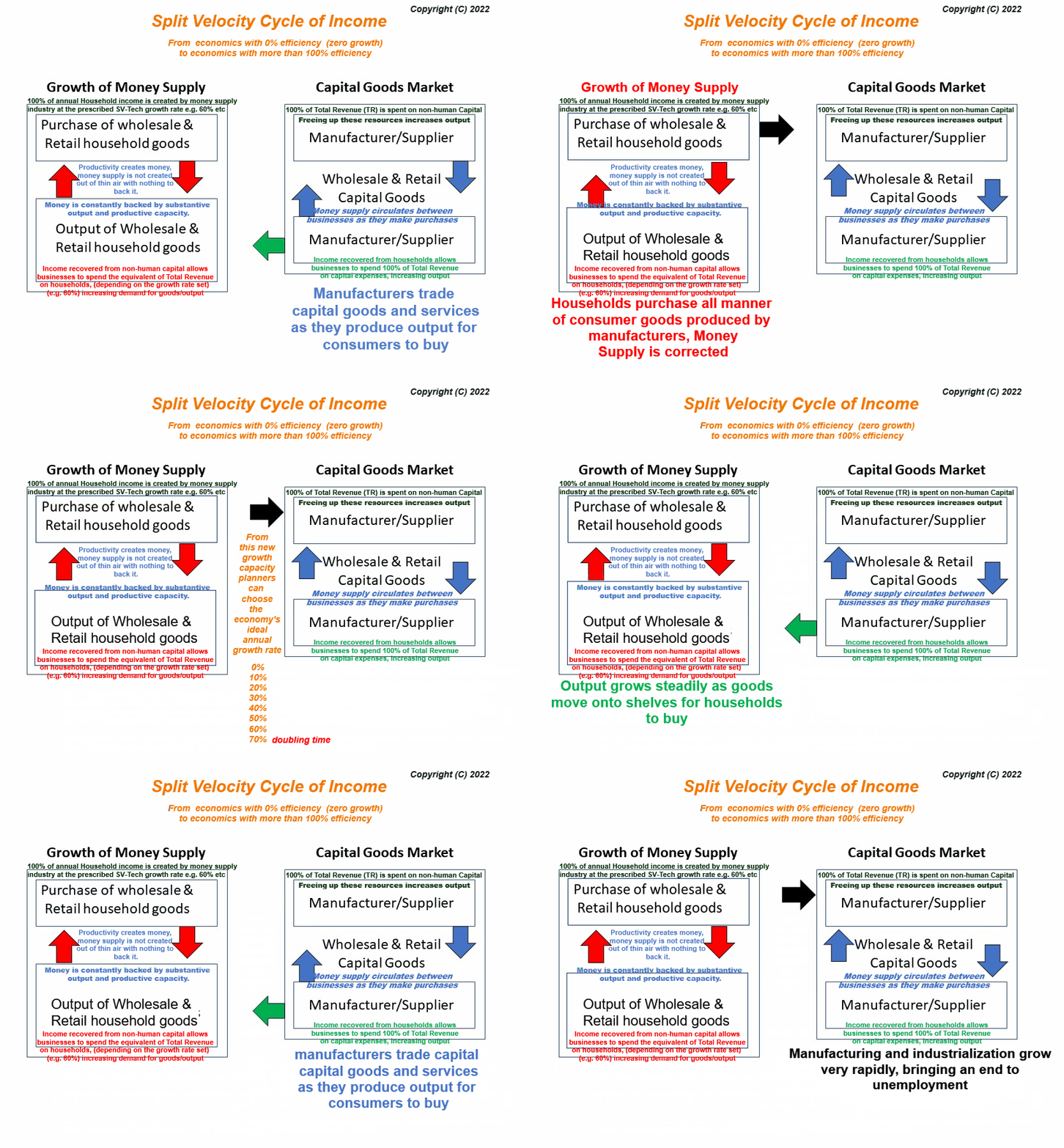
The animation above shows how Split Velocity offers a robust technology for managing an economy towards growth and abundance. In the cycle shown above the annual growth rate though constant is adjustable downward or upward. At present, every economy in the world is a zero growth economy. A zero growth economy is crippled by a low GDP growth rate and is identified by the fact that it cannot survive without cost-plus pricing or mark-ups.
The output of wholesale and retail goods entering the economy is balanced by money supply provided by the money supply industry. See “operationalising the money supply industry” below. Output or goods in circulation being churned out by the capital economy must be constantly balanced by money supply to the household economy to seek and maintain constant price. This money supply deficit, which will annually be equivalent to GDP means the money supply industry is essential and has to supply the e-currency to keep up with this output and growth.
Split Velocity increases output of goods in an economy by shrinking not increasing money supply. Shrinking money supply and making it more efficient and requiring it to do more work increases the output of household wholesale and retail goods. When e-money is created or minted via an operationalised money supply industry it enters the economy backed by productivity that in real terms is backed by this existing output.
Increasing the efficiency of money increases productivity and output. This productivity and output is then monetized by an increase in money supply. When money is created in Split Velocity it is backed by goods and productivity, equivalent to upto 100% of GDP. No other financial system or model in the world today offers this level of financial safety for backing currency, not even a gold standard. Any currency issued using Split Velocity gains this stability.
Money supply in a Split Velocity economy is backed by productivity and output. For a gold standard to keep up with Split Velocity a central bank would have to store gold equivalent to a country’s GDP, which is impractical. The gold standard is not as robust as a Split Velocity model as a means of protecting the value of a currency and the ability to keep it stable.
Consumer expenditure patterns determine how money is distributed to industry.
From day 1 of the calendar year the current economic system is designed to lose 100% of its growth and productive capacity. Businesses resist this attempt to shut them down by using cost-plus-pricing. They are only able to in aggregate recover as little 3% or 5% of the losses to subtraction. The consequence of this is that by the end of the year an economy only grows by 3% or 5%. These mediocre growth rates are the scientific explanation for why governments the world over struggle with various forms of scarcity and poverty due to inadequate economic resources.
From day 1 of the calendar year Split Velocity is designed to be capable of recovering or gaining 100% of GDP. Split Velocity protects the economy by defending businesses instead of trying to shut them down. It is capable of recovering 100% of the resources being needlessly lost to subtraction in the CFI by a weak, substandard and poorly designed financial model driven by a weak economics and restore this lost value to businesses and households.
Split Velocity resolves the widening conflict between labour and machines (non-human capital)
A major concern for the labour movement and governments across the world is the relentless onward march of technology. Robots and AI taking the place of human jobs in both physical and mental areas of the workspace that pose the single greatest dilemma or challenge to the ability of human labour to remain relevant, find relevant work and the capacity of workers to earn an income with which to live a meaningful life.
However, by Split Velocity managing the economy into households and non-human capital, any application of technology, be it AI or robots that takes up jobs previously performed by households does not take financial resources away from households, instead it channels new resources to households. These resources can be used to keep human beings employed, help them find new skills, enjoy a higher standard of living and remain in receipt of income with which to continue to find work, vocations, life-style adjustments, and life fulfilment.
Smarter more efficient machines not only create more wealth for households, they also increase the quality and output of goods. This means that not only are more and more goods finding their way onto shelves for households to consume, these goods are of an ever increasing quality.
Science not Rhetoric: Together we can end global poverty and scarcity
Furthermore, investment in and the advancement of non-human capital (e.g. with access to 100% of total revenue (TR) for repaying loans, tax, covering overheads and capital expenditure (CAPEX) per annum improves its efficiency, which in turn increases its capacity to generate output of household products, not just quantitatively but qualitatively. This essentially will mean the end of human suffering caused by scarcity anywhere in the world, basically the end of global poverty not just as an “ideal” but a fundamental scientifically verified outcome of economics, finance and business management.
This means that robotics, AI and automated industries are no longer on a course that is diametrically opposed or in conflict with labour. In fact the rapid expansion of the capital economy in an SV-Tech model only serves to raise and improve the opportunities and standard of living for labour and households in general. Both humanity and machines/AI in the SV-Tech economy can thrive in harmony as the progress of one enhances the progress of the other.
The non-human capital economy needs households to consume the goods it manufactures in order to earn income with which to keep growing and remain in operation. Therefore, its primary role is to keep putting household goods on shelves that people want to buy. To compete these goods have to become better and more attractive to consumers over time. Improvements and advancements in AI and non-human capital leads to greater output of goods of ever improving quality.
The consumption of goods feeds the non-human capital economy with the financial resources it needs to keep growing continuously from year to year. The rate of growth of populations moves in tandem with the more than robust capacity for productivity of the non-human capital economy to feed and cater for it.
In order to satisfy demand non-human capital will keep building better machines, it will keep taking on bigger investment projects and to do so will continue to borrow from banks. All this activity only serves to provide goods to households.
In fact in this model it is unlikely that population growth rates can ever exceed the ability of the non-human capital economy to produce the output required for all of humanity to enjoy more than a robust standard of living. All
With the Split Velocity model humanity and ever growing populations will never starve, lack shelter or want for anything material that is basic for human life. The economy can provide adequate goods and the reason for this can be verified as being made possible by science that ensures it is a condition that is both pervasive and sustainable.

 Split Velocity Solutions Ltd