
14th September 2023
Adam Smith, who is considered the father of economics, published the book the Wealth of Nations in 1776, nearly 250 years ago. Since that time our understanding of economics, business, accountancy and finance has grown remarkably. However, despite the greatest minds applied to determine how and why countries can become prosperous why is it that nations continue to struggle with scarcity in some shape or form and wrestle with outright poverty to this day? Why has a lack of wealthy nations generally characterized what is observed in countries? Even countries that are described as “rich” first world nations or developed countries have not escaped the problems created by scarcity, they are simply comparatively better off.
The problem has to do with the design of the circular flow income. Often concepts in economics tend to appear complicated and lofty such that it is difficult to rationalise or sense check various theories. The consequence of this is that critical mistakes can be made and continue to generate chronic problems that carry on in perpetuity. The circular flow of income is one of these problems.
Let’s try to simplify this problem to an extent that any layperson can relate to it. A person who needs to water a garden in a dry climate may take a bucket, fill it with water and walk a short distance to where the garden is and empty the water in the bucket onto crops. The modern day CFI, which is understood over time, namely 1 year to determine GDP, assumes that the bucket is efficient, it is filled with water and this water is used to irrigate crops. However, the gardener cannot explain why out of the vast area cultivated and seeds planted the yield from the garden is rarely ever greater than 4%-5% per year (It should be noted that a growth rate of 15% though regarded as remarkable today, is considered “slow” when compared to the annual growth rates Split Velocity technology demonstrates it can achieve).
Split Velocity examines this process, not just over time (1 year) but also at any point in time. At any point in time the design of CFI is such that it subtracts money or financial resources between factors of production, namely households and capital creating a tremendously inefficient economic model where 100% of growth is lost (all the water in the bucket). To escape this loss businesses use a practice called cost-plus-pricing where they demand more for the products they sell than they are actually worth in terms of what it cost to produce them. Hence, the persistence of scarcity and inflation in the modern day economy. When a bucket (the economy) has a poorly designed CFI and therefore has holes (subtraction) and is losing the sum of its capacity for economic growth this is what causes poverty or scarcity observed in modern economies. The fact that the holes in the bucket have not been identified in economics, business, accountancy and finance, is why poverty and scarcity have not been addressed
The sad images shown below are the consequence of the management of global resources in this age or in this world with a dysfunctional CFI (the water in the bucket being needlessly wasted). This dysfunction causes no one to be spared of suffering in some shape or form be they rich or poor, business owners or employees. The rule of these resources is rendered inadequate because it is crippled by a broken and defective CFI that manufactures inordinate levels of scarcity and poverty. To make things worse inflation is grafted into the very superstructure of how it functions. This defective model is generally known to be intolerable and the suffering it is causing humanity out of ignorance is not acceptable.

Favelas, Brazil are created by the defective CFI.

Alexandria, SA is created by the defective CFI.

Kheliche, SA is created by the defective CFI.

Dharavi, India is created by the defective CFI.

Kibera, Kenya is created by the defective CFI.

Kensington, Philadelphia – USA, these conditions are created by a defective CFI.
Symptoms of scarcity and poverty such as these can be wiped out within a single generation by using Split Velocity to recover losses due to scarcity being generated by the defective CFI and restoring them to the economy. The defective CFI belongs to this current “world” which is made by a “backward civilisation” or “age” that is built on scarcity and the suffering it creates for businesses and humanity. Even though things may look difficult for businesses and life unbearable for many there is great hope. It is inevitable that “this world” is at an end, it will be cast out, meaning it will be relegated to the past by new knowledge and a greater understanding of the the CFI that naturally ushers in a new age, a new civilization that is far greater, that is founded and built on unprecedented prosperity, rather than this world, as it is seen and experienced today, that is founded on unprecedented scarcity. The kind of adverse scarcity and poverty witnessed in the images above will end, in this era. Thinking the bucket is full when it is in fact empty is a grand deception cast over the entire globe of 8 billion people, however, there will come a time when this deception is thrown out and overcome, that humanity may enjoy the provisions it deserves, a greater prosperity it was meant to have.
If greatest thinkers of the developed world such as both Adam Smith and Karl Marx could not solve this problem there is a need to dig deeper. Policy makers need to understand that they cannot fight scarcity and poverty using conventional tools. The haemorrhage of useful resources from every economy in the world today (i.e. shown by the water being lost from the bucket) is equivalent to GDP per day and per annum. This is a colossal loss of “blood” from the economy that FDI, poverty initiatives, restructuring etc cannot mitigate, stop and roll back.
When a tap, a bucket and water are used to rationalise how the modern day CFI functions, its easy to see that the economy is losing tremendous amounts of productivity because the bucket cannot efficiently hold water (it has holes due to subtraction). This explains why economies the world over experience such low growth rates. From the water being lost due to inefficiency, businesses are only able to recover as little as 4%-5% of it, and this becomes the slow growth rates with which people are familiar today and which have continued to remain a problem. Even if you were to make a succinct list of 100 of the greatest economists that have ever lived in human history, none were able to see or identify this problem, it has remained in plain sight, yet unseen even in the highest academic circles, for a quarter of a millennium!

Because modern day economics only sees the function of the CFI over time, it is completely oblivious to the losses taking place at any point in time, which means economics is completely oblivious or unaware of the fact that the economy (the bucket) is constantly losing water (real economic growth). Hence the public and people in general have remained wondering how and why scarcity and poverty plagues countries to this day, and have been perplexed about it for 250 years!
The failure to accurately identify and diagnose the scientific origin of scarcity within the CFI has caused many philosophers to lead the masses on various paths and schools of thought all the way into the 21st Century without genuinely bringing an end to poverty and scarcity. Persistent scarcity created by an inefficient and poorly designed CFI has led to two prominent opposing schools of thought in economics prescribed to managing economies these are namely Capitalism from Adam Smith and Communism from Karl Marx. Though both these schools offer different approaches for managing scarce resources they do not identify the fact that scarcity fundamentally and scientifically emerges from the faulty design of the CFI. Both schools assume that the bucket is full of water at the time it is emptied on crops, which means that the arguments on which they are built are based on a false assumption and therefore cannot provide a workable solution to the problem, if they were able to, poverty and scarcity would no longer exist today. The belief that the bucket is full when emptied, is grand deception that sadly has perpetrated scarcity, poverty and hardship around the world despite innumerable interventions by both local and global development institutions.
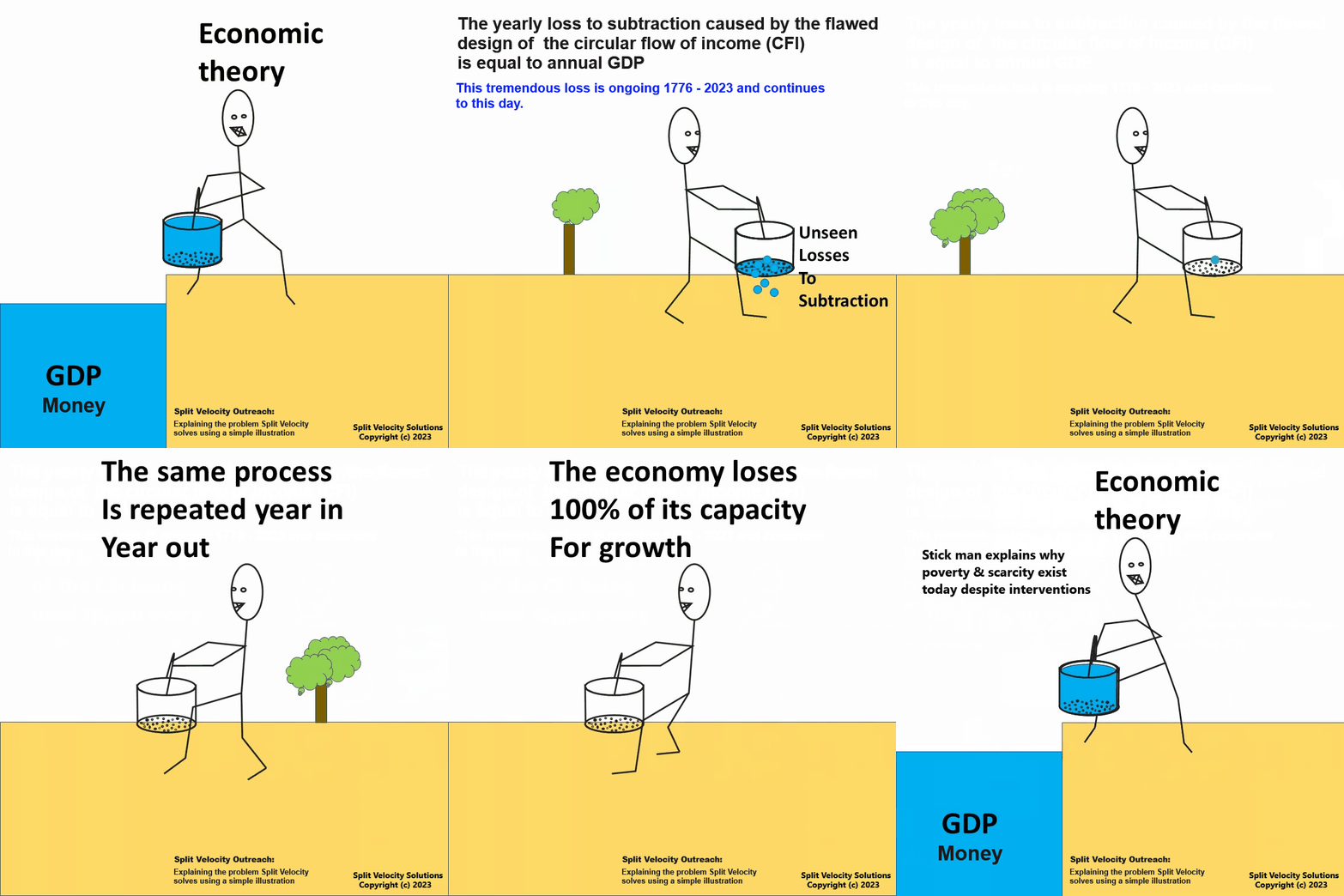
Economic theory tells the public when the bucket is emptied onto crops it is 100% full (CFI over time). However, an audit of the CFI shows that the bucket, when it is emptied, is completely empty (CFI examined at any point in time), the little drop which finances growth is businesses using cost plus pricing or mark-ups to resist being shut down by the zero growth design of the economy.
Would you water your garden using a bucket that is full of holes, where nearly all the water you pour into it leaks out the bottom before you reach your crops? And keep doing this generation after generation repeatedly for 250 years? This form of scarcity, suffering and bondage placed like a blanket over entire civilisations (8 billion people) is rather unusual.
[The bucket and water explanation for losses in the inefficient and ineffective CFI equivalent to GDP per annum offer a simple way to understand how these losses occur. For a more expedient academic explanation follow this link for the empirical evidence based test]
If you understand the explanation offered above, then its easy to see how the CFI can be described as a “machine” or mechanism for the national and global creation, generation and distribution of scarcity or poverty. Slow economic growth and poverty is created and distributed by human beings. This creates a fundamental paradox because the defective CFI creates exactly the opposite economic conditions to the growth and prosperity that governments and humanity in general say they aspire to.

 Split Velocity Solutions Ltd