
30th October 2021
Economists often describe countries and their economies in terms of a growth rate, GDP and GDP per capta, inflation and so on. It is sometimes difficult to understand how a country worth many billions of dollars in GDP, is in fact poor. The fact that this data refers to countries entails that they are portrayed at a large scale such that it is difficult to relate to how the information being shown is relevant and how it affects ordinary people. The consequence of this is that it becomes difficult for the majority of people to understand what changes in the growth rate means. To get past this problem let us attempt to reduce countries to individuals, as a way of better understanding what the implications of these lofty terms are.
Instead of an economy lets reduce the concept to that of an individual so we can compare the growth rate between two economies. One is a large advanced developed economy and the other a developing economy. For the sake of example lets use the United States of America and Zambia. To simplify and humanize the concept of growth rates so that it is easier to understand lets view the two countries as two individuals or friends Uncle Sam and Uncle Zed.
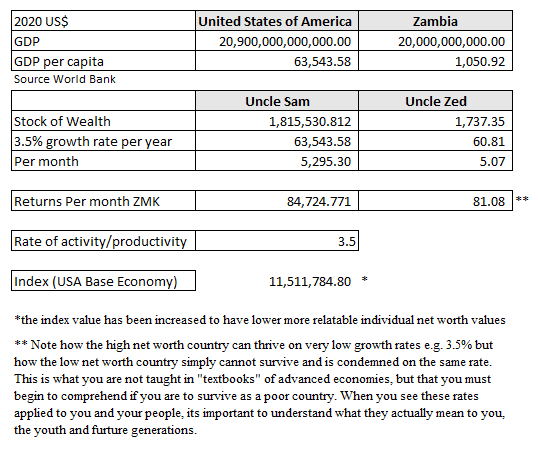
In order to reduce the two economies to individuals an index will be used to shrink the economies down equally to a level where they can be humanized as individuals (GDP/11,511,784.8*) , with the base derived from the larger more advanced economy. This allows us to simplify the concept to “individuals” instead of “countries”, which is easier to convey and understand because they are more relatable.
With this done now Uncle Sam’s Stock of wealth as an individual is US$1,815,530.81 and Uncle Zed’s comparative stock of accumulated wealth is US$1,737.35. Basically Uncle Sam is worth US$1.8 m and Uncle Zed is worth US$1,737.35.
………
A Financial Advisor would almost immediately recognize the fact that the value of Uncle Zed’s annuity is wholly inadequate and that his financial planning has been improperly assessed. A yield at 3.5% will not work for him. In fact, this advice provided by highly educated experts will condemn him. What is interesting is that this same improper growth rate is what is being advised and proposed by reputable research, monitoring and policy formulation institutes for developing countries like Zambia. In other words these institutes are unable to distinguish between the growth rate appropriate for a developed and developing economy.
The correct and accurate advice from a professional body, advisory or institute would be for Zambia to set aside low growth rates more appropriate for developed economies by implementing a Split Velocity System, more appropriate for a developing economy, to increase its economic activity and thereby its growth rate from 3.5% to 32.8% and above in order to secure the country’s economic future.
In order to bridge the gap between developed and developing countries within a generation or less (10 – 25 years) Zambia needs a minimum annual growth rate of between 32.8% – 48%. This is the identification of the problem. If research, policy and monitoring institutions do not know how to achieve this, it is then their role to engage in study and the research that will identify how to make this possible in order to help government in its effort to serve the country and people, after all research is part of their role and mandate.
Out of his full capacity to work and be productive (100%) Uncle Sam chooses to only apply 3.5% of his effort. He leaves the remaining 97% idle. Uncle Sam recognizes that his net worth is US$1.8 m. In essence Uncle Sam is like a retiree. He has been active for a long time and has accumulated an impressive amount of wealth (US$1.8 m). He can now afford to sit back and do very little (3.5% economic activity or output). From 3.5% he is able to enjoy retirement benefits of US$63,543.58 per annum and live relatively comfortably for the rest of his life. Every month he receives a cheque for US$5,295.30. He is content in his lifestyle, his well deserved lack of activity, low productivity and earnings are the benefits of being retired and he has built universities to teach others how to achieve his success.
On the other hand Uncle Zed is very young, being only a few decades old he has only accumulated US$1,737.35. Uncle Zed admires his good friend Uncle Sam’s income and lifestyle. He has graduated from one of Uncle Sam’s universities and therefore tries his best to emulate how Uncle Sam manages his finances. Since Uncle Sam survives on 3.5% per annum, Uncle Zed, who is able to be 100% productive understandably also decides to apply the knowledge he has learned from Uncle Sam’s university to be advanced like him, he sets for himself, aspires to be and is therefore only 3.5% active.
The table above shows that the outcome of Uncle Zed’s applied knowledge is an annual income of US$60.81. He receives a cheque of US$5.07 per month for the rest of his life. By following Uncle Sam’s 3.5% growth rate and economics or financial methods Uncle Zed will very likely be impoverished for the rest of his life. Every time representatives from developed economies meet Uncle Zed, they give him a pat on the back for aspiring to the greatness of being advanced and developed and are genuinely pleased with Uncle Zed, this is understandable, because it is generally assumed that policy that works for wealthy developed economies automatically works for poorer developing economies. The table above shows that this assumption is flawed.
Realistically, in order to match Uncle Sam’s standard of living and life-style (per capita income of US$63,543.58 and monthly earnings of US$5,295.30) within his lifetime, Uncle Zed cannot have a growth rate of 3.5%, like Uncle Sam. To match Uncle Sam’s income within his lifetime, at his net worth, his growth rate must be a minimum of 32.8% per annum. But when Uncle Zed goes through his textbooks he received from universities from advanced economies there is no information on how any country can achieve an annual growth rate of 32.8%. Even though Uncle Zed is able and willing to work to increase his output and productivity the economic textbooks he reads tell him a rate of 3.5% is the best and should be aspired to. However, this is a rate that works for those who have already accumulated vast levels of wealth like Uncle Sam and it does not work for Uncle Zed, especially that his wife has just given birth to twins, Mulenga and Jelita. He feels he must now see how best to ensure that his children will have better life than his. Everyone can relate to Uncle Zed’s dilemma. He is every bit as capable, smart, ambitious and focused as Uncle Sam, but he is not at the same stage in his life-cycle.
In order to gain a productivity level of 32.8% and above Uncle Zed realizes he has no choice but to ditch textbooks and methods from “advanced economies” because they are made for the wealthy at much later stages in their life-cycle. He must improve upon the knowledge given to him from advanced economies and make it relevant to his own economic circumstances as a vibrant, youthful young man with plenty of energy, but no wealth to speak of.
The professional formulation of growth rates
The table above clearly shows that the practice of ascribing low growth rates suitable for wealthy developing economies to poorer developing countries by research, monitoring and policy institutes is in fact misinformed and can be considered a form of bad advice bordering on a form of malpractice, which becomes more evident when viewed from the perspective of financial advisory services related to pensions and annuities.
The table above shows that to be meaningful to a country the economic growth rate cannot be just an imaginary number or a number that appears to conform with the expectations of economics as it is understood to apply to developed economies. Rather, it must be time bound, targeted and characterized by an objective suitable for the life-cycle stage of the economy. The time frame should ideally be within a generation, that is, 10 to 25 years for its impact to be relevant to citizens of a country living at that time, especially the youth who represent citizens at the peak of their capacity to work and to be active in the economy. The professional advisory on the growth rate a country should have must be targeted, for example, the basic target should be one that bridges the per-capita income gap between countries. In the same way that the table above clearly requires different approaches to managing wealth, the growth rate prescribed for an economy is an immediate indicator of whether an economy is being managed by those who understand the ramifications of their decisions. Even a layperson should be able to see that setting a growth rate of 3.5% for a poor economy, condemns it citizens as surely as it condemns the low net worth individual. Sadly, this is precisely what the state of the art textbooks are instructing professionals managing poor developing countries to do, to the extent that they cannot see anything wrong with the approach they use to manage these economies, which is effectively condemning them to perpetual poverty.
There must be a “ditching of the text-books” if they cannot yield the advice and mechanisms developing countries require for transformation and if they are setting imaginary limitations on what humanity can achieve, after all, no one has a monopoly on knowledge not even the respected authors that shape what is understood about the world today. Where it does not exist the relevant business, economic and financial solution required to bridge this gap within prescribed parameters must be identified through research without compromise. It is not enough to simply predict the growth rate and try to conform with contemporary views. It is necessary to identify the problem and through relevant interventions put in place the mechanisms that will effectively determine the required growth rate. This growth rate must be sufficient enough to bridge the wealth gap between developed and less developed economies in a manner that is time bound and relevant to the generation existing at the time.
A Split Velocity system is the only known method for capturing and recovering as much as 100% of GDP per annum by correcting inefficiencies in the circular flow of income that make it possible to move a developing economy to a developed economy within a generation or less. This is why applying this knowledge to developing economies is not only practical but necessary for ending the seemingly perpetual cycle of scarcity and poverty they face.
It is hoped that by humanizing what an economy is from a country to something more tangible and relatable, like an individual, as has been illustrated above it is easier for laypersons, policy makers and those with knowledge about business and economics to understand why higher growth rates for developing economies is key to their future and low growth rates they have been taught to aspire to will lead inevitably to their exploitation, demise and entrenchment in perpetual poverty. This is the fact of the matter as surely as would be the case for a retiree whose pensions and annuities were improperly advised will face unnecessary hardship and suffering at a time in their lives when being advanced in age makes them vulnerable and helpless to do anything to change their economic circumstances. Setting growth rates and providing an advisory on them should ideally take place with this in mind.

 Split Velocity Solutions Ltd